


Author | Produced by Joyce | Vernacular Blockchain (ID: hellobtc)
The Bitcoin ecosystem seems to be on fire: First, the social application Damus, the former founder of Twitter, exploded out of the circle, and it once again made the Bitcoin Lightning Network popular. Later, the Ordinal protocol in the Bitcoin ecosystem made Bitcoin-based NFTs a hot spot for speculation, especially the Bitcoin block congestion problem: one Bitcoin block alone occupied 3.9MB of NFT capacity, and Bitcoin had the highest The block capacity is only 4MB! Naturally, in addition to the investment or speculative value of NFT on Bitcoin, there is also a wave of discussion about the security issues caused by large-scale occupation of Bitcoin block capacity.
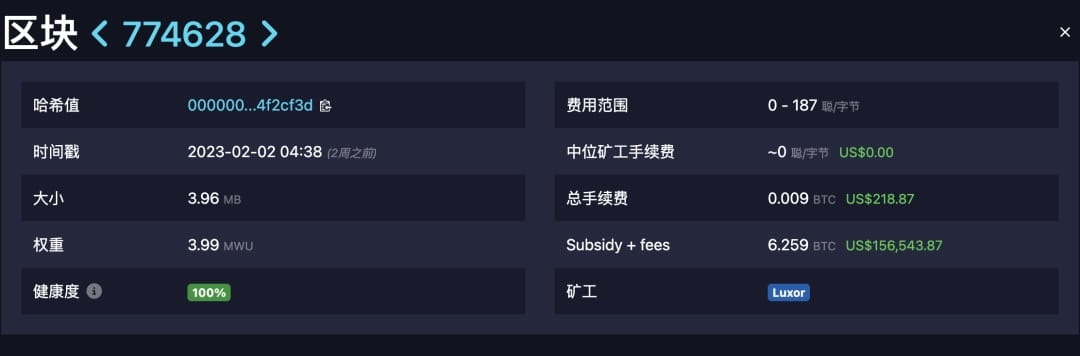
Bitcoin block 774628, block capacity is 3.96MB, data source: mempool
In addition, the price of Layer2 network stack on Bitcoin nearly doubled in one day, which made people in the industry focus their attention: In addition to the value storage of Bitcoin itself and the payment of Lightning Network, there are other application ecosystems in the Bitcoin ecosystem? Is BitcoinFi really coming?
01 Overview of Bitcoin Ecosystem
Compared with the prosperity of Ethereum and other ecosystems, there are not many remarkable projects in the Bitcoin ecosystem. This can be roughly seen from the TVL. The current TVL of the entire Ethereum ecosystem has a market value of about US$30 billion. However, the market value of the entire Bitcoin ecosystem is estimated to be around US$200 million, and the gap is not small.
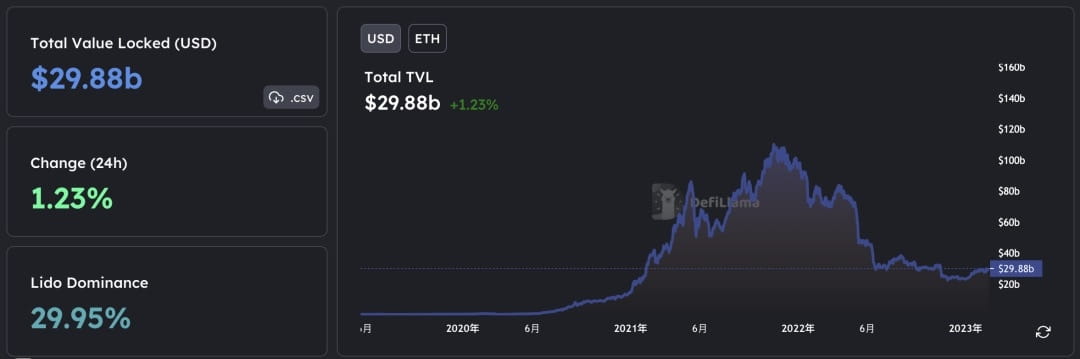
The current TVL status of the Ethereum ecosystem, source: DeFiLlama
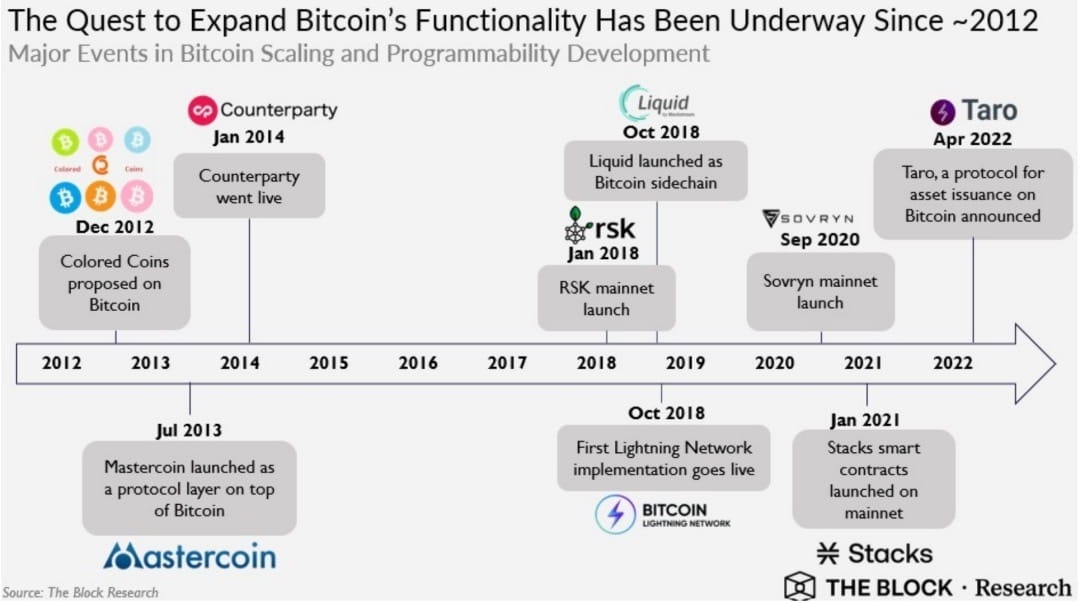
However, when other public chains or cross-chain bridges are repeatedly attacked by hackers due to security issues, it is not surprising that Bitcoin, as the leader in the encryption industry and the most stable and secure blockchain network, is "targeted" . As the CEO of Trust Machines, one of the largest financing projects in the Bitcoin ecosystem in recent years, Muneeb Ali said when he released financing information in February last year: "The network value of Ethereum is approximately US$500 billion, but the applications built on this basis There are $500 billion worth of programs. If you look at Bitcoin, it's a trillion-dollar network, but there are very few applications built on it. In the long term, I don't think the world will stay like this. I think Bitcoin can still create a lot of value." So, what are the underlying infrastructures currently built in the Bitcoin ecosystem? Let’s first look at the picture below. After the Bitcoin mainnet was launched in 2009, many underlying protocol projects began to try to expand the Bitcoin ecosystem:
Data source: The Block Research
Of course, the first three projects are rarely heard of now. The RSK project, which was launched on the mainnet in 2018, was known as the top ten king-level projects in the last bull market and should be the most popular project in the Bitcoin ecosystem at that time. However, it seems that there has been little movement since its launch. On the contrary, the Lightning Network project, which was launched in 2019, has developed rapidly, leading Bitcoin to break through from value storage to payment means. Moreover, what is very meaningful is that this breakthrough is not only in the field of encryption, but also brings Bitcoin into the real world.
Of course, in addition to the Lightning Network, the real hot hotpot in the Bitcoin ecosystem is Stacks, which will be launched in 2021. Layer 2, DeFi, NFT, domain names... in the Bitcoin ecosystem are almost all related to Stack. Indeed, since Judging from the current development situation, Stacks is one of the few bright spots in the current Bitcoin ecosystem.
02 Current status of Bitcoin ecosystem protocols
Regarding various protocols in the Bitcoin ecosystem, the four currently active ones are Lightning Network, RSK, Liquid and Stacks. A closer look at their current status shows that the differences are quite large, and there is little comparability with other public chain ecological data. However, after all, Bitcoin is the largest crypto asset by market value, and the stability and security of its network are unquestionable. If DeFi, NFT or other ecosystems based on the Bitcoin network can further develop in the future, these current ecological applications may be The basics are also worth a good understanding of.
Lightning Network
For many people, the Lightning Network may be the only memorable project in the Bitcoin ecosystem. The Lightning Network was born in 2018 and is considered one of the most important innovations since the birth of Bitcoin. It mainly solves the problem of offline real-time transaction processing of Bitcoin and has indeed achieved Bitcoin's high speed, high TPS and low-cost transactions. The Lightning Network has developed very rapidly since its birth. The total number of Bitcoins locked in the Lightning Network has reached more than 5,400. Although compared to the BTC cross-chain to ETH and other chains (such as the current 175,000 wBTC, 9,000 hBTC ) There is still a relatively large gap, but judging from the number of users, it is indeed worth looking forward to. According to statistics from Arcane Research, as of March 2022, more than 80 million people will already be using the Lightning Network on installed applications (such as Cash App, etc.).
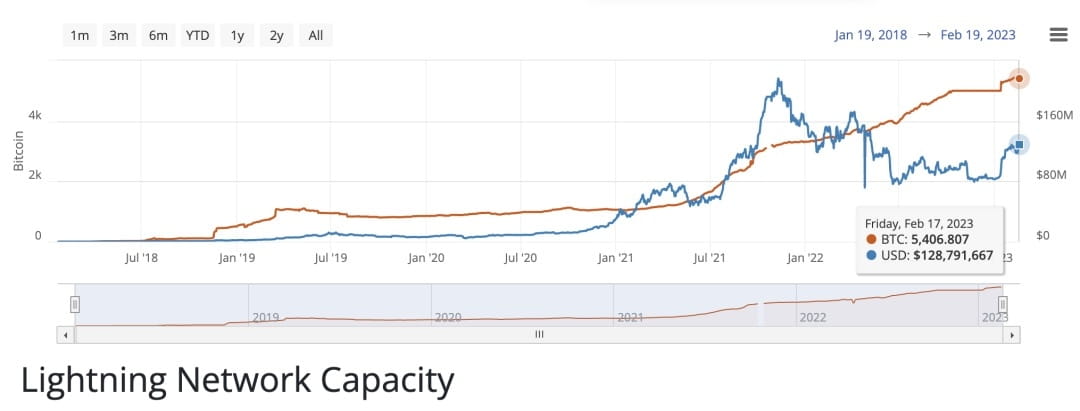
Changes in the number of Bitcoins in Lightning Network channels, source: bitcoin visuals
At present, the entire Lightning Network ecosystem is indeed booming. The figure below shows the ecological development of the Lightning Network as of April 2022.
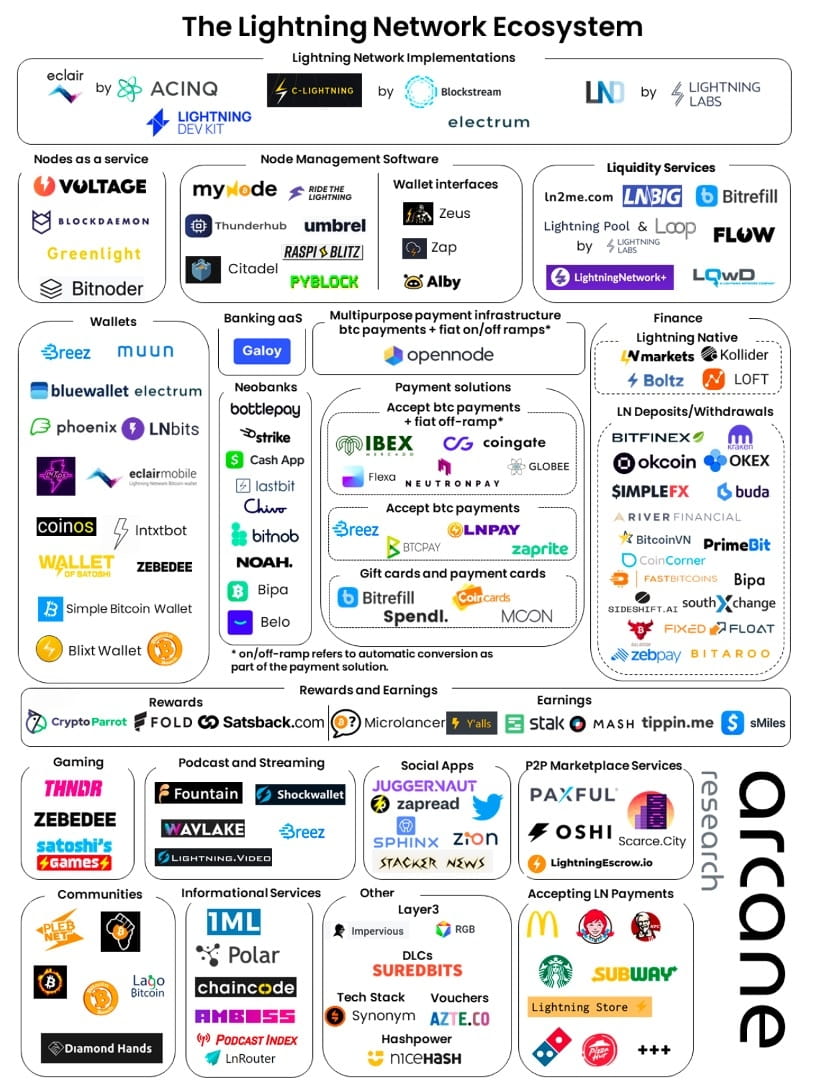
Source: Arcane Research, April 2022
At present, the Lightning Network ecosystem has developed quite richly, including Lightning Network nodes and liquidity services, wallet payment applications, games, social networks, retail scenarios, etc. In addition to these, a series of DeFi applications and protocols are currently being developed on the Lightning Network, including asset issuance platforms, smart contract protocols, Dex, derivatives platforms, etc. However, they are still in the initial stage and there are no very eye-catching ones. .
Liquid Network Ecosystem
Liquid Network is a Bitcoin side chain developed by Blockstream. The Blockstream team has a very strong background, including several core Bitcoin developers. It is not an exaggeration to say that it is an all-star development team in the circle. Liquid can achieve fast transfers and take into account privacy. Not only that, crypto assets can also be issued on Liquid. For example, in November 2011, the US$1 billion bond that El Salvador planned to issue will be issued on the Liquid Network. However, by This plan has not yet been implemented. As for the specific projects in the Liquid ecosystem, there is currently not much available data through public channels. Compared with several other side chains or Layer 2, progress seems to be much slower.
RSK protocol and ecology
RSK is a side chain of Bitcoin. It can be expanded through additional functions such as smart contracts without changing the underlying code of Bitcoin. Moreover, RSK also has good compatibility with Ethereum in terms of EVM and other aspects. Therefore, although the TPS is only 11~15, when it first debuted in 2007, RSK exceeded expectations as a superstar project. However, as the market has declined and project development has not been as good as expected, the voice has gradually become less and less, and has become a neglected existence. At present, the total TVL on the RSK protocol is less than 80 million US dollars, of which the loan agreement MoneyOnChain accounts for nearly half, the DeFi platform Sovryn is 20 million US dollars, and other projects are almost negligible.
Stacks Protocol and Ecosystem
As the first token issuance project approved by the SEC in history, Stacks should be the most popular Bitcoin ecological protocol at present. From the financing progress since its establishment, it can be seen that Stacks is also the Bitcoin Layer 2 protocol currently favored by capital. However, the total TVL on Stacks is not large. The current total is less than 20 million US dollars. Alex, who is known as the first one-stop complete DeFi service platform on Bitcoin, contributed nearly 90%.
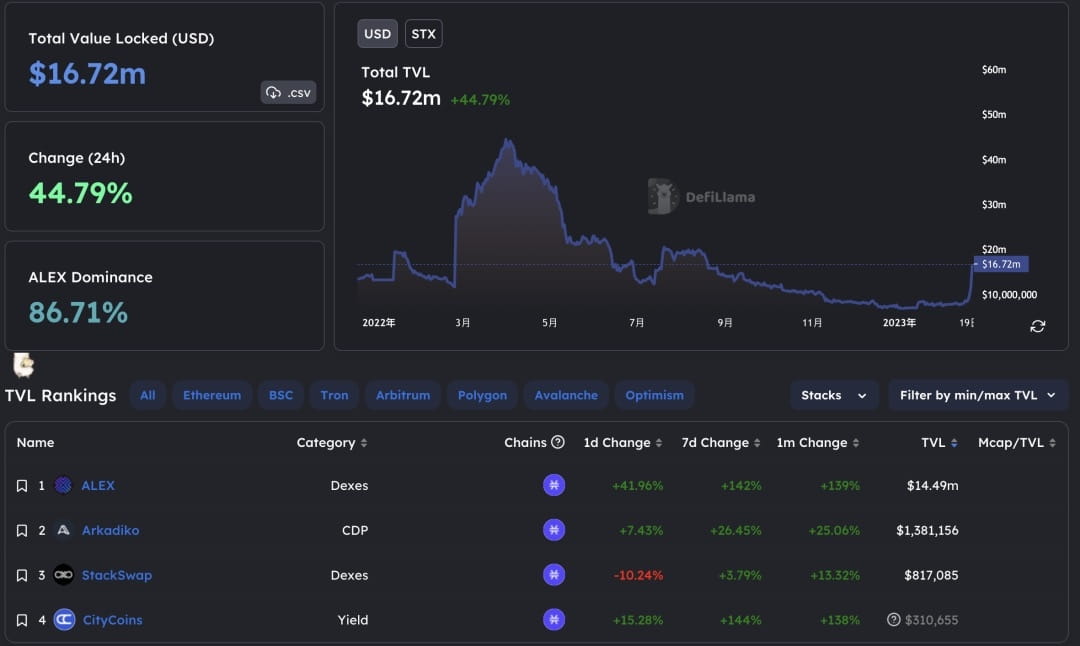
Stacks ecological TVL and related projects, data source: DeFiLlama
In addition, the .btc domain name built on the Stacks protocol has also exploded with the bull market of domain names some time ago. As the first domain name project in the Bitcoin ecosystem, especially with btc as the suffix, it will naturally make people think of The ENS domain name of .eth, if the Bitcoin ecosystem further develops, the .btc domain name is indeed worth looking forward to.
03 Financing status of various protocols or projects in the Bitcoin ecosystem
Compared with the total financing amount of nearly 30 billion U.S. dollars in the entire encryption industry in 2022, the financing volume of only a few hundred million U.S. dollars in the Bitcoin ecosystem is indeed not worth mentioning. However, through horizontal comparison, we can easily see the popularity and popularity of various sectors of the Bitcoin ecosystem. After all, institutional investors are relatively more sensitive to trends.
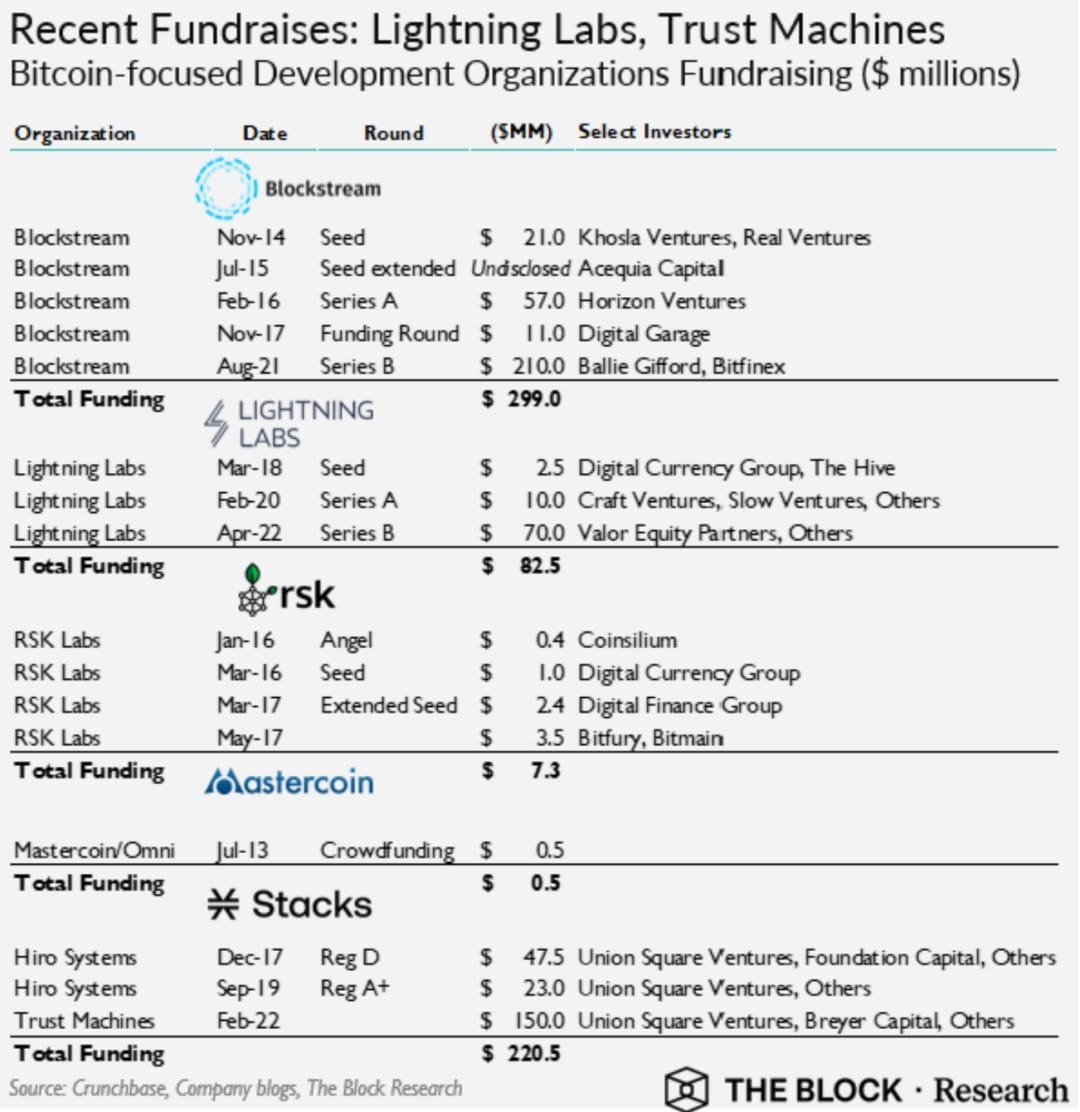
Bitcoin ecological protocol financing situation, sources: Crunchbase, Company blogs, The block Research
It is not difficult to find from the financing data of various sectors of the Bitcoin ecosystem that Blockstream and Stacks are the Bitcoin ecosystem teams most favored by institutions. Blockstream has many Bitcoin core developers. Although there is no obvious explosion in the protocol ecosystem at present, institutions still Recognize the star team. As for Stacks, the financing data from 2017 to 2022 is very conspicuous in the entire Bitcoin ecosystem. Trust Machines, an ecological application system based on Stacks, raised US$150 million in February 2022. This amount of financing is placed in the entire cryptocurrency The industry is also very prominent. Judging from the amount of financing and the development of the protocol ecosystem, Stacks is a well-deserved star protocol in the entire Bitcoin ecosystem.
04 Summary
After more than ten years of development, Bitcoin has been running wildly on the road of value storage, and its market value has increased thousands of times in the past decade. As the most stable and secure blockchain network, does it have greater development value in addition to value storage? Can the Bitcoin ecosystem grow like the Ethereum ecosystem? Judging from the current development of the Bitcoin ecosystem, everything is still just a small test. As for the true future, more lengthy and patient exploration is needed. After all, the ecological development of Ethereum does not happen overnight. Pioneers always have to go through hibernation before they can take off. What do you think about the development trend of Bitcoin ecosystem? Welcome to chat in the comment area.
END