



Recent speculations suggest that NVIDIA may add the leading cryptocurrency to its treasury reserves. Although unconfirmed, this information raises debates about the institutional impact of such a decision and its possible effect on the company's performance, which is facing a significant drop in its stock value in 2025.
To assess the potential benefits of this move, BeInCrypto spoke with representatives from Banxe, FINEQIA, CoinShares, Bitunix, and Acre BTC, who analyzed whether investing in Bitcoin could represent a long-term advantageous strategy for NVIDIA.
Rumors about NVIDIA's possible investment in Bitcoin
In recent weeks, several reports have emerged on social media suggesting that NVIDIA, a pioneer in GPU-accelerated computing, is considering adding Bitcoin to its balance sheet.
These reports remain purely speculative at the time of publication, as NVIDIA has not made any official statements on the matter. When BeInCrypto sought clarification, a company spokesperson declined to comment.
Even as rumors, these reports highlight the significant impact of such a decision on public perception of Bitcoin. Given NVIDIA's current economic circumstances, marked by a substantial decline in stock value, an announcement of this nature would not be entirely unexpected.
Recent economic challenges
In the past five months, NVIDIA has been navigating economic and geopolitical obstacles that have substantially impacted the company's operations and overall financial performance.
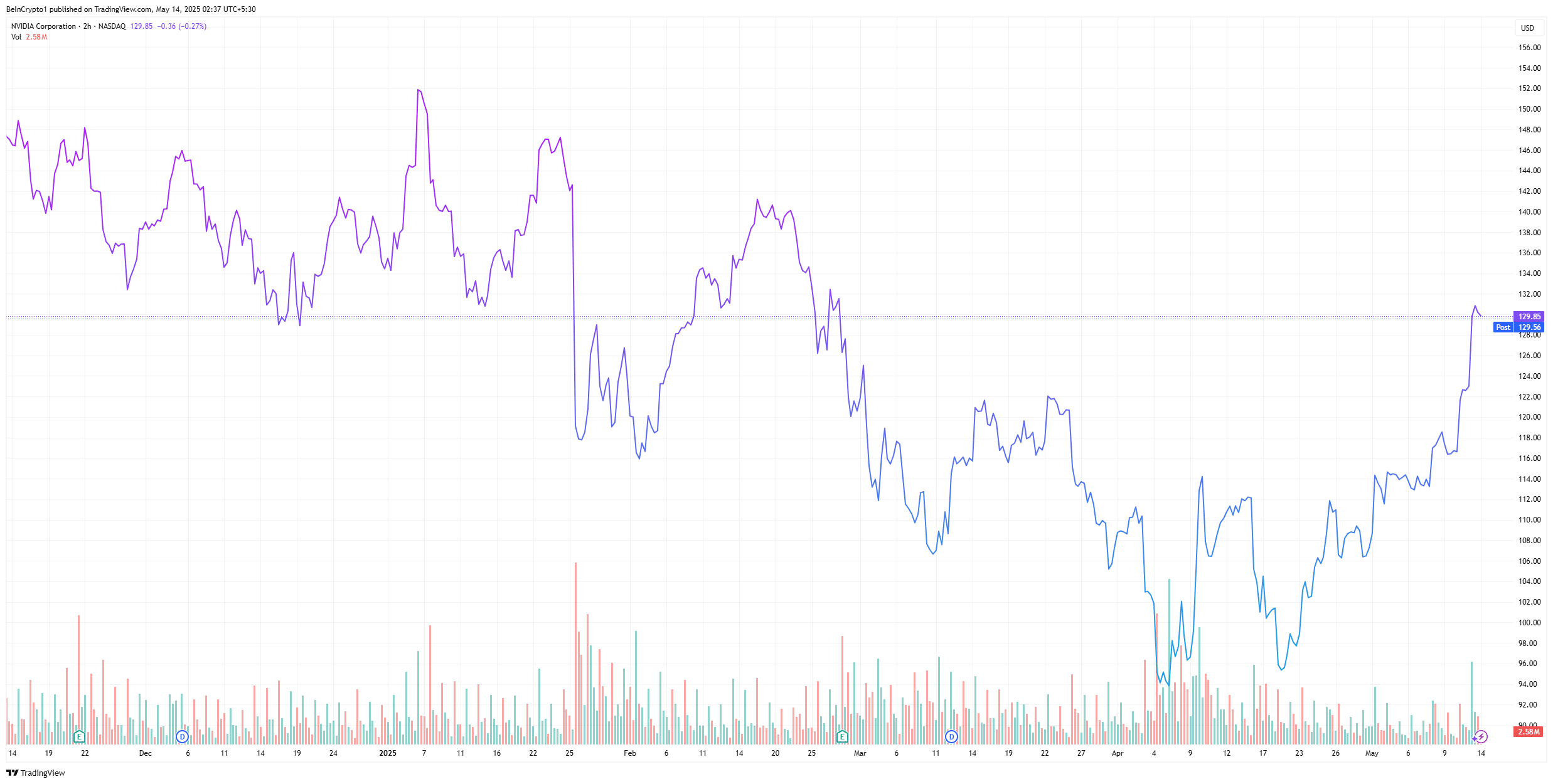 NVIDIA Stock Price Chart in 2025. Source: TradingView
Between the export restrictions from the Biden era and recent Trump trade policies, combined with risks of global inflation, a weakened U.S. dollar, and increased competition from other GPU manufacturers, NVIDIA has faced challenges on all fronts.
Risk assets generally underperformed in the early months of 2025, despite signs of a recent recovery. Additionally, increasing competition, particularly in the GPU and AI sectors, poses a threat to NVIDIA's market leadership and raises the possibility of market share reduction. Ongoing U.S. tariffs also present a significant risk, with little clarity on their future direction. Together, these elements likely led some investors to reduce their exposure to NVIDIA, securing profits after an impressive rally that saw the stock price rise about 9 times between early 2023 and early 2025, said Matteo Greco, Senior Associate at FINEQIA, to BeInCrypto.
Thus, NVIDIA's stock price was impacted. According to recent reports, NVIDIA's shares have fallen 35% since their last price peak in January.
NVIDIA's shares reacted particularly poorly to the news that China's Huawei Technologies is testing a new AI chip more powerful than NVIDIA's H100.
Given these circumstances, NVIDIA may mitigate current economic challenges by diversifying its treasury assets.
Should NVIDIA consider adding Bitcoin to its balance sheet?
With its limited supply and low correlation to traditional markets, Bitcoin emerges as a promising alternative for inflation protection for companies.
If NVIDIA were to consider this, it would follow a trend established by other companies that have invested in this asset class for similar reasons in recent years.
We have seen similar cases when Strategy and Tesla gained attention by allocating parts of their treasury to Bitcoin. These cases demonstrated that a bold crypto strategy can capture market attention and align a company with visionary investors. In fact, in April 2025, companies that hold Bitcoin on their balance sheets collectively control over 630,000 BTC (more than 3% of the supply), so NVIDIA would not be entirely alone in exploring this path, said Banxe CEO Alex Guts.
Such a move would significantly alter how other institutional investors view Bitcoin, encouraging more companies to adopt a similar strategy. The crypto community would likely celebrate the news, considering it would solidify Bitcoin's legitimacy as an asset class.
There is also a benefit in stakeholder and market perception. Owning Bitcoin could broaden NVIDIA's appeal to a new class of investors or partners. This could attract interest from the crypto community and tech-savvy young investors who see the company as aligned with their values. This could even influence employee perception – many tech employees are crypto enthusiasts, so this may help position NVIDIA as an attractive and innovative place to work, added Guts.
This potential move by NVIDIA would also align with the company's existing ties to the cryptocurrency space, given the crucial role of its technology in Bitcoin mining.
NVIDIA's role in the Bitcoin ecosystem
Bitcoin mining, particularly its Proof-of-Work consensus mechanism, is a natural application for NVIDIA's products.
NVIDIA is a company known for being at the forefront of technology (AI, graphics, etc.). By adding Bitcoin, they would reinforce this image of being visionary. In fact, some would say this move leverages NVIDIA's legacy in the crypto space – its GPUs have been instrumental in cryptocurrency mining over the past decade, said Guts to BeInCrypto.
On this, Greco added:
There is already a natural connection between NVIDIA and Bitcoin, so seeking direct exposure to the asset seems logical. Bitcoin's hash rate, a key metric measuring the network's computational power, has been consistently rising, repeatedly hitting new all-time highs. In this context, NVIDIA's support for Bitcoin can also be interpreted as support for its own growth. An increase in demand for GPUs among Bitcoin miners could translate into increased revenue for the company.
However, the extent to which NVIDIA needs Bitcoin for stability remains controversial.
Risks of adding Bitcoin to NVIDIA's treasury
As it stands, NVIDIA already has other strategies that help the company protect itself against volatility and inflation. Adding Bitcoin to the mix may seem excessive.
Bitcoin offers diversification benefits as a non-correlated asset and a potential hedge against dollar depreciation in the long term. However, in practice, NVIDIA already employs currency hedging strategies to manage currency risk, said Satish Patel, Senior Investment Analyst at CoinShares, to BeInCrypto.
This becomes especially true when considering how volatile Bitcoin can be. While the asset may generate significant gains during bull markets, the losses it can incur are equally severe.
The first risk to consider should be price volatility. A significant drop could result in a substantial unrealized loss on the balance sheet in the short term; under current accounting standards, Bitcoin is treated as an 'intangible asset' and the decline would not be amortized, which would have a direct impact on the income statement, explained Bitunix analyst Dean Chen.
Thus, Bitcoin may not be the natural choice to defend NVIDIA against its current stock declines. Such an investment would need to reflect a long-term strategy rather than an impulsive decision.
Would BTC make any difference to NVIDIA's stock price?
Bitcoin has demonstrated high long-term returns, albeit with considerable volatility. For companies capable of bearing the associated risks, including large price fluctuations, it offers potential for significant future profits.
Looking at historical performance, Bitcoin has been the best-performing asset over the past 15 years. This makes it, at least on paper, a strategic addition to enhance a company's treasury, said Greco.
With its substantial financial resources, NVIDIA could absorb Bitcoin's volatility without a major impact on its balance sheet. In this sense, the company has little to lose but also little to gain.
Unless the allocation of Bitcoin is significant, the impact on NVIDIA's stock price in the long term is likely to be muted. Even Tesla, with over 11,500 BTC, has not been widely reclassified by investors as a crypto treasury play. Ultimately, such a move would likely benefit Bitcoin's market perception more than NVIDIA's stock price, at least until digital assets are more widely accepted in traditional finance, Patel added.
In fact, NVIDIA's decision to invest in Bitcoin depends on timing and urgency, especially considering recent developments that have alleviated some pressures on the company.
Relief from export restrictions: a boost for NVIDIA
Last week, the Trump administration announced its plans to reverse certain export restrictions from the Biden era on advanced semiconductor chips.
Biden's 'AI Diffusion Rule' established these restrictions to strengthen U.S. technological leadership by preventing advanced chips from being diverted to concerning countries, especially China. Given that China was NVIDIA's main buyer, the rule significantly harmed its sales.
The U.S. embargo on shipping chips to China has caused a projected revenue decrease for NVIDIA of approximately $5.5 billion per quarter since the first quarter of 2025. Additionally, testing and advancements in AI chips by Huawei and others have put NVIDIA in direct competition in strategic markets, said Chen.
A reversal would be highly advantageous for NVIDIA's sales, especially amid this new wave of chip manufacturers.
Similarly, the recent pause in tariffs between the U.S. and China led to an increase in NVIDIA's stock price. Despite its temporary nature, the news is a positive signal for the company, promising to reduce uncertainty and enhance sales gains and stability in the supply chain.
Considering these developments, adding Bitcoin to NVIDIA's balance sheet may not be as urgent anymore. If NVIDIA were to make such a decision hastily, it could also drive away traditional investors and long-time buyers.
Many areas of traditional finance remain highly skeptical of Bitcoin due to its short history and highly volatile nature. If NVIDIA adds Bitcoin as a treasury asset, traditional investors might see this as a poor decision, potentially alienating long-standing customers.
The article 'Is NVIDIA going to add Bitcoin to its reserves? Find out more' was first seen on BeInCrypto Brazil.