



In the fast-changing financial markets, speed is money. 2/3 the speed of light is just a blink for ordinary people, but for high-frequency trading firms, it could determine the outcome of a trade. Today, we will discuss the 'speed war' of high-frequency trading and those stories of heavy investments made for millisecond advantages.
To be 0.07 milliseconds faster than competitors, a company spent $14 million, which is merely 1/5700th of a blink!
0.07 milliseconds of value: A battle of speed
Imagine that blinking takes 0.4 seconds, while a high-frequency trading company named Jump Trading spent $14 million just to improve data transmission speed by 0.07 milliseconds (or 0.00007 seconds). This company purchased a 120,000 square meter plot of land across from the largest futures exchange in the world—the Chicago Mercantile Exchange (CME)—not to build a building or for feng shui, but to set up a microwave communication station to ensure that trading orders can be delivered to the exchange as quickly as possible.
Based on previous similar microwave tower cases from Nasdaq, this improvement can only bring a 0.07 millisecond enhancement. It seems negligible, but for high-frequency trading, this tiny bit of time could be the source of enormous profits. It is worth noting that the traditional optical fiber transmission speed is about 2/3 the speed of light, while microwave transmission speed is close to the speed of light, making it 50% faster than optical fibers. More importantly, optical fiber installations are often not straight, whereas microwave transmission can take 'shortcuts.'
For human traders, the difference between 0.00007 seconds and 0.00014 seconds is meaningless, as it takes about 0.15 to 0.225 seconds for the human eye to process information. However, Jump Trading's target is not humans, but computers—their algorithmic trading systems can make decisions and execute operations in microseconds.
High-frequency trading: Buying and selling completed within 0.2 seconds
Jump Trading is a typical high-frequency trading (HFT) firm. When publicly traded companies release earnings reports, central banks adjust interest rates, or important data like CPI are announced, its servers use complex algorithms to predict stock price fluctuations in the coming seconds and automatically execute buy or sell operations through computers. Because high-frequency trading time is extremely short, even a slight fluctuation in stock price can yield significant profits or reduce losses. Therefore, how to obtain information and complete trades faster than competitors is the core pursuit of every high-frequency trading firm.
This is not Jump Trading's first time spending money for speed. As early as 2013, they acquired a microwave tower in the UK that had previously been used by NATO, solely to transmit data faster to the London Commodity Exchange. Speed has become the lifeline of high-frequency trading.
The ultimate interpretation of trading speed: The Ulta earnings event
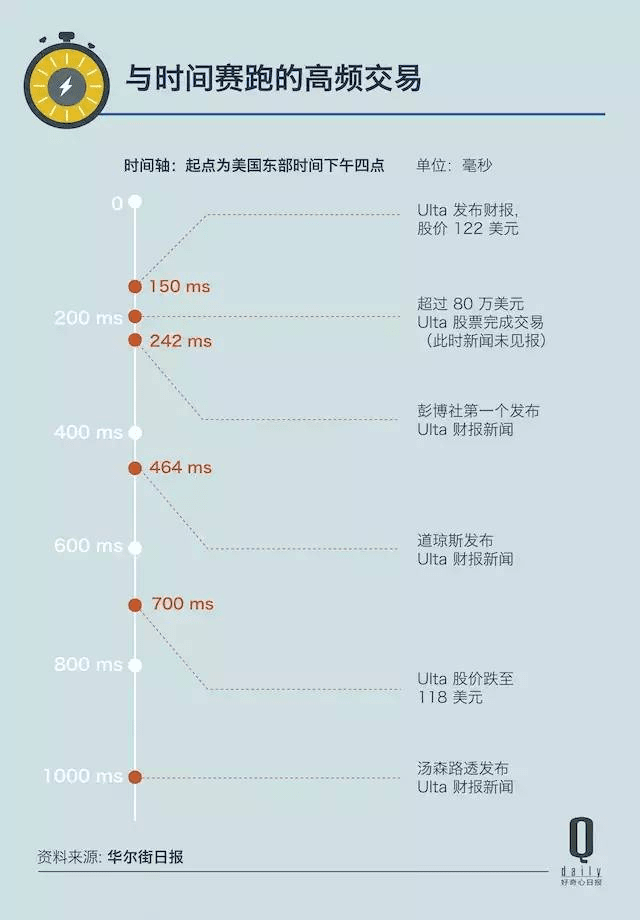
(Wall Street Journal) once revealed a classic case that exposed how fast high-frequency trading can be. On December 5, 2014, at 4 PM Eastern Time, cosmetics retailer Ulta released its earnings report, with the stock price at $122. The following events unfolded in milliseconds:
• 4:00:00.15: PR Newswire releases earnings news to high-frequency trading firms and terminals like Bloomberg.
• 4:00:00.20: A high-frequency trading firm sells $800,000 worth of Ulta stock for $122.
• 4:00:00.242: Bloomberg is the first to release the Ulta earnings news.
• 4:00:00.464: Dow Jones publishes related news.
• 4:00:00.7: Ulta's stock price has dropped to $118.
• 4:00:01: Thomson Reuters has just released the earnings news.
At this moment, only 0.85 seconds have passed, and no human trader can read the earnings report title, but the high-frequency trading computers have already completed their operations. Humans simply cannot compete with such speed.
This event drew the attention of the U.S. Securities and Exchange Commission (SEC), and PR Newswire faced regulatory pressure. Although its CEO Cathy Baron Tamraz insisted that 'nothing was wrong,' the company stopped directly sending financial data to specific paying users after consulting its major shareholder Buffett, due to public opinion and potential impact. Now, high-frequency trading firms must wait for Bloomberg to release information before they can act, delaying by about 0.192 seconds. It seems fairer, but for machines, the speed competition has never stopped.
Technological frenzy: The battle of microwaves, optical fibers, and lasers
In the 'speed war' of high-frequency trading, the most advanced technologies are employed. Generally, optical fiber networks are the preferred choice for long-distance high-speed connections, but their transmission speed is limited by the medium (about 200,000 meters/second), and the laid routes often follow railroads, not in a straight line. In contrast, microwave transmission speed in the air is close to the speed of light (300,000 meters/second), and by setting up signal towers on mountaintops or high-rise buildings, companies can shorten transmission distances as much as possible through relay.
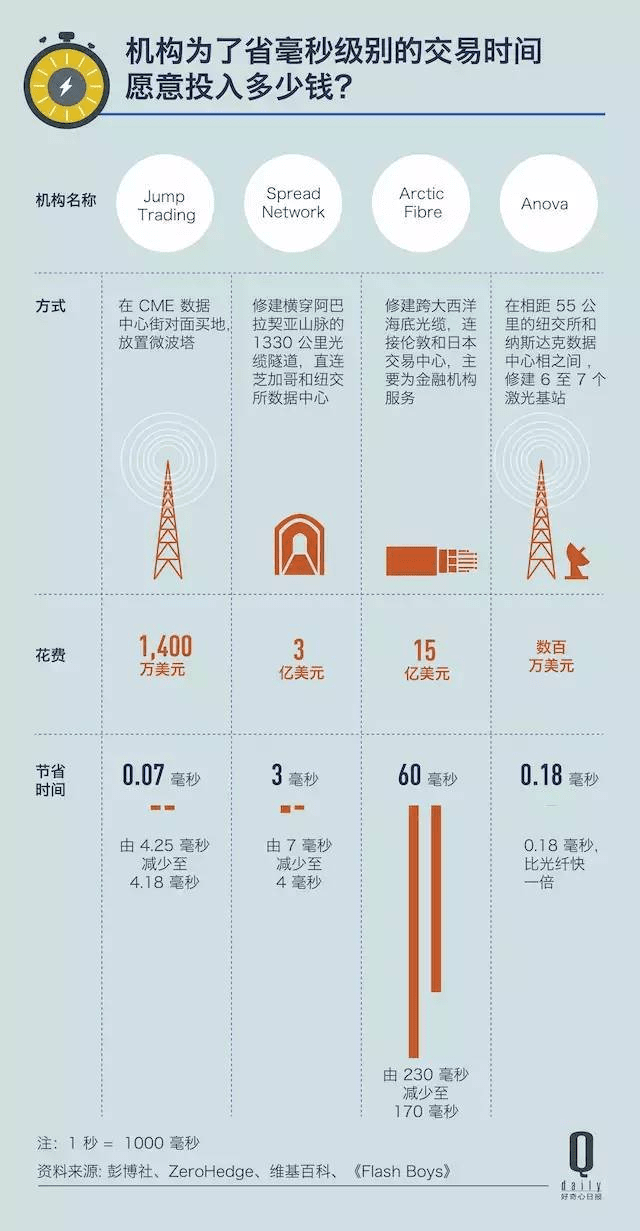
Jump Trading set up microwave towers across from the Chicago Mercantile Exchange in pursuit of ultimate speed. In fact, the CME's own data center also relies on microwave transmission. In 2015, McKay sold land to the CME for use as a data center, and recently, DuPage County near Aurora approved McKay to build a new microwave tower, bringing it 188 meters closer to the CME trading center, with the same goal of saving even 0.00007 seconds.
However, microwave transmission is not perfect. Its communication quality is easily disrupted by adverse weather conditions (especially rain), with a reliability of only about 90%. Additionally, the bandwidth of microwaves is limited; for instance, the bandwidth of a single microwave base station provided by Anova is only 100 Mbps, while optical fibers can reach up to 1,000 times that. Therefore, microwaves are more suitable for small data trades sensitive to speed, while optical fibers are better for transmitting large volumes of data, such as publicly listed companies' earnings reports.
In addition to microwaves and optical fibers, there are companies exploring more extreme solutions. Spread Networks spent $300 million starting in 2010 to dig a fiber optic tunnel through the Appalachian Mountains, shortening the data transmission time by about 3 milliseconds. Additionally, there are projects for undersea cables across the Arctic, including 'Artic Fibre', 'Arctic Link', and Russia's 'ROTACS', with a total cost of about $1.5 billion, aiming to reduce the data transmission time between the two financial centers of London and Tokyo from 0.23 seconds to 0.17 seconds, saving nearly 8,000 kilometers of path.
An even more promising technology is laser communication. Anova has set up laser stations between Manhattan in New York and the NYSE and Nasdaq data centers, using infrared lasers to transmit data, which is twice as fast as optical fibers, with a bandwidth of 2 Gbps and little weather impact. Anova CEO Michael Persico revealed that they are also installing equipment at 1275 K Street in Washington to obtain U.S. government economic data in real-time. However, laser communication requires straight-line transmission and must address the effects of high-rise building sway on signal accuracy.
The value of high-frequency trading: Efficiency or profit-seeking?
What has high-frequency trading brought? (Wall Street Journal) Author Larry Tabb once asked, 'High-frequency trading has faced widespread criticism; what have they done wrong?' As the founder of the Tabb Group, he is an advocate of high-frequency trading, believing it makes the market 'more efficient than ever,' enabling institutions to complete trades in milliseconds, a reflection of technological advancement.
The core of high-frequency trading is to save time, accelerate buying and selling, and ultimately make money more efficiently.
However, critics like Mark Cuban, owner of the NBA's Dallas Mavericks, call high-frequency trading the 'ultimate hack,' arguing that its speed game is unrelated to a company's real value. Buffett has also mocked investment strategies that rely on complex formulas. In 2005, he placed a $1 million bet, claiming that hedge fund returns could not outperform index funds. In 2007, Ted Seides, a partner at Protege Partners, took up the challenge. A decade later, Buffett's chosen index fund had an average annual growth rate of 7.1%, while the five hedge funds returned only 2.2%, more than three times the latter's return.
The return rates for high-frequency trading firms are also declining. In 2016, according to (Institutional Investor) data, only Renaissance and Bridgewater fund managers earned over $1 billion annually, but their returns have lagged behind the market for several years. Nowadays, there are more high-frequency trading firms, making the market fairer, but the returns for participants are not as good as before. Nevertheless, the trend of machines replacing humans is irreversible. In March of this year, BlackRock, the world's largest asset management company (managing $5.1 trillion in assets), began using AI for stock selection and laid off more than 30 analysts and fund managers, accounting for 7% of the department's total.
The insights of high-frequency factors: From microseconds to daily
High-frequency trading may seem distant, but its principles can be applied to personal investments. Converting high-frequency data to daily frequency data can still uncover decent alpha returns. The ultimate pursuit of speed is not only a technical competition but also a reflection of the improvement in financial market efficiency.
In the competition of machines and speed, no one can afford to stand still. In the future, financial technology will bring more surprises and challenges. Are you ready?