
Facing increasing competition from upstart competitor Blur, NFT marketplace OpenSea announced today that it will temporarily remove its 2.5% sales fee and reduce creator royalty protections in response to a rapidly changing market. There is no doubt that the royalty war in the NFT market has escalated again.
Blur's start is amazing
OpenSea’s move comes after a big week for upstart marketplace Blur, which launched last October. On Wednesday (February 15), Blur airdropped its BLUR tokens to more than 100,000 NFT traders, then advised NFT project creators to block OpenSea trading and said it would not charge marketplace fees to traders.
Blur sets four scenes, namely:
1. No blocking: If the collection does not disable Block, it will not be possible to disable the zero-royalty or optional-royalty market. In this case, Blur will charge 0.5% royalties, while OpenSea is optional. 2. Block Blur: Any NFT project that blocks Blur or other zero-royalty/optional-royalty markets will be forced to pay royalties on OpenSea, but transactions can still be made on Blur, which requires a minimum royalty of 0.5%. 3. Block OpenSea (recommended): Blur recommends not using OpenSea, and Blur hopes that creators will not use OpenSea. Any NFT project that does not use OpenSea will be forced to pay full royalties on Blur. 4. Block neither: Blur requires OpenSea to cancel the setting of optional royalties for NFT projects on Blur. If OpenSea cancels this policy, NFT projects will be able to collect royalties on both platforms at the same time. Currently, NFT project creators cannot collect royalties on both Blur and OpenSea at the same time. They can only collect full royalties on either OpenSea or Blur, but not both.
Can OpenSea's response fend off Blur?
According to OpenSea, 80% of the market transaction volume today does not pay full royalties, so adjustments have been made in view of changes in the market ecosystem, including launching a limited-time 0-fee trading event; enabling optional copyright services with a minimum standard of 0.5%, applicable to all series that do not enforce royalties on the chain; updating operator filters to allow NFT markets with the same policies to jointly increase market liquidity.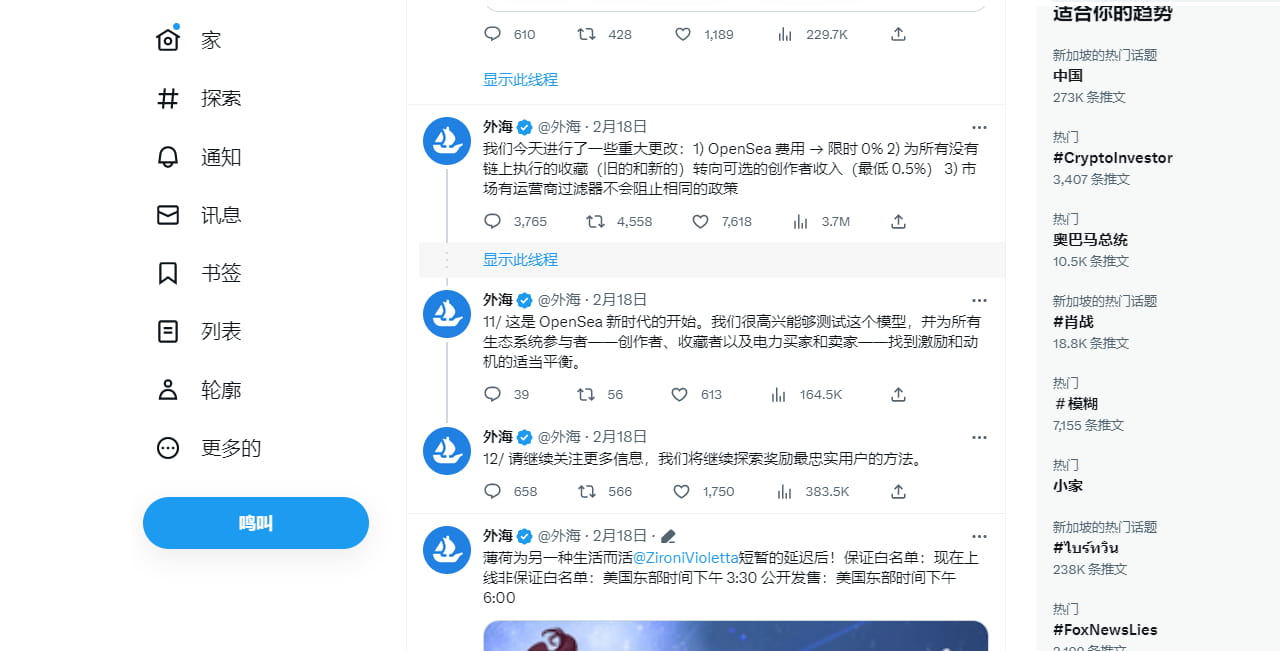 From the analysis, in addition to cutting its own transaction market fees for a "limited time", effectively cutting off its main source of income, OpenSea will only impose a mandatory creator royalty of 0.5% on the chain for projects without NFT transactions, although sellers can choose to pay a larger percentage. Creator royalties are usually 5% to 10% of the sales price paid to NFT creators, and are also the way some NFT projects currently generate ongoing income after the initial sale of tokens.
In fact, at the end of last year, OpenSea made some changes to its creator royalty approach, and ultimately stated that it would implement a full royalty setup for all NFT projects created before a certain date in January 2023, but would only enforce future royalties for new projects using an on-chain enforcement tool.
OpenSea’s own enforcement tools block marketplaces that do not fully enforce creator royalties, including Blur, but Blur was apparently able to find a way around the blacklist and has been gaining more and more users in just a few weeks. On-chain data shows that Blur’s user base is growing rapidly, while OpenSea is doing the exact opposite.
Obviously, OpenSea found problems with its own model, so it decided that its operator filtering tools would no longer block the zero-royalty NFT market, but this move seems to be a little late. Dune Analytics data shows that after the launch of Blur tokens, the daily transaction volume of NFTs soared to 30,409.79 ETH, a three-month high. In addition, the sales volume of NFTs also reached 32,773, and the number of independent users was 9,689, both of which were three-month highs.
The NFT ecosystem has undergone a huge change
Now, even OpenSea has to admit that the NFT ecosystem has undergone tremendous changes. They admit that since October 2022, they have found that transaction volume and users have begun to shift to NFT markets that do not fully execute creator income, and this shift is still accelerating rapidly.
OpenSea admitted on social media: “We thought we could facilitate widespread implementation of creator income, and we hoped that others would come up with more resilient solutions - but this did not happen. Recent events - including Blur’s decision to reduce creator income (even for filtered collections) and the false choice they forced creators to make between Blur or OpenSea’s liquidity - prove that our attempts did not work.”
There is no doubt that today's NFT market is trying to find a development path that is beneficial to creators and traders. At least for now, Blur's strategy is effective. Let us wait and see whether this upstart rival can compete with OpenSea or even surpass its market position.