



The historic collapse of Terra's LUNA and its sister token UST in 2022 shook the cryptocurrency market. What started as one of the most ambitious experiments in decentralized finance quickly became one of its most catastrophic explosions.
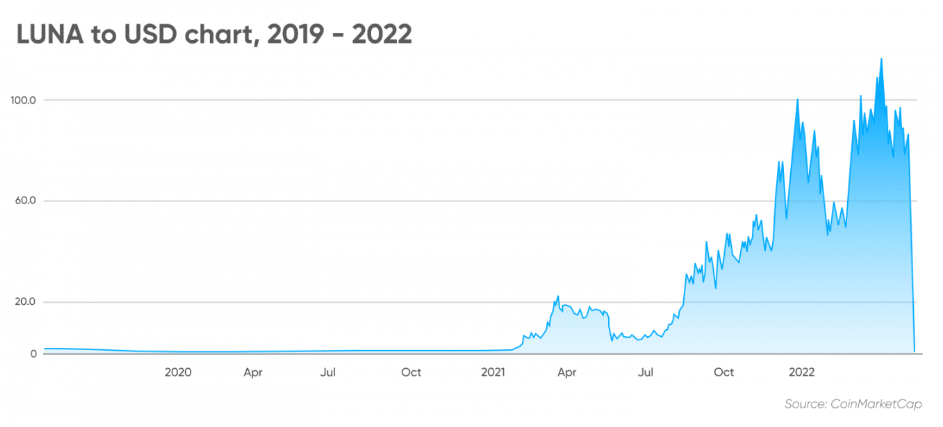
Within weeks, a project valued at over $60 billion (equivalent to the current market cap of Solana) collapsed, breaking years of trust, billions in savings, and a vision that promised to reshape finance. Here’s how it all unfolded – from the rapid rise to the design flaws that caused a domino effect that no one could stop.
The meteoric rise of LUNA – From 66 cents to $104 in 14 months
The Terra blockchain was designed by Terra Labs, based in South Korea, and led by Do Kwon, a Stanford graduate computer scientist. The system consists of two main tokens: LUNA and TerraUSD (UST).
These digital currencies are designed to work together. LUNA is meant to keep UST, a stablecoin pegged to the U.S. dollar, stable through a delicate balancing act of minting and burning.
This was not just another cryptocurrency project. The idea garnered serious attention. By March 2022, UST had risen from $180 million at the beginning of 2021 to a market cap of nearly $15 billion. At the same time, the price of LUNA soared from $0.66 to a peak of $104.58 on March 9, 2022. Even as other markets were declining due to geopolitical tensions, Terra held strong.
In February 2022, Terra's DAO signed a $40 million sponsorship deal with the Washington Nationals baseball team. There was talk of UST being accepted at stadiums. This was no longer niche finance – it had become mainstream.
How the model was supposed to work
The focus of the Terra system is an algorithm. Unlike traditional stablecoins like USDT and USDC, which are backed by real assets, UST maintains its peg through LUNA. When UST trades above $1, users can swap $1 of LUNA to mint UST and profit from the difference.
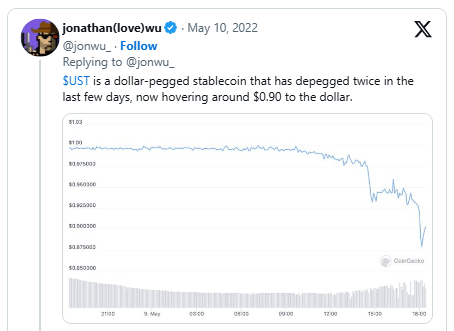
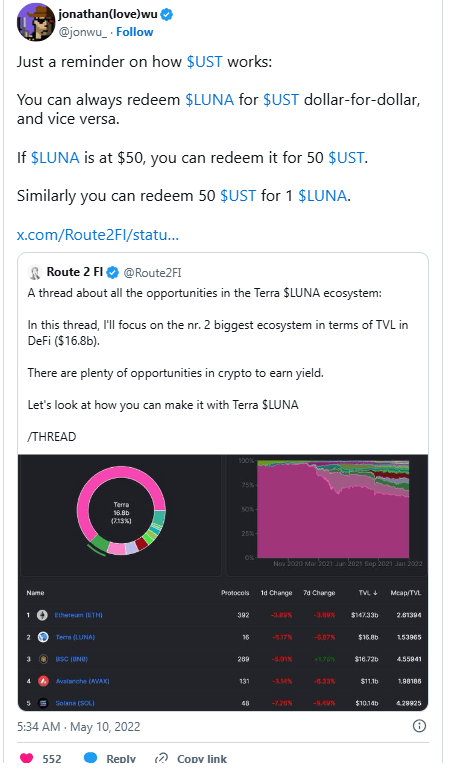
It worked for a time. UST became the fourth-largest stablecoin in the world. LUNA became one of the top 10 cryptocurrencies. The Anchor Protocol, where UST could earn about 20% interest, attracted billions from users seeking passive income.
By early 2022, critics began warning about this fragility. An article from the University of Calgary noted that algorithmic stablecoins were "inherently fragile" and "always vulnerable."
As the 20% yield of Anchor became unsustainable and began to decline, fear set in. Confidence – the only glue that holds everything together – started to weaken.
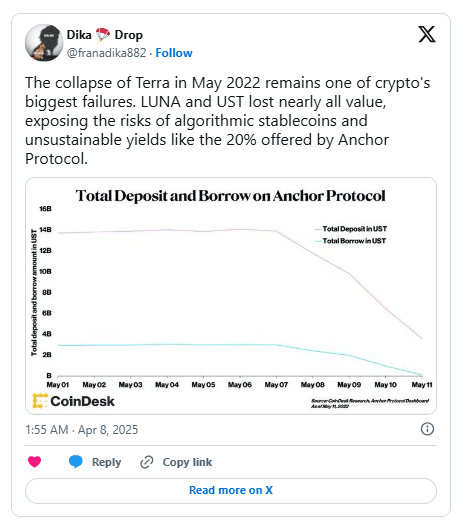
Luna Foundation Guard (LFG), based in Singapore, attempted to restore confidence by securing $1 billion in Bitcoin reserves to protect the peg. But that was too little, too late.
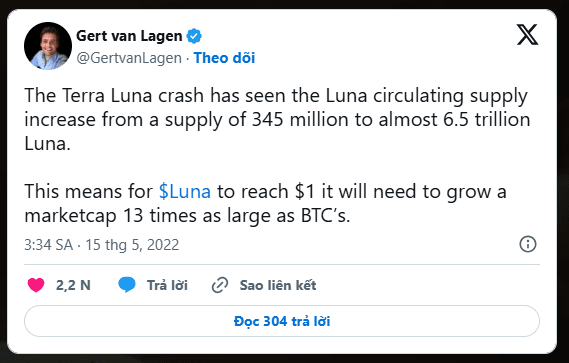
In May 2022, it happened. A massive UST sell-off began. As its price fell below $1, investors rushed to exit. To maintain the peg, more and more LUNA had to be minted. But minting more LUNA meant diluting its value. The price of LUNA plummeted. As it dropped, the system printed more LUNA, creating a hyperinflationary spiral.
The numbers became staggering. The supply of LUNA skyrocketed from 345 million to over 6.5 trillion in just a few days. Its price dropped to nearly zero. UST, once a proud $15 billion asset, could not maintain its peg and fell below 10 cents.
Investors witnessed their life savings vanish. Billions of dollars were wiped off the market overnight. The entire Terra ecosystem – with all its projects and partnerships – collapsed.
What Remains After the Fall
By June 2022, Terra was officially dead. Exchanges delisted both UST and LUNA. Major DeFi protocols built on Terra were abandoned. Anchor, Chai, and Mirror – all darlings of the Terra dream – became useless.
The U.S. Securities and Exchange Commission has stepped in. The commission has issued a subpoena to Do Kwon regarding the Mirror Protocol, which allows users to trade synthetic stocks like Apple and Tesla. Meanwhile, Kwon and Terraform Labs have contested in court, challenging the SEC's authority.
Public opinion has changed dramatically. The idea of algorithmic stablecoins, once hailed as innovation, is now seen as reckless. The collapse of Terra caused a ripple effect throughout the cryptocurrency space, erasing investor confidence and attracting closer regulatory scrutiny.
What does the collapse mean for the future
The collapse of LUNA was not just a single currency losing support. It was the explosion of an idea – that decentralized algorithms could replace traditional centralized systems without consequences. The collapse forced investors, developers, and regulators to rethink how to build these systems.
In the months following the collapse, global regulators began tightening oversight of stablecoins. Questions about transparency, reserves, and accountability became the focus of any new project. And algorithmic stablecoins have yet to recover their reputation since then.