



The recent dispute over the development route of the Bitcoin network caused by Inscription has once again surfaced. Who is right? There is still no answer to whether Bitcoin should be used as a settlement layer or as digital gold, but in fact this question has been with Bitcoin for 15 years. Crypto Venture Capital ABCDE compiles complete information on Bitcoin expansion to provide users with insights from the past and the present.
This article is compiled and compiled by Lianxin. If you have any questions, please refer to the original text.
Should Bitcoin become a computing system or digital gold?
Whether Bitcoin should be a payment system or a digital currency has been controversial since its early days.
Satoshi Nakamoto favors digital gold but with reservations
On June 17, 2010, Satoshi Nakamoto wrote on the Bitcoin forum:
The design (Bitcoin) supports every possible transaction type I designed many years ago, including escrow transactions, bonded contracts, third-party arbitration, multi-signatures, and more. These are all things we want to explore in the future if Bitcoin can be widely accepted, but they must all be designed from the beginning to ensure that they can be realized later.
Large-scale applications and transactions represent more complex instructions and larger block space. Therefore, between July and September 2010, Satoshi Nakamoto modified the BTC code many times, including removing two opcodes, disabling some functions of the Bitcoin programming language Script, etc.
Satoshi Nakamoto finalizes 1MB limit
On the other hand, when BTC was founded, there was no limit on the block size so that the required transactions could be processed within time. But the price of BTC was low at the time, so malicious transactions were prone to occur (and the costs were low). To solve this problem, Satoshi Nakamoto presided over a soft fork on September 12, 2010, confirming that the block space should not exceed the 1 MB limit. On October 4 of the same year, developer Jeff Garzik tried to remove the restriction in the new client he developed, but was opposed by the community and Satoshi Nakamoto.
Satoshi Nakamoto said that the block space limit is temporary, and the block limit can be gradually increased in the future to meet the needs of expansion.
 Satoshi Nakamoto expressed the need to expand capacity in the future
In December 2010, due to unknown reasons, Satoshi Nakamoto sent his last public message and withdrew from the public eye. However, at this time, the issue of Bitcoin network expansion was not really finalized, and the 1MB limit was also This laid the foundation for a series of subsequent controversies.
Bitcoin’s other application scenarios have been left in limbo
During this period, discussions on Bitcoin application scenarios other than payment also appeared on the bitcointalk forum. For example, in November 2010, appamatto proposed a proposal to build a decentralized domain name service on the Bitcoin network, but the proposal did not Not recognized by early members, including Satoshi Nakamoto, the proposed BitX became a core component of Ethereum and other projects, and BitDNS eventually developed into the first altcoin, Namecoin.
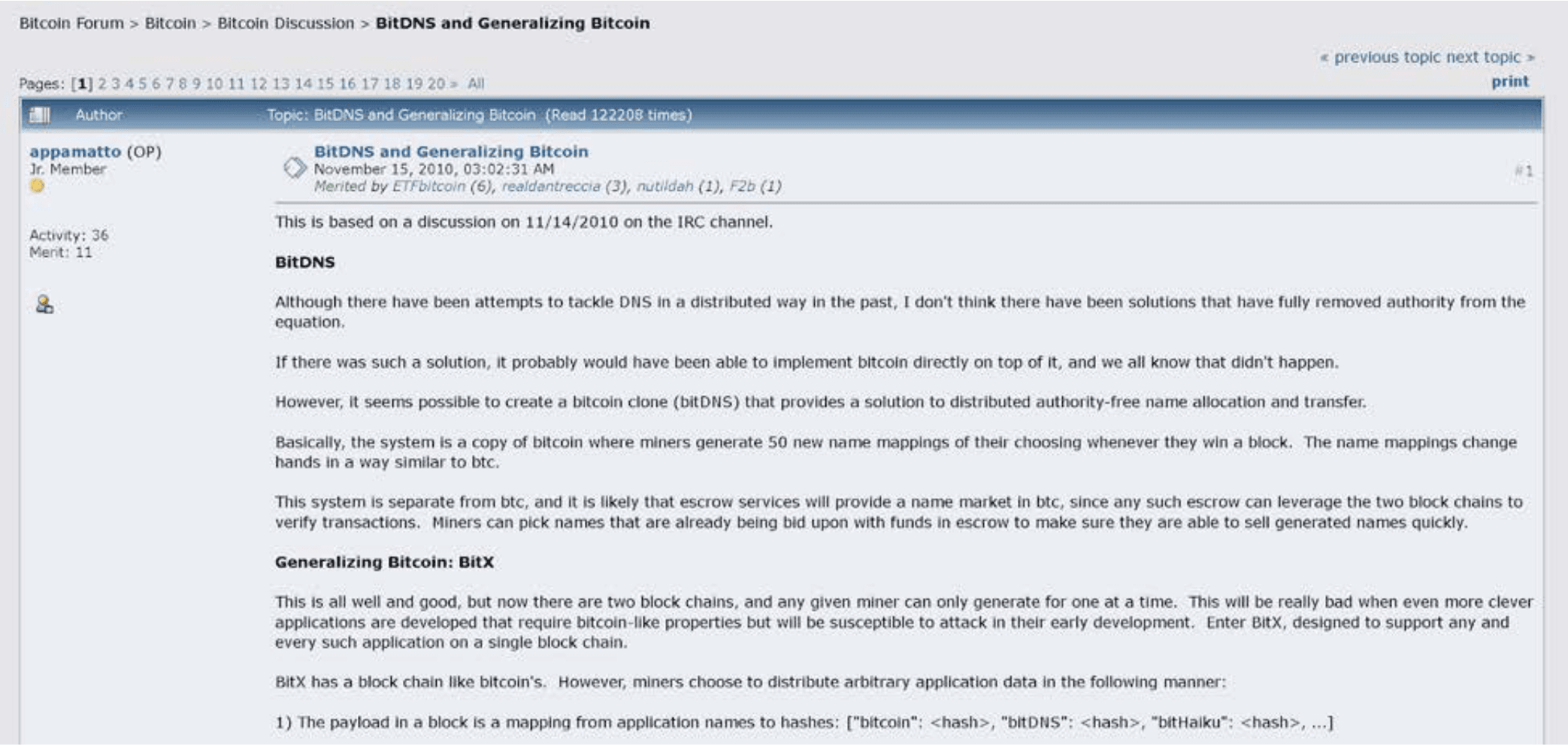 Discussion on the application of Bitcoin domain name Bitcoin forks brought about by the expansion dispute
With the popularity of Bitcoin, the problem of online transaction congestion has become increasingly serious.
The expansion controversy has become increasingly fierce with the disappearance of Satoshi Nakamoto
In 2015, Gavin Andresen and Mike Hearn announced that BIP-101 would be implemented in the new version of BitcoinXT, hoping to increase the block space limit to 8 MB. Core developers including Greg Maxell, Luke Jr, Pieter Wuille and others objected, believing that this approach would raise the threshold for running a full node and would have uncontrollable impacts.
(Kill ORDI and other BRC20? Developers threaten to fix Bitcoin loopholes next year. What is the Bitcoin community arguing about?)
This debate eventually entered a heated discussion and split. There is no absolute advantage or disadvantage between the two routes:
Adhering to the small block route cannot answer the core question "After the block reward is reduced, how can low transaction volume maintain sufficient node rewards to ensure network security?"
And 8 MB will not be the final solution. Once a large block is chosen, it is likely that continuous expansion will be required. Unlimited expansion will lead to a stack of technical risks.
Scaling controversy leads to multiple Bitcoin forks
The essence of this debate remains "What is the vision of Bitcoin?" This debate eventually led to a split in the community and a hard fork that began in 2017. In addition to BCH and later BSV, many other BTC forked coins also appeared during this period. According to the BitMEX Research report, at least 50 new forked coins appeared within one year after the BCH fork alone.
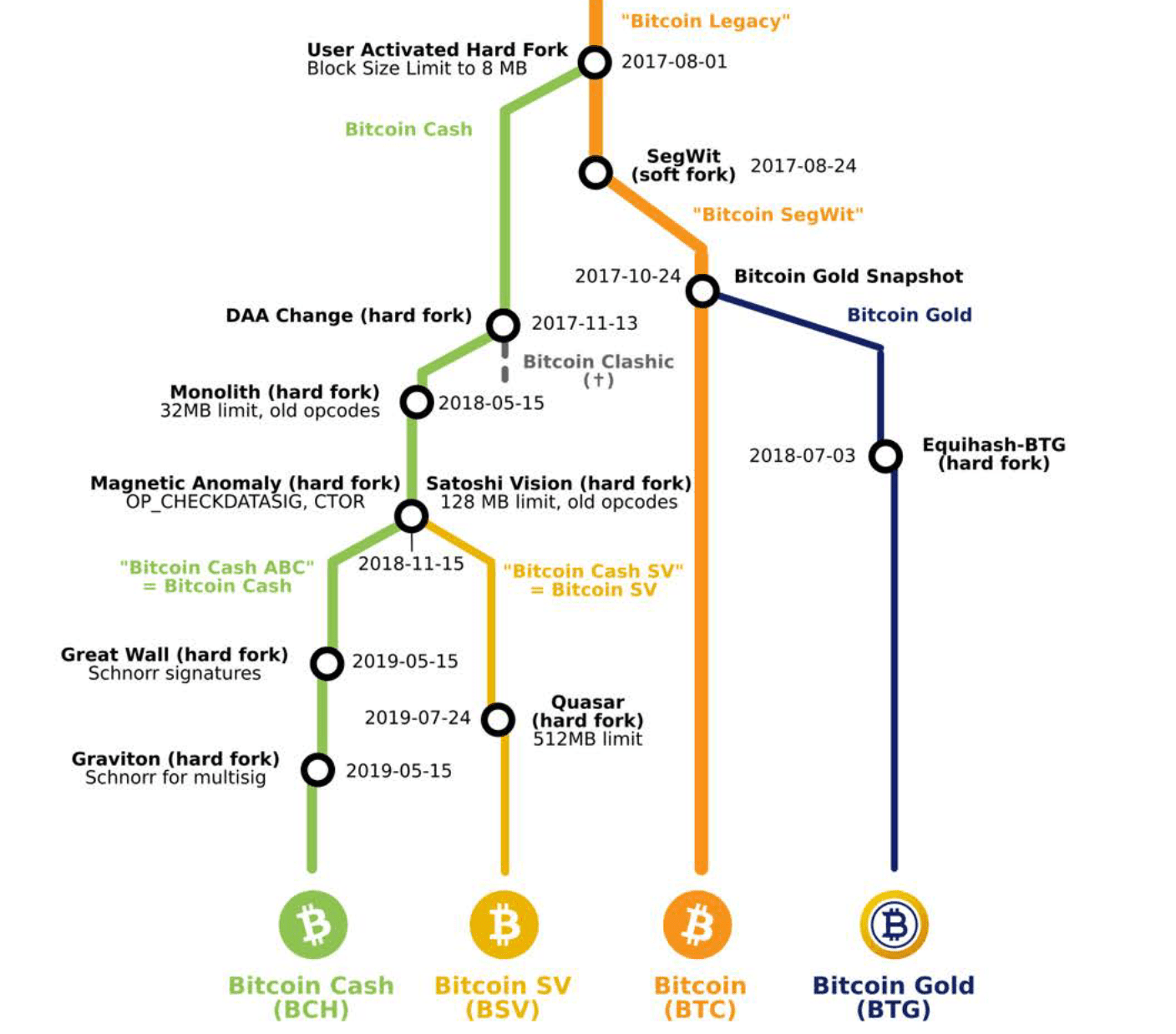 Bitcoin fork map, other means of expansion emerge
After the above-mentioned hard fork war, the community gradually introduced a series of new technical solutions to improve scalability while maintaining the block size, the most important of which are SegWit and Taproot.
SegWit
As an alternative to directly increasing the block size, Segregated Witness was introduced at the same time as the BCH fork. SegWit divides the transaction into two parts. The first part contains the sending and receiving addresses, and the second part saves the transaction signature or witness data, which is moved out of the main block but retains the verification function.
The removal of witness data allows more transactions to be accommodated in the same block size, improving throughput in another way.
SegWit was introduced in the form of a soft fork, and the adoption rate continues to increase. By 2020, it has been adopted by more than 60% of nodes, and by December 2023, it has reached 95%.
Supplement: SegWit did not initially limit the length of verification information, which allowed subsequent projects to bypass the 1 MB block size limit by verifying information, and also paved the way for the subsequent rise of Ordinals. . This practice has been controversial in the community. Some opponents believe that SegWit's failure to set a length limit is a bug, and therefore the method of using verification information to transmit data is an unfair attack.
Taproot
In November 2021, another important upgrade, Taproot, also officially took effect in the form of a soft fork.
This upgrade consists of BIP340, BIP341 and BIP342:
BIP340 introduces Schnorr signatures that can verify multiple transactions at the same time, replacing the Elliptic Curve Digital Signature Algorithm (ECDSA), once again expanding network capacity and speeding up the processing of batch transactions, providing a solution for deploying complex smart contracts. the possibility;
BIP341 implements Merkleized Abstract Syntax Tree (MAST) to optimize the storage of transaction data on the blockchain;
BIP342 (Tapscript) uses Bitcoin's scripting coding language to adapt to Schnorr signature and Taproot implementations.
The Taproot upgrade brings further expansion of the Bitcoin network and the possibility of executing smart contracts.
Bitcoin Layer2
As the dispute over block size has settled, Bitcoin L2 has begun to enter the public eye on a large scale, with the most mainstream routes being the Lightning Network and side chains.
The Lightning Network was first proposed by Joseph Poon and Thaddeus Dryja in 2015. The core idea is to lock a portion of Bitcoins in a multi-signature address, thereby establishing a separately governed channel protocol so that transactions can be carried out off-chain. OK, the final result is confirmed by the Bitcoin network. In March 2018, Lightning Labs announced that the Lightning Network was officially launched on the Bitcoin mainnet, with representative applications including Strike, Taro, Lightspark, etc.
The side-chain solution was attempted earlier. In 2014, Blockstream published the first technical paper on the Bitcoin side-chain solution, but the solution was not actually implemented. RSK released the white paper in 2015 and launched a fully functional mainnet in January 2018. In September of the same year, Blockstream also launched the Liquid Network side chain.
In addition to RSK and Liquid Network, Stacks, RootsStocks, Drivechain, etc. are also Bitcoin network sidechain solutions.
In addition, Bitcoin community developers are also exploring and experimenting in aspects such as state channels and roll-up.
Scaling issues drive Bitcoin’s ten-year development
The early Bitcoin project was greatly influenced by the opinions of Satoshi Nakamoto, and most of the community and development took the non-scalable path of digital gold. With the disappearance of Satoshi Nakamoto and the popularity of Bitcoin, the expansion controversy has surfaced again and triggered a hard fork on the network. Recently, many improvement solutions have emerged, including SegWit, Taproot, Lightning Network and side chains.
It can be said that the updates of the Bitcoin network in the past fifteen years have all been troubled and improved due to capacity issues.
Block space is the most important issue for Bitcoin network developers and dominates the development of Bitcoin. Now the emergence of Inscription has disrupted the progress of developers and once again caused serious network congestion. It is not difficult to understand why some Developers are so unhappy. Understanding the history and context will allow you to think independently rather than conform to the crowd more objectively.
Back then, Luke Dashjr opposed increasing the block space limit out of concern that it might have uncontrollable effects. Compared with his current disgust and disgust for inscriptions, he can't help but feel sad, but it does show the weight of the decentralization of the Bitcoin network. The network is not affected by any individual.
After understanding the history, how the Bitcoin network should develop is now a matter of course, and it is also an issue that all crypto participants need to think deeply about in the future.
This article The history of the Bitcoin network revolves around the expansion issue and has developed to this day. It first appeared in Chain News ABMedia.