


Introduction
In recent years, many light games have chosen to launch Mini Apps on Telegram, hoping to leverage Telegram's vast user base to bring a large number of players to the project team. Most Mini Apps are click-based and nurturing games that distribute tokens to players through airdrops. The number of airdrops should theoretically correlate positively with game performance, yet some players report that despite similar game progress, why do spending players receive several times more airdrops?
This article will use the aforementioned controversies as a starting point to analyze the distribution mechanisms of already airdropped projects and the possible airdrop results of recent airdrop projects, and compare Ton and Kaia blockchains, which both issue Mini Apps, to explore whether these games are conducive to player participation in the ecosystem or more inclined towards Pay to Win gameplay to obtain airdrops.
Telegram Mini App game mechanisms
Telegram Mini App games are all lightweight applications that can be played directly within the Telegram application without additional downloads. These games focus on blockchain-related elements, and while the gameplay varies, the following mechanisms usually appear:
On-chain check-in: By interacting with one record on the Ton blockchain, players can receive daily check-in rewards.
Invite friends: Players can receive one-time rewards or share friends' earnings through the invitation mechanism.
Top-up mechanism: Players can purchase game top-up tokens through Ton or other cryptocurrencies.
Why do different games exhibit similar mechanisms? One can think in reverse about the needs behind the project teams.
Project team needs
Game teams still face issues such as funding and financing during development; otherwise, they might face bankruptcy before the token generation event (TGE) arrives. Thus, we can infer that the advantages provided by users to the project teams are as follows:
On-chain activity: Players can prove the game's activity by consuming Ton to interact on-chain.
Number of players: Through the invitation mechanism, players will do their best to attract more players to join the game to obtain invitation rewards.
Direct income: Top-ups are the most direct way to earn revenue, as players' top-ups directly generate income for the game team.
In this way, the game team not only creates on-chain activity for the game but also visually sees growth in the number of players, laying the foundation for future financing and promotion.
Airdrop standards
Based on the above inferences, it can be understood that project teams will likely distribute airdrops based on the contributions made by players, and the contribution standards may be a combination of the three standards along with some game performance to determine the final airdrop quantity players receive. How significant is the ‘top-up amount’ among the three standards? We can observe from the standards of already airdropped projects.
Airdrop mechanism of already airdropped projects
Observing the progenitor of Tap to Earn - Notcoin, and the first popular nurturing game - Catizen, one can learn whether spending elements are an important standard for airdrops.
Notcoin
Notcoin is a Mini App in which players need to continuously click on the coin icon within the game to accumulate points, and they can enhance their earnings by inviting friends or completing tasks. The game design is very simple, yet it sparked heated discussions at the time, as it was hard to believe that such a simple game could earn airdrop rewards.
Final airdrop standards and spending efficiency assessment
Airdrop standards are based on scores exchanged for $NOT tokens, with an exchange rate of 1000:1 $NOT. Notcoin has no spending elements and relies purely on clicks and inviting friends to earn points. If users have Telegram Premium, they can receive additional points rewards.
Evaluated based on airdrop standard scores, Notcoin has no direct purchasing score paths, thus the game's airdrop results can be judged to be unrelated to spending, and there is no Pay to Win issue.
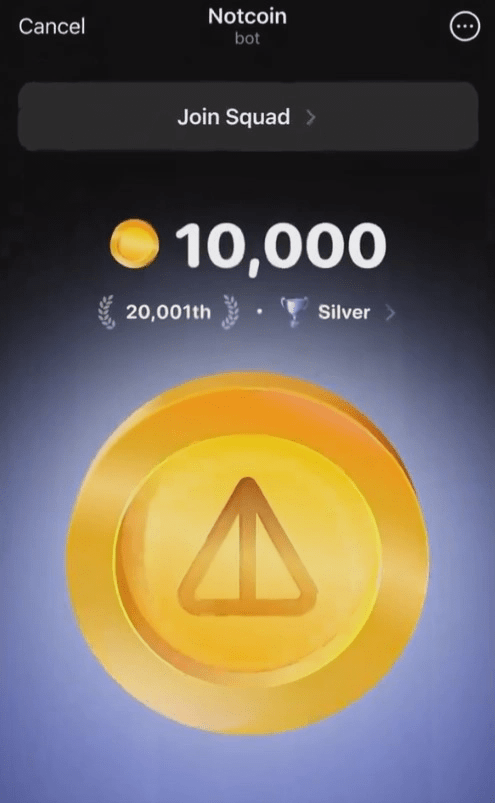
Image source: Notcoin X
Catizen
Catizen is a cat-themed nurturing game where players upgrade cats by merging cats of the same level and increase the income generated by the cats. Although the gameplay is simple, it features systems such as on-chain check-in, inviting friends, fishing, and a shop, making it difficult for players to determine which aspects to focus on to maximize airdrop profits.
Final airdrop standards
According to the explanations in the Catizen white paper, the final standards considered for airdrop references include:
vKitty coin income: The higher the level of the cats, the higher the vKitty income produced per second.
Fish coin consumption: The quantity consumed by using fish coins in the game.
wCati: Tokens issued in the Launchpool within the Catizen game.
xZen: Reward tokens for on-chain interactions, which have no use in the game but can serve as airdrop standards.
Spending efficiency assessment
The fish coins in the airdrop standards are the in-game top-up tokens, and the consumption paths are mostly to acquire more and higher-level cats, so spending indeed helps players increase their airdrop weight.
According to airdrop statistics, spending players receive airdrop returns of approximately 2.5 to 3 times their top-up amount. While the return rate seems quite good, considering the time cost and the electricity cost consumed while idling, the author believes that although spending helps obtain more airdrops, the gap between low spenders (around tens of dollars) and non-spending players can still be compensated for by time.

Recent airdrop projects
In March, two highly anticipated project airdrop announcements are coming, namely Bombie, a game themed around shooting zombies in the Catizen ecosystem, and Wizzwoods, a magical wizard closely related to BeraChain.
Bombie
Players fight against powerful bosses and earn silver coins used as airdrop criteria by opening airdrop boxes to obtain equipment and upgrade character levels, further enhancing character abilities through skills, robots, and other auxiliary systems.
Spending elements
As another work in the Catizen ecosystem, Bombie still carries spending elements:
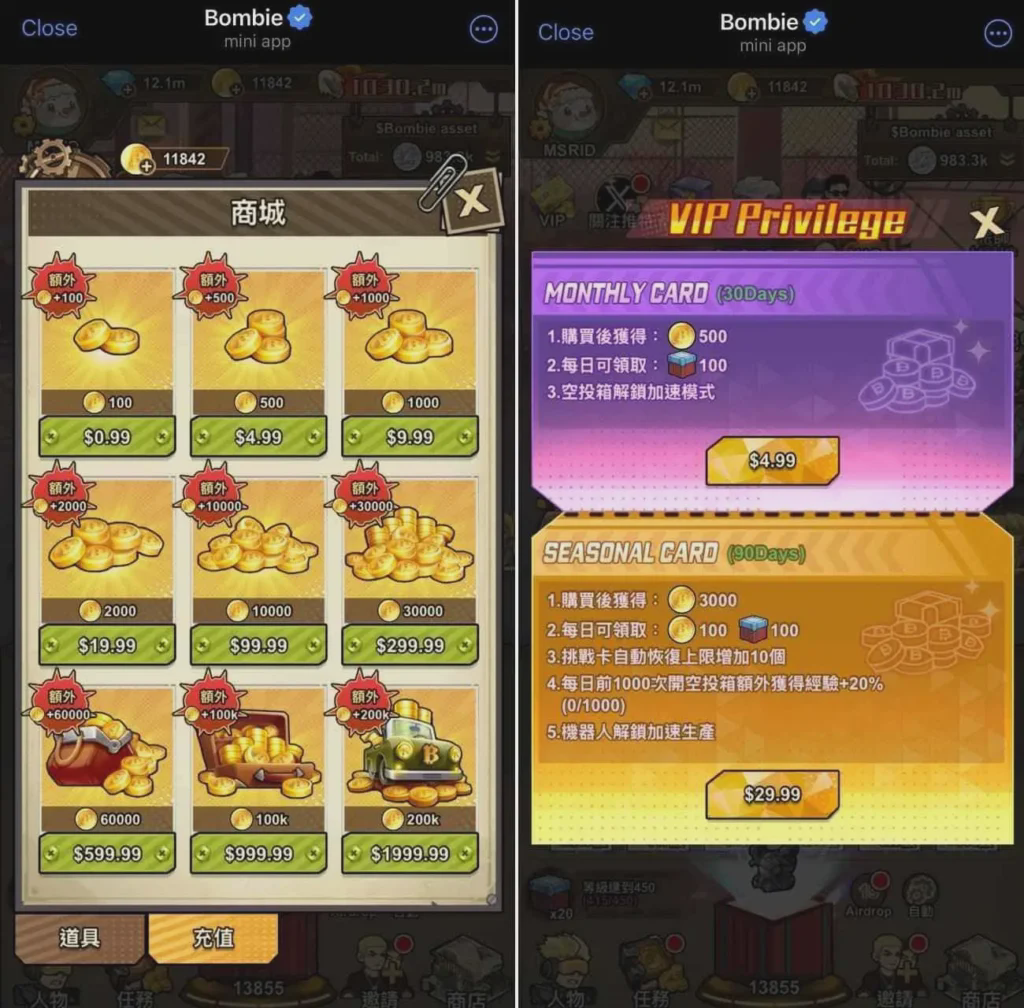
Coins: Coins are the in-game currency in Bombie, which can be purchased using CATI, TON, USDT, and other cryptocurrencies. Coins can be used in the shop to buy airdrop boxes, skill books, and other items that benefit character enhancement.
VIP qualification card: Divided into monthly and quarterly ticket systems, players who purchase VIP will receive daily coins and airdrop box rewards and can select accelerated opening mode to save a lot of opening time.
The seemingly reasonable consumption channels have recently sparked controversy due to the introduction of new activities.
Community controversies
Many players who play Bombie are likely hoping to obtain airdrops, thus the source of controversy is undoubtedly related to the topic of airdrops.
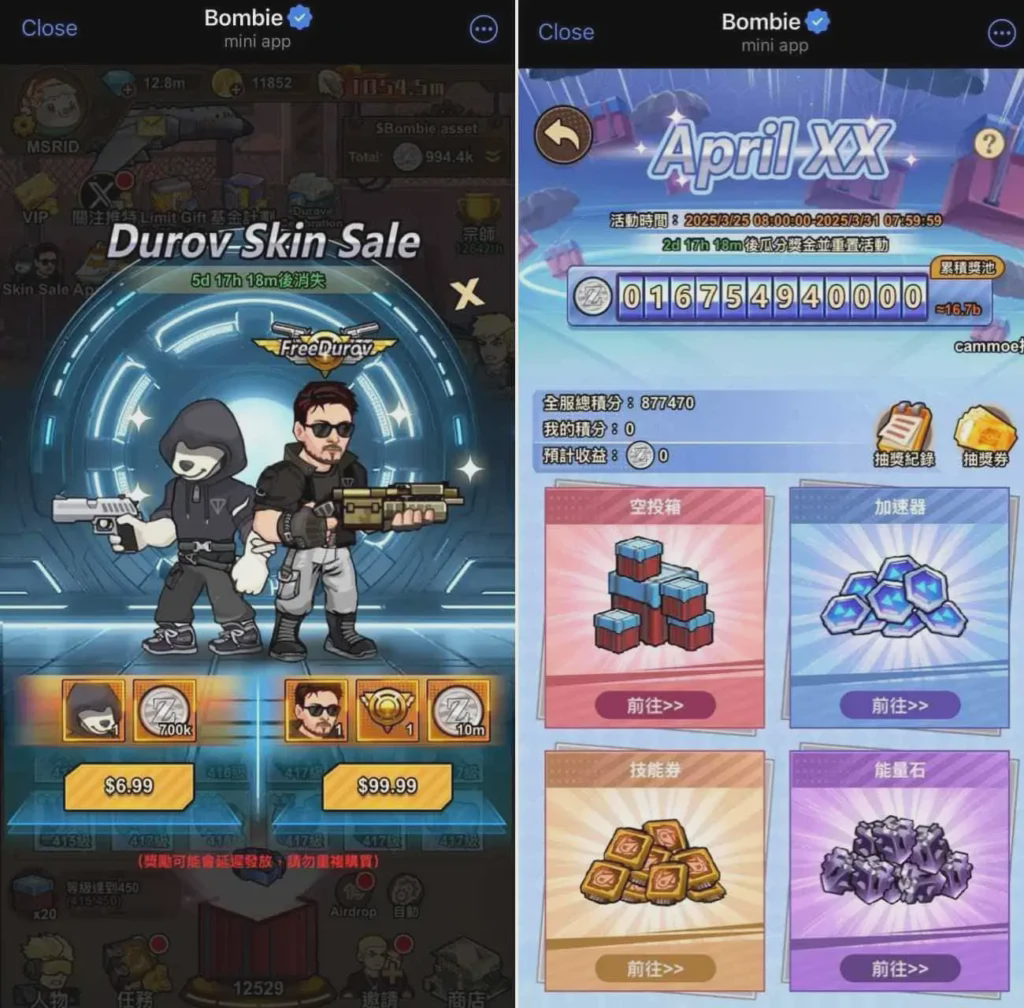
TGE has been delayed without news: The official statement during the game's launch claimed that TGE would take place in Q1 2025, but now, as April approaches, no announcements have been made, and players have not received airdrop news, but rather the spending activities have come first.
Spending to buy airdrops: Players currently only know that the airdrop standard is based on the quantity of 'silver coins,' yet recent activities continue to introduce packages containing silver coins, and there’s more than one such activity, leading early players to feel that their hard work in playing is useless.
Spending efficiency assessment
For players who have recently participated in the silver coin event, it undoubtedly leads to a more favorable airdrop expectation. However, early spending players focused on improving character abilities may suffer, and if you are optimistic about airdrop rewards and still have a budget, you might want to observe whether more similar events will be launched before the official airdrop.
Wizzwoods
Wizzwoods is a pixel nurturing game where players manage wizards to mine three different resources, upgrading statues on the island and expanding the island. Wizzwoods has announced that it will launch on 3/29 TGE, so let's see if this game has Pay to Win elements!
Spending elements
In contrast to Bombie, which has many spending activities, Wizzwoods' spending elements are relatively straightforward:
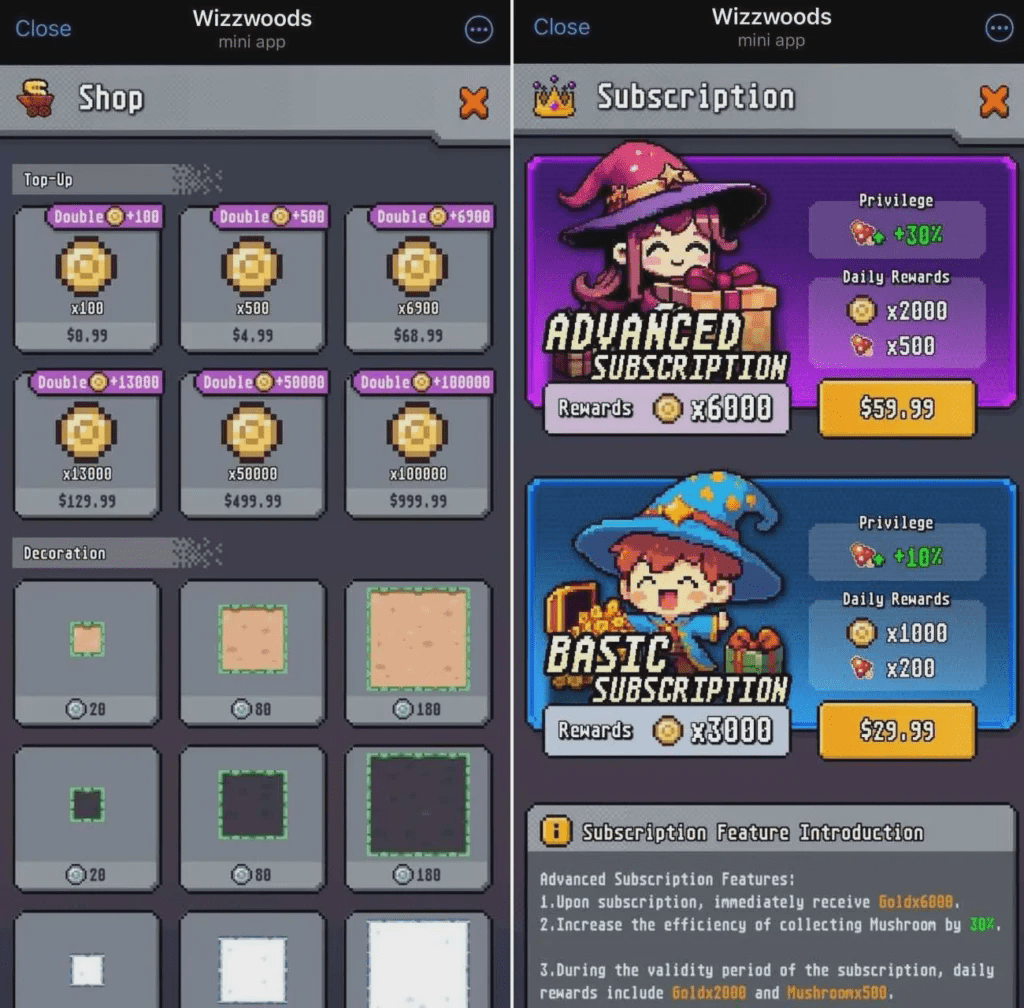
Coins: A top-up currency purchased using cryptocurrencies, which can be used to upgrade wizard levels.
Subscription: Can receive one-time + daily coin rewards and increase red mushroom output.
Airdrop rewards and unlocking conditions
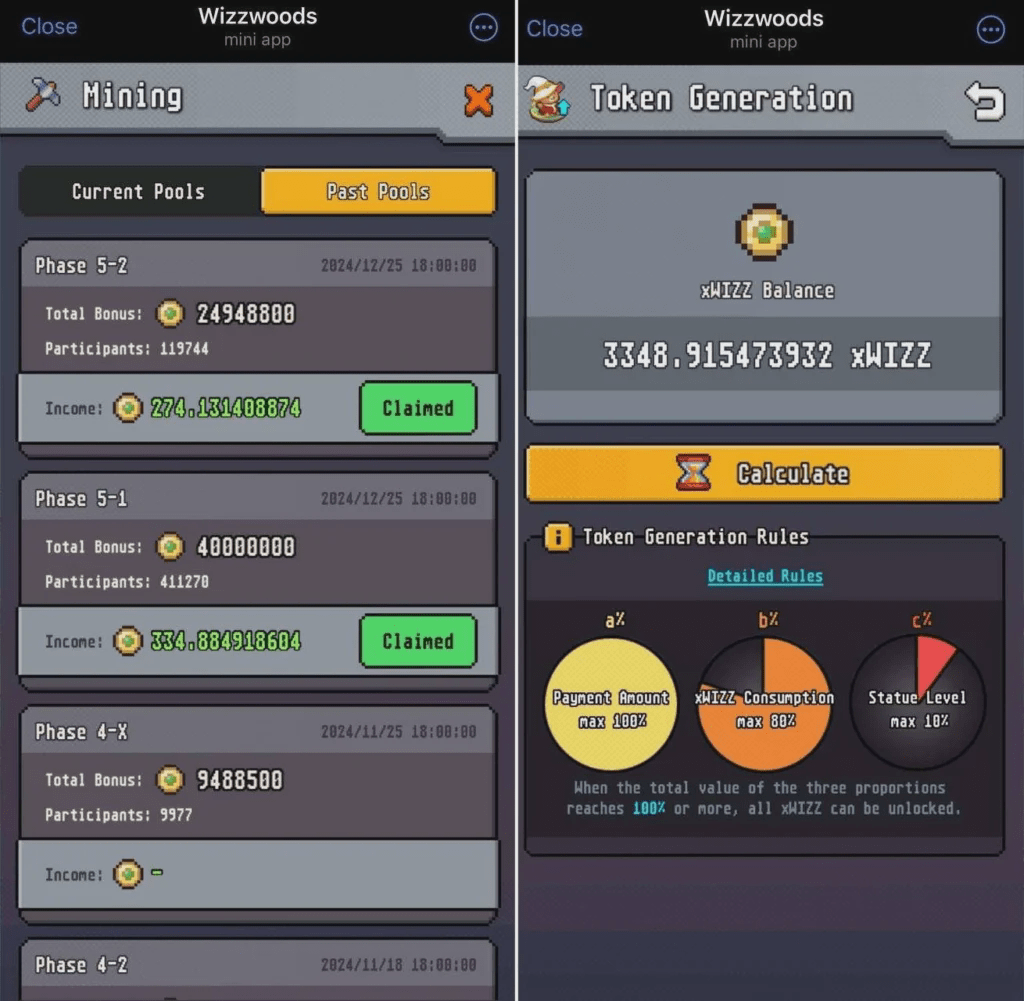
The airdrop quantity of Wizzwoods is straightforward; as long as players have participated in the in-game $xWizz mining pool, they can receive airdrop rewards for that period. The condition for participating in the $Wizz mining pool is that the statue level reaches level 30, and players can increase mining efficiency based on in-game performance (wizard level, statue level, island attractiveness).
However, obtaining $xWizz does not mean that players can withdraw all of it during the 3/29 TGE; they still must follow the unlocking rules below:
Top-up amount (0-100%): When the top-up amount reaches over $600, 100% of the airdrop can be unlocked.
$xWizz consumption (0-80%): Consuming up to 30,000 $xWizz can unlock 80% of the airdrop.
Statue level (0-10%): Statue level 90 and above can unlock 10% of the airdrop.
Spending efficiency assessment
The spending advantage of Wizzwoods mainly lies in quickly upgrading wizard levels to increase resource production, which further enhances statue levels to expand the island, helping players seize more shares in the $xWizz mining pool.
Compared to Bombie, Wizzwoods does not have activities for directly purchasing airdrop shares, and I believe that airdrop unlocking will become the biggest advantage for spending players. Consider that most non-spending players can only unlock less than 20% of $xWizz, while spending players can unlock airdrop tokens early, making subsequent selling or participation in the ecosystem more flexible.
Comparison of Ton vs. Kaia blockchains
Telegram has launched several popular games based on the Ton blockchain, attracting millions of users to participate in the Web3 ecosystem. Similarly, the globally renowned messaging application LINE has partnered with the Kaia blockchain, allowing users to play Mini Apps directly within the LINE application. Let's take a look at the respective advantages of these two blockchains.
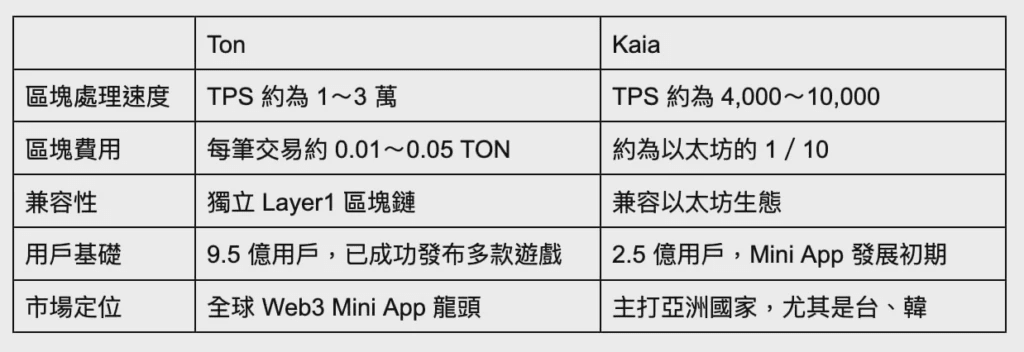
It seems that Ton outperforms the Kaia blockchain in many aspects, but Ton experienced two major outages (lasting 7 hours and 6 hours respectively) while handling the $Dogs airdrop in August 2024. Given that no Kaia blockchain-related Mini Apps have airdropped yet, it is impossible to directly compare which blockchain is more suitable for developing Mini Apps.
Conclusion
Telegram Mini Apps indeed provide game players with opportunities to engage with the Web3 ecosystem, but from Notcoin to Catizen and then to Pixelverse, the number of airdrops received by spending players has significantly increased. Is it really worth it for players to participate without spending money and investing time?
The author believes it ultimately depends on personal choice. If you are willing to treat the game as entertainment while earning a bit of return, Mini Apps are still worth trying. However, if your only goal is to earn airdrops, then you need to carefully assess whether the time cost is sufficient to achieve the expected rewards.
This report is for informational sharing only and does not constitute any form of investment advice or decision-making basis. The data, analyses, and views cited in the text are based on the author's research and public sources and may contain uncertainties or be subject to change at any time. Readers should make investment judgments cautiously based on their own situation and risk tolerance. For further guidance, it is recommended to seek professional advice.