



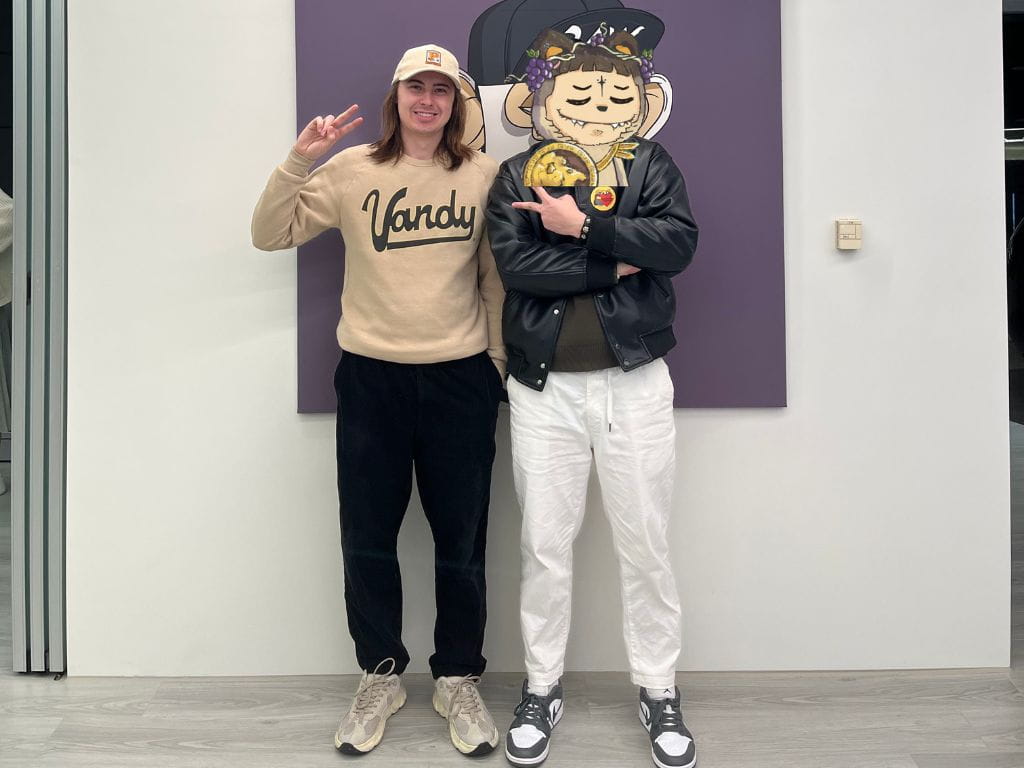
Before the MOVE to NCCU event, Chain News interviewed Movement co-founder Cooper Scanlon. In addition to Cooper and the entrepreneurial story of Movement Labs, we also exclusively shared the progress of Movement's dedicated network, corporate culture, and exclusive alpha from Rushi at the crypto czar dinner.
(Movement co-founders will meet with the Taiwan community on March 19 and 20! The event will exclusively share Web3 entrepreneurial experiences.)
Founders without impressive backgrounds dropped out to engage in Move language development.
NEO: Could you please introduce yourself first? About your background, etc.
Cooper: I grew up in a very rural community where there weren't many opportunities and not many career options around. So in high school, I worked full-time to support myself and my family. I got into Vanderbilt University, hoping that getting into a good school would lead to a good job and then a good career, achieving financial freedom and independence.
Once I got to Vanderbilt, I started learning some different things, such as human and organizational development, which is a bit like business psychology, as well as computer science and philosophy. I have always been looking for the next big trend, where the opportunities are, and where I should spend my time. Then I came across blockchain and cryptocurrency, and I was very interested in the intersection of finance and technology.
Because this is an entirely new industry, in most industries, there are always some people with much more experience than you, which makes those industries very rigid. But blockchain is a brand new field, so I was very eager to get involved. So I started learning, taking relevant courses, and trying to focus every paper or project around blockchain, forcing myself to learn. I also discussed this topic with others, and then I used these experiences and knowledge to make proposals, starting collaborations with traditional financial companies.
I would first understand the structure and operation of their company, then teach them about blockchain and cryptocurrency, and how these technologies impact their business. What's particularly cool is that at that time I was just a sophomore or junior in college, yet I could talk for hours with managing partners of large funds every week. I realized that if I took the traditional career route, I would never be in the same room with them. But because I became an expert in an emerging and specialized field, they wanted to learn from me, which really motivated me to keep pushing and invest even more.
Eventually, we started building a project. But when using Solidity (the Ethereum smart contract language), we encountered many pain points, one of which was that coding is really difficult. Solidity existed before the term real-world asset came about; it was not designed for that purpose at all.
For those funds, they can only trust that we know what we are doing because it is hard for regular people to understand Solidity. And for funds in their network, it is difficult to explain to their limited partners (LPs) why they should invest money into Solidity contracts that are often hacked. That’s when we discovered the Move language. At that time, Aptos and Sui were announcing their huge funding rounds, each raising hundreds of millions of dollars.
I started learning Move and realized that Facebook created this language precisely to address the pain points I encountered. So I decided to dive in and start using Move to develop structured products and financial applications. At that time, I was interning at Bloomberg while also developing my own projects, creating structured products with Move, while studying in school. It was too much of a burden for me, making it difficult to balance.
One day, I suddenly realized that while this internship was cool, even if I got a full-time job there, the salary wouldn't be enough for me to move to a city like New York and sustain a living. Even if I could do that, I would first have to advance my salary to apply for an apartment, which was unreasonable. The modern career system is not designed for newcomers; the whole society is a Matthew effect, with money continuously flowing to the top.
But in cryptocurrency and Web3, the more you invest, the more you get back; it's a one-to-one return. I realized that my interest in cryptocurrency far exceeded that in traditional careers. If that's the case, why should I stay in this internship rather than spend my time on cryptocurrency? So I decided to quit my internship. On the same day, I thought, if I'm not taking this internship or job, why am I still in school? So I also dropped out on the same day, quit my internship, and fully committed to developing with the Move language.
NEO: Well, this sounds like a typical story of most people without a rich background seeking financial freedom. When did you first come into contact with blockchain? Was it in 2019?
Cooper: I first heard about blockchain when CryptoKitties came out, around 2016 or 2017. But I really dove deep into it in 2021.
NEO: What was the situation like back then? Were NFTs popular?
Cooper: At that time, I wasn't deeply involved in NFTs. I was just trading tokens on Coinbase and started getting involved from that angle.
Movement upgrades Ethereum, adding real-world impact.
NEO: Alright, let's talk about Movement. The Bitcoin white paper is considered the most concise white paper. Can you introduce Movement in a few simple points?
Cooper: The Move language is faster and safer than Solidity. Movement directly applies the Move language to Layer 2, so we have significant differentiation.
NEO: Is it an extension solution for Ethereum? So is it something that bridges Move and Solidity?
Cooper: I would say we are upgrading Ethereum. Ethereum, as a meta network, we apply Move directly on it. Although there are bridges, because you need to bridge from Ethereum to our network, compared to Layer 1 blockchains like Aptos and Sui, they are in direct competition with Ethereum, Solana, and others. As a Layer 2, we are fully aligned with Ethereum, so we can attract users seamlessly. And bring liquidity from Ethereum into Move contracts without competing with it.
NEO: But I think that's a good question because last year I heard someone say Movement is Layer 2, but later said it isn’t Layer 2. The white paper looks more like an Ethereum sidechain. So what exactly is it?
Cooper: That's a great question. We are constantly upgrading and improving our architecture. I think we are brewing something new that may create a new category. So we are continuously improving our architecture and making progress.
NEO: Ethereum is often referred to as the 'world computer' or 'infinite garden.' What do you imagine or envision for Movement?
Cooper: My vision is to create real-world impact. I believe Ethereum opened the door to many great things and many new use cases. Solidity is like magic, both good and bad. The good part is that it opens new possibilities for smart contracts and brings us into the future. But now we are at a point where Solidity is becoming a thing of the past; it is actually hindering industry development. Ethereum created a lot of value and showcased many possibilities, laying the foundation for where our industry is today.
But I believe overly grand and abstract thinking is actually hindering the development of the network. Because despite the visions of 'infinite gardens' and 'world computers,' what does that mean in reality? I think this has hindered Ethereum's adoption and also the growth of ETH prices because it hasn't had a concrete impact on you. So when I say we want to be a chain that generates real-world impact, we focus on how to create a better user experience for everyone globally.
For example, our Parthenon system tracks participation, and we reward community members for engaging with the network, allowing people to truly be part of it and continually earn rewards for their positive actions on-chain. Another way to create real-world impact is that many people received six-figure rewards from the Move airdrop, worth hundreds of thousands of dollars, and more received five-figure airdrops.
This is very meaningful. People around the world, like our community member Passel, work several kilometers underground in Ukraine's mines, but now he can improve his family's quality of life. Some Move users have bought cars for their parents and houses for their families; this is real-world impact. The second area is that we will introduce large financial institutions into our network. These products are usually only available to a very small number of ultra-high-net-worth individuals, and even many Americans cannot access them, let alone others around the globe.
But I believe cryptocurrency represents the revival and democratization of the American dream. My vision is to bring these high-quality financial products into Movement, and then democratize them to users in emerging markets and economies worldwide, allowing them to access not only dollars but also the best financial products.
The liquidity for Cornucopia will go live as soon as external partners fix the issues.
NEO: Alright, this question is a bit spicy. There are already hundreds of public chains; we clearly don’t need that many Layer 1 or Layer 2. So what kind of demand do you think is necessary for the ecosystem to be sustainable? I previously asked Rushi this question, and his answer was community. But I think real demand needs a breakthrough, not just faster or safer. Do you agree?
Cooper: I think 99% of Layer 2s are nearly identical, just each one is 10% faster, with new marketing gimmicks, but no substantial differentiation. The significant differentiation of Movement is that we use the Move language, which is the next-generation improvement of Solidity, created by the best engineers at Facebook, addressing the pain points of that language and creating a more scalable blockchain development. So we do have substantial differentiation.
NEO: Let's talk about the security of the Move language; I know Sui and Aptos also use the Move language, and Movement seems to resemble the version of the language created by Facebook.
Cooper: Yes, Move is designed for real-world assets and security. The way Move contracts work is by breaking everything down into modules, each defining its functions, who has access, and where assets can move. This way, you can hard-code security. Take the example of an Ethereum vault being hacked; someone breached the vault and extracted all the funds. But if it were Move, even if you could access the vault's wallet, you wouldn't be able to extract it to random different wallets; you can only move the assets to predefined places.
This greatly enhances security, and coding is more intuitive, making learning and building easier. Because of these security mechanisms and readability, auditing costs are lower and faster. If we were still college students trying to develop applications with Solidity, it would take too long and have too many vulnerabilities. If an application has any success, it might be hacked within a month. But with Move, it's easier for college students to try developing, reaching security thresholds, and as long as they don't mess up basic coding, vulnerabilities will be much fewer.
From an audit perspective, auditing Solidity is time-consuming and expensive because you might need doctoral-level knowledge to understand all vulnerabilities. But the auditing cost of Move is significantly lower. If you're a student or a first-time developer, once you find product-market fit, it's easier to get audits and ensure security.
NEO: So if a case worth billions like Bybit happens on Move, can it be avoided?
Cooper: From what I understand, the situation with Bybit being hacked was that a message went through a multi-signature that looked like a normal transaction but actually concealed code for unauthorized access to the hacker. I think this is more of a user interface issue rather than a smart contract vulnerability. So I don’t think this is an issue with Solidity or Move. One interesting aspect of the Move language is that it has formal verification, like a logical process, which can tell you in real-time whether there are issues while running the code.
NEO: Alright, let's talk about Movement. The Movement mainnet has just launched, but many projects and liquidity are not fully ready. What stage are we currently in?
Cooper: Yes, for the launch of the network, our current priority is to bridge Cornucopia TVL to the application. This TVL will not be idle; it will all be used for staking, liquidity pools, or lending, providing a solid foundation for launching DeFi. Ultimately, we will offer incentives for users of the chain, those depositing into Move, and those using the application. But currently, we are facing some issues with external partners in bridging Cornucopia TVL.
NEO: When will the liquidity for pre-deposits be ready? You mentioned soon?
Cooper: Yes, our partners are handling it; we are waiting for them to fix it.
Movement corporate spirit: Pursuing perfection, ecological symbiosis.
NEO: Back to the Movement Labs part, for young people without a background, startups need breakthroughs. How did you and Cooper find your breakthrough?
Cooper: Both of us are exploring in Web3 and are drawn to Move because we believe the Move language has a great opportunity to become the standard for smart contract development. We want to be among the first to use it.
NEO: For young teams, having unlimited imagination and energy to practice is crucial. But perhaps the most important thing is survival; did Movement encounter any significant challenges in the early stages, and how did you survive?
Cooper: The biggest challenge was starting in a bear market when confidence in the Move language was low in the industry. We were still college dropouts; how could we compete with giants like Facebook? We worked extremely hard and seized every opportunity to prove ourselves. There was a time we needed to write 42 pages of documentation in three days, including the white paper, ecosystem development plan, market strategy, etc. We had already dropped out, but friends encouraged us to go to the library and go into full mode. That was harder than any classroom assignment, but we accepted the challenge and completed it.
As a young person, no one has any reason to believe you; you have to prove yourself, work harder, and show the industry that you are worth being optimistic about.
NEO: Movement is still young; can you talk about your company culture?
Cooper: Of course. Our culture has several characteristics: one is that we always strive for 100%. For example, with papers, we do not accept 90% or 95%; even if it means rewriting or starting from scratch, as long as we believe we can do better, we will do it. We also work very hard and are fully committed. I hardly go out; I just work, but it’s fulfilling because we are doing great things. Combining the pursuit of 100% and 24/7 effort, we can go a long way in a short time.
This is why Movement can achieve so much in a short time. We also value these traits when hiring, looking for people who are willing to put in their all and pursue 100%. If we find a way to do better a week before the deadline, we are excited to start over because it brings us closer to perfection. This mindset allows our team to do great things.
Another core principle is that our success comes from helping others succeed. The way we succeed is by creating opportunities for others and helping them first. This is my personal belief and also our hiring standard. The best way to create wealth for oneself is to create wealth for others. If you can create wealth and opportunities for others, it will come back to you. So at every step, we think about how to help developers, communities, and the ecosystem thrive. We believe this way people will stay, more will join, and network effects will be created.
This is the fourth key aspect of our thinking and operation: network effects. We don’t want to do things for a single purpose; we want things to connect and enhance each other. For example, Cornucopia not only exposes people to the network and applications, but also allows high APYs and rewards from each application, providing liquidity to the network and enhancing the transaction experience. Our Parthenon program rewards the community, making people feel recognized, just like showing rare items in a game.
The Move airdrop not only stimulates the on-chain economy but also allows you to be seen as an important user in every application. For new applications, distributing tokens to users who airdropped to us is a great way to acquire users. This can create a wealth flywheel effect for the community, allowing the best to receive the most funding, becoming an infinite game of value creation.
What are they talking about at the crypto czar dinner with David Sacks?
NEO: Recently, you have been interviewed by traditional media outlets like Bloomberg and Yahoo Finance. As such a young person, what does this exposure feel like?
Cooper: Very cool. Even cooler is receiving messages from acquaintances saying, 'You’re in the news.' This means a lot to me; they value my opinion. When communicating with them, you must be very pragmatic, keep sentences concise. I’m more of a philosophical thinker who enjoys dialogue and divergent thinking, but they require sticking to the rules, quickly stating facts, with no personal opinions, and everything must be verified. This is a very different approach, but being an opinion leader in the industry is cool.
NEO: Rushi was invited to the crypto czar David Sacks' dinner, can you share some alpha from the gathering?
Cooper: The U.S. has a significant interest in the global dominance of the dollar. The U.S. is now competing with many countries for partnership status in emerging nations, such as Vietnam. We believe that by bringing large American financial institutions into the Move language and on-chain, we can more easily bring people from emerging economies onto the chain and into the U.S. economy. This is a huge contribution to the country, which is also why the government recognizes it, such as World Liberty purchasing Move.
We are also focused on bringing companies back to the U.S. Many are afraid of legislation, but our goal is to bring participants back to the U.S. and align with government interests. This has a positive impact on the crypto industry.
The market cares more about efficiency than decentralization.
NEO: After the Bitcoin ETF launches and even after Trump established Bitcoin asset reserves, decentralization has once again become a topic of discussion. Movement is also viewed as a project that is closer to the government; how do you see the art of balancing decentralization and government adoption? What do you think is an appropriate stance on this spectrum, and what role does Movement play in it?
Cooper: A few thoughts. First, the decentralization of tokens is the most important. Some projects have staked tokens that are double the circulating supply, which means investors and teams are dumping on users and the community. I think as users and traders, we should be wary of these exploitative behaviors; many chains extract value from users in a shameful way. Our airdrop is the best on the testnet, truly recognizing community members and providing substantial funding. Teams and investors cannot stake; your tokens are yours, and they will not be diluted or extracted.
Secondly, the market cares more about efficiency than decentralization. Solana was criticized for being too centralized early on, but look at its current position; it is a giant. Even when it crashes, people don’t care because of its good performance and many activities. In contrast, Ethereum emphasizes decentralization, but this leads to no clear substantial impact and poorer performance. Working with the government is the most bullish thing, indicating that we have a 5-10 year long-term plan that will benefit the network, holders, application developers, and participants.
Being at odds with the government will not yield positive results. We will deliver results for those who believe in us, in a truly decentralized way, looking at token distribution, seeing that holders, investors, and the team cannot stake, your tokens will not be diluted, that is decentralization.
Movement continues to lay out plans in Taiwan, planning to establish regional centers.
NEO: Regarding Movement's roadmap, will there be more collaborations with Taiwan in the future? We know Movement previously had research collaborations with National Tsing Hua University in Taiwan.
Cooper: I have high hopes for Taiwan; there is a strong developer community here. Communities like Boba DAO, GM Labs, and Sats have gathered many Solana developers learning Rust and developing with it; many are also developing Move on Sui. I believe the next stage is developing Move within Movement. We will invest substantial resources; this is my first stop in Asia and the place I will stay the longest, closely collaborating with partners like Boba DAO and Route-X teams, as well as many great media outlets.
Our goal is to establish regional hubs where industry participants like developers, communities, traders, and venture capitalists can gather to piece together the puzzle. Everyone contributes, and everyone benefits from the collaboration. For example, novice developers can meet projects looking to hire you, or those learning Move can connect. If you are a trader, you can meet projects you can help promote. My vision is to unite all of Taiwan into a cohesive group that benefits each other.
This article features an interview with Movement co-founder Cooper, revealing plans to establish regional centers in Taiwan and sharing the exclusive story of dropping out to start a business, first appearing on Chain News ABMedia.