


Crypto friends, today let's talk about the application of the calendar spread strategy. Calendar Spread is a common options arbitrage strategy suitable for market conditions where the volatility term structure has a certain slope. It is mainly used for volatility arbitrage, trading on the characteristic that long-term implied volatility (IV) is higher than short-term implied volatility.
Volatility term structure and calendar spread arbitrage
The volatility term structure describes the relationship between implied volatility (IV) of options with different expiration dates. Generally:
Contango: long-term IV is higher than short-term IV, indicating market expectations of rising future volatility.
Backwardation: long-term IV is lower than short-term IV, indicating market expectations of declining future volatility.
Calendar spread strategies exploit this volatility difference for arbitrage, mainly divided into Long Calendar Spread and Short Calendar Spread.
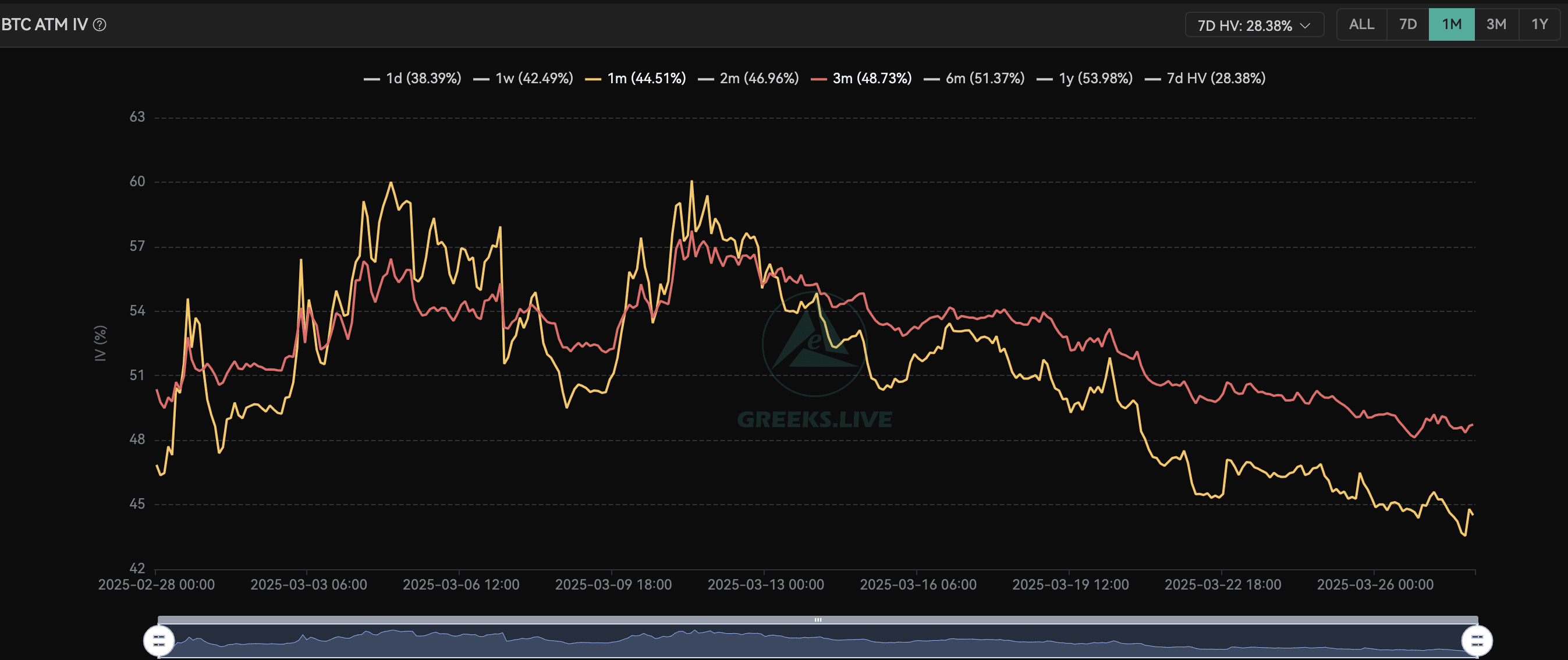
Long Calendar Spread — suitable for a contango term structure.
Trading logic:
Buy long-dated options (IV high).
Sell short-dated options with the same strike price (IV low).
Applicable for contango, where long-term IV is higher than short-term IV.
Arbitrage principle:
Short-dated options depreciate faster under time value decay (Theta Decay).
Higher long-term IV means that if market volatility falls, long-dated options may depreciate more slowly or even appreciate.
Profit methods:
If market volatility rises: long-dated option IV appreciates, while short-dated options expire or depreciate quickly, resulting in strategy profit.
If the market is stagnant or slowly fluctuating: near-month options lose time value rapidly, while long-dated options retain value, resulting in strategy profit.
Short Calendar Spread — suitable for backwardation.
Trading logic:
Sell long-dated options (IV low).
Buy short-dated options with the same strike price (IV high).
Applicable for backwardation, where long-term IV is lower than short-term IV.
Arbitrage principle:
Short-dated options have higher IV, possibly due to short-term events (such as earnings reports, CPI data, FOMC meetings) causing volatility spikes.
Long-term IV is relatively low, indicating that long-term volatility is returning to normal, and the market expects future volatility to decline.
Profit methods:
If market volatility declines: short-dated options IV decreases, while long-dated options IV remains unchanged or slightly increases, resulting in strategy profit.
If the market is stable: time value decay affects long-dated options less, resulting in strategy profit.
Risk factors in calendar spread arbitrage
Gamma risk: short-term options have high gamma, which may lead to losses if the market price fluctuates sharply.
Volatility risk: implied volatility may not change as expected, for instance, long-term IV may not rise or short-term IV may increase instead of decrease.
Liquidity risk: insufficient market depth may lead to significant slippage, affecting arbitrage returns.
Event risk: events such as earnings reports and macro data releases may cause short-term volatility spikes, affecting strategy performance.
Practical examples
Assuming the current SPX index is trading at 4500 points, and the volatility term structure is in contango:
Near-month (1 month) IV = 15%
Long-month (3 months) IV = 20%
You can construct a Long Calendar Spread:
Buy SPX 4500 Call, 3 months to expiration (IV = 20%)
Sell SPX 4500 Call, 1 month to expiration (IV = 15%)
If the market remains stable or long-term IV rises, your position will profit.
Summary
Long Calendar Spread (buy long-term, sell short-term) is suitable for contango, betting on rising long-term IV or market stability.
Short Calendar Spread (sell long-term, buy short-term) is suitable for backwardation, betting on declining short-term IV or reduced volatility.
When trading, pay attention to Gamma, Theta, Vega, and key event risk management.
If you are interested in this strategy, you can backtest and analyze it in real-time using specific underlying assets (such as SPX, Bitcoin options).