


Key points
Since Mark Zuckerberg fully bet on the metaverse four years ago, this concept has now been listed as one of the biggest blunders in the tech industry in recent years.
One of the main reasons for the decline of the metaverse is the rise of generative artificial intelligence.
Despite the overall industry downturn, some projects continue to maintain strong development momentum. Experts point out that this field is undergoing a process of purging the inauthentic and gradually squeezing out insincere participants.
When Mark Zuckerberg articulated his vision for the metaverse in October 2021, the idea of a digital utopia where people could connect and interact in an immersive virtual environment seemed achievable.
This billionaire founder believes the metaverse is the next frontier of the internet, and the company immediately began investing billions of dollars to develop the technology needed to realize its metaverse strategic vision.
Zuckerberg even renamed Facebook to Meta to reflect its new strategic ambition to build the metaverse. The metaverse is a virtual world built on virtual reality and augmented reality technologies, where people can interact, work, and create in this environment.
Given the massive funding scale that Meta (which has invested approximately $46 billion in the metaverse since 2021) and other competitors have poured into this concept, it is hard to imagine why the metaverse has failed to take off.
Once, artists including Sir Elton John and Travis Scott held concerts in the metaverse, while people also began to tour cities and visit art exhibitions in virtual environments.
However, four years after CEO Zuckerberg's strategic pivot, the metaverse has become one of the biggest failures in the tech industry in recent years. Due to its failure to deliver on its grand promises, the massive influx of billions of dollars into the sector has receded, and public attention has plummeted.
According to DappRadar's data, the transaction volume and sales number of metaverse NFT projects in 2024 have dropped to the lowest levels since 2020, with transaction volume plummeting 80% year-on-year and sales volume down 71% compared to the same period last year.
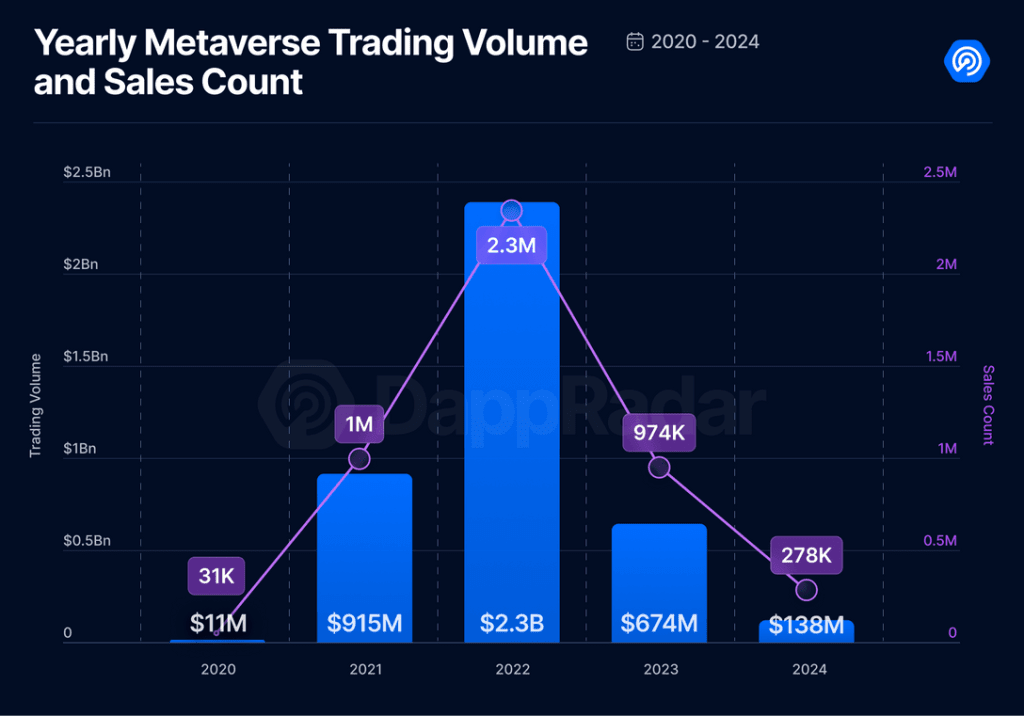 DappRadar
AI 'intercepts' the metaverse
According to expert opinions, one of the main reasons for the decline of the metaverse is the rise of generative artificial intelligence (AI) chatbots (such as OpenAI's ChatGPT and Google's Gemini).
BQ9 ecosystem growth organization co-founder and CEO Irina Karagyaur told Cryptonews: 'Generative artificial intelligence has achieved immediate and scalable commercial impact.'
Karagyaur is also an expert member of the United Nations International Telecommunication Union (ITU) metaverse focus group, and she further pointed out:
Unlike the metaverse, which requires high infrastructure investment, AI tools represented by ChatGPT, MidJourney, and DALL·E demonstrate immediate usability. Business users and consumers are increasingly turning to AI due to optimized automated processes and enhanced content generation efficiency. The strategic shift in venture capital is particularly significant: capital is pouring into AI startups, while metaverse-related projects are facing downgrades.
Herman Narula, CEO of the metaverse venture incubation firm Improbable, revealed to Cryptonews that artificial intelligence has played a significant role in the decline of the metaverse.
He stated that AI technology has seized the industry's attention as 'the next generation of disruptive technology,' causing a massive shift in focus away from the metaverse. Moreover, this evolution involves multiple other factors.
"The term 'metaverse' has drawn criticism for being linked to speculative cryptocurrency hype, with companies raising large amounts of capital, selling significant assets, and making a series of promises that ultimately went unfulfilled," Narula further pointed out:
After Meta (formerly Facebook) announced its entry into the metaverse space, related tokens such as Decentraland (MANA), The Sandbox (SAND), and Axie Infinity (AXS) saw significant price increases.
Today, as external doubts about the future of Meta's metaverse dream continue to ferment, related token prices have plummeted in the context of extremely low daily active user numbers.
Since reaching an all-time high in November 2021, the prices of SAND, MANA, and AXS tokens have all fallen by over 95% from their peaks. Among them, MANA once hit a historical high of $6.96, SAND surpassed $5.20, while Axie Infinity's AXS token once reached an astronomical price of about $153.
However, a recent on-chain data analysis from cryptocurrency research firm Glassnode shows that despite the price volatility, in these three projects, 'committed holders are steadily increasing their positions.'
For example, Glassnode noted that the MANA token formed a significant chip concentration area around $0.60, reflecting an increase in market buying activity after the price drop. Similar chip accumulation patterns are also seen in SAND and AXS tokens.
Glassnode believes: 'The ongoing chip accumulation phenomenon in major metaverse tokens indicates that many investors view these projects as undervalued investment opportunities rather than failures.'
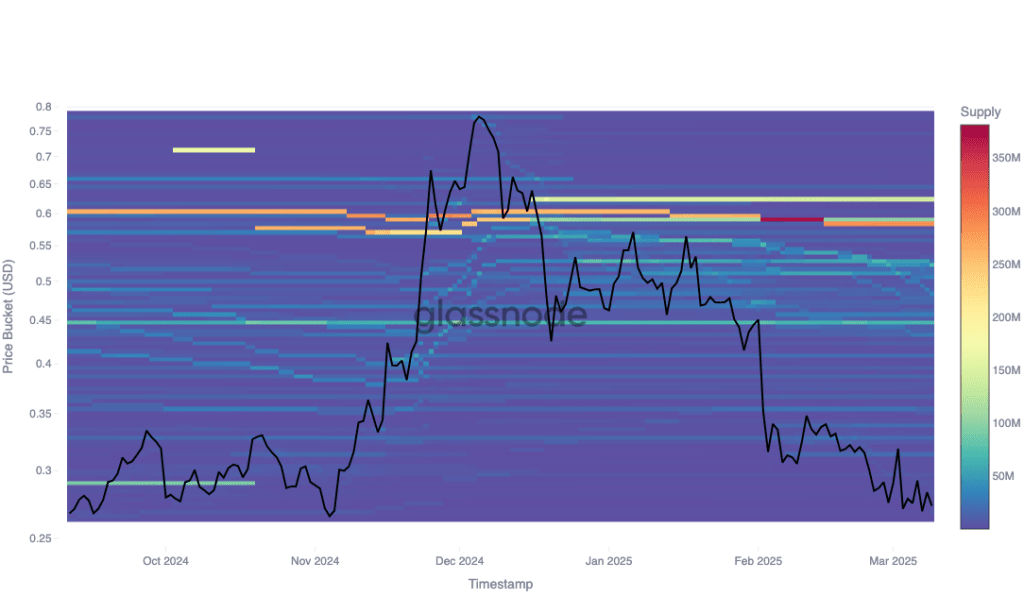
According to data from CoinGecko, as of the time of writing, the native token MANA of the Decentraland platform is currently at $0.27, down 2% for the day; The Sandbox token SAND fell 3.2% to $0.28; Axie Infinity's ecosystem token AXS has dropped over 1%, currently at $3.43.
Hardware becomes a 'roadblock' to landing
Charu Sethi is an expert in the Web3 field and also the chief ambassador for Polkadot. In an interview with Cryptonews, Sethi stated that the business model of the metaverse was not fully mature when its concept became popular.
"At that time, major brands launched NFTs and expensive virtual land projects one after another, but almost no users gained sustained value." She stated, "For example, despite attracting millions of dollars in investments, Decentraland and The Sandbox have long had their daily active user numbers hovering below 5,000."
Sethi also discussed how the high prices of high-end virtual reality (VR) and augmented reality (AR) headsets and the 'complex login processes' further hindered the popularization of the metaverse.
Hardware is key to enhancing the metaverse experience.
"Therefore, funding and attention have shifted to artificial intelligence, which can provide immediate returns on investment," she emphasized, stating: "For many businesses, the rapid returns brought by AI overshadow the metaverse."
As part of the metaverse race, Meta and Apple launched VR headset devices that allow users to immerse themselves in virtual spaces.
After using these hardware devices, people can do various things in the metaverse through digital avatars: gaming, social interactions, and even virtual offices. But these types of headsets can be a bit expensive.
The Apple Vision Pro is priced at $3,500, while the Meta Quest 3 headset starts at $500. In contrast, AI tools like ChatGPT offer limited free services, and their premium version at $20/month provides unlimited service without the need for users to purchase additional hardware.
ITU metaverse expert Karagyaur pointed out that the growth of the VR headset market has stagnated due to devices like Apple Vision Pro and Meta Quest 3, which 'only attract niche user groups and have failed to open up the mass consumer market.'
She said: 'Due to the failure to explore a sustainable profit model, the metaverse field's high input and high risk have become increasingly difficult to justify.'
Kim Currier, market director of the Decentraland Foundation, pointed out that the metaverse is not just a narrative of VR/AR hardware. "It creates a virtual space for human collaboration, where users can socialize, explore together, and create new things," she emphasized.
Currier continued: Although Apple Vision Pro and Meta Quest 3 'have already sparked a wave of innovation, the consumer side still faces a reality: it is unrealistic for the vast majority of users to wear headsets all day.'
Currier is more interested in how artificial intelligence and the metaverse can bring real benefits to people, referring to these individuals as 'core users of the metaverse.'
This senior executive from Decentraland does not see the rise of generative artificial intelligence as 'competition,' but rather as an 'opportunity,' stating:
Industry reshuffle
Currier, the market director of the Decentraland Foundation, attributed the weakening of the metaverse to: 'market bubbles caused by over-expectations; technological bottlenecks that are difficult to overcome; and structural changes in the tech industry.'
Currier told Cryptonews that the current phase of cooling in the metaverse is indeed a reconstruction of industry value, and this reshuffling is filtering out loyal builders:
BQ9 ecosystem executive director Karagyaur emphasized that the metaverse has not gone extinct but is undergoing a technological paradigm shift—this field is 'evolving into AI-enabled vertical application clusters based on public demand.'
"While the initial hype may have faded, what remains is something more profound: a shift from enterprise-controlled virtual worlds to community-driven ecosystems centered around humanity," she elaborated, adding:
"Although industrial applications (such as the collaboration between Siemens and NVIDIA in the digital twin field) continue to develop, the real vitality has shifted to platforms like Roblox, Fortnite, and Immortal Worlds. Here, experiences are shaped by user communities rather than enterprises. These platforms do not sell solutions for escaping reality but empower people to create, connect, and collaborate."
Polkadot blockchain project representative Sethi cited industry data indicating that the gaming platform Roblox surpassed 80 million daily active users in 2024, with a peak of 4 million concurrent online users this year, continuing to lead in metaverse user engagement metrics.
Epic Games' phenomenon-level game (Fortnite) maintains strong growth momentum—according to the latest operational data, its single-event user reach consistently exceeds ten million, solidifying its position as a leading social entertainment platform in the metaverse.
Polkadot blockchain analyst Sethi deeply deconstructed the (Fortnite) ecosystem enabling model—through brand strategies that synchronize the virtual and physical with luxury brands like Balenciaga and the phenomenon-level film IP (Star Wars), the platform successfully created a business closed loop with daily user retention exceeding a million, validating the continuous value creation of metaverse IP operations.
Hope in the darkness
Experts say that Zuckerberg's bet on the metaverse has turned into a complete disaster. In 2024, Reality Labs, the department responsible for developing metaverse products under Meta, reported a record operating loss of $17.7 billion.
Meta's official financial reports show that Reality Labs has accumulated losses nearing $70 billion over the past six years. Although Zuckerberg's metaverse blueprint has turned to dust, several projects within that ecosystem still show countercyclical growth trends.
Blockchain data analysis agency DappRadar released the (2024 Annual Gaming Industry Report), highlighting the two most influential metaverse projects of the year: the digital identity protocol Mocaverse and the blockchain gaming platform Pixels, both achieving breakthroughs in user scale and commercial value through differentiated ecological construction strategies.
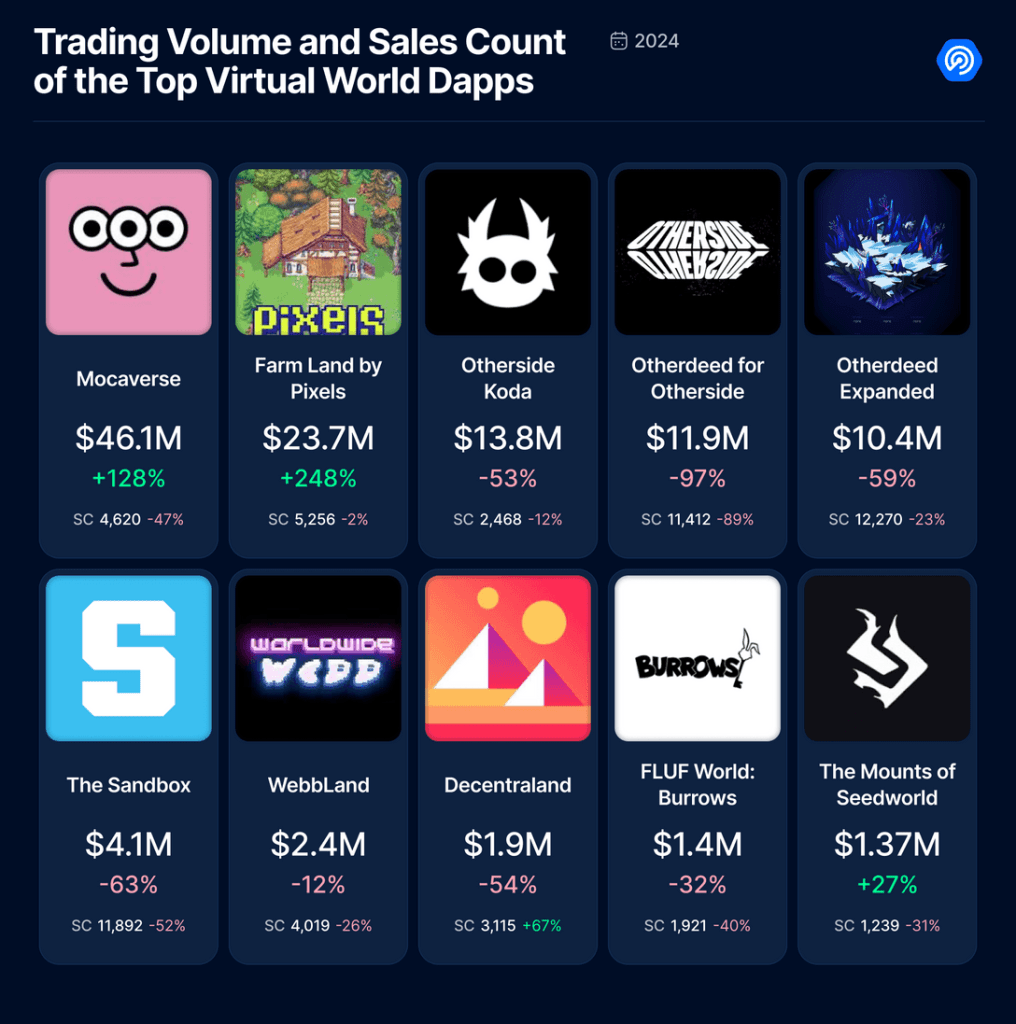 DappRadar
The Mocaverse project developed by Animoca Brands launched the MOCA token and an on-chain decentralized identity called Moca ID, attracting 1.79 million user registrations in a short time and successfully integrating with 160 Web3 applications.
The report indicates that the project has secured $20 million in funding to expand its ecosystem and launched the Realm Network aimed at 'promoting interoperability in gaming, music, and education.'
Pixels was first launched in 2022. Last year, this browser-based farm-themed multiplayer online game 'gained tremendous attention,' with its daily active user count surpassing one million.
The Pixels project has migrated from Polygon to Ronin Network, integrating its assets named 'Farm Land NFT' into Mavis Marketplace.
DappRadar also mentioned some important developments in Yuga Labs' Otherside metaverse, The Sandbox, and Decentraland. Among them, Decentraland launched a new version of the desktop client, which reportedly 'enhances operational performance and optimizes visual effects.'
The report states that the creator-centric economy of the Decentraland platform is its 'significant feature,' where creators can retain 97.5% of their sales, and also earn a 2.5% royalty share on secondary sales of digital assets—this revenue distribution ratio sets an industry record.
Nevertheless, there are still serious deficiencies in certain aspects. According to DappRadar's data:
Is the metaverse on the decline?
ITU expert Karagyaur stated in an interview with Cryptonews that the success of the metaverse will 'depend on integration, not isolation.' She explained:
"It can only continue to develop where it can supplement existing industries, rather than trying to replace them. The next phase of digital technology development will no longer aim to escape reality but will focus on improving reality itself."
Herman Narula, founder and CEO of Improbable, which developed the Yuga Labs metaverse platform The Otherside, pointed out that value-driven innovation can save the metaverse. Beyond dazzling visuals, users must possess practical value.
"The metaverse has always been a deeper, more reality-rooted concept, rooted in meeting people's fundamental needs for self-actualization," he said.
"While the 'extravagant' Meta investor meeting-style metaverse has gradually faded, we are still working to create a version that focuses on technology and practicality," he said.
Narula also mentioned that teenagers and minors spend a lot of time on gaming platforms like (Minecraft), Roblox, and (Fortnite), participating in increasingly complex virtual experiences, economic activities, and even engaging in virtual work.
This article is a collaborative reprint from: PANews
More reports
NVIDIA stock has seen a death cross; why is it still down after the GTC conference? Will AI cryptocurrencies rise or fall?
The mysterious backer behind Binance and OpenAI is him! What kind of life does the Emirati prince lead daily, enjoying electric cars, chess, and health?