


Author: Nancy, PANews
Once upon a time, the TON ecosystem rapidly rose with the strong traffic support of Telegram, amidst a fervent atmosphere of 'traffic equals value.' However, as the traffic dividend gradually fades, the curtain of reality is torn away, and the growth engine of the TON ecosystem begins to slow down. A single narrative logic, imbalanced resource allocation, impacts from external events, and fluctuations in the market cycle have plunged the TON ecosystem into a period of growing pains.
Currently, TON may welcome a turning point after the traffic recession, with the $400 million financing supported by top venture capitalists and positive news following the exclusive binding with Telegram bringing new growth expectations for TON.
Secured $400 million in financing, exclusively benefiting from Telegram's traffic
On March 20, the Open Network Foundation (TON Foundation) announced that it had secured a round of financing exceeding $400 million, with investors including Sequoia Capital, Ribbit Capital, Benchmark, Kingsway, Vy Capital, Draper Associates, Libertus Capital, and SkyBridge among several well-known venture capital institutions. It is reported that this financing was not completed through traditional equity or cash forms, but through the purchase of TON tokens, which is seen as recognition of TON's growth potential.
Public data shows that TON had completed six rounds of financing prior to this, mostly through over-the-counter (OTC) transactions. In terms of investment scale, the last publicly disclosed round of financing amounted to $30 million, while this fundraising ability has significantly increased, with a funding scale of $400 million setting a new historical investment record for TON. Notably, this round of financing has attracted participation from multiple top Western venture capitals, whose capital backgrounds are very strong, and their past achievements have added more imaginative space to the TON narrative.
For example, Ribbit Capital, as a venture capital firm focused on fintech and the crypto space, has successfully bet on industry giants such as Revolut, Nubank, Coinbase, and Robinhood; Benchmark has invested in well-known companies such as eBay and Instagram with precision; while Sequoia Capital's investment landscape is also very broad, covering Stripe, Nubank, Klarna, Firek, and more.
For TON, this round of financing means much more than the funds themselves; the collective backing of traditional Western capital releases a signal of mainstream recognition for TON, especially considering the uncertainties that previous regulatory pressures have brought to TON's development.
In addition to gaining capital endorsement, TON has also welcomed positive news at the ecosystem level. Although TON and Telegram previously separated independently due to regulatory difficulties, both sides have now re-bound deeply. In January of this year, Pavel Durov publicly stated that TON would become Telegram's exclusive blockchain partner. As part of this exclusive partnership, all Telegram mini-applications must migrate to the TON ecosystem, and the TON token will become the exclusive payment asset for all Telegram chat services.
Telegram's strong traffic support will bring more development space for TON. According to Pavel Durov's latest disclosure, Telegram now has over 1 billion monthly active users, making it the world's second-largest messaging application (excluding China's WeChat). User activity is also on the rise, with each user opening Telegram an average of 21 times a day and using it for 41 minutes daily. Additionally, Telegram's revenue growth is significant, reaching $547 million in profit by 2024. Furthermore, Telegram continues to refine its products, constantly optimizing the user experience; for example, it recently announced the launch of its third major update of the year, enhancing video features and AI sticker search, and plans to introduce transaction and revenue functions in its self-hosted crypto wallet, while launching a loyalty program for TON holders to further promote the popularization of the TON ecosystem.
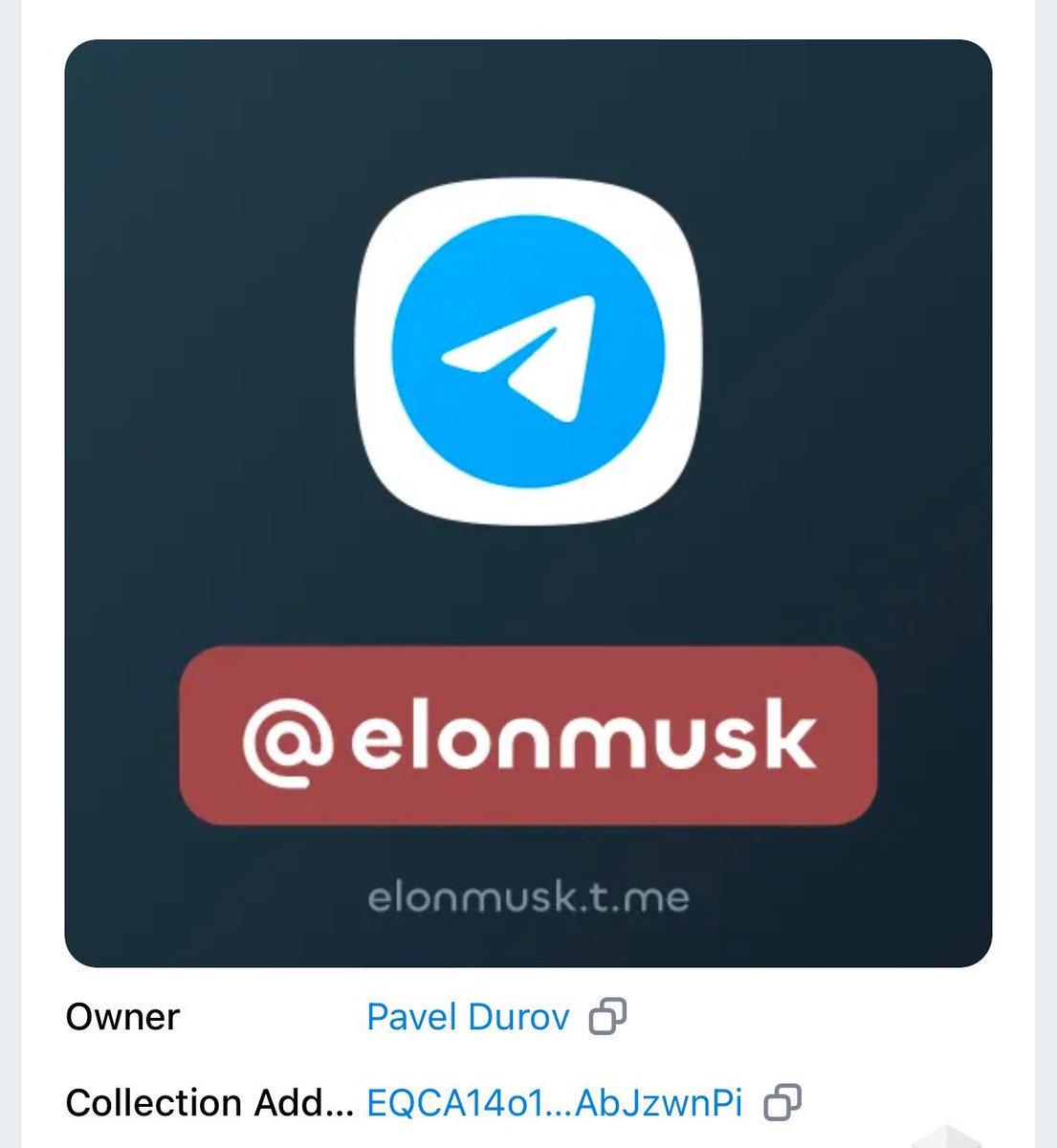
Recently, Pavel Durov's return has injected new confidence and vitality into TON. Durov is regarded as the core promoter of TON, and his personal circumstances directly affect community confidence and the pace of ecosystem development. In August last year, he was arrested in France for Telegram's alleged insufficient regulation of illegal content, causing market confidence to falter and leading to a crash in TVL and token prices. However, recent adjustments by French authorities to judicial oversight conditions have allowed him to return to his long-term residence in Dubai, and the sentiment within the TON community has warmed accordingly. Since Durov's return, he has been active, such as spending 5,000 TON to acquire the username 'elonmusk' on Telegram, and the AI robot Grok developed by his xAI has now landed on Telegram, providing free access to Premium subscribers.
Strong financial support, top-tier venture capital endorsement, deep binding with the Telegram ecosystem, and Durov's return are all factors that have collectively driven the market's high optimism towards the TON narrative.
The ecological boom is in a major decline, and multiple dilemmas urgently need to be resolved.
However, at this stage, the TON ecosystem still faces severe challenges. Over the past year, several key indicators of the TON ecosystem have shown a significant downward trend, gradually entering a cooling period from its previous prosperity.
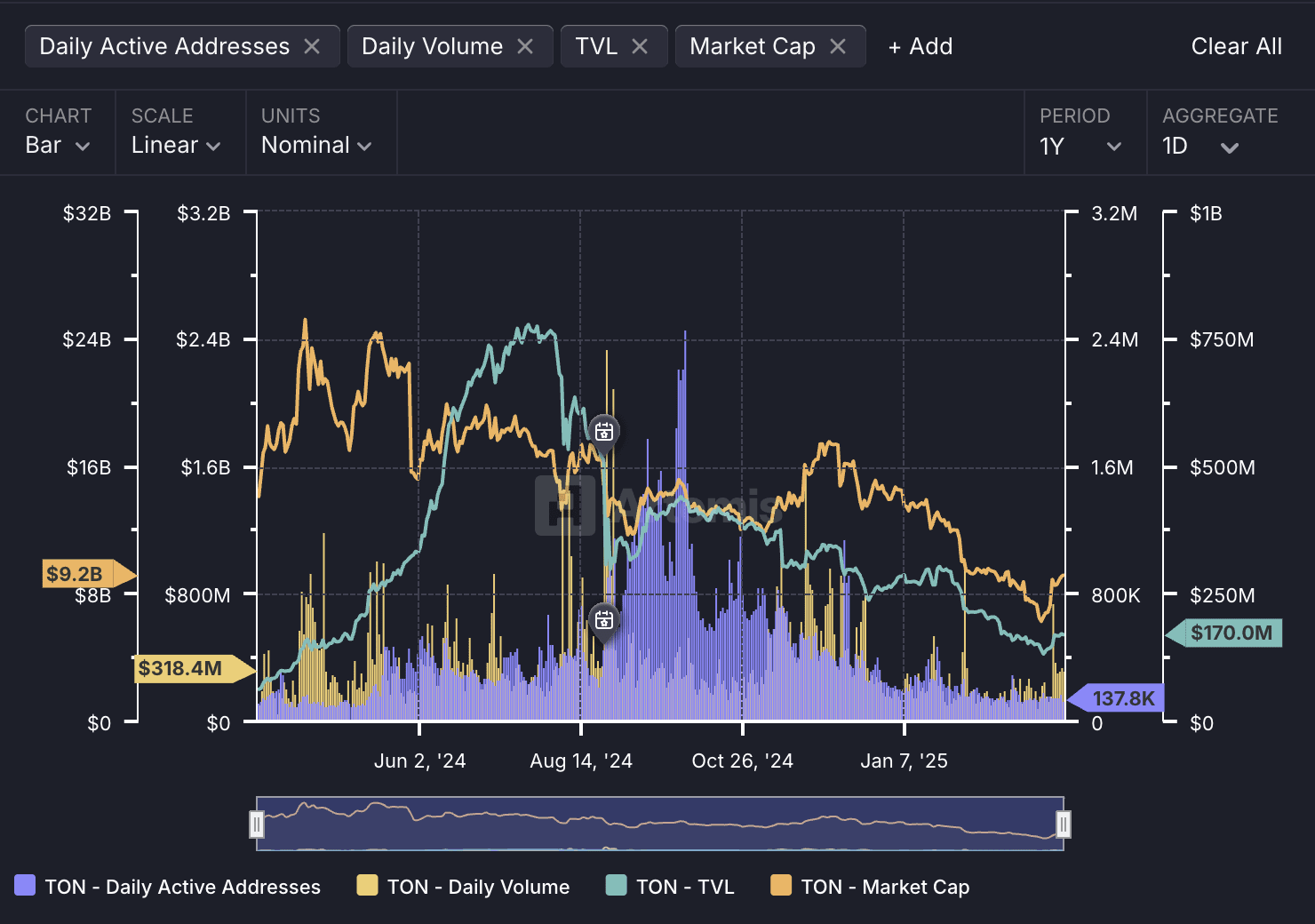
Data from Artemis indicates that over the past year, the price of the TON token has dropped over 54.8% from its peak, with its market value significantly shrinking from a high of $25.2 billion. At the same time, the total value locked (TVL) in the TON ecosystem has also experienced a major decline, plummeting from a peak of over $770 million to the current $170 million, a drop of as much as 77.9%.
The decline in on-chain activity further highlights the predicament of the TON ecosystem. Data from Artemis shows that the number of daily active addresses on TON has plummeted from a peak of 2.5 million to the current 137,000, a drop of more than 94.5%. Meanwhile, daily trading volume has decreased from a peak of $2.3 billion to the current $320 million, a decline of 86.1%. The sharp decline in these figures clearly outlines the internal economic vitality of the TON ecosystem, with user participation and trading activity significantly shrinking.
The current situation of the TON ecosystem is intertwined with multiple factors. On one hand, TON relied heavily on small programs and mini-games within the Telegram ecosystem in its early days, quickly attracting a large amount of traffic due to the massive user base of the social platform. However, this growth model based on short-term popularity has struggled to sustain after the wealth effect weakened and user novelty faded, losing its key driving force. In particular, while many users were attracted early on through mechanisms like 'Tap To Earn,' this did not effectively convert them into long-term stable ecosystem participants, leading to a rapid depletion of traffic dividends.
On the other hand, the narrative of the TON ecosystem mainly revolves around the social attributes of Telegram and mini-games. Compared to other public chains, its layout in diversified tracks such as DeFi, AI, and DePIN is obviously insufficient, with relatively weak competitiveness. From the tracking of TON's TVL distribution by DeFiLlama, it can be seen that in the past month, only the liquidity staking protocol Tonstakers has a TVL exceeding $10 million, and there are only 13 projects with TVL ranging from millions to tens of millions of dollars, highlighting the high concentration of TON ecosystem projects and its shortcomings in diversified development. Moreover, the high technical development threshold of TON, with its unique programming language and architecture design being unfriendly to developers, has resulted in slow progress in project development within the ecosystem, making it difficult to attract more quality teams, further limiting the ecosystem's diversity and innovation capacity.
In addition, the internal imbalance of resource allocation within the TON ecosystem has exacerbated its predicament. As previously mentioned, TON's market promotion and resource investment have also been concentrated on Telegram mini-games, including Catizen, Notcoin, and Hamster Kombat, which achieved great success through viral spread on Telegram during their launch. However, similar phenomena have not been successfully replicated in other tracks of TON. At the same time, due to a large concentration of resources in a few top applications, other small and medium-sized projects struggle to share user and investor attention due to lack of market exposure and narrative support. This imbalance not only leads to an overly singular development of the TON ecosystem but also weakens its risk resistance capability. Coupled with changes in the overall market environment and external competitive pressure, TON's predicament has further intensified.
In summary, whether TON can open a new growth curve depends not only on the continued empowerment of external traffic but also on achieving substantial breakthroughs in ecosystem diversification, technological innovation, and resource integration.
(The above content is excerpted and reproduced with the authorization of the partner PANews, original link)
Disclaimer: The views expressed in this article are solely those of the author and do not represent the views and positions of Block客. All content and opinions are for reference only and do not constitute investment advice. Investors should make their own decisions regarding trading, and the author and Block客 will not bear any responsibility for direct or indirect losses resulting from investor trading.
"Telegram founder regains freedom, TON announces $400 million financing, is the development dilemma turning a corner?" This article was first published on (Block客).