


Airdrops have become a cornerstone of token distribution, serving as a marketing tool, community-building mechanism, and incentive for protocol engagement. However, the model is far from perfect. While some projects have executed successful airdrops that strengthen user loyalty, others have faced backlash due to misallocations, sybil attacks, and misaligned expectations.
Binance Research’s latest report, Where Are Our Airdrops Going?, provides a deep dive into the state of airdrops in 2025, analyzing past failures, highlighting missed opportunities, and proposing solutions to ensure a more sustainable future for token distribution.
The Shift in Airdrop Strategies
As the industry matured, airdrop strategies evolved. Initially, airdrops were simple—projects would distribute tokens to early adopters with minimal requirements. Today, the landscape is divided into two primary models:
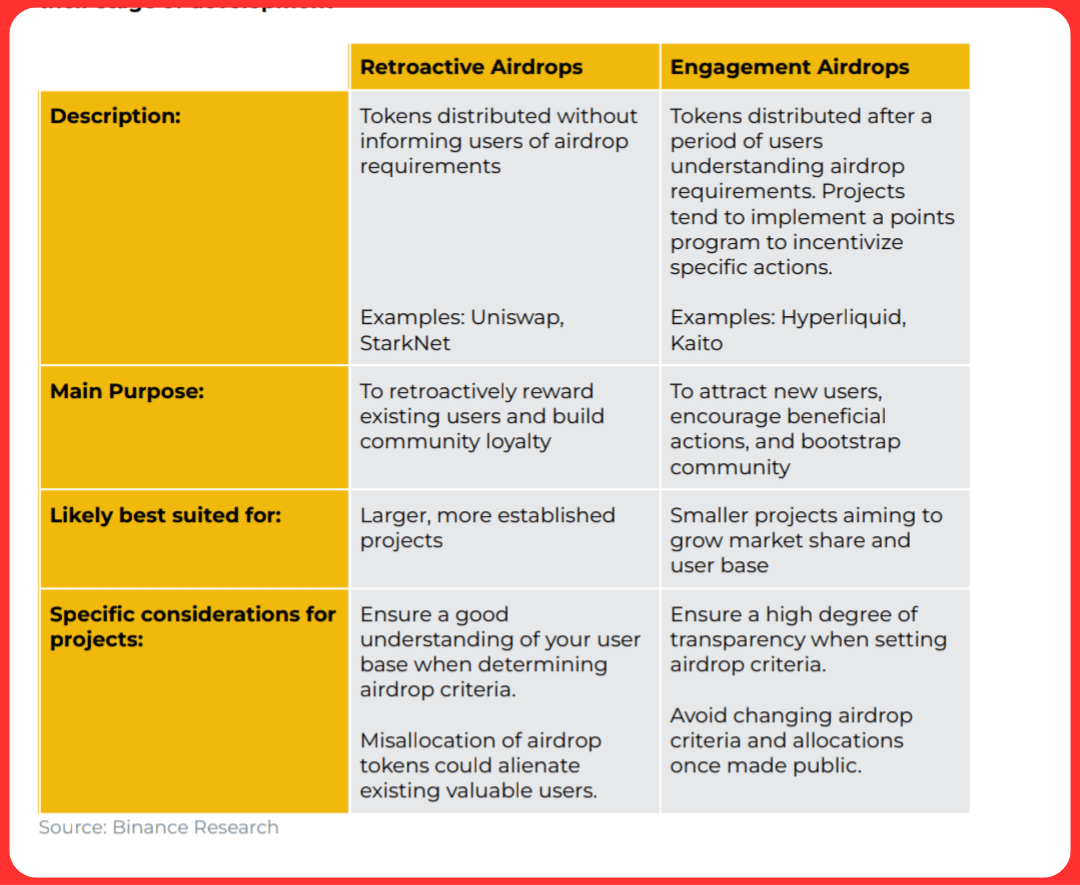
Retroactive Airdrops: Tokens are distributed based on past user activity, rewarding long-term participation without prior notification.
Engagement Airdrops: Users are given specific tasks to complete (e.g., using a testnet, staking assets, or participating in governance) to qualify for rewards.
Each approach has its merits, but both have encountered significant issues in recent years, leading to growing skepticism from the crypto community.
Key Challenges in 2025 Airdrops
1. The Rise of Sybil Farming
As token incentives grew, so did the sophistication of airdrop farming. Bots and multi-wallet strategies have plagued distributions, with sybil attackers manipulating engagement-based airdrops and draining value before genuine users can benefit. Some projects attempted to counteract this by implementing stricter verification methods, but these often resulted in unfair exclusions.
Example: Scroll’s October 2024 airdrop faced heavy criticism for failing to detect large-scale farming, leading to an outsized allocation going to a few individuals while many genuine users were left with minimal rewards.
2. Opaque Eligibility Criteria
Many projects fail to clearly communicate airdrop qualification rules, leading to user frustration and negative sentiment. When users believe they have met the criteria but are later excluded, confidence in the project diminishes.
Example: Redstone’s March 2025 airdrop saw last-minute changes in token allocation, reducing the community’s share from 9.5% to 5%. This triggered backlash, with accusations of insider favoritism and mismanagement.
3. Overweight Allocations to Insiders and VCs
A growing concern in 2025 is the high percentage of airdropped tokens allocated to teams, early investors, and influencers, leaving the actual community with a disproportionately small share. While some level of insider allocation is necessary, excessive distributions undermine the goal of decentralization.
Example: KAITO’s February 2025 airdrop allocated over 40% of its supply to insiders, leading to immediate token dumps and negative community sentiment.
4. Technical Barriers and Complex Claim Processes
Airdrop claims should be seamless, but many projects introduce technical difficulties—either intentionally (to reduce claims) or due to poor execution. Complicated processes result in lost tokens, user frustration, and lower retention rates.
Example: Magic Eden’s December 2024 airdrop required users to download a new wallet, which had several reported security concerns. This led to lower claim rates and a net negative sentiment toward the initiative.
Missed Opportunities: How Airdrops Could Be More Effective
1. More Thoughtful Distribution Models
Projects often default to either an equal distribution or a volume-based reward system, both of which have flaws. An optimized approach would incorporate a blend of:
Loyalty-weighted rewards: Prioritizing long-term users over transactional volume.
Proof-of-humanity verification: Reducing sybil activity while ensuring fair access.
Performance-based distribution: Rewarding users who provide tangible value to the ecosystem.
2. Stronger Community Involvement
Airdrop recipients should have some influence over allocation models. Projects can implement governance-based decision-making or involve the community in setting eligibility criteria. This would improve trust and ensure a fairer distribution.
3. Improved Monitoring and Anti-Farming Mechanisms
Tools like on-chain analytics, wallet behavior tracking, and sybil detection frameworks should be integrated into airdrop distribution. Some projects have successfully partnered with firms like Nansen to eliminate bot-driven claims, but broader adoption is needed.
4. Long-Term Alignment with Project Growth
Instead of treating airdrops as short-term promotional tools, projects should structure them as ongoing incentive mechanisms. Features like vesting schedules, staking multipliers, and governance participation requirements can ensure recipients remain engaged.
Future Outlook: What Comes Next for Airdrops?
Airdrops are unlikely to disappear, but their effectiveness hinges on innovation. The next wave of airdrop models will likely incorporate:
AI-powered eligibility scoring to prevent manipulation.
Hybrid on-chain/off-chain reputation systems for fairer distribution.
More integration with DeFi and staking models to reward long-term holders instead of short-term claimers.
As the industry continues refining its approach, projects must remain adaptable and transparent to maintain community trust. The lessons learned from 2025’s airdrop missteps will shape the future of token distribution, determining whether airdrops remain a valuable tool or fade into inefficiency.
This article is written and published by Binance Research. We do not hold any words or claim anything here. This is just a simple interpretation of their report on Airdrop in 2025 .