

The New York Supreme Court is set to review the lawsuit against the creators of the Libra token (LIBRA), accusing them of deceiving investors and siphoning off more than $100 million through an unfair liquidity scheme.
What began as a promising cryptocurrency project quickly turned into a financial nightmare for thousands of investors. Now, with allegations of manipulation, insider profits, and political influence, the case could set a significant precedent for how cryptocurrency projects handle investors' money. Could this lawsuit expose one of the largest cryptocurrency scams in recent years?
The lawsuit has been filed against Kelsier Ventures, KIP Protocol, and Meteora.
On March 17, Burwick Law filed a class action lawsuit against Kelsier Ventures, KIP Protocol, and Meteora, accusing them of launching LIBRA in a fraudulent manner. The lawsuit also highlights how Argentine President Javier Milei promoted the token on X (formerly Twitter) as a way to boost private sector funding in Argentina.
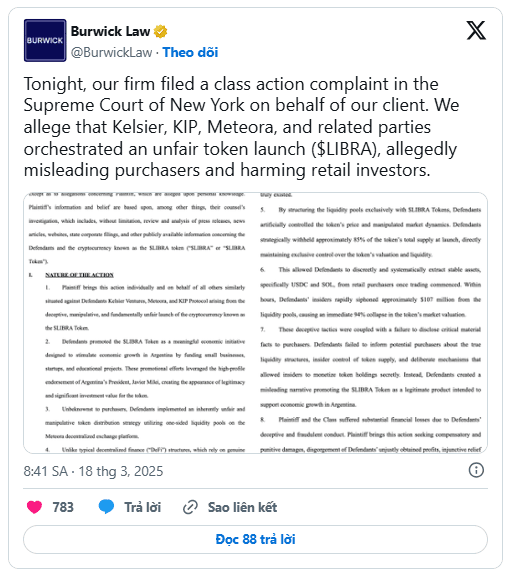
The lawsuit criticizes KIP and Meteora for using a one-sided 'predatory' liquidity pool to artificially inflate LIBRA's price. This setup allegedly allowed insiders to withdraw funds with huge profits while ordinary investors suffered losses. Within hours of launch, insiders reportedly withdrew about $107 million, causing LIBRA's value to plummet by 94%.
Is President Milei involved?
Although President Milei is mentioned in the lawsuit, he is not named as a defendant. Burwick Law argues that the companies used Milei's influence to make LIBRA appear more legitimate, misleading investors about its potential. The lawsuit also reveals that 85% of LIBRA tokens were withheld at launch, a fact not disclosed to investors.
Investors suffer significant losses while insiders profit.
Burwick is seeking financial compensation for investors, legal action against the involved companies, and measures to prevent future fraud when launching cryptocurrency tokens. According to blockchain analytics firm Nansen, 86% of the 15,430 largest LIBRA wallets have sold at a loss, totaling $251 million. Meanwhile, only 2,101 wallets were profitable, earning $180 million.
Kelsier Ventures and the company's CEO, Hayden Davis, are among the biggest beneficiaries, reportedly making about $100 million. Davis, who may now face an Interpol red notice, has denied owning or directly selling the tokens.
Milei has denied actively promoting LIBRA, claiming that he merely 'spread the word' about it. Despite the legal challenges, Argentina's opposition has failed in its attempt to impeach him over the scandal.
As the case unfolds, the cryptocurrency world is watching closely – because if the creators of LIBRA can escape punishment, who will be next?