


Overview of the Seven Major DEXs
In the past week, the survival status of decentralized exchanges has sparked widespread discussion.
Hyperliquid shook the market due to 50x leverage whale 'self-explosive arbitrage', and its HLP insurance pool suffered a loss of nearly 4 million dollars after accepting liquidation orders.
On the other hand, GMGN, which was once thriving during the Pump period, has also fallen into a serious dilemma. According to Dune's data, the platform's revenue has plummeted from 2.34 million dollars on January 19 to 74,000 dollars on March 11, a drop of nearly 97%. At the same time, high community feedback costs for KOL marketing spending, user loss, and increased competition from CEXs have raised further concerns about GMGN's future.
In this article, ChainCatcher reviews the recent earnings of seven mainstream DEXs for readers' reference.
Quick Interpretation (no nonsense, straight to the conclusion)
Jupiter and PancakeSwap still maintain high daily earnings, with stable long-term earnings performance.
Hyperliquid leads in earnings over the past 24 hours but has significantly retreated from historical highs.
Raydium and Shadow Exchange have seen a substantial decline in earnings, with market activity noticeably weakened.
Aerodrome and THENA, although experiencing significant declines, still possess certain profitability.
Below is a comparison of the earnings of several mainstream DEXs over the past 24 hours and their historical highest daily earnings:
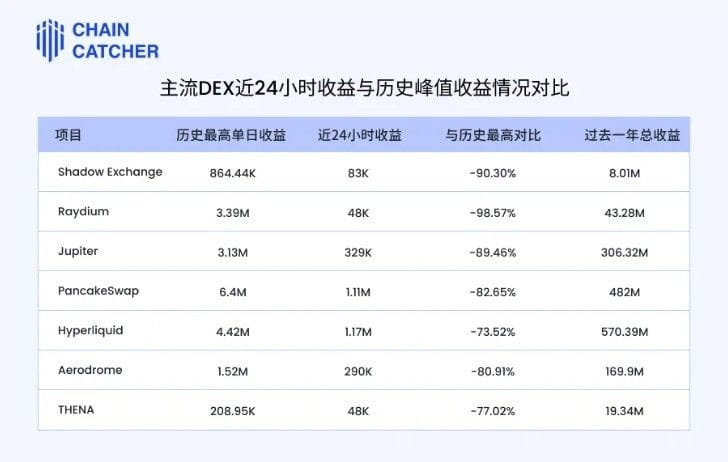 Full text data source Defillama, as of March 12
Breaking down one by one, revealing the current status and trends of mainstream DEXs.
1. Shadow Exchange
✅ Background and Positioning: A native centralized liquidity layer and exchange deployed on Sonic. Supported by the x(3,3) incentive model, the goal is to provide an efficient and low-cost trading experience.
📉 Earnings Data: Historical high of 864.44K, near 24 hours 83K, a decline of 90.30%.
📊 Market Performance: Ranked in the top ten for cryptocurrency revenue over the past 30 days, user activity remains stable. The x(3,3) mechanism improves capital utilization efficiency, and the MEV protection mechanism optimizes the trading experience, resulting in considerable earnings for liquidity providers and traders. The Gems reward system attracts deep participation from the Sonic ecosystem, promoting protocol ecological expansion and demonstrating sustained growth potential.
2. Raydium
✅ Background and Positioning: The leading AMM DEX in the Solana ecosystem, which has attracted a large user base in the past due to low transaction fees and efficient trading.
📉 Earnings Data: Historical high of 3.39M, near 24 hours only 48K, a decline of 98.57%, market activity has significantly receded. Its native token
📊 Market Performance: In Q4 2024, it once accounted for 61% of SolanaDEX trading volume, but the TVL was only 39% of Uniswap, indicating active trading but relatively insufficient liquidity. At the same time, since Raydium's trading volume is highly supported by Pump.fun, it must seek to expand its layout into new non-meme areas.
3. Jupiter
✅ Background and Positioning: The leading DEX aggregator in the Solana ecosystem, providing optimized best trading paths and is the core pillar of Solana DeFi trading volume.
📉 Earnings Data: Historical high of 3.13M, near 24 hours 329K, a decline of 89.46%, but maintains relatively high activity compared to other DEXs.
📊 Market Performance: As the DEX with the largest trading volume in the Solana ecosystem, it has high depth liquidity and cross-platform integration, resulting in low user trading costs. However, recently, it was questioned about insider trading due to the Libra incident, and no further investigation results have been released yet.
4. PancakeSwap
✅ Background and Positioning: The leading DEX in the BSC ecosystem, maintaining competitiveness with low gas fees, fast transactions, and multi-chain expansion (such as Ethereum, Arbitrum, Polygon, etc.).
📉 Earnings Data: Historical high of 6.4M, near 24 hours 1.11M, a decline of 82.65%, but still maintains relatively high profitability in the DeFi field.
📊 Market Performance: Thanks to the activity in the BSC ecosystem, PancakeSwap has a broad DeFi user base and continually expands product functions (such as NFTs, staking, etc.).
5. Hyperliquid
✅ Background and Positioning: A decentralized derivatives trading platform in the Arbitrum ecosystem, employing an active market-making mechanism, differentiating it from GMX.
📉 Earnings Data: Historical high of 4.42M, near 24 hours 1.17M, a decline of 73.52%, but still holds a dominant position in the DeFi derivatives market.
📊 Market Performance: Thanks to traders attracted by high-leverage trading, Hyperliquid maintains a lead in trading volume and profitability. However, recently, due to the impact of whale arbitrage events, users have raised doubts about its liquidity management mechanisms, leading to some capital fleeing for safety.
6. Aerodrome
✅ Background and Positioning: The core DEX of the Base ecosystem, employing the ve(3,3) economic model to incentivize liquidity providers and optimize the trading experience.
📉 Earnings Data: Historical high of 1.52M, near 24 hours 290K, a decline of 80.91%, market liquidity has decreased but still maintains a certain level of activity.
📊 Market Performance: Dominating in the Base ecosystem, benefiting from recent signs of revival in the Base chain's golden dog, the market performance is strong, with trading volume and market capitalization continuously growing, and high community participation.
7. THENA
✅ Background and Positioning: One of the DEXs in the BNB ecosystem, employing the ve(3,3) economic model, aiming to enhance the sustainability of liquidity incentives.
📉 Earnings Data: Historical high of 208.95K, near 24 hours 48K, a decline of 77.02%, although it has declined, it still has certain competitiveness in the BSC ecosystem.
📊 Market Performance: It is considered a second-tier DEX in the BSC ecosystem, facing strong competition from PancakeSwap, but its ve(3,3) model can still attract some liquidity. According to website disclosures, THENA is planning to migrate to version V3. This upgrade will introduce 'Hooks' functionality, allowing smart contracts to be deployed on specific liquidity pools to execute specific logic during user interactions. This will support advanced order types, complex applications, and customized needs, further enhancing the protocol's flexibility and functionality.
Currently, decentralized exchanges are generally experiencing a trend of declining earnings, intensified competition, and structural differentiation. The revenue of mainstream platforms has generally fallen by 70%-98% from historical peaks, significantly affecting market activity.
Jupiter and PancakeSwap continue to lead the market with high daily earnings, maintaining relatively stable long-term performance by relying on ecological layout and user base to sustain competitiveness. Hyperliquid still holds a place in the derivatives market, but concerns about its risk control capabilities arose due to whale arbitrage events, impacting capital liquidity. Raydium and Shadow Exchange saw a drastic reduction in earnings; the former was affected by a decline in Pump.fun trading volume, while the latter faced weakened overall market activity. Aerodrome and THENA still exhibit some profitability but are under pressure from stronger competitors in their respective ecosystems.
Looking ahead, DEXs still need to address three core issues:
How to maintain trading activity—market cooling, user trading willingness declining, how can DEXs enhance user stickiness?
How to optimize liquidity management—whale arbitrage, intensified CEX competition, how can platforms build a more robust liquidity system in the DeFi space?
How to achieve sustainable income—during the bear market cycle, high fee models are difficult to support long-term, do DEXs need new profit models?
In the face of industry challenges, the future survival path of DEXs may no longer just be about trading volume, but about liquidity, risk control mechanisms, and ecological layout.
This article is a collaborative reprint from: Deep Tide
More Reports
Should cryptocurrencies be taxed? What are the next legislative plans? Ge Ru Jun answers four key questions.
The U.S. Senate Banking Committee has passed the 'Stablecoin Bill'; why has this raised concerns among bankers?