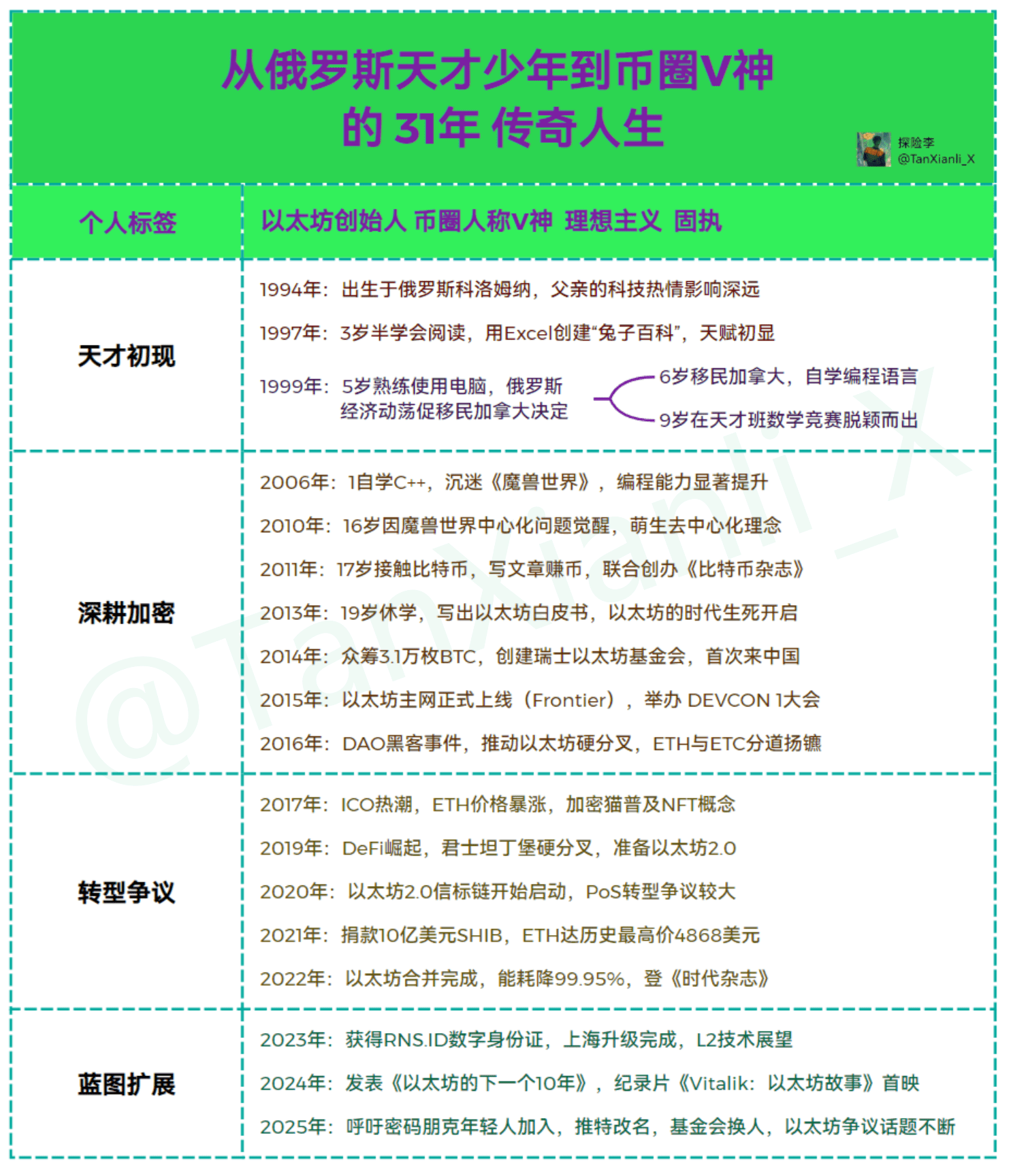
I believe you must have heard of the name Vitalik Buterin in the cryptocurrency circle. He started using computers at the age of 4, wrote the Ethereum white paper at the age of 19, created a 100 billion ecosystem at the age of 24, and donated more than 1 billion US dollars. Now at the age of 31, he is criticized for being "stubborn" and "idealistic." Some people call him "V God" and some people scold him "Little V", but can you believe that this skinny Russian boy has subverted the entire blockchain world by himself?
I spent 4 days, reading hundreds of X posts, forums, and interviews, and wrote this 13,000-word article to peel off the fog of Vitalik Buterin's "genius halo" and stubbornness. From a small Russian town to the counterattack of the Ethereum Empire, and then to the current predicament, the most exciting secrets of the cryptocurrency world are hidden here. Don't skip it, it's full of useful information, and it's detailed by year. Read it patiently, it will definitely subvert your perception of "Virgin Vitalik"! 👇
------- Start of the text ----------
1994: A talented boy started in the cold city of Kolomna
On January 31, 1994, Vitaly Dmitriyevich Buterin was born in Kolomna, an industrial town on the outskirts of Moscow, Russia, about 100 kilometers away from Moscow with a population of only 150,000. Kolomna is famous for its historic Kremlin and industrial environment, but living conditions are relatively simple. The temperature here often drops to minus 20 degrees Celsius in winter, which is bitterly cold; the summer is filled with dust emitted by factories, and life is monotonous and hard.
His father, Dmitry Buterin, is a computer scientist, and his mother, Natalia Ameline (née Chistyakova), has a background in finance. Both are intellectuals, come from middle-class families, and live on wages.
When Vitalik was born, his father Dmitry was a 21-year-old student who was passionate about technology. His parents named him "Vitaly" in the hope that he would grow up healthily. Later, his parents were busy with work, and he was often taken to the park by his grandmother, but he spent more time playing alone, as quiet as a little philosopher. His father Dmitry used an old computer to program at home, and Vitalik often sat aside and stared at the screen, showing a strong interest in numbers.
At this time, Vitalik's interest in technology had not yet emerged, but his parents' academic background and family environment had already planted the seeds for his future genius. The old TV set in his home and his father's second-hand computer became his favorite "toys" in the future, and he had no interest in playing in the mud with his peers.
In 1994, Russia was in a period of economic transformation. After the disintegration of the Soviet Union, the economy was in turmoil, the ruble depreciated, and the living standards declined. This laid the groundwork for the Vitalik family to immigrate to Canada (1999).
1997: The 3-and-a-half-year-old reading prodigy’s talent begins to emerge!
When Vitalik was 3 years old, his father Dmitry founded his first business (a financial software resale and consulting company). By the age of three and a half, Vitalik had learned to read, even faster than his father had when he was a child. His sensitivity to numbers was particularly prominent, and his family found that he could quickly add two-digit numbers in his head, for example, when others were still calculating with their fingers, he had already blurted out the answer. His mother once mentioned that Vitalik's mastery of language was slightly later than his peers, but once he spoke, the content of his expression was often beyond expectations. This characteristic of "late speech but deep thinking" became a symbol of his childhood.
When Vitalik was 4 years old, he began using Microsoft Excel to create complex tables, such as a document called the "Rabbit Encyclopedia" filled with mathematical formulas. His father recalled: "When he was 4 years old, I taught him Excel, and he learned it faster than I did, and his eyes lit up like a little alien." His mother Natalia said: "He doesn't like to talk, but when he touches numbers, his eyes light up, as if he is possessed by something."
That year, Vitalik was wrapped in a heavy blanket in the winter and endured the dust in the summer. He held his father's old computer (Commodore 64) in the shabby apartment all day, drawing flowcharts with pen and paper, which was very different from his peers' interests. While his classmates played scooters, he borrowed math books from the library, and his mother often took him to the local small bookstore to buy some children's programming books.
He wrote simple graphics programs in BASIC. His parents were amazed at his learning speed and decided to provide him with more resources. This year, his "computer" talent began to emerge, and the foundation of his technical path was quietly laid. His parents began to realize that this "quiet little weirdo" might have an extraordinary future.
1999: Mathematical genius emerges, last days before immigration!
During his last year in Kolomna, 5-year-old Vitalik became proficient in using a computer, playing simple DOS games such as Prince of Persia and trying to write small tools in BASIC.
Life was still monotonous. He and his parents lived in an old apartment, which was heated by electric heaters in winter and full of dust in summer. He became fascinated by logic puzzles. His parents bought him his first programming introductory book (Computer Basics) and took him to the local computer club to learn.
This year, the Russian economy was in turmoil and the ruble depreciated. Vitalik's father Dmitry decided to immigrate to Canada with his family to find better opportunities. The decision to immigrate opened up his international vision and laid the foundation for his future development. But at that time he did not understand that his father's move would change the trajectory of his life. With his love for computers, he was about to say goodbye to the dusty town of Kolomna.
2000: Immigration to Canada, a turning point in technological enlightenment
At the age of 6, Vitalik moved to Toronto, Canada with his father and stepmother Maya (his parents separated in the late 1990s, and his mother Natalia Ameline stayed in Russia). The family lived in a cramped little apartment and struggled to make ends meet with his father's income as a programmer.
Dmitry bought a second-hand Windows computer as a gift, and Vitalik began to learn programming, getting in touch with the Logo language and writing simple programs, such as drawing a little turtle. At the age of 6, he learned pi to six decimal places and created his own virtual universe based on the Excel program.
In 2000, Vitalik started first grade in Toronto, Canada, learning English and showing amazing learning ability. His math and science scores far exceeded his peers. In third grade, he was assigned to the gifted math class, a place designed specifically for gifted children.
The image of a thin figure wearing round-frame glasses first appeared. He was not sociable and focused on numbers and codes. His classmates remembered that he always sat alone in a corner with a notebook full of formulas. He taught himself HTML and JavaScript on a new computer, and his parents subscribed to programming magazines for him to encourage his interest.
This year, his interest in programming was officially ignited, and Canada's relaxed educational environment and abundant resources provided support for the development of his talent. He began to get in touch with the Internet and study open source code, laying the seeds for future innovation.
2003: The “weirdos” in the math gifted class
At the age of 9, Vitalik has already stood out in the gifted class at school. He performed well in math competitions and won the Canadian National Mathematics Competition Excellence Award. His teacher called him a "math genius." He also solved complex algebraic equations with pen and paper at an amazing speed. His teacher even suspected that he cheated, but after checking, he found that it was all the result of self-study. He can complete a difficult problem that takes his peers an hour in 20 minutes.
He was not sociable. When his classmates were chatting about Pokémon, he was studying algorithms. In physical education class, he was thin and ranked last in the running. His classmates joked, "Vitalik, why don't you become a computer scientist?" He replied coldly, "The body is not important, the brain is valuable."
This year, his mathematical talent was widely recognized, his lonely and "arrogant" personality began to emerge, and his technical foundation was further consolidated. He began to teach himself Python and write small tools. His parents subscribed to programming journals for him. He also participated in an off-campus programming summer camp, met his first batch of technical partners, and his interest grew day by day.
2006: The lonely 12-year-old who loves programming
This year, his classmates may still be worried about their homework, but he has long been regarded as an outlier by his teachers - a math genius. He likes the complicated multiplication tables in math class and the discussions about the mysteries of the universe in science class. After class, he would run home, turn on his father's computer, and use Excel spreadsheets to build his own little world - the digital games he called "rabbit encyclopedia" when he was a child have become more sophisticated.
At the age of 13, Vitalik has entered middle school, where he studies mathematics, physics, and computer science, and has always been ranked first. His teachers marveled at his "machine-like" thinking, and he could write complex algorithm codes in one hour and defeat all his opponents in school.
In his spare time, Vitalik is addicted to World of Warcraft. At the same time, he taught himself C++ and used it to write multiple games, including a small program that simulates the trajectory of a pinball in a room, a modified version of Space Invaders, and a medieval fantasy-themed chess game. He is addicted to these virtual worlds he created, which not only improves his programming skills, but also deepens his understanding of game design and logical thinking.
However, physical education was still his weak point. His thin body often made him lag behind in running, and the loose school uniform made him look even thinner. He liked board games and began to try vegetarianism, which he still maintains. He used an old computer to simulate game logic and study optimization algorithms. His parents bought him a new computer (Pentium 4), and he spent all day on it.
This year, programming capabilities have improved significantly, technical paths have become clearer, and the character of "pragmatism" has begun to emerge, laying the foundation for future blockchain innovation. He also participated in the International Mathematical Olympiad (IMO), and although he did not win a prize, he performed well.
2010: The Age of Rebellion and the Awakening of Decentralization
At the age of 16, Vitalik was still introverted and liked to be alone. At this time, he was deeply addicted to World of Warcraft. He worked until late at night every day and played dungeons with the warlock character. He was no different from an ordinary internet-addicted teenager. He often spent a whole day on the game until 2010, when Blizzard cancelled the life siphon skill of Vitalik's favorite character in World of Warcraft without any reason. This was a huge blow to Vitalik, and he quickly posted on the forum and even sent an email to Blizzard's engineers to ask for the restoration of life siphon. But the World of Warcraft creation team has always been tough. The direct response was, "It cannot be restored."
At this time, Vitalik immediately realized that this was not just a change of roles, but that the power of the roles was controlled by a centralized organization. He felt that this was a very horrible and unfair thing. So Vitalik deleted (World of Warcraft), but the matter did not end there.
Vitalik began to think about the logic behind this. He felt that under this centralized management, the relationship between players and game operators was unequal. Game companies could change or even shut down games at will. In this way, all the efforts of players in the game could be turned into nothing at any time and anywhere due to the wishes of the game operators. It was because of this experience that the idea of decentralization was planted in Vitalik's mind.
His parents supported him in developing more interests. Later, his interests expanded to American TV series (Friends), board games and encryption technology. His parents also bought him his first cryptography book (Cryptology and Network Security). He was thin, wore round-frame glasses, wore torn T-shirts, and lived a low-key life. His classmates thought he was like a "nerd".
In Toronto that year, Vitalik was still an inconspicuous teenager. He had never heard of Bitcoin, nor did he know what blockchain was. But in those quiet days, his heart was burning - his love for logic and his curiosity about systems. That year, he was tempered by competitions, awakened by games, and learned from books. His future, like the first snow in winter, quietly opened up a new world.
2011: Bitcoin enlightenment, blockchain youth awakening
In early 2011, 17-year-old Vitalik Buterin was introduced to the concept of Bitcoin by his father Dmitry Buterin. At first, Vitalik was not interested in Bitcoin and even thought it was doomed to fail. But three weeks later, when he heard about Bitcoin again, he decided to study it in depth, which changed the trajectory of his life. Bitcoin was launched by Satoshi Nakamoto in 2009 and began to spread in the technology circle by 2011.
Since he had no money to buy bitcoins or equipment to mine them, he began writing articles about bitcoin for an online publication called Bitcoin Weekly, paying 5 bitcoins per article (about $3.50 at the time). The quality of his articles was high, so he caught the attention of Mihai Alisie, a Romanian bitcoin enthusiast.
In September, Mihai Alisie contacted Vitalik to co-found a new Bitcoin magazine. Vitalik agreed and became the co-founder and main contributor of Bitcoin Magazine, the first serious publication dedicated to cryptocurrency, which accumulated about 1.5 million readers until it was acquired in 2015.
Vitalik became more and more active in the Bitcoin community, and his articles and opinions received widespread attention. He began to communicate with Bitcoin developers and enthusiasts around the world, which laid the foundation for his later creation of Ethereum.
2012: Bitcoin and blockchain fall in love
In September, Vitalik was admitted to the University of Waterloo in Canada to study computer science. During his university years, he worked as a research assistant for the famous cryptographer Ian Goldberg. He also won a bronze medal in the International Olympiad in Informatics held in Italy.
Vitalik continues to deepen operations at Bitcoin Magazine, writing in-depth articles such as The Future of Bitcoin: The Decentralized Economy, participating in global Bitcoin conferences such as the San Jose Bitcoin Conference, and meeting key industry figures such as Hal Finney and Gavin Andresen, early supporters of Satoshi Nakamoto.
Through the media, he discovered that so many people were interested in Bitcoin, blockchain, and cryptocurrency. This is a field with unlimited potential, a model that is different from the current Internet. As a result, Vitalik completely became a Bitcoin believer and decided to work hard for it.
At this time, his community influence expanded, he discussed the limitations of BTC with developers, and came up with expansion ideas, laying the foundation for Ethereum. His thin figure frequently appeared at meetings, wearing round-frame glasses and a 20-dollar T-shirt, low-key but full of energy.
2013: Wrote Ethereum white paper at age 19, a shining example of genius
Bitcoin is also very popular in the United States. Vitalik's Bitcoin magazine also held an exhibition in California. This exhibition allowed Vitalik to experience not only the activeness of the online community, but also the strong interest of offline people in Bitcoin and blockchain.
In the middle of the year, Vitalik decided to take a six-month break from college and travel around the world, visiting all the Bitcoin communities he could find to see what everyone was doing. While traveling in Israel, Vitalik met two digital encryption companies that were trying to develop a set of Bitcoin-based smart contracts to issue their own tokens and run financial contracts.
Vitalik immediately became interested. As one of the developers of Bitcoin 2.0, he immediately proposed a new idea to the Mastercoin community, which was studying the scalability of Bitcoin: "Develop a smart contract platform for Bitcoin, allowing users to quickly and easily write scripts and create their own applications based on Bitcoin." However, because all the improved technologies of Bitcoin at the time centered around payment and security attributes, Vitalik's proposal was quickly rejected, so he decided to start over.
At the end of November, Vitalik began sharing a white paper he wrote, an email titled "Introducing Ethereum: A Universal Smart Contract/DAC Platform," in which he elaborated on the shortcomings of the Bitcoin system and the ideas behind his new project: a Turing-complete, programmable, universal blockchain based on smart contracts, making it the ultimate platform for decentralized applications. In the white paper, Vitalik named his project Ethereum.
The name Ethereum comes from a subject called the Ether conjecture by scientists in the 19th century, which was a once-hypothesized medium for the propagation of electromagnetic waves. V God simply borrowed this name and started the Ethereum project.
At first, Vitalik only sent the white paper to a few of his closest friends. After reading it, they found it very interesting and sent it to other community members. In this way, Vitalik’s idea about Ethereum quickly became popular in the Bitcoin community. Many people were excited about this avant-garde idea and came to Vitalik to discuss it in person. The most active one among them was Gavin Wood, the founder of Polkadot.
This milestone marked the official launch of the Ethereum project and laid the foundation for his future achievements
Ethereum Chinese name episode:
In 2015, Cancer and Guru worked together to translate the Ethereum white paper, allowing the Chinese Internet to recognize the vision of this smart contract network for the first time. In the end, Cancer decided to translate Ethereum as: Ethereum, Ether is ether, and the root word eum means factory.
2014: Crowdfunding of 31,000 $BTC, Ethereum set sail
In January, the Ethereum project was publicly announced to be launched. The core team consisted of Vitalik Buterin, Mihai Alisie, Anthony Di Iorio, Charles Hoskinson, Joe Lubin and Gavin Wood, but the initial funding for development was only a portion of Vitalik Buterin’s original royalties.
Coincidentally, due to his outstanding contribution to the development of Bitcoin 2.0, Vitalik received a $100,000 Thiel Scholarship from Peter Thiel, the founder of Paypal and an early investor in Facebook. After receiving the money, Vitalik did not stop for a minute and began to work full-time with Gavin Wood on the development of Ethereum.
In February, Vitalik first announced the Ethereum project at the Bitcoin Miami Conference. In April of the same year, Gavin Wood published the Ethereum Yellow Paper, which elaborated on the EVM technical description and became the technical bible of Ethereum. According to the specific instructions in the Yellow Paper, Ethereum is compatible with seven programming languages, including C++, Go, Python, and Java, making Ethereum more optimized in development and programming.
Vitalik was just a pure programmer at the time. He was humble, answered questions, exchanged experiences and code techniques with everyone, and sometimes spoke very fast about ideas that others couldn't understand. He was even called a liar during the free exchange after the Bitcoin event. When it comes to Ethereum, no one here believes him.
In the end, he decided to bring his unproven and undeveloped public chain to China to test the waters. He felt that there were many Bitcoin supporters and enthusiasts in China, and he believed that he could raise funds here.
In May, the Bitcoin Mining Machine Conference organized by Bao Erye Guo Hongcai was held in Shenzhen. Zhang Nangeng, Li Lin, Xu Mingxing, Xie Jian and other industry leaders were present. The atmosphere of the conference was very lively and the entire market was full of vitality. At this time, the mainstream voice in the Chinese crypto market was Bitcoin mining and trading. There was no knowledge of the newly arrived Ethereum. Many people even suspected that Ethereum was a project started by Hangzhou people and Vitalik Buterin was an actor they hired.
Vitalik stayed in China for a total of 3 weeks during his first visit to explore the upcoming pre-sale of Ethereum. His first stop was to visit Huobi’s Du Jun, introducing him to the goals and concepts of Ethereum, hoping to get funding from Du Jun, but he was kicked out as a scammer.
At a blockchain community event in Shanghai, Vitalik gave a speech on the theme of the opportunities of the second-generation digital cryptocurrency to Da Hongfei, Chu Xiahu, Xu Yiji and other bigwigs who were sitting in the audience for more than an hour. As a result, half of the bigwigs were drowsy, and the other half were busy trading. They gave roughly the same conclusion to the 19-year-old youth in front of them: this kid is a liar, just to make money. When taking a group photo, Vitalik was not only squeezed to the last row, but also half of his face was covered.
Finally, under heavy pressure, in order to obtain development funds, Vitalik decided to raise funds through ICO, exchange Bitcoin for Ethereum, and established the Swiss Ethereum Foundation. Starting from July 22, Ethereum conducted a 42-day crowdfunding, with the price initially set at a discounted price of 2000 ETH per BTC, and it would remain at this level for 14 days, and then linearly drop to the final price of 1337 ETH per BTC. In the end, a total of 31,531 BTC (worth about 18.43 million US dollars at the time) was raised.
In July, Vitalik founded the Swiss Ethereum Foundation, a non-profit organization responsible for overseeing the development of Ethereum open source software. POC5 was also released, and the money from the ICO was placed in the Ethereum Foundation, becoming an important source of funds for Ethereum, thus establishing Ethereum as the second largest cryptocurrency by market value.
This year, with the support of funds, Ethereum developed rapidly, released POC6, the team began to take shape, the technology took the first step, and the industry status began to emerge. In November, Ethereum also held its first small developer conference (DEVCON 0) in Berlin.
2015: Mainnet launch, the beginning of Frontier
In May, Ethereum released its last test network (POC9), codenamed Olympic. In order to better test the network, members who participated in the test network during the Olympic phase will receive Ethereum rewards from the team.
After nearly two months of rigorous testing, the team released the official Ethereum network in late July, which also marked the official operation of the Ethereum blockchain. The release of Ethereum is divided into four stages, namely Frontier, Homestead, Metropolis and Serenity. In the first three stages, the Ethereum consensus algorithm adopts the Proof of Work (POW) mechanism, and in the fourth stage it will switch to the Proof of Stake (POS) mechanism.
On July 30, Ethereum released the Frontier phase. Frontier is the initial version of Ethereum, tailored for developers and using a proof-of-work mechanism with a gas limit of 5,000 gas per block. It is not a fully reliable and secure network at this time. Frontier is a blank slate of the Ethereum network: an interface for mining and a way to upload and execute contracts. With the release of Frontier, Ether also began to be traded on exchanges around the world.
The primary version of the Ethereum network was not secure, so Vitalik started giving speeches around the world, inviting Ethereum enthusiasts to contribute code and calling on miners to join the network to improve security and earn Ether. With Vitalik's efforts, the Ethereum community began to become active. Early Ethereum was very easy to mine, and some Internet cafe owners used idle equipment to mine Ethereum, and some of them accumulated tens of thousands of ETH.
In September, Ethereum Thawing Frontier was released. The Thawing Frontier fork occurred at block height 200,000, which lifted the 5,000 Gas limit per block and set the default Gas price to 51 Gwei.
From November 9 to 13, Ethereum held a five-day developer conference (DEVCON 1) in London, attracting more than 300 developers from all over the world. But behind the glory, problems have never disappeared. What Vitalik faces is not only the impetuousness and desire of the industry as a whole, but also the crisis of Ethereum itself.
The main difference between Ethereum and Bitcoin lies in Ethereum's unique smart contract. This attempt to become a digital, fully transparent, decentralized contract intermediary has encountered problems such as network congestion, slow transactions, and excessively high fees after the advent of the blockchain 3.0 era.
In addition, Ethereum's smart contracts are very versatile and malleable. Any user can customize their own smart contracts according to their needs. And this smart contract can also be used in other cryptocurrencies. These are the advantages of Ethereum, but they also bring security risks to Ethereum.
There was an episode this year:
In May 2015, after the Ethereum main chain was launched, the foundation had almost no funds. Vitalik said that they were almost out of cash, and even Bitcoin was almost gone, so they needed to sell Ethereum to support developers. Xiao Feng from Wanxiang bought 410,000 Ethereum at a price of $1.2, and spent a total of $500,000 to support our foundation. This matter was very important to the Ethereum Foundation and saved the foundation's life. For Wanxiang, it was also a very good investment.
2016: The DAO hack, the crossroads of hard fork
On March 14, Ethereum released the Homestead phase. Compared with the Frontier phase, the Homestead phase has no obvious technical milestones, but it only shows that the Ethereum network has been running smoothly and is no longer an unsafe and unreliable network. In this phase, Ethereum provides a graphical wallet, and the usability is greatly improved. Ethereum is no longer exclusive to developers, and ordinary users can also easily experience and use Ethereum.
In May, Ethereum's decentralized organization The Dao set a crowdfunding record of $150 million. The DAO is a decentralized autonomous organization created by developers who maintain the Ethereum community and the Ethereum protocol. The Dao is not controlled by any organization, so it has been targeted by hackers.
On June 17, hackers found a code vulnerability in The Dao and quickly organized an attack, eventually stealing more than 3.7 million Ethereum, about 60 million US dollars, accounting for about 14% of the circulating ETH. When the news came out, the price of Ethereum fell, directly causing the market value to evaporate by 500 million US dollars.
This incident triggered a heated debate within the community. Thanks to the fact that the contract did not allow users to withdraw their own Ethereum, the team had time to formulate countermeasures. After a brief discussion, the team came up with two options: shut down The DAO, and everyone including the hacker would bear the loss, or roll back the block through a fork to compensate the DAO investors.
Less than a year after the mainnet was launched, affected by the DAO incident, in order to recover funds and push for a hard fork, Vitalik finally decided to let everyone choose freely. Those who insisted that the blockchain could not be changed stayed to maintain and manage the original Ethereum, while those who agreed with him accepted the fork and modified the current Ethereum security vulnerabilities.
A few days later, the hard fork plan was announced, and more than 85% of the miners’ computing power supported the hard fork. On July 20, Ethereum implemented a hard fork at block height 1,920,000. The new chain retained the name ETH, and the original chain became Ethereum Classic (ETC), two independent blockchains.
Later facts proved that the fork did not kill Ethereum. After the fork, the Ethereum community regrouped and quickly got back on track. But those who questioned the fork were not wrong. This fork did buy another time bomb on the development of Ethereum.
In September, the third Ethereum Developer Conference (DEVCON 2) was held in Shanghai. The conference was directly sponsored by Microsoft and mainly discussed some upgrades and updates to the network in March, including smart contracts that allow developers to freely create dApps on Ethereum, and the new token standard that later had a far-reaching impact - ERC20.
The arrival of ERC20 has greatly facilitated the issuance of coins and financing for blockchain teams, and the huge potential it contains far exceeds the expectations of the developers attending this conference.
2017: ICO boom and controversy, ETH price surges and plummets
Initial coin offerings (ICOs) have become a very popular way to raise funds. A large number of projects use Ethereum smart contracts to create and sell their own tokens, raising more than $5 billion (such as Bancor and Status). Vitalik called for regulation at this time, warning of bubble risks, and the price of ETH rose from $8 at the beginning of the year to about $700 at the end of the year (On January 14, 2018, Ethereum reached an all-time high of $1,418, with a daily trading volume of nearly $10 billion and a market value of $135 billion.)
On March 1, the Enterprise Ethereum Alliance (EEA) was announced to create enterprise-level blockchain solutions and jointly develop industry standards. The establishment of EEA marks Ethereum's increased investment in blockchain scalability, security and privacy issues, and its focus on project deployment for enterprise applications.
On May 19, the price of Ethereum surpassed the $100 mark for the first time, and in June, Ethereum surpassed the $400 mark with the support of Russia as a surge in upward energy emerged.
Vitalik was named one of the 100 most influential people by Time. Later, he wore a traditional hat and traveled to Shanghai, China. He spoke fluent Chinese and the community called him "V God". However, 90% of ICOs are worthless coins. After losing a lot of money, retail investors complained: "V God, you built a casino!" He argued: "I only provided the tools, why blame me?" He was under great pressure and gave speeches around the world. His thin body (only 58 kg) was even more exhausted.
On July 19, a vulnerability was discovered in Parity wallet version 1.5 or higher, and hackers stole about 153,000 ethers, causing a loss of about $30.6 million. On November 6, because Parity developers did not initialize the library contract, a user triggered a vulnerability and destroyed the contract, which again caused the multi-signature wallet of about 513,800 ethers (worth about $154 million) to be frozen.
On October 16, the first part of Ethereum's third phase Metropolis, Byzantium, was launched. The Byzantium hard fork reduced the block mining reward from 5 ETH to 3 ETH, postponed the difficulty bomb for one year, added the ability to call other contracts without changing the state, and added certain encryption methods to achieve second-layer network expansion.
In November, the fourth Ethereum Developer Conference (DEVCON 3) was held in Mexico, attracting more than 2,200 developers from all over the world. Vitalik announced that the scalability of the Ethereum network would be solved through solutions such as "sharding".
On November 28, CryptoKitties, a cat-raising game based on Ethereum developed by Canadian startup Axiom Zen, became popular and quickly occupied 20% of Ethereum transaction traffic, becoming the most popular application on Ethereum, which also led to transaction congestion and rising fees. CryptoKitties is not only the first large-scale blockchain game on Ethereum, but also made a huge contribution to the popularization of the concept of NFT (non-fungible tokens) in the mainstream.
Although ICO is controversial, it has given many people a deeper understanding of smart contracts. Ethereum users have also experienced explosive growth, with the number of addresses increasing from 1 million at the beginning of the year to 18 million at the end of the year. Vitalik has also been promoted from a small V to a V God, and is often invited to participate in various domestic conferences, roundtables and AMAs.
2019: Gas fee crisis and upgrade, the rise of DeFi
On February 28, Ethereum implemented the Constantinople hard fork at block height 7,280,000. This upgrade includes multiple Ethereum Improvement Proposals (EIPs), such as EIP 1234, which reduces the block reward from 3 ETH to 2 ETH. This development is called "The Thirdening" (Ethereum's third block reward halving)
After the Constantinople upgrade was successful, the team continued to work on Serenity, which is today’s Ethereum 2.0. As before, it will be divided into two steps: Istanbul (which is also included in the three phases of Metropolis) and Ethereum 1.X. The Istanbul hard fork was successfully completed on December 8. The keywords of this upgrade are cost and speed, which reduces the gas cost and increases the TPS limit to 3,000.
On October 8, Vitalik attended the Ethereum Developer Conference (Devcon 5) held in Osaka, Japan, which is the annual event of the Ethereum community. He delivered a keynote speech, detailing the progress of Ethereum 2.0, including the implementation plan of the beacon chain, sharding and PoS, and discussed the technical roadmap with developers.
Vitalik led the transition of Ethereum to version 2.0, with the core goal of moving from proof of work (PoW) to proof of stake (PoS), and introducing sharding to improve network throughput. The Beacon Chain testnet of Ethereum 2.0 was launched, which is the core component of the PoS mechanism. He coordinated the research team through the Ethereum Foundation to promote the development and debugging of the testnet in preparation for its launch in 2020.
This year, DeFi promoted the ecosystem and Uniswap changed the on-chain transaction method, but the gas fee issue caused controversy and the need for Ethereum 2.0 upgrade was urgent.
2020: Transformation and upgrading, opening the 2.0 era
This year, the world has changed, the epidemic has locked down the city, but Vitalik has not stopped
In February, Vitalik gave a speech at the ETHDenver 2020 conference in Colorado. He discussed the development of decentralized finance (DeFi) and expressed optimism about the progress of Ethereum 2.0, saying that it has "progressed rapidly and steadily in the past few months." The Grey Glacier network upgrade on June 30 postponed the difficulty bomb by three months, and staking was introduced to the Ethereum ecosystem on October 14.
On December 1, the Beacon Chain, the 0th phase of Ethereum 2.0, was officially launched. This marks the transition of Ethereum from the Proof of Work (PoW) to the Proof of Stake (PoS) consensus mechanism. The launch of the Beacon Chain lays the foundation for future shard chains and higher transaction processing capabilities.
Vitalik emphasized in 2020 that Ethereum research and development will continue despite the challenges. He mentioned that future changes will address the issues noted at the time and updated Ethereum's roadmap, showing progress in research on data sharding and light clients.
2021: Ethereum reaches all-time high
Ethereum has undergone four major upgrades in 21 years, namely: the Berlin upgrade on April 15, the London upgrade on August 5, the Altair upgrade on October 27, and the Arrow River upgrade on December 9. If you are interested, please search for it yourself or send me a private message.
In May, Vitalik donated $SHIB tokens worth about $1 billion to the Indian COVID-19 Relief Fund, the largest single charitable donation in the history of cryptocurrency, and donated $ELON worth $336 million to the Methuselah Foundation for research on extending human life. This move caused the price of $ELON to plummet by 70%. V God also donated about $441 million of $AKITA tokens to Gitcoin, a public fundraising platform based on Ethereum. On May 17, V God destroyed 45% of SHIB coins.
On September 29, Vitalik Buterin gave a speech titled “A Blind-Box Talk on Blockchain – Heard from Vitalik Buterin” at the Nanyang Technological University’s Distinguished Speaker Series in Singapore. He discussed the current state of blockchain and its applications in areas such as DeFi, NFT, ENS, and DAO, and introduced Ethereum’s efforts to solve existing problems.
Ethereum fluctuated greatly throughout 2021, from a low of $915 on January 11 to an all-time high of $4,868 on November 10, a price that has not been broken as of today, March 6, 2025!
2022: Ethereum 2.0 and merger, the lowest price in 4 years
On February 24, after Russia invaded Ukraine, Vitalik immediately expressed support for Ukraine and raised millions of dollars in cryptocurrency for Ukraine through donations and visits, reinforcing the concept of ‘crypto charity’.
In March, Vitalik Buterin appeared on the cover of Time Magazine. On March 23, Time Magazine will release a decentralized magazine with Vitalik Buterin on the cover in the form of NFT. By the end of the month, the NFT was released and listed on OpenSea, with a floor price of around 0.23 ETH.
In June, Vitalik wrote a post explaining why his Twitter name was changed to "豚林vitalik.eth". Vitalik said, please do not use your real name to refer to your passport name, your government has no right to define who you really are. If you use a different name in most daily interactions, that is your real name. In August, the first anniversary of the Ethereum London upgrade, more than 2.57 million Ethereums were destroyed, but Gas did not decrease but increased, and even a series of Gas Wars broke out.
In September, Vitalik's new book (Proof of Stake) was published. In the same month, he also published a post saying that we have finally confirmed that the Ethereum merger has been completed. This is an important moment for the Ethereum ecosystem. Everyone who helped make the merger happen should be very proud today. Promote the transformation of Ethereum POW to POS. After the transformation and merger, the energy consumption of Ethereum will be reduced by about 99.95% (from 112 TWh/year to 0.01 TWh/year).
On October 11, the sixth Ethereum Developer Conference (Devcon 6) was held in Bogota, Colombia. This was the first offline Devcon event since 2019, attracting more than 1,200 speaker applications from around the world, and 60,000 people watched the live broadcast in 4 days. Vitalik Buterin shared his views on the future development of Ethereum at Devcon VI.
At the end of December, Vitalik wrote that some smart people told me that Solana is a serious and smart development community. Now those opportunists have been washed away, and the Solana chain will have a bright future. It is difficult for me to judge from the outside, and I hope the community has a fair chance to thrive. He then elaborated on the expanded definition of the beautiful vision of cryptocurrency: including improved expansion, privacy, UX and encrypted social networking.
The price of Ethereum in 2022 fell to the lowest price in nearly 4 years, $882, but I believe that Ethereum will reach $8,000 this year!
2023: Digital identity and the development of Layer 2
On January 5, Vitalik Buterin obtained the RNS.ID digital ID card from the Republic of Palau.
On March 15, Vitalik Buterin pushed Ethereum to complete the Shanghai upgrade, which was a major update following the 2022 merger. The Shanghai upgrade was completed on April 13 (carried out when Epoch was 194048), with a block height of 6209536. The current Ethereum staked volume is approximately 18.15 million, with a stake rate of 15.07%, and an annualized staked return of approximately 3.76%.
In May, Vitalik gave a keynote speech at the EDCON 2023 conference in Podgorica, Montenegro, discussing three technical challenges of Ethereum: scalability, privacy, and user security. He reviewed the development of Ethereum and looked forward to its future development. He mentioned that through L2 technology, Ethereum will be able to achieve a transaction processing capacity of more than 100,000 transactions per second, and expressed confidence in the future development of Ethereum on many occasions.
In June, Elon Musk followed Vitalik Buterin’s Twitter account, and Vitalik Buterin also said that Ethereum’s real competition is not other chains, but the rapidly expanding centralized world.
In September, Vitalik said at the Permissionless conference that encryption-based social solutions have the potential to be more decentralized, private, and secure than the current Web2 environment. He cited building blocks such as ENS, PoH proof, POAP, and envisioned a gradual process that allows new Web3 users to create an Ethereum address, initially controlled by services such as Gmail, but using account abstraction to allow people to gain ownership when they are ready to use more crypto-native methods.
At the end of December, Vitalik Buterin updated the Ethereum roadmap for 2024, which mainly includes six parts: The Merge, The Surge, The Scourge, The Verge, The Purge, and The Splurge. He also emphasized that the role of Ethereum single slot implementation in the post-merger PoS improvement is being consolidated, and it is the simplest way to solve the many current weaknesses of Ethereum PoS design.
Vitalik is still single and low-key in 2023. He doesn't like to be surrounded by people and rarely attends social events. His clothes and outfits are still simple, usually a Dell computer and a khaki canvas bag with cat patterns.
2024: Release of new journey for the next 10 years
V God published an article (My Technological Optimism) in early 2024. In February, he gave a speech at the Decentralized AGI Summit in Denver to discuss the combination of AI and blockchain. In April, he also gave a speech at the Hong Kong Web3 Carnival and said that compared with 5 years ago, Ethereum's ability to support mainstream large-scale applications has been greatly enhanced; large-scale applications should be built on (or built into) L2 and use the latest technology; developers' main choices should consider ease of development, performance, interoperability, and security; different applications have different choices.
In July, Vitalik Buterin delivered a keynote speech (The Next 10 Years of Ethereum) at the Ethereum Developer Community Conference EDCON 2024, saying that in the next 10 years, we can do more, and using Ethereum L2 will become as smooth as using the Ethereum mainnet directly.
However, since 2015, about 422,000 ETH (worth $1.04 billion as of September 1, 2024) has flowed out of Vitalik’s Ethereum address. In the past two years, more than 840,000 ETH has flowed out of this address.
In September, the documentary (Vitalik: The Ethereum Story) premiered worldwide and is scheduled to be broadcast on major streaming platforms in 2025. The documentary records the story of Vitalik and the Ethereum developer community's struggle for an open Internet, including interviews with Vitalik, his parents, and other artists and technical experts such as Dmitry Buterin, Danny Ryan, Itzel Yard, and Tim O'Reilly. Vitalik then left a message on a photo of the two of them posted by singer JJ Lin: I believe that one day of love is worth forever. Time was frozen at this moment.
In early October, Vitalik said that any tokens sent to me would be donated to charity, and then the#Memecoinsent by the wallet project was exchanged for ETH. Among them, 8 MEMEs such as MSTR, Milo, and POPCAT sold more than 650 $ETH, worth more than 1.7 million US dollars, and there were 11.76 billion MOODENG donated by MoodengCTOETH, and 7.8 million DEGEN
On October 17, the "10th Blockchain Global Summit" hosted by Wanxiang Blockchain Lab was officially held. In his speech, Vitalik reviewed the development path of Ethereum and looked forward to the future. "In the future, Ethereum can reach more than 100,000 TPS through L2, and any transfer from Ethereum chain to other chains can be realized within 2 seconds, and even form a unified user experience. In addition, Ethereum's infrastructure is also expanding, and secure links are more important than EVM.
In December, Vitalik posted that he was very happy to be Moo Deng's adoptive father. In the next two years, she will grow up and I will donate 10 million Thai baht (about 290,000 US dollars) to support her. Maybe more, because I have set aside 88 ETH for Moo Deng and its relatives. May they live long and prosperously.
2025: The most controversial year
In January, Vitalik Buterin published an article titled (d/acc: One Year Later), reviewing the progress of his proposal of “decentralized and democratic differentiated defensive acceleration” a year ago, and further expounding on the connotation, challenges and future development direction of the concept.
In February, when responding to questions related to ETH 3.0, Vitalik Buterin said that there is no ETH 3.0. Some people would say that Justin Drake’s five-year plan is it, but that plan is only the consensus layer, not the execution layer, so it is only part of the future of the Ethereum blockchain. The relationship and balance between L1 and L2 is an execution layer issue.
In mid-February, Vitalik responded that the claim that he holds 3/5 seats on the Ethereum Foundation board is not accurate. He clarified that he has only held one seat on the three-member board since 2017.
At the end of February, Vitalik said that many users' crypto asset losses were not caused by theft, but by software vulnerabilities, forgotten passwords, lost devices, accidental damage to paper wallets, etc. Because there are no attackers to hunt down, victims do not have a strong need to talk about it. And usually because victims think that no one should be blamed except themselves, they are ashamed to speak up. The security plan of crypto wallets should also consider the problem of asset loss.
In March, Vitalik said that what Ethereum needs is a large number of young people with a cypherpunk vision. All the OGs are exhausted, and now it’s up to the next generation. He also changed his Twitter avatar to a creature image from World of Warcraft, which is a revisit of his youthful hobby!
The emotional mystery of Vitalik Buterin: The love story of a lonely genius, is he destined to be single?
Vitalik’s wealth is as high as $1 billion, but when it comes to Vitalik’s personal life, the gossip of friends in the cryptocurrency circle may be disappointed. As of March 2025, he has not confirmed any relationship. He may be single now, focusing on blockchain technology and Ethereum ecosystem development.
In 2023, there were rumors that he was in a relationship with a Chinese woman in the blockchain industry, but Vitalik has never publicly confirmed any relationship. He once said that he was focused on technology and the Ethereum ecosystem. He was introverted and had poor social skills, and was considered to be "destined to be single." Some people joked that he was a "blockchain monk," while others speculated whether he was hiding a secret in his relationship.
Finally, let me end with Zhao Changpeng’s opinion on Vitalik Buterin:
Without Vitalik’s contributions, smart contracts, ERC20, NFT, SBT, L2, etc., cryptocurrency would not be what it is today!
-------- End of the full text ---------
This article is compiled based on public information and has not been reviewed by Vitalik. If there are any errors, please contact @探险李 for modification!
As a legend in the blockchain world and co-founder of Ethereum, Vitalik Buterin has already stood at the pinnacle of technological and financial innovation at the age of 31. From a small town in Russia to Canada, from a math prodigy to a billionaire, and then to the spokesperson of the "decentralized dream", his story is full of drama and inspiration!
The birth of a legend often requires the efforts of several generations. If Vitalik didn’t have such a geeky father, didn’t his father introduce Bitcoin to him, and didn’t choose the blockchain industry, his story might be completely different. As the saying goes, ‘Men are afraid of choosing the wrong career, and women are afraid of marrying the wrong man’!
Do you admire Vitalik’s genius or complain about his stubbornness? Let me know in the comments!
This article took me 4 full days to write. Please forward it to your friends in the cryptocurrency circle and unlock Vitalik’s secrets together.
Give me a like to support my hard work, and follow me, let’s unlock more legends of the big guys in the cryptocurrency circle together!