


Celebrity memecoins have recently gained popularity, with figures like Elon Musk, Donald and Melania Trump, and Javier Milei driving significant traffic to this speculative trading area. Once limited to artists and influencers, the memecoin craze has attracted the attention of political leaders.
In an interview with BeInCrypto, industry leaders from BingX, Titan, Bitget, and Trust Wallet discussed the overall appeal of memecoins, their associated risks, underlying advantages, and future prospects in the broader crypto sector.
Celebrity endorsements of memecoins
Memecoins generate great enthusiasm in the cryptocurrency market, attracting investor interest. The accessibility of memecoins for crypto and non-crypto users, combined with their simple launch process, has led to an increase in celebrity-backed tokens.
"At best, memecoins capture a unique cultural vibe and trigger contagious community virality. Celebrities amplify this effect by adding an instant dose of mainstream appeal and buzz on social media, effectively lighting a viral fuse," said Eowyn Chen, CEO of Trust Wallet.
When regulatory hurdles make it difficult to promote crypto projects, memecoins emerge as a practical marketing alternative for developers. Renowned experts, such as crypto analyst Miles Deutscher, have also spoken about the particular appeal that memecoins initially had for small retail investors.
Deutscher argued that the emergence of platforms like Pump.fun can be interpreted as a reaction to the aggressive crackdown by former SEC Chairman Gary Gensler on the crypto industry. According to him, Pump.fun was created in direct response to the increasing difficulty of launching fair projects.
To some extent, Chen agrees with this analysis.
"On one hand, strict regulations have forced many projects that could have been launched as ‘serious’ utility tokens to reinvent themselves as memecoins. These tokens offer wild and unpredictable price swings that attract speculators—so much so that exchanges rush to list them. On the other hand, memecoins capture a cultural vibe that is both rebellious and humorous," she said.
Chen also provided a historical and sociological explanation for the growing trend of memecoins.
Generational trends and the rise of memecoins
In the 1990s, playwright William Strauss and historian Neil Howe coined the term known as the Strauss-Howe hypothesis. According to this theory, the progression of human society is closely linked to generational change, exhibiting patterns that repeat every 80 to 100 years.
These cycles feature four generations competing for power, leading to a tipping point that forces substantial social and political restructuring. Inspired by this theory, author G. Michael Hopf developed a quote that represents these four cycles:
"Hard times create strong men. Strong men create good times. Good times create weak men. And weak men create hard times," the quote says.
According to Chen, we are currently in the last phase, where weak men create hard times, and we use memecoins to mock them.
"According to Strauss-Howe generational theory, we are in the 'Fourth Turning', a moment when people expect the future to be grim—think economic stagnation, imminent wars, and a general attitude of 'what's the point?'. When life feels like a constant lottery, why not bet on a coin as unpredictable as your roommate's food? Memecoins, with their irreverent humor and joke-style, allow people to laugh at the system while secretly hoping for a visionary rebirth. They are not just investments; they are a way to vent frustrations, embrace risks, and even find a bit of community spirit—all with a wink and a nod," she explained.
While these memecoins may offer relief from a grim future, the question remains whether they represent a viable long-term investment or just a passing fad.
The allure of memecoins among public figures
Several public figures have recognized the attractive prospects of memecoins. Their accessibility and ease of use attracted prominent names to launch their own tokens.
"The increase in popularity of memecoins coincides with the emergence of decentralized platforms and social media-inspired applications that make it easy for anyone with a wallet to launch a token. Celebrities have recognized this as an opportunity to monetize their audience and strengthen fan engagement," said Vivien Lin, Product Director at BingX, to BeInCrypto.
Considering that younger generations tend to use memecoins more, celebrities can use these types of token launches to engage most of their fanbases.
"Now, add a bit of celebrity gloss to the mix. When a public figure launches a memecoin, they can think in simple terms: it can connect with a young, digital-native base audience to signal that it is cool. And of course, tokens seem capable of growing at unimaginable speed and value, which drives many financial motivations behind it as well," Chen said.
In fact, the current wave of celebrity memecoins is not particularly unique. It reflects past crypto waves that used different strategies to produce similar results.
"This wave of celebrity memecoins bears similarities to previous NFT trends, where celebrities launched collections promising exclusive experiences for fans. Both trends demonstrate how celebrities leverage technology to enhance fan engagement and create new forms of connection," Lin added.
However, there is a notable difference between memecoins launched by influencers or pop artists and those launched by political leaders, especially when they are sitting presidents of a country.
Memecoins as trackers of public sentiment
When pop star Iggy Azalea launched her token MOTHER, its high point hit $136.6 million. Meanwhile, Haliey Welch's HAWK token peaked at $500 million.
However, when political figures, such as the US presidential couple and Argentine President Javier Milei, launched their memecoins, the peak market capitalization reached billions of dollars.
"These coins have been one-off events, and replicating them would be nearly impossible. The success of TRUMP was partly driven by the buzz surrounding Trump's re-election and global recognition. It is incredibly rare to see a token achieve a market capitalization over $3 billion in a single month of trading," said Lin.
The trading activity of memecoins launched by political figures can be useful to reflect broader public sentiment and alignment with the figures themselves.
"Although this kind of rapid increase is exceptional, it highlights how crypto markets can quickly reflect trends, with investors essentially ‘voting’ through their transactions. This makes crypto a valuable tool for identifying emerging social and financial sentiments," Lin explained.
On this point, Chris Chung, founder of the Solana swap platform Titan, added:
"The main driver of the current popularity of celebrity memecoins is the hype surrounding the US election. People wanted to get involved in political action, and the TRUMP and MELANIA memecoins offered an easy and quick way to do so."
However, despite initial price increases, if a solid roadmap does not accompany token launches, the prospects for long-term viability seem bleak.
A short-lived success
The rise of memecoins associated with celebrities is driven by their influence, market speculation, and cultural trends. The initial excitement generated by these coins attracts investors, and this cycle repeats as new celebrity-backed tokens emerge, attracting both initial investors and trend followers.
But, repeatedly, the success of celebrity token launches has proven to be short-lived.
"Celebrities, aware of the short-term nature of trends in today's creative economy, recognize the demand and capitalize on the opportunity by endorsing these tokens. However, the long-term success of these coins remains uncertain, as they heavily rely on continued public interest and market speculation," said Alvin Kan, Chief Operating Officer of Bitget Wallet, to BeInCrypto.
The viability of any memecoin, whether celebrity-endorsed or not, is straightforward, he said.
"There is little evidence that these coins can sustain their price or popularity over time. Typically, after a rapid appreciation, the price falls, as seen in recent launches. For these coins to evolve into more stable investments, they would need to develop stronger community engagement and broader utility. Without such developments, celebrity-backed memecoins are more likely to remain speculative and short-term," Kan said.
According to Chung, there are many examples to support this explanation.
"I think it's the same with any memecoin. You have a short-term spike, but unless it shows some benefits or strong follow-through, it will disappear. Memes that survive have a team behind them with a strong narrative. DOGE is still here because it had ongoing support and endorsement from Elon Musk. WIF is still here because it is a bit of a status symbol if you are an OG on Solana, as DOGE and SHIBA are on other networks. But PNUT, for example, fell off the radar because no one continued building the narrative behind it. It was just a short-term hype," he said.
In fact, analyzing what other memecoin projects did right can serve as indicators of what celebrity projects did wrong.
Lessons from successful projects
Dogecoin emerged as a joke in late 2013, created by Billy Markus and Jackson Palmer as a relaxed alternative to serious cryptocurrencies. Inspired by the 'Doge' meme, it quickly gained popularity. According to the official site, Dogecoin surpassed Bitcoin's transaction volume within two weeks.
After Markus and Palmer left in 2014, a core development team took responsibility for maintaining and advancing the cryptocurrency. Despite its humorous origins, Dogecoin has cultivated a substantial and dedicated community.
The success of the Shiba Inu coin mirrors that of Dogecoin. Its prominence is largely credited to its integration with internet meme culture. Viral moments, including celebrity tweets, influencer endorsements, and extensive social media campaigns, significantly boosted its popularity.
"DOGE and SHIB spent years building communities, publishing whitepapers, and contributing to philanthropic efforts like dog rescue programs, Olympic sponsorships, and clean water initiatives, once they realized their token was gaining more market share," Lin explained.
Celebrity memecoins that learned to integrate real-world utility into their products early on have also benefited from long-term success.
"Iggy Azalea's MOTHER token maintained engagement through events, giveaways, and partnerships for token holders," Lin added.
However, this was not the case for most celebrity memecoins.
"In contrast, celebrity memecoins receive an instant boost from top-down endorsements—they create quick buzz and viral hype, but often lack the deep and sustained community support necessary for long-term success. In summary, while celebrity-backed tokens capture immediate attention, lasting value comes from genuine grassroots engagement," Chen explained.
Given this reality, celebrity memecoins offer investors more risks than rewards today.
Associated risks
The main risks associated with celebrity memecoins include pump-and-dump schemes and rug pulls.
"Investing in celebrity-backed memecoins comes with a set of risks that mirror those found in the broader memecoin space, although they may sometimes be amplified by extra hype. For example, pump-and-dump schemes remain a significant danger—when a celebrity endorsement sends prices soaring based on social media buzz, the rally can quickly evaporate once the initial excitement diminishes," Chen told BeInCrypto.
When Javier Milei launched LIBRA earlier this month, insider traders were the first to buy the token when prices were still low. Within an hour of its launch, LIBRA had reached a market capitalization of over $4 billion.
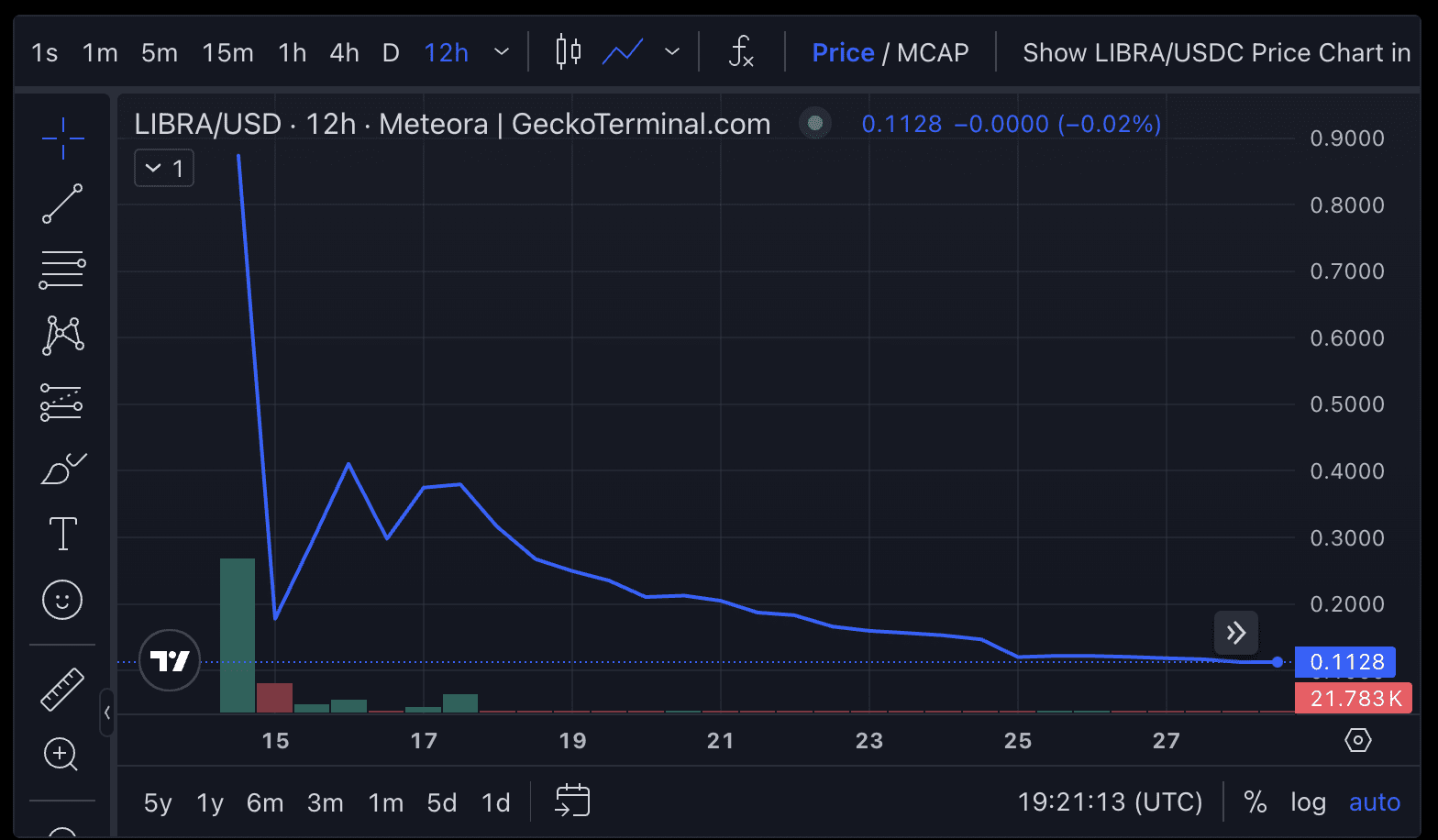 Price chart of the memecoin LIBRA. Source: GeckoTerminal.
Taking advantage of the rising prices, insiders sold off most of the token supply, causing a price drop. Meanwhile, small investors lost over $250 million. The episode serves as a key example of how these types of schemes impact inexperienced investors the most.
"Celebrity-backed memecoins follow a similar hype pattern driven by influencers seen in past cryptocurrency trends. However, the key difference lies in the target audience: earlier waves of memecoins were often promoted by crypto-native figures, such as Elon Musk or well-known developers. Today's celebrity memecoins aim to attract a broader audience that is more familiar with the celebrity endorsing the coin than with the cryptocurrency space itself," explained Kan.
Moreover, the involvement of celebrities significantly raises the stakes, as their influence generates substantial traffic, amplifying the potential for catastrophic consequences.
Legal and ethical issues
When celebrities are involved in fraudulent schemes linked to memecoins, the backlash tends to be greater. After the boom and bust of LIBRA, Milei received over 100 legal complaints in Argentina, while opposition leaders threatened to impeach him.
The launch of Haliey Welch's Hawk Tuah memecoin ended under similar circumstances. After reaching a market capitalization of half a billion dollars, the token plummeted within 20 minutes.
"The ethics of celebrity-backed financial endorsements are under intense scrutiny. Investors often do not know the true intentions of the teams behind these tokens. In the case of Haliey Welch's Hawk Tuah token, allegations of fraud and misleading practices led to the rapid collapse of the project. As Welch's fanbase was largely non-native to crypto, many investors felt deceived," commented Lin.
In response, several legal actions were taken against Welch.
"Consider the consequences of the entire Hawk Tuah fiasco. Investors filed a lawsuit against her, and there were even reports that she is being investigated by Interpol," Chung said.
In response, industry experts anticipate that regulators will increase their oversight of memecoins.
Regulation under scrutiny and investor protection
Several celebrity memecoin launches ending in chaos set important precedents for how regulators and the industry will address these issues.
"As memecoins and celebrity endorsements gain more attention, regulators are likely to intensify their scrutiny. Regulators may begin to categorize these endorsements as market manipulation or fraudulent activities, especially in light of ongoing investigations into cryptocurrency promotions and celebrities. This could result in stricter guidelines regarding disclosures and anti-fraud measures. While the regulatory landscape is still evolving, the popularity of celebrity-backed memecoins may decline if stricter regulations are imposed," Kan told BeInCrypto.
There are also measures that individual investors can take to minimize risks.
"Education is key. Before exploring any token—celebrity-backed or not—users should research its origins, tokenomics, and community involvement. If a token is heavily tied to the influence of a single person without clear utility or decentralization, it may be a red flag. It is also important to recognize that memecoins, especially those driven by celebrities, are highly speculative, and people should never invest more than they can afford to lose," Chen said.
Chang agreed with this latter point and added:
"The diversification of information is an important part of this—being more connected to Crypto Twitter can help investors stay updated on news and narratives."
Meanwhile, portfolio diversification is essential to reduce overexposure to memecoin investments.
"Diversifying investments and avoiding putting more money into these coins than one can afford to lose can help mitigate risks. Monitoring the market and staying informed about potential price changes and hype can also prevent significant losses," Kan said.
However, the responsibility for long-term viability must fall on the memecoin projects to establish robust foundations, rather than expecting investors to mitigate risks alone.
The future of celebrity memecoins
Industry experts unanimously agree that community and utility are the primary determinants for the future success of celebrity memecoins. Without them, they are doomed to fail, and small investors will suffer the most.
"Celebrity memecoins will really be like any other memecoin. If a celebrity can form a sufficient following and maintain the narrative around the memecoin, the token will survive. Otherwise, it will die like the vast majority of memecoins," Chung said.
This will determine the success or failure of the project.
"As more negative stories accumulate around the collapse of celebrity-backed coins, ethical and regulatory challenges may discourage further celebrity involvement. The future of these coins will likely depend on whether they can evolve to offer more sustainable communities and utility, or if they will remain tethered to short-term hype," Kan concluded.
In the end, only time will reveal the fate of celebrity memecoins.
The article Experts Analyze the Appeal and Risk of Celebrity Memecoins in the Crypto Market first appeared on BeInCrypto Brazil.