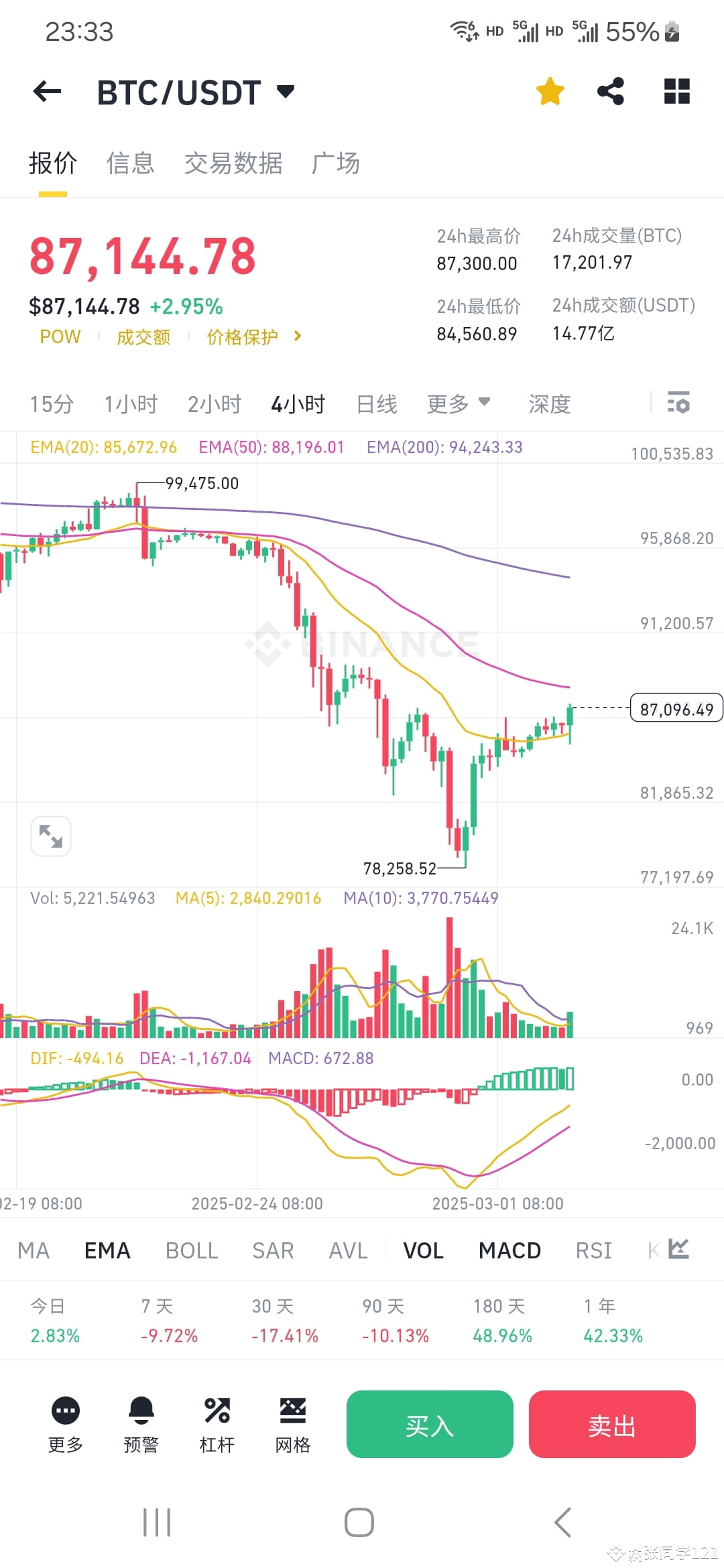
Convergence and divergence, or expansion and contraction, are unique forms of the Bollinger Bands indicator. Trends are generated at the points of convergence and end at the points of divergence. During the relatively stable adjustment phase of price fluctuations, the upper and lower bands of the Bollinger Bands are in a converging state, commonly referred to as convergence; during the relatively volatile breakout phase of price fluctuations, the upper and lower bands of the Bollinger Bands are in a diverging state, commonly referred to as divergence.
Bollinger Bands are calculated using the standard deviation, which measures price volatility, and the width reflects the degree of price fluctuation. The alternating appearance of convergence and divergence reflects a cyclical pattern of volatility.
☕
We can measure the width of the Bollinger Bands using the limit width indicator WIDTH. WIDTH is the ratio obtained by dividing the difference between the upper and lower bands (4 times the standard deviation) by the middle band. The wider the Bollinger Bands, the larger this indicator value; conversely, the narrower the Bollinger Bands, the smaller this indicator value.
$BTC
#CZ新代币模型设想
#白宫首届加密货币峰会
#芝商所将推出SOL期货
Bollinger Bands are calculated using the standard deviation, which measures price volatility, and the width reflects the degree of price fluctuation. The alternating appearance of convergence and divergence reflects a cyclical pattern of volatility.
☕
We can measure the width of the Bollinger Bands using the limit width indicator WIDTH. WIDTH is the ratio obtained by dividing the difference between the upper and lower bands (4 times the standard deviation) by the middle band. The wider the Bollinger Bands, the larger this indicator value; conversely, the narrower the Bollinger Bands, the smaller this indicator value.
$BTC
#CZ新代币模型设想
#白宫首届加密货币峰会
#芝商所将推出SOL期货