



A few recent tweets have sparked discussions in the Pi Network community about the possibility of extending the grace period for KYC verification. Some Twitter users have claimed that the deadline has been pushed back to March 14, 2025, giving Pioneers more time to complete their Mainnet checklist. But is this claim true?
A Twitter user named Dr. Nicolas Kokkalis, with about 34 thousand followers, tweeted, "Extension of the grace period! Good news, Pioneers! The grace period has been extended to March 14, 2025. You have more time to complete your Mainnet checklist and secure your Pi. Don't hesitate—act now!" Along with the tweet, he also shared an image stating the same.
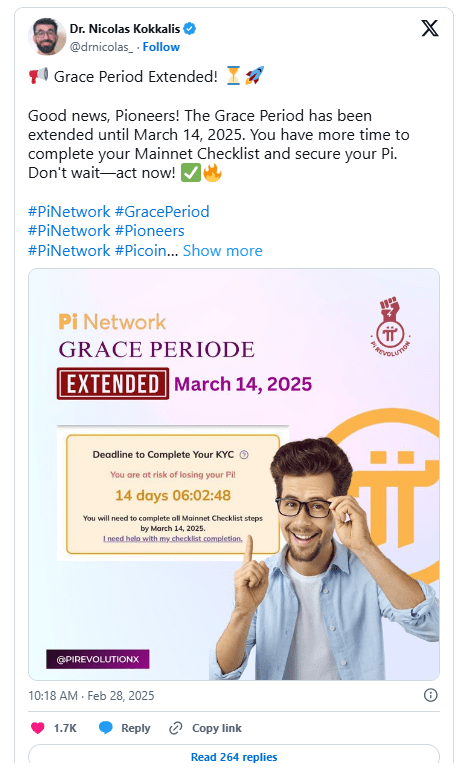
Another Twitter user, Dr. Chengdiao Fan, with about 11 thousand followers, shared something similar: "LATEST PI NEWS: The grace period of the Pi Network has now been extended to Pi Day (March 14, 2025). Pi Day marks the actual Open Mainnet launch!" He also attached an image with a 14-day countdown.
At first glance, this seems like great news for Pi users who have not yet completed KYC. But is it true?
Upon closer inspection, the images in these tweets raise some doubts. The images seem slightly off as if they have been altered or distorted. Additionally, when cross-referenced with official sources, there is no mention of any such extension.
For those who don't know, KYC (Know Your Customer) is an important process in Pi Network to ensure that all users are real people and not fake or duplicate accounts. Completing KYC is necessary to access and transfer Pi on the Mainnet, which is officially launching on February 20, 2025.
Even a quick Google search still shows February 28 as the deadline, with no updated information about any extension. This makes the circulating tweets seem suspicious. Just because someone with a lot of followers says something on social media doesn't mean it's true.
So, what's the final word? The claim that Pi Network has extended the KYC grace period is false. The deadline is still February 28, so users should be careful when believing everything they see online without checking official sources.