


Source: Four Pillars, compiled by Golden Finance Xiaozou
Kostas Kryptos, co-founder of Mysten Labs, recently stated, 'Walrus is the most modern decentralized hard drive.'
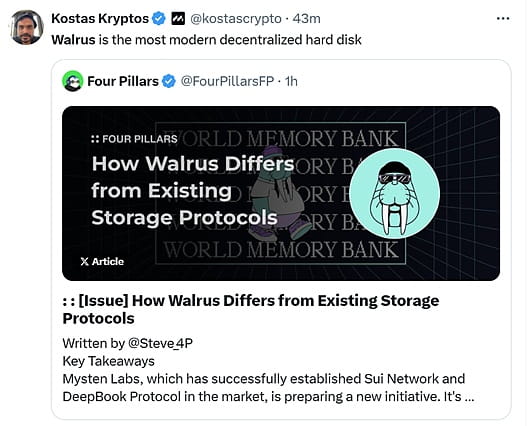
Walrus is a decentralized storage protocol within the Sui ecosystem. In this article, we will delve into what distinguishes this protocol from other existing storage protocols.
Key points of this article:
Mysten Labs has successfully launched the Sui Network and DeepBook Protocol in the market and is now preparing a new initiative—the Walrus Protocol.
Although there are already many protocols in the decentralized storage market, Walrus is still receiving a lot of attention for two main reasons: 1) its cost-effectiveness and security far exceed existing storage solutions; 2) through the Sui Network, the stored data can achieve programmability.
Walrus is regarded as the most advanced project among existing decentralized storage protocols, and its future utility and value will attract great attention.
1. Background Introduction—Why Walrus? Why Now?
After successfully launching the Sui Network and Deepbook protocol, Mysten Labs is now venturing into new territory with Walrus. The success of Sui Network and Deepbook has brought great expectations for Walrus. However, despite the market's keen interest in the Walrus protocol, there are still some doubts.
These concerns stem from several points: the decentralized storage market has become saturated, many existing solutions perform poorly, and there are market concerns about resource allocation—particularly whether Mysten Labs has diverted resources due to new projects while continuing to develop and expand the Sui Network.
Therefore, we will delve into the structure of the Walrus protocol, analyze its differences from existing decentralized storage solutions, and study the relationship between Walrus and the Sui Network, focusing on how Walrus integrates with Sui's architecture and enhances the Sui ecosystem.
1.1 Differences between Walrus and Existing Storage Solutions
To understand the necessity of Walrus, we first need to explore its differences from existing decentralized distributed storage solutions. From my perspective, Walrus has three significant differences from existing storage models (especially Filecoin and Arweave):
1.1.1 Storage Cost Efficiency
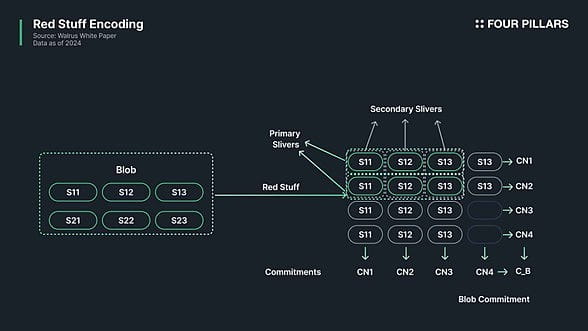
First, there are significant differences in storage costs between Walrus, Arweave, and Filecoin. As noted in Four Pillars' article on Walrus, Arweave requires all nodes to replicate and store all data, while Filecoin allows users to decide the number of nodes for data storage (users can choose to have only one miner store the data or distribute 100 copies across 100 different miners. Naturally, the more miners requested to store the data, the higher the cost).
In comparison, Walrus adopts Reed-Stuff Encoding, which is significantly cheaper than Arweave and Filecoin, with efficiency up to 100 times higher (whereas Arweave requires the entire network to store data, leading to replication costs up to 500 times, Walrus only requires 4-5 times replication to remain efficient). At the same time, the probability of data loss is also significantly reduced.
In short, Walrus addresses the drawbacks of Arweave and Filecoin. Arweave has a low probability of data loss but high replication costs, while Filecoin provides relatively economical storage based on user demand, but low-cost options may lead to higher risks of data loss. Walrus combines the advantages of both, maintaining low replication costs while minimizing data loss probability.
Moreover, as the number of nodes increases, Arweave's costs grow linearly, as all nodes/specified nodes must store a complete copy of the data. In contrast, Walrus only requires a single network data transmission, with each node storing part of the data, reducing the burden on individual nodes as the network expands. This structural difference makes Walrus's storage cost efficiency significantly higher than that of Arweave and Filecoin.
1.1.2 Programmability
Although Walrus is more efficient than Arweave and Filecoin, its most significant distinction from existing storage models lies in 'programmability.' Traditional storage serves merely as a simple data repository, while Walrus achieves programmable decentralized storage through the Sui Network, extending its functionality beyond basic data storage.
What if smart contracts could directly reference or trigger data stored in decentralized storage? For example, when minting an NFT, the image file could be stored in Walrus, and a blob data object could be created on the Sui Network, linking it to the NFT object. This addresses the criticism of traditional NFTs being 'incomplete' (i.e., the token is on-chain, while the NFT art metadata is stored off-chain), making NFTs through Walrus a true Web3 asset.
Another example directly related to data storage is that Walrus's blobs can be stored as Sui objects and controlled through Sui's Move smart contracts, which can transfer stored data to other users or automatically change ownership. This is why we say the data in Walrus is programmable.
In contrast, Arweave and Filecoin have limited or almost impossible dynamic integration with on-chain applications. Although Filecoin has added some smart contract capabilities through FVM (Filecoin Virtual Machine), the ability to modify and control data remains limited, making Walrus significantly superior in programmability compared to both.
1.1.3 Data Access and Deletion
One characteristic of existing storage protocols is that once data is uploaded, anyone can access it and it cannot be deleted. While this feature may be useful for individual users, it poses significant limitations for organizations and businesses that need to store sensitive data or require modification/deletion of data. In contrast, Walrus allows users to dispose of or modify their data when needed (this is completely different from Arweave, where data cannot be deleted or modified; and unlike Filecoin, where data deletion is not at the user's discretion but due to contract expiration or the node storing the user data going offline and no longer existing in the network).
Some may worry that this conflicts with the principle of immutability in blockchain, but it is important to remember that only blob data is deleted in Walrus. Independent of the deletion of blob data, transaction data maintains its immutability, and deleting blob data does not affect the integrity of the blockchain.
The enhanced utility of Walrus compared to traditional storage increases its adoption potential in traditional and Web2 enterprises, and its versatility is highly anticipated in the future.
1.2 The Synergy between Walrus and Sui Network
After exploring the differences between Walrus and existing storage protocols, we will now examine the relationship between Walrus and the Sui Network. When Mysten Labs announced the preparation of the Walrus protocol, many were critical, questioning whether 'they should focus on Sui instead of creating another protocol?' However, a basic understanding of how Walrus operates reveals that it does not divert Sui's attention but should be seen as a storage stack built to enhance applications on Sui. In other words, Walrus not only complements the Sui Network from a storage perspective but also positively affects the governance token SUI of the Sui Network, making the two inseparable. Let's explore this in more detail.
1.2.1 The Symbiotic Relationship between Sui and Walrus
In fact, Mysten Labs had significant concerns about the maintenance and management of storage during the initial design phase of Sui. This is because, as usage increases, the state of the blockchain inevitably grows, which could ultimately lead to increased transaction fees for future Sui Network users. Therefore, from the early design phase of Sui, Mysten Labs introduced the unique concept of a storage fund to address the storage challenges of Sui.
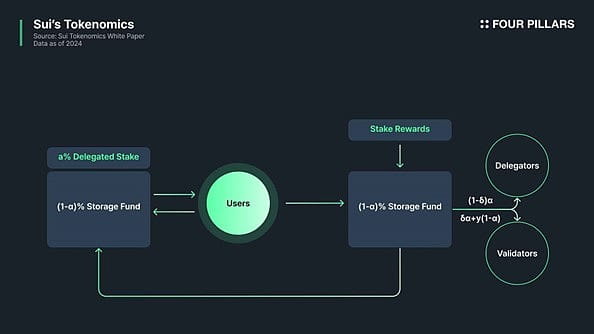
The operation of the Sui storage fund is as follows: the fees users submit to Sui validators are divided into 1) gas fees related to computation and 2) storage costs for data storage. Sui charges users in advance for the storage cost of permanent data storage and pools these funds into the storage fund. The storage fund continuously reallocates the accumulated amount to validators while the data remains stored on-chain. Additionally, if users delete data, they can receive a refund of the storage cost.
Sui's unique on-chain data storage system produces two results:
1) Users can receive storage cost rebates when deleting on-chain data, creating economic incentives to reduce the capacity of the distributed ledger.
2) The system addresses sustainability issues related to storage by charging storage fees in advance and using them as incentives for future validators.
Although Sui addresses sustainability issues with this unique structure, on-chain storage of large blob data (such as media files) remains burdensome. This is where Walrus comes into play—storing large blob data through Walrus while objectifying the blob's metadata on Sui for control, making the data programmable without directly storing it on Sui.
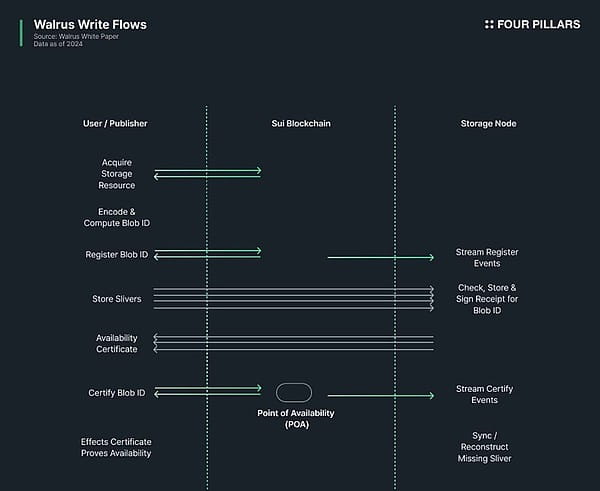
Moreover, through Sui, Walrus achieves the most significant feature compared to other storage protocols, which is the programmability and controllability of stored data. Ultimately, Sui and Walrus form a symbiotic relationship, creating unique advantages and complementing each other's limitations.
1.2.2 Walrus makes SUI tokens a deflationary asset
As shown in the storage fund example, the Sui Network requires a certain amount of Sui tokens to be paid as the storage cost for any object. Walrus is no exception. When creating blob data objects in Walrus, Sui tokens proportional to the size of the object will be locked in the storage fund.
Although a portion of the fee can be refunded when deleting data, some fees create a burning effect by permanently removing tokens from circulation. In other words, the more data stored through Walrus, the more Sui tokens are permanently locked in the storage fund, creating a virtuous cycle where increased usage of Walrus leads to a decrease in Sui supply.
In summary, the emergence of Walrus is good news for the Sui Network, both from a network and asset perspective, and it is expected that the Sui ecosystem will develop in a more diversified direction through Walrus.
2. Conclusion—Walrus will become the most critical protocol for Sui
2.1 Mysten Labs is not just building a blockchain
When Mysten Labs was first established, I thought it was just a company focusing on the Sui Network. However, after witnessing the launch of services like Deepbook and the Sui Naming Service, I began to think about what Mysten Labs' vision is. When I came across Walrus, I concluded that their goal is to build a complete Web3 decentralized infrastructure.
Mysten Labs has a different time horizon than other companies when looking at this industry. They are not just issuing tokens, creating hype, and selling off; rather, they have a vision to lead innovation in all areas such as execution, storage, consensus, and communication, while understanding the inertia of users accustomed to Web2 services and building the most suitable user interfaces for them.
Execution and consensus are handled by the Sui Network (continuously evolving through programs like Mysticeti and Pilotfish & Remora), storage is managed by Walrus, communication is handled by SCION (a next-generation internet architecture known for protecting network packets against DDoS and routing attacks—note that SCION is not created by Mysten Labs but is mentioned because it will be applied to the Sui Network), and the user interfaces familiar to Web2 users are managed by zkLogin, Stashed, SEAL, and KELP.
If all these plans can take root successfully, I believe Mysten Labs can rewrite the existing Web3 paradigm. My initial thoughts were limited. Mysten Labs is not just trying to build a blockchain—they are a team building infrastructure for a new network. Of course, I believe Sui is at the core of Mysten Labs' vision, while other plans play a supplementary role. Walrus is no exception; in my view, Walrus may be the most important protocol among them.
2.2 Walrus is not limited to the Sui ecosystem
However, Walrus is not limited to the Sui ecosystem. Like other storage protocols, Walrus can be used by any third party outside of Sui applications, and it may even become a useful alternative to existing storage protocols or other DA layers (such as Celestia, EigenDA, Avail).
The availability of Walrus expands the demand for Sui tokens beyond the Sui Network. When Walrus is used, objects are created on the Sui Network, leading to a reduction in Sui supply. In other words, Walrus has the potential to make Sui tokens a more attractive asset by creating external demand (this is not investment advice but a structurally possible scenario). Therefore, Walrus is expected to become a bridge for Sui's multi-directional expansion.
2.3 Can Walrus surpass Filecoin?
While comparing the value between specific protocols is a nuanced issue, I am very optimistic about the future of Walrus because: 1) its operating mechanism is much more efficient than existing storage protocols; 2) it can perform tasks that existing storage protocols cannot complete (becoming DA or making stored data programmable); 3) it already has a solid network and user base through the Sui Network.
If Walrus not only becomes the storage layer for Sui Network but also, as envisioned by Mysten Labs, becomes the representative storage protocol for Web3, it has the potential to become the leading protocol in the storage field.