

By Tyrannosaurus Haym
Compiled by: FIHRY Isla, Biteye core contributor
Ethereum is built on a decentralized and resilient node network, but quite a few nodes are centralized and are relatively fragile at present. The following will focus on DVT (Distributed Validator Technology), Obol Network, SSV Network and the roadmap for further decentralization of Ethereum in the future.
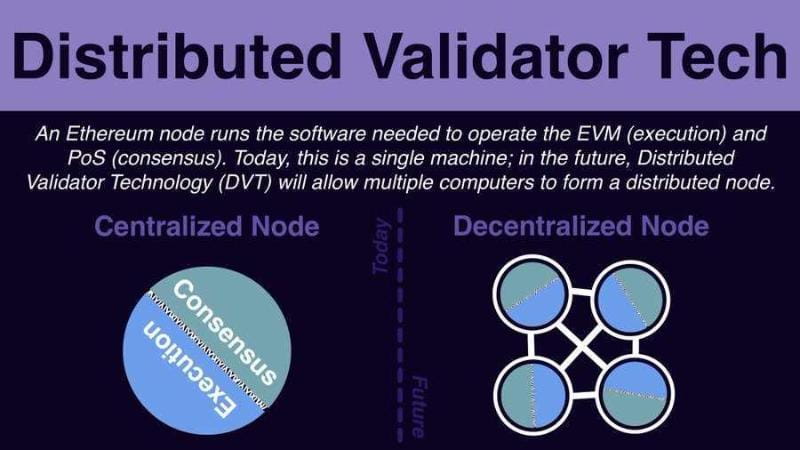
(Currently, an Ethereum node consists of a computer that manages both the EVM execution layer and the PoS consensus layer, while a distributed "node" can be composed of multiple servers)
01 Ethereum node operation principle
As we all know, Ethereum is known as the world computer, which is a network composed of nearly 20,000 computers (nodes). Each node is a real computer (server) in the real world, communicating directly between peers.
The only purpose of maintaining such a large number of Ethereum servers is to provide a stable and reliable shared computing platform - the Ethereum Virtual Machine (EVM).
The EVM provides the background for transactions (computations), and everything users do on the chain happens in the EVM.
Each node runs a local version of the EVM, which is then put on-chain through a process called Proof of Stake (PoS) and is kept fully synchronized by copies of all other EVMs.
Under the entire architecture, each Ethereum node currently runs two software at the same time.
Execution clients (e.g. @go_ethereum, @nethermindeth) responsible for implementing the EVM.
Consensus clients (e.g. @ethnimbus, @sigp_io), which monitor PoS and ensure the security of Ethereum.
A node can exist without staking any $ETH. It should be noted that it will not receive any rewards, is not responsible for on-chain, and is only responsible for synchronizing network data. When a node operator stakes 32 ETH, their node will create a new validator and begin to participate in PoS.
(Translator's note: A server can create multiple validators, depending on the server performance configuration and how many ETH there are.) It can also be understood this way:
- Multiple nodes form a real-world computer, and each node stays in sync, keeping the Ethereum network in constant contact and the EVM securely in sync
- A validator is a virtual entity operated by a node, existing in the node server, and participating in PoS
It can be seen that the entire network is resilient, with thousands or tens of thousands of nodes, and few events will affect each node, so today's Ethereum network has maintained a good operating record for a long time. But what about individuals? For those who control the huge Ethereum network, the ability to resist failure cannot be said to be perfect.
Let’s take a simple example: suppose you are a home staker and the power goes out for a few hours. During the time your node is out of power, you will incur penalties (minus the equivalent amount you earned during that time). If you are only offline for a few hours, it won’t take long for your node to resync with the head of the blockchain. However, the longer you are offline, the longer it will take to resync, with a full resync taking several days.
During this time, you’ll be penalized. This is bad enough for a home staker, but imagine you’re a large staking-as-a-service provider like Lido Finance or Coinbase, where a data center outage or a bad config file could bring down the entire De-Fi landscape. At this point, one might suggest running a backup node — if something happens to the primary node, then you can load your private keys into the backup and continue validating. But with today’s technology, this is a risk in itself.
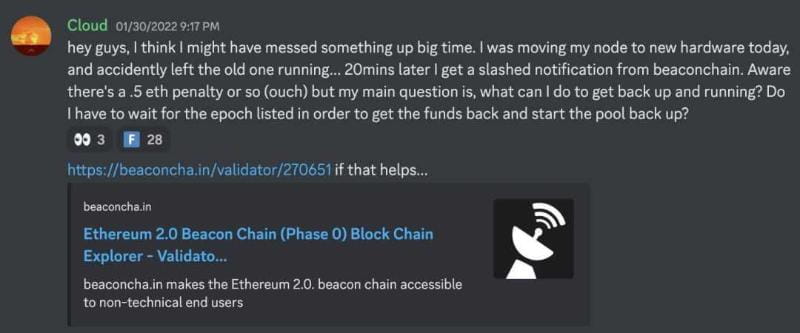
(The user was punished for double signing because he switched the node to new hardware and the old hardware was not completely stopped.) The distributed validator technology (DVT) we introduce today can perfectly avoid the above problems.
02 What is DVT Technology
In simple terms, think of a (normal) node as consisting of a consensus and EVM, while a DVT node is composed of multiple consensus and execution clients distributed across multiple machines.
If 32 $ETH are deployed to the Ethereum deposit contract, a DVT cluster consisting of n members will be formed, and an m-of-n shared validator key (m<n) will be generated. Every time this validator key participates in PoS, at least m members must agree.
From a protocol perspective, the fundamental principle for ensuring the smooth operation of Ethereum is that each validator is responsible for completing verification in a timely manner in their designated rounds.
DVT is precisely a cryptographic technology that can make validators more stable and secure in exercising their signature responsibilities, and safely distribute individual responsibilities to an m-of-n group. Now let's go back to the topic of family staking. With DVT, suppose you, me, and Vitalik build a DVT cluster. At the same time, we use Coinbase as a backup in case of emergency.
For example, even if there is a power outage in Singapore, you in Dali and V God in Canada still have power, and we can rest assured because we are still verifying. DVT provides Ethereum with the tools it needs to continue to decentralize, further consolidating its trusted neutral position as the Internet's settlement layer. And DVT is just a technology, and we may see it implemented in many different ways.
03 Current projects using DVT technology
Let's look at two projects that use DVT.
Obol Network
Obol Network recently raised $12.5 million to put their plan into action. In simple terms, regular native nodes run an execution and consensus client, while Obol nodes will add a third-party client on top of that.

Currently, Obol Network is not online yet, but users can get a good understanding of the working mode of DVT through the screenshot of their DVT launchpad (see the picture below).

(Choose your cluster size, add operator addresses, choose the number of validators, deploy.)
SSV Network
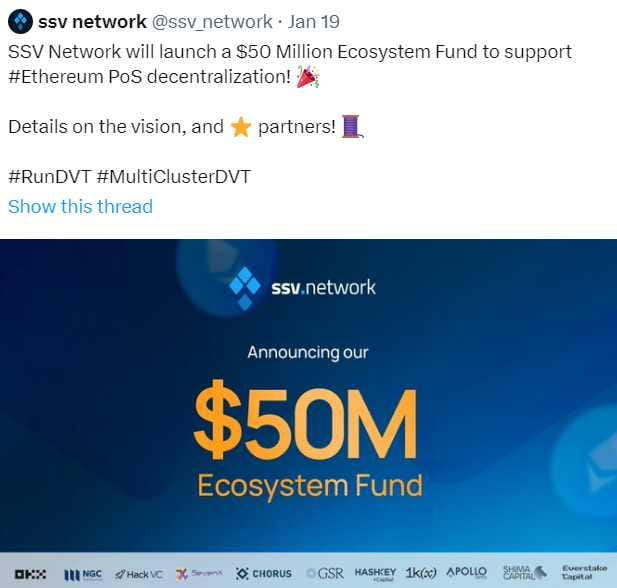
SSV just announced a $50 million ecosystem fund (good news, this is a big deal in the DVT space). SSV Network uses the same DVT technology concept, but the real highlight is its operator network.
Users interested in deploying validators will bring their ETH to SSV, which will create a DVT cluster from 4 operators. This is just the beginning. DVT is not only about creating more stable Ethereum nodes, but its emergence can make the concept of nodes and validators more clearly separated, and thus clarify their respective meanings. The most intuitive example is reflected in the next Ethereum roadmap. One of the core technologies required to implement Danksharding is to run advanced elliptic curve cryptography on each block. This may be computationally heavy for Ethereum nodes at this stage, but it will be easier to implement if it is used in a DVT cluster.
For more information about Danksharding, please refer to:
https://inevitableeth.com/home/ethereum/upgrades/scaling/data
04 Airdrop Hypothesis (Translator’s Supplement)
Obol launched the Bia testnet on January 31st, which aims to test the scalability of Obol DVT, with the expectation of seeing >500 active clusters, >5000 participants activated through the launchpad, and running successfully for >30 days.
01/30/2023 Bia testnet launched
01/30/2023 Cluster creation
02/06/2023 Activate cluster
02/06/2023 03/31/2023 Operation (minimum 30 days)
03/31/2023 End
04/20/2023 Bia Testnet Report
Although the official testnet document emphasizes that Bia is a non-incentivized testnet, meeting the requirements will reward a technical ambassador's POAP, and whether additional airdrop rewards will be given to POAP in the future is worth a try.
POAP eligibility is as follows:
Cluster creation and successful distributed key generation ceremony (proven by submitting a cluster type table)
Running an active cluster for more than 30 days
Become a leader in the cluster
Run in 3 different setups in 4 cluster setups: 6 nodes, multi-client, mult-geo or multi-host (i.e. at home, cloud, etc.)
Submit a completed feedback form after cluster creation and at the end of Bia
Submit a complete Grafana dashboard to the dashboard competition (more details to come in mid-February)
Officials say that POAPs that earn 5 Technical Ambassadors will grant the recipient a [Junior Technical Ambassador] role in the community, along with recognition, access to the Obol team and other benefits. https://www.notion.so/52 ee 03 cb 655 c 4 da 4 ad 2814 f 93 bb 21 a 93
There are other tasks outside of Biya that can also earn Technical Ambassador POAP. For a complete list of ambassadors, please refer to the [Obol Ambassador Program] page. https://www.notion.so/52 ee 03 cb 655 c 4 da 4 ad 2814 f 93 bb 21 a 93
Cluster deployment tutorial:
https://obol-dvt.notion.site/Obol-Bia-Testnet-Handbook-700 3ac 195 a 2d 422 fa 3 f 0 ee 31 cc 15 e 4 d 6
Original link