


On February 3, Trump’s new Treasury Secretary Scott Bessent said that “over the next 12 months we will be monetizing the asset side of the U.S. balance sheet.” These comments, against the backdrop of the U.S. government funding a new sovereign wealth fund, prompted Gillian Tett of the Financial Times to suggest that growing speculation about a gold revaluation may be behind the surge in gold.
“The value of U.S. gold stocks in the national accounts is currently only $42/ounce,” she said. “But informed observers believe that at current prices ($2,800/ounce), $800 billion could be injected into the U.S. Treasury General Account (TGA) through repurchase agreements. This would likely reduce the need to issue large amounts of Treasury bonds this year.” (Technically, it is, but in reality, given that the U.S. government spends more than $7 trillion a year, the “benefit” of doing so would not be enough to cover two months of spending.)
In any case, panic is spreading throughout Wall Street, believing that the value of gold could suddenly be revalued by about 70 times, to the extent that Mark Cabana, Bank of America's top Federal Reserve expert and former New York Fed staff member, was also invited to express his views on whether the Treasury would really shock the world by allowing gold to 'float.'
Cabana wrote in the article (Monetization of U.S. Assets and Gold Revaluation) that, although he acknowledged he does not yet know the details of Bessent's plan, it may include non-traditional financing options for the Treasury. The excerpt below captures his remarks, along with some professionals' views.
U.S. Government Balance Sheet: Not a Standard T-Account
The government's balance sheet is unique: it does not always resemble that of a business or household. As shown in the first chart, there is a significant gap between the total size of assets reported by the U.S. federal government (nearly $5.7 trillion) and the total size of liabilities (approximately $45.5 trillion).
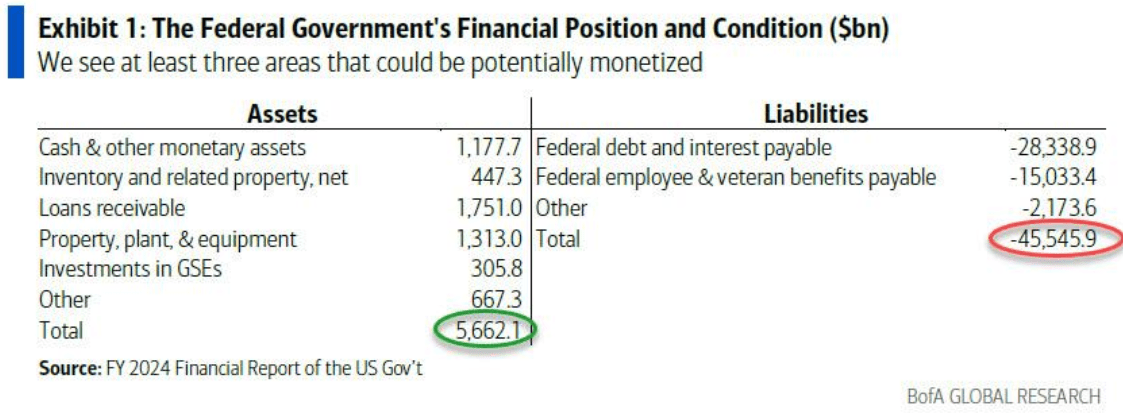
The U.S. Treasury notes that the balance sheet does not include the financial value of sovereign powers such as government taxation, business regulation, or the formulation of monetary policy, nor does it include the value of non-operational resources of the government, such as national resources and natural resources under the government's management. As Cabana pointed out, the value of tax and management is considered to offset the huge asset-liability gap, which is a unique characteristic of government. Alternatively, cynics might say this represents a large value bestowed upon superpowers and reserve currency status.
Three potential areas for the monetization of U.S. assets
To better understand Bessent's comments on the monetization of U.S. assets, Cabana focused on those balance sheet items that could potentially be revalued or sold to fund sovereign wealth funds or other government priorities. At least three areas can achieve monetization:
Fixed Assets (PP&E)
Institutional investment (Fannie Mae and Freddie Mac)
Gold and silver
Cabana believes the chances of any asset monetization are relatively low. However, given the potential massive impact (especially on gold), Bank of America's clients are asking for explanations. Details are as follows:
Fixed Assets: The most standard but with the least impact
The total amount of property, plant, and equipment (PP&E) in U.S. government assets exceeds $1.3 trillion. PP&E consists mainly of tangible assets including land. The PP&E held by the Department of Defense accounts for about 64.7% of total government assets, excluding 22.8 million acres of land and rights. The U.S. government could potentially monetize PP&E, but given national security implications/the presence of the Department of Defense and the need for Congressional involvement in revenue-generating disposals, this possibility is low. When selling PP&E, the U.S. government would exchange PP&E assets for cash or ultimately invest in other government priorities.
Selling assets does not raise funds for other projects unless its net effect is to reduce the deficit, meaning total spending relative to income is reduced. It is still unclear whether the revenue from selling property or facilities will exceed the new costs of seeking private alternatives for that property or facility. The Congressional Budget Office (CBO) is likely to need to score such disposals to see if they will reduce the deficit.
Fannie Mae and Freddie Mac: Government shares could be monetized
Selling shares of Fannie Mae and Freddie Mac is another way to monetize U.S. assets. The U.S. currently holds stakes in government-sponsored enterprises (GSEs), with a total investment value of $339 billion as of the end of fiscal year 2024, mainly in senior preferred stock. Fannie Mae/Freddie Mac could potentially be privatized (Bill Ackman would be pleased) to raise funds, though mortgage guarantees pose a challenging issue. Privatization of Fannie Mae and Freddie Mac would take more than 12 months, which seems inconsistent with the timing mentioned in Bessent's comments.
Revaluing gold: the greatest impact... but currently low likelihood
Wall Street and everyone else are primarily focused on the possibility of revaluing gold to achieve the monetization of U.S. assets. It is still unclear whether the Secretary of the Treasury can unilaterally revalue gold. Here is what is known.
The latest financial statements from the U.S. government show it holds $11.1 billion in gold and silver.
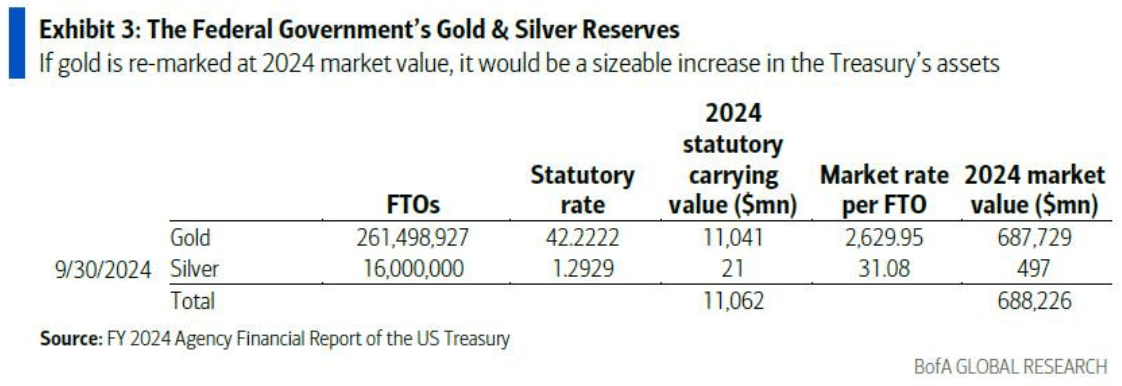
This is based on the static price of $42.22 per ounce set by law when Nixon severed the last link between the dollar and gold in 1973. This gold price is referred to as the 'statutory rate.' According to the latest financial report from the Treasury Department, if the Treasury were to revalue its gold, the market value for 2024 would be $688 billion. This means the Treasury's assets would increase by $677 billion.
There are many technical considerations regarding U.S. gold holdings, including:
The U.S. Treasury owns this gold, which is offset by gold certificates issued by the Treasury to the Federal Reserve at the statutory rate.
The value of gold certificates is recorded in the Treasury's cash balance (TGA).
The statutory gold price is established by Title 31, Section 5117 of the U.S. Code, although there is a provision stating: 'With the approval of the President, the Secretary of the Treasury may prescribe regulations he deems necessary to carry out this section.'
Current laws specify the value of gold certificates, but it is still unclear how much influence the Secretary of the Treasury has on the potential revaluation of gold. The revaluation of gold in the U.S. will impact the balance sheets of the Treasury and the Federal Reserve.
For the U.S. Treasury: assets will increase due to the value of the revalued gold, and liabilities will increase due to the scale of the gold certificates issued to the Federal Reserve.
For the Federal Reserve: assets will increase due to the value of the gold certificates, and liabilities will increase due to the cash credited in the Treasury's cash balance.
Here is a key question: the impact on the Federal Reserve's balance sheet looks like quantitative easing, even without the need for open market purchases, the initial growth of the Federal Reserve's liabilities is in the TGA.
In other words, the best way to put it is: this is a QE-like operation, with the Federal Reserve quietly injecting nearly $700 billion in cash into the Treasury... but effectively doing nothing!
In terms of net worth, a gold revaluation would increase the balance sheet size of the Treasury and the Federal Reserve, allowing the TGA to be used for the Treasury's priorities (i.e., sovereign wealth funds, debt repayment, deficit filling, etc.). Meanwhile, the Federal Reserve and the Treasury would magically conjure $700 billion out of thin air for any purpose, all because the Treasury agreed that the fair value of gold is its fair value.
Undoubtedly, a gold revaluation, even if not completely unexpected, would be viewed by the market as an unorthodox practice. For decades, U.S. gold has not been revalued, possibly to guard against: (1) volatility in the Treasury and Federal Reserve's balance sheets; (2) concerns about the independence of fiscal and monetary authorities.
Cabana believes that a revaluation of gold could lead to a reduction in TGA payments, thereby stimulating macro activity, increasing inflation risks, and adding extra cash to the banking system (an increase in TGA will eventually lead to an increase in Federal Reserve reserves or deposit reserve balances). Essentially, a revaluation of gold would simultaneously loosen fiscal and monetary policy (all else being equal).
Indeed, it's like a form of quantitative easing, but without real quantitative easing.
Cabana's conclusion is that a gold revaluation is possible (and certainly more likely after Bessent's comments), but there are legal issues, 'which may not be welcomed by the market because it amounts to loosening fiscal and monetary policy + weakening fiscal/monetary independence' (yes, in other words, it's quantitative easing, or QE). Moreover, ironically, a revaluation of gold would also cause gold prices to soar (not to mention Bitcoin and other things that might subsequently be re-monetized).
Therefore, before Bessent provides more credible details on how to 'monetize the asset side of the U.S. balance sheet,' Bank of America believes the chances of U.S. asset monetization are low. 'However, we are aware that Trump's actions are very swift and will disrupt everything that hinders him, so we believe the chances of a gold revaluation are skyrocketing, which is also why gold trading prices are close to $3,000.'
Article forwarded from: Jin Shi Data