

In 2022, sustainable models for tokenized communities will slowly begin to emerge, new community experiments will learn from old mistakes, and OG communities will begin to adapt to the changing tide.
Written by: Forefront
Compiled by: Frank, Foresight News
This is not the first time Forefront has reviewed the annual development of the tokenized community track in the crypto industry, but there is no doubt that things have changed a lot in 2022.
Among them, Forefront’s first report, “2020 Social Token Year in Review” explores the emerging prospects of crypto social, covering the origin of personal tokens through tokenized time (Matthew Vernon’s “Boi”), the initial ALEX issuance of Showtime’s current founder, the early development of RAC, how NFTs can be used as a means of payment (token WHALE), permissioned access (CollabLand) and more...
It should be noted that on December 28, 2020, there were no more than a few dozen social tokens on Ethereum, with a total of approximately 7,000 holders and a total market value of US$81 million. This year's report is a celebration of our achievements and the opportunity before us to bring tokenized communities to the masses.
From social tokens to community tokens
At the end of 2020, just before Forefront’s first report was released, Forefront began its transformation into the “Home of Social Tokens,” gradually aggregating everything from creator tokens to NFT collector tokens.
As NFTs began to take off, new communities began to emerge, and soon it became clear that all social tokens were moving in the direction of community tokens - a shift from individual to collective creation.
So much has changed that in July 2021, more than six months after the original Social Token Year in Review, the Forefront community felt it necessary to revisit the light-speed development trends in the space.
Back then in 2021, the community was recognized as the center of the crypto social ecosystem, but despite this, many poor decisions were made as people tried to fulfill the promise of Web3 and tokens as a new economic model.
The 2021 report highlights the rise of seasons belonging to communities such as FWB and Forefront, with Roll Hack, Rally and Bitclout making waves one after another, Bankless DAO also making a shining debut, and communities such as Cabin, Krause House and Songcamp also becoming popular.
As we head into 2022, people are understandably excited that “the year of the DAO” is coming, and to some extent this is true — 2022 is the year that sustainable models for communities begin to emerge, as new community experiments learn from old mistakes and the OG community begins to adapt to the tide of change.
2022 is the year that the tokenized community is truly born.
The OG community continues to mature
Over the past few years, the crypto ecosystem’s perception of tokenized communities has changed, first in late 2020 and into 2021, when any community with a social token fell within the definition of a “tokenized community.”
But as these communities grew and contributors identified what made tokens valuable and necessary, the Forefront team evolved the definition of tokenized communities to include on-chain communities that use governance tokens to allocate funds for community projects.
This new definition is both illustrative and realistic. When we originally published our article on tokenized communities last March, only a handful of communities fell under this seemingly strict definition.
Today, even “OG” tokenized communities like FWB, Forefront, Bankless, etc. are slowly moving towards sustainable economic models focused on funding community projects, which in many ways is a definition that all projects aspire to - because it represents a world of sustainable, collaborative online communities.
While it’s now easier than ever to launch and participate in an on-chain DAO, community participation remains a major issue — every tokenized community continues to struggle to achieve quorum on certain proposals, attract talented builders and creators, and generate sustainable momentum for their establishment.
Meanwhile, some communities, like Lil Nouns, find themselves with a very large and diverse token holder base, but low community engagement due to a lack of a centralized vision and mission.
Forefront established Pulse to give the community the opportunity to collectively communicate on-chain around their mission, goals, values, and interests.
With the rise of Web3 social and products like Farcaster, Lens, Yup, etc. thriving in 2022, it’s clear that 2023 will be the year that tokenized communities that have figured out their economic models refocus on their community engagement to ensure long-term sustainable development and growth.
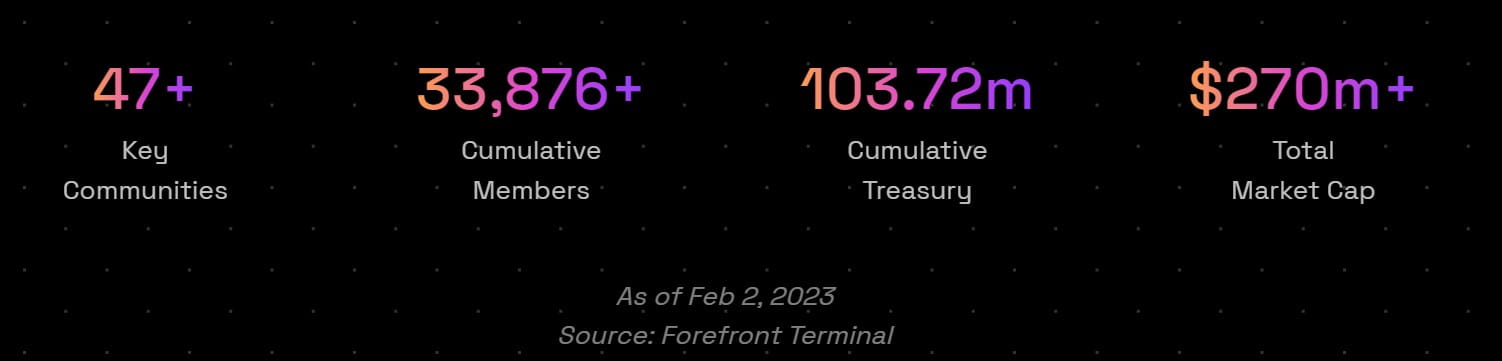
According to Forefront Terminal statistics, as of February 2, 2023, Pulse covers more than 47 key communities, with a total of more than 33,876 members, a cumulative treasury balance of approximately US$103 million, and a total project market value of more than US$270 million.
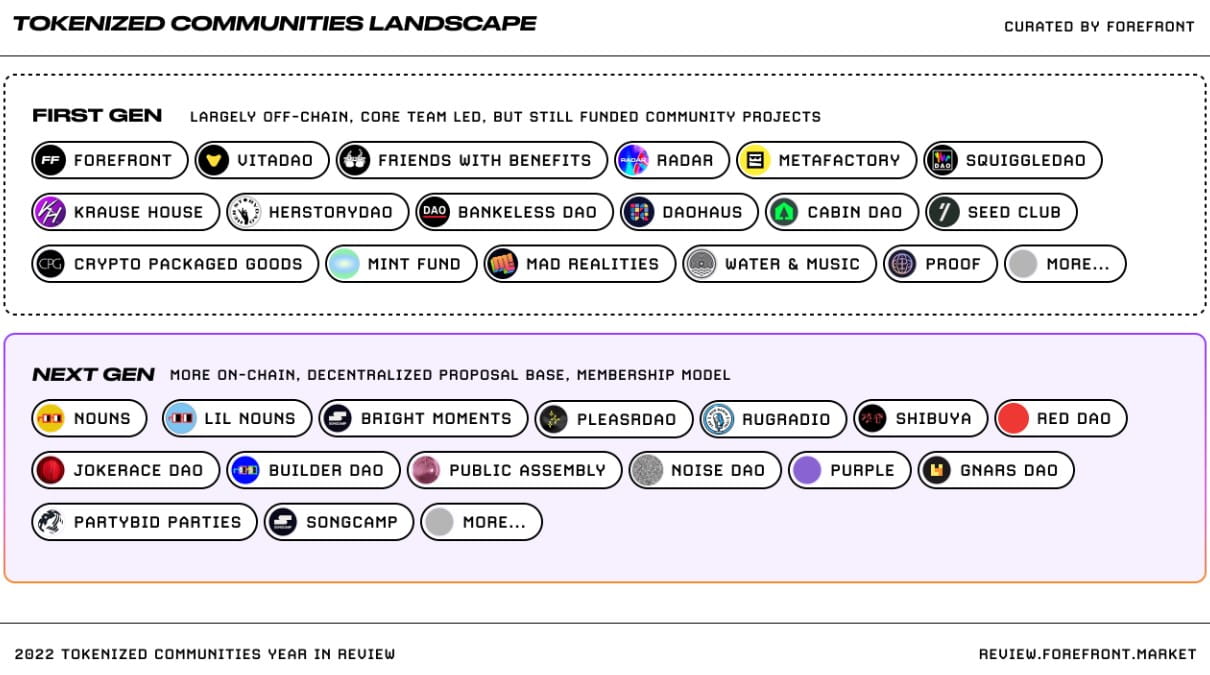
Unlock "Nounish"
We couldn’t have an annual review without a meaningful discussion of Nouns DAO.
Nouns DAO, launched in 2021, advocates for a simple on-chain commitment: one Noun auction per day, forever.
The Nouns perpetual auction mechanism has proven to be a way for tokenized communities to unlock sustainable revenue, reflecting (in theory) the value of governance in allocating funds to community projects.
Nouns' treasury currently holds more than 27,800 ETH, hundreds of voting members, and a rich ecosystem of builders and creators, all of which have led to a surge in Nouns' meme properties.
Of course, many communities have viewed Nouns as a replicable model with varying degrees of success. For example, Lil Nouns and Gnars, as Nouns “subDAOs”, have both built a good reputation and increased the Nouns meme attributes while adopting more specific community authorizations. However, both also have bottlenecks in terms of capital accumulation, and have been slow to reach even a small fraction of the funds that Nouns DAO has.
On the other hand, projects like SongADAO take existing creative efforts (such as Jonathan Mann’s Song a Day) and turn them into a tokenized community by adopting the Nounish perpetual auction mechanism.
Jokedao also launched a DAO driven by perpetual sales (weekly instead of daily): jokerace DAO, which launches a joke competition every week, and participants use jokedao to vote for the best jokes. The winning jokes will be minted as NFTs, making it the first NFT series DAO that is fully generated and managed by its members.
Purple, Public Assembly, BlvkHvnd, and other DAOs gained momentum in Q4 thanks to Nouns Builder’s protocol, and the Builder DAO (the DAO that manages the Builder ecosystem and protocol) has become the second largest treasury in the Nounish ecosystem.
Nouns DAO ecosystem highlights include:
Prop House. Prop House is a public infrastructure designed by Nouns DAO that helps the Internet community incentivize the development of the ecosystem (treasury funds 1,820 ETH);
Nouns Builder. Nouns Builder is a tool that allows any DAO to be created and governed on-chain as a Nouns DAO (treasury funds 1000 ETH);
Nouns On The Ground. An experimental Proliferation exploring ways to bring Nouns into the real world (662 ETH in treasury).
PFP Becomes a DAO
Thousands of new PFP series have emerged in 2021, each with their own community, mission, and values. However, most of these communities are asking, "What happens next?" They rely on the core team to continue building the ecosystem, while the community essentially acts as a free marketing force.
Meanwhile, tokenized communities like Nouns DAO are gaining momentum, allowing token holders to fund proposals based on the community’s mission, with funds being allocated to community projects rather than hoarded by a core team.
With the launch of ApeCoin DAO, the PFP project has a rough blueprint and new possibilities - although ApeCoin DAO uses a brand new token for governance, BAYC holders and other Yuga ecosystem members are able to participate in the DAO in a meaningful way without having to wait for the core team to move the ecosystem forward.
More PFP communities have begun to transition to DAOs, or are at least discussing this, and with the rise of new on-chain and off-chain tools, we expect that in 2023 many PFP projects that are able to build great brands will really begin to empower their communities.
One of the biggest examples is Moonbirds, whose DAO is set to launch early this year. The DAO will have $2.6 million worth of assets, including $2 million in ETH, for NFT holders to manage.
Proof, the startup behind Moonbirds, will also grant the DAO 35% of creator royalties for Moonbirds and its derivative Oddities series, and the organization will initiate a "cold start" warning that allows Proof to veto any "rogue proposals" in a manner similar to the Nouns DAO.
Business model evolution
“The DAO is the product.” — @thattallguy
As of 2020-2021, the tokenization community really only has one business model (if you can call it that) that seems to work: treasury diversification funding.
In March 2021, the FWB governance module approved a treasury diversification round for 7% of the token supply at a valuation of $10 million; later that year, they approved a new round of treasury diversification funding at a valuation of $100 million.
Forefront also raised a vault diversification round at a $20 million valuation in late 2021, and Cabin and others followed suit.
This model is obviously flawed: tokens are sold en masse like equity, taking them away from potential active members and still failing to generate sustainable income for the project coffers.
This is why people are so excited about Nouns’ perpetual auction model: revenue can scale as the community and its memes grow.
However, it is clear that most tokenized communities still struggle to generate sustainable revenue. No other “nounish” DAO has been able to generate even a fraction of the revenue through Nouns’ perpetual auction mechanism.
Some communities, like Water & Music and Forefront, have managed to generate revenue through “membership passes” similar to Web3 native media subscriptions; others, like FWB, focus on brand partnerships, leveraging the influence and expertise of their community to build unique collaborative experiences with major brands like Hennessy.
Meanwhile, by the end of 2022, open-source experiments had become a mechanism for DAOs to profit from significant media or cultural artifacts — Nouns DAO used Zora to create a DAO explainer video that generated over 300 ETH.
One of the most exciting things about working in these communities is that people come to the table with an ambition to, as Jess Sloss recently said, “do something that people want to be a part of.”
Looking across the space, it’s hard not to get excited about the big dreams of the tokenized community.
For example, Krause House is building at the intersection of Web3 and sports, with the ultimate goal of becoming the first to purchase and collectively manage an NBA team!
Cabin is building a network city for online creators, which now looks more like a global shared network for thoughtful people to create, coexist and protect. As the Zero community flourishes in Austin, Texas, there will be more such communities in the future. Although their visions are not clearly related, Cabin is often seen as an early manifestation of Balaji's "network state" (Foresight News Note: Balaji "network state" refers to a community organized around a specific vision of managing society. It started as an online club, but eventually became strong enough over time to seek political autonomy and even diplomatic recognition).
FWB also leans into this vision of a “decentralized city” and is more focused on becoming a cultural hub for “shaping Web3.” The community is undoubtedly one of the OG communities and continues to pave the way for other tokenized communities to conduct new and interesting experiments, including brand partnerships, IRL events, grant programs, and more.
Finally, it’s becoming increasingly clear that tokenized communities are also the future of media, and judging by decentralized media experiments like Rehash, collaborative media tools like Forefront’s Pulse, and the new funding opportunities enabled by the rich networks of tokenized communities emerging every day, there’s no doubt that media economics will fundamentally change, not just because of their digital nature, but also because of their networked nature.
Even the world of long-form video production is being disrupted by DAOs: Shibuya, a project launched by Pplpleasr, crowdfunds long-form video productions — like shorts, movies or TV series — by selling NFTs called “Producer Passes,” upending the traditional studio-driven approach that now dominates the industry.
ERC-20, NFTs, and the Dual Token Model
Many are calling 2022 the year ERC-20 died: with ERC1155s being used for “versions” and 721s being used for non-fungible tokens, ERC-20 appears to be an unsuccessful experiment. DAOs are supposed to be sitting on large treasury funds, but when more than 90% of those treasuries are their own native governance tokens, the market is understandably widely concerned about them.
Many also pointed out issues with its security properties, the complexity of managing liquidity pools, and the lack of revenue generated by token airdrops, making ERC-20 an unsustainable economic tool.
However, some new or old communities choose to use a dual-token model to retain their ERC-20 tokens.
Paradigm has made significant progress towards an effective two-token model by launching GOO (Gradual Ownership Optimization) for its Art Gobblers project: the more Goo a Gobbler owns, the faster it generates more Goo. This means that the total supply of Goo will increase faster and faster every day, from thousands to millions or more.
Communities such as rugDAO also use a similar token distribution model, where the longer a user holds their NFT, the more ERC-20 tokens they receive.
In general, most of the failures of ERC-20 tokens to date stem from two issues: insufficient revenue and lack of distribution.
First, ERC-20 tokens are useless without a meaningful treasury to govern them. NFTs are advantageous not because they are inherently better governance tokens, but because buying an NFT generally means money goes into the project treasury, so there is something to be governed by the community.
Secondly, NFT distribution models are generally more fair, while ERC-20 token distribution looks very similar to traditional startup equity distribution in many communities.
These two issues are common but not inherent to token standards. Given the need to explore areas such as community reputation, tipping, ownership distribution, participation, etc., we expect ERC-20 tokens to make a comeback in 2023 and beyond.
Cultural Production Community
If you look closely enough, you might argue that 2022 is the year of the “Metalabel,” and you’d be right.
A Metalabel is a relaxed club where a group of people with similar interests work together to support a work. A Metalabel is also a lightweight structure that creates economic, emotional, and creative alignment among collaborators, and it can also be a tokenized community (and many are actually).
Metalabel, the eponymous company that coined the term, is building tools and models to help facilitate the development and production of “Metalabels” around the world. In many ways, however, the hardest work is defining the types of communities that already exist.
For example, Songcamp is an artist group founded in March 2021, which became popular in 2022 with Camp CHAO. This "unorganized band" consists of more than 80 musicians, producers, designers, and operations staff, who have co-created more than 40 songs and generated more than $500,000 in NFT sales revenue, which is divided equally among the band's participants.
Songcamp isn’t the only music community adopting Web3 tools, 2022 saw the dawn of music collector communities, decentralized record labels, nounish music DAOs, and more, in many ways, music is an art that fully embraces Web3 and experiments without limits.
DAO tooling matures
Bottom-up governance tools:
Jokedao — an on-chain, bottom-up governance tool for any community;
Prop House – Nounish dao’s competitive governance tool;
No platform membership tools:
Guild — automated governance tools for tokenized communities;
Token-driven knowledge and operational tools:
Clarity — document and task management tool for distributed teams;
Wonderverse — a token-driven project management and operations tool;
Publishing tools:
Mirror — a decentralized distribution and creator monetization platform;
Lens — a decentralized social media platform where users own their data;
Farcaster — decentralized social media with a Twitter-like client;
Token creation tools:
ZORA — All-In-One NFT creation protocol;
Coinvise — universal token minting platform;
Manifold — a code-free NFT minting tool for creators;
Recruiting and Networking Tools:
Backdrop — decentralized professional network;
Layer3 — a decentralized bounty and reputation platform for tokenized communities;
On-chain permissions and readability tools:
Metropolis — a secure wrapper for managing on-chain membership;
Hats — an on-chain role management tool for DAO members;
Annual Articles
《Life After Lifestyle》,Toby Shorin;
《Hyperstructures》,Jacob Horne;
《An Exploration Of Internet-Native Organizations》,Scott Moore & Maxwell Kanter;
《The Onchain Era》,Yancey Strickler;
《The New Creator Playbook》,Variant Fund;
《Why NFT Creators Are Going Cc0》,Flashrekt & Scott Duke Kominers;
《DAOs Are Not Corporations: Where Decentralization In Autonomous Organizations Matters》,Vitalik Buterin;
《The Ownership Economy 2022》,Variant Fund;
《Tokenized Communities》,Jihad Esmail;
《The Laws Of Lorecore》, Shumon Basar;
《Decentralization》,Not Boring;
《What Co-Ops And Daos Can Learn From Each Other》,Austin Robey;
《Scaling Trust In DAOs: Trustware Vs Socialware》,Orca Protocol;
《Beyond Phygital》,Red DAO;
《Old But Goodie - My Collectible Ass》,McKenzie Wark;
What to watch for in 2023
Regulatory clarity: Groups like Syndicate and LexDAO have been exploring how to design DAOs that comply with existing laws, while a16z and others have been writing extensively and working with lawmakers to design effective DAO regulations. Expect this progress to accelerate in 2023.
On-chain minimalism: The power of tokenized communities lies in the fusion of “trust software and social software”. As more and more DAOs are put on-chain, it is expected that the tools built for community collaboration and trustless funds will explode.
Online communities are transformed into on-chain communities: With the advancement of the Reddit Community Points project, online communities are rapidly moving to the blockchain. Tokenized communities will not just start from scratch, but will be born from some of the most active communities on the Internet today;
Rebranding without changing the technology: When it comes to mainstream adoption, branding will be a major narrative in 2023. “NFT,” “DAO,” “token,” and other crypto-native terms are not accepted by most consumers, and further adoption of this technology needs to be accompanied by a rebranding of the technology.
DAO & Brand Partnerships: FWB laid the foundation for DAOs to collaborate with major brands, and Nouns DAO is taking up the baton, with brands looking to collaborate with these active on-chain communities in the new year.
Conclusion
2022 was truly a year from hell, but 2023 is off to a warming start for the industry.
The tokenized community is finally hitting its stride, with the market gradually developing new revenue models and funding community projects that were never previously funded by traditional institutions.
As more of the internet community begins experimenting with Web3 tools, we’ll inevitably see a Cambrian explosion in creativity and business scale, often in ways we couldn’t have imagined even a decade ago.