As President Trump of the United States shows a friendly attitude towards cryptocurrencies, major asset management companies have also submitted ETF applications for other cryptocurrencies following the Bitcoin and Ethereum spot ETFs, covering SOL, DOGE, XRP, LTC, and more.
However, not all of these applications will enter the SEC's formal review process, and some may even be directly rejected. Therefore, if the SEC accepts an application, it is in itself a significant piece of news.
SEC accepts DOGE, XRP ETF applications
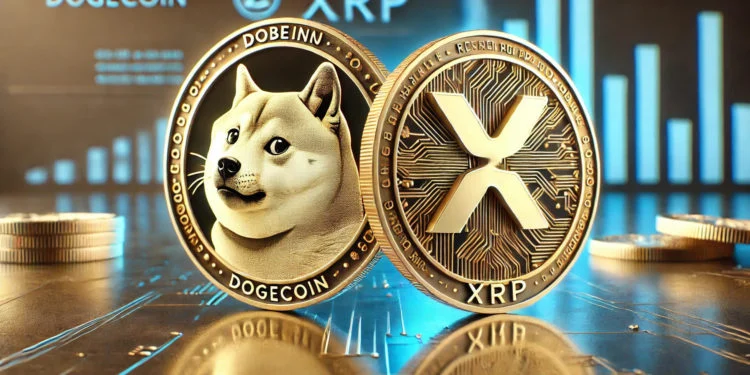
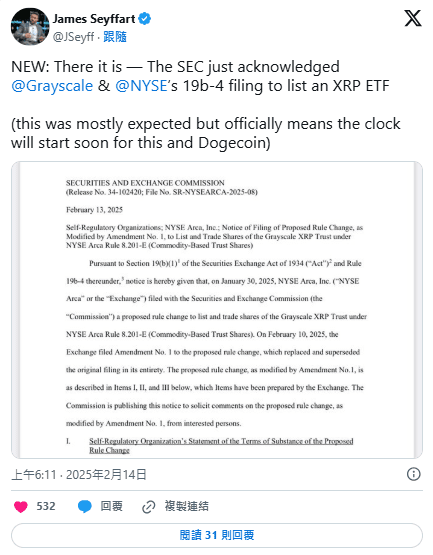
Today, Bloomberg senior ETF analyst James Seyffart posted on X that the SEC has officially accepted the 19b-4 applications submitted by Grayscale and NYSE Arca, aimed at converting the Grayscale DOGE Trust and Grayscale XRP Trust into ETFs and listing them for trading on NYSE Arca.
James Seyffart stated:
Under the previous SEC system, they would not have accepted applications at all. For example, in December of last year, Solana's application was rejected. Essentially, this means there is a chance (to be approved for listing).
What does SEC acceptance mean?
Fox Business reporter Eleanor Terrett further explained that this is undoubtedly a positive signal, as it shows the SEC is starting to consider such products, and the likelihood of these ETFs being approved in the future is increasing. She stated:
Does this mean automatic approval? No. This does not even guarantee that the SEC will ultimately approve the application.
So why is this still worth paying attention to?
Because it indicates that the SEC's stance is more open and has not directly refused to consider such products. Looking back to last December, due to the SEC led by Gensler refusing to discuss with exchanges, the $SOL 19b-4 application was eventually withdrawn by the exchange itself.
Of course, all these new cryptocurrency ETF applications (like $LTC, $DOGE, $SOL, $XRP, etc.) still need to go through the complete review process, but this is a good start, at least indicating that these products have a chance of being approved and listed in the future.
Eleanor Terrett added that next, the SEC should process those publishers who submitted XRP ETF applications later than Grayscale, including Bitwise, 21Shares, Canary Capital, and WisdomTree. Additionally, the 240-day review period for Grayscale's application will begin from the date its documents are officially published in the Federal Register, which is expected to take effect in a few days.
SEC Review Process
To further explain the SEC's review process, after the SEC confirms the 19b-4 application, it will undergo a review of up to 240 days, with the specific process as follows:
1. Acceptance and public announcement
Once the SEC confirms receipt of the 19b-4 application, it will register it and make an announcement in the Federal Register.
This typically marks the beginning of the formal review process and triggers an initial 45-day review period.
2. Preliminary review (45-day period, extendable to 90 days)
The SEC must decide whether to approve, reject, or extend the review period within 45 days of receiving the application:
3. Further extension of the review (up to 240 days)
If the SEC believes further review is needed, it can extend the decision deadline, up to a maximum of 240 days (usually extended in increments of 90, 60, or 30 days).
4. Final ruling (approval or rejection)
The SEC ultimately needs to make a decision within the 240-day statutory period:
Approval: If the SEC confirms that the proposal meets market fairness, liquidity, and regulatory standards, it will be formally approved, allowing the exchange to implement changes.
Disapproval: If the SEC believes that the proposal poses potential risks (such as market manipulation, regulatory loopholes, etc.), it will reject the application.
Exchange withdraws application (not mandatory): Before the SEC makes a decision, the exchange can voluntarily withdraw the 19b-4 application to avoid the negative impact of a formal rejection.
Probability of approval for the four major cryptocurrency ETFs
In early February, the SEC also accepted the 19b-4 applications for Grayscale Solana and Litecoin ETFs, further advancing the review process for altcoin ETFs. Bloomberg analysts James Seyffart and Eric Balchunas recently made predictions on the approval probabilities for these four major cryptocurrency ETFs: SOL, DOGE, LTC, and XRP.
Litecoin (90%): LTC has a 90% highest probability of approval because the SEC classifies this cryptocurrency as a Bitcoin fork and categorizes it as a commodity. However, two analysts believe that while LTC is most likely to be approved, it may not attract too much capital inflow.
DOGE (75%): As the largest meme coin, the 19b-4 documents submitted by Grayscale and Bitwise have gained SEC recognition, thus resulting in a higher probability of approval.
Solana (70%): There is a 70% chance of approval before October 10, 2025, which is also the deadline for the SEC to make a final decision, as the SEC has currently expressed recognition of the Grayscale 19b-4 documents.
XRP (65%): Although XRP is an established altcoin with high market interest, it is still involved in legal proceedings with the SEC, so its current probability of approval is relatively low.
XRP, LTC surge
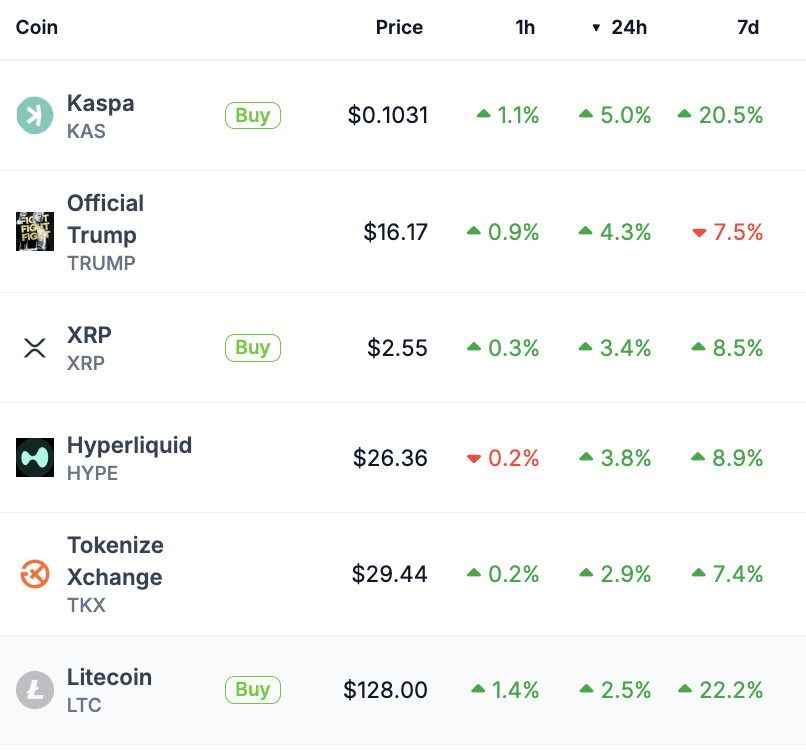
Affected by this news, XRP and LTC saw impressive gains. CoinGecko data shows that XRP and LTC increased by 3.4% and 2.4% respectively in the past 24 hours, ranking as the third and sixth highest gainers among the top 100 cryptocurrencies by market cap.