

Paolo Ardoino, CEO of Tether, the world's largest USDT issuer, stated that although it is still far from quantum computers being able to crack Bitcoin encryption, as quantum computing technology develops, Satoshi Nakamoto's 1 million Bitcoin wallet will eventually be cracked and re-enter market circulation, prompting venture capitalists to call for early prevention.
On Sunday (February 9), Paolo shared his views on Twitter, writing: "This is my prediction: Quantum computing is still very far from posing a substantial risk to Bitcoin encryption. Before quantum computing poses a serious threat, Bitcoin will introduce addresses resistant to quantum attacks."
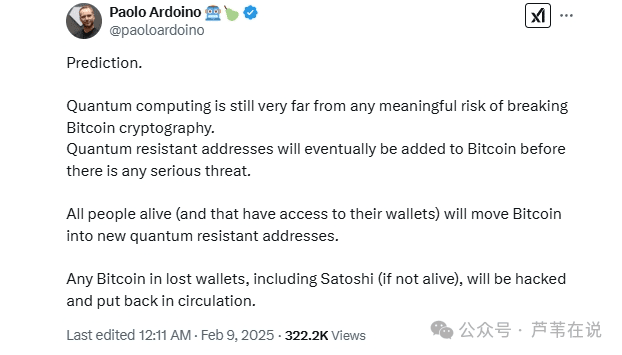
He continued:

Famous venture capitalist Chamath Palihapitiya has issued a warning on Twitter, pointing out that quantum computing poses a potential threat to first-generation encryption technologies, although the specific timeline remains unclear, and this transformation will not occur rapidly in the short term. However, assuming he is a significant holder of Bitcoin, he might foresee this risk and take preventive measures in advance.
In December 2024, Google announced a significant breakthrough: its next-generation chip Willow successfully tackled a key challenge in quantum computing. This chip is equipped with 105 quantum bits (qubits) and can solve problems that would take traditional computers a billion years to complete in just 5 minutes. This achievement not only caused a stir in the scientific community but was also reported by Nature magazine, regarded as an important milestone in the development of quantum computing.
However, advancements in quantum computing have raised concerns about the security of Bitcoin. Theoretically, quantum computers could potentially crack encryption algorithms, especially for those Bitcoin addresses that adopted the early Pay-to-Public-Key (P2PK) format. Therefore, as quantum computing continues to advance, the Bitcoin community and the entire cryptocurrency sector need to closely monitor this potential risk and take necessary measures to ensure asset security.
It is worth noting that Satoshi Nakamoto's 1 million bitcoins are stored in this format, making them a potential target for attacks.
It is understood that P2PK (Pay-to-Public-Key) is a payment format adopted in the early days of Bitcoin, characterized by the direct disclosure of the public key. In a traditional computing environment, it is nearly impossible to derive the private key from the public key. However, the development of quantum computers could upend this situation, as quantum computation can leverage Shor's algorithm to successfully deduce the private key from the public key, thereby accessing and controlling the funds in the associated Bitcoin addresses.
Emin Gün Sirer, founder and CEO of Ava Labs, conducted an in-depth analysis of this issue. He pointed out that the Bitcoin held by Satoshi Nakamoto, due to its use of the early P2PK format, may face the risk of being targeted by attackers attempting to crack it for an extended period in the future. To mitigate this potential threat, Sirer suggests that the Bitcoin community consider taking measures to freeze this portion of Bitcoin held by Satoshi Nakamoto. This proposal aims to protect the overall security of the Bitcoin network and prevent potential asset losses due to breakthroughs in quantum computing technology.
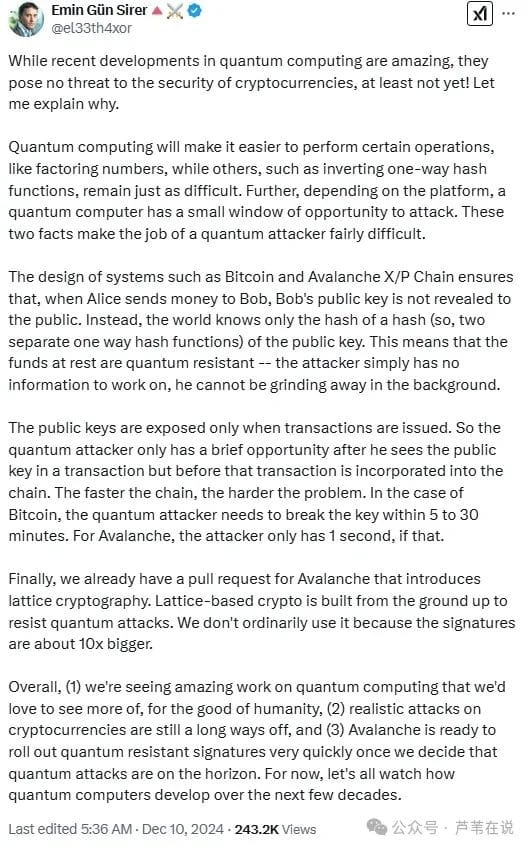
As blockchain technology evolves, the most common modern Bitcoin address format is Pay-to-Public-Key-Hash (P2PKH), which only exposes the hashed public key and can relatively effectively resist quantum attacks. Therefore, early P2PK addresses are considered the most vulnerable link in the Bitcoin ecosystem.