


Written by: 0xjs@Golden Finance
Deepseek, a technological breakthrough of “national level”, is still having an impact, and the entire Chinese assets may need to be re-evaluated.
On February 5, 2025, Deutsche Bank published a research report (China eats the World), which swept the screen among investors. Deutsche Bank said that 2025 is the year when China surpasses other countries. In 2025, China launched the world's first sixth-generation fighter and low-cost artificial intelligence system "DeepSeek" within a week. Marc Andreessens called the launch of "DeepSeek" the "Sputnik moment" of AI, but it is more like China's "Sputnik moment", marking the recognition of Chinese intellectual property rights. China's areas of excellence in high value-added fields and dominating the supply chain are expanding at an unprecedented rate. China has companies that occupy a leading position in almost every industry, and as Chinese companies expand in the global market, China's valuation discount should turn into a premium at some point in the future. Investors must shift significantly to investing in Chinese stocks in the medium term, and Hong Kong/China stocks will usher in a big bull market in the medium term.
Notably, the title of the research report borrows from a famous quote by a16z founder Marc Andreessen: 'Software is eating the world', and the first part of the report 'This is China's, not AI's, 'Sputnik moment' also draws from Marc Andreessen's recent comments on DeepSeek: 'DeepSeek is AI's Sputnik moment.'
Below is the full text of Deutsche Bank's research report:
Original Title: China Eats the World
Author: Peter Milliken, CFA, Research Analyst
This is China's, not AI's, 'Sputnik moment'
We believe 2025 will be the year the investment community realizes that China is surpassing other countries in the world. Today, it is becoming increasingly difficult to ignore the fact that Chinese companies are providing better cost-effectiveness across multiple manufacturing sectors and even in an increasing number of service sectors, often with better quality.
Investors pay a price to dominate, and we expect the 'China discount' to disappear. Moreover, due to policies favoring consumption over production, and possibly due to financial liberalization, we believe profitability is expected to exceed expectations throughout the cycle. We believe the bull market for Hong Kong/Chinese stocks began in 2024 and will exceed previous highs in the medium term.
China first emerged as a leader in global clothing, textiles, and toys. Subsequently, it took the lead in basic electronics, steel, shipbuilding, and recently in white goods, solar energy, and other less prominent fields.
China has also unexpectedly dominated industries such as complex telecommunications equipment, nuclear power, national defense, and high-speed rail. These technological achievements have not been valued by investors before.
By the end of 2024, China will be in the spotlight for rapidly rising to become the world's leading exporter of automobiles, with a large number of feature-rich, attractive, and competitively priced electric vehicles flooding the global market.
In 2025, China launched the world's first sixth-generation fighter jet and low-cost artificial intelligence system 'DeepSeek' within a week.
Marc Andreessen referred to the launch of 'DeepSeek' as AI's 'Sputnik moment', but it is more like China's 'Sputnik moment', marking the recognition of Chinese intellectual property rights. China's performance in high value-added fields and dominance in supply chains is expanding at an unprecedented pace.
We believe global investors often significantly underweight Chinese assets, just as they avoided fossil fuels a few years ago until the market punished those who made non-market-oriented decisions. We see that today, funds have minimal risk exposure to China. Investors who prefer leading companies with moats cannot ignore this: the companies with broad and deep moats today are Chinese companies, not their economically perceived superior Western counterparts.
China's manufacturing strength is evident, with its merchandise exports being twice that of the U.S. China contributes 30% of global manufacturing value added, and its share in the service sector is rapidly increasing. People have avoided China as an investment destination due to concerns about a weak Chinese economy, but despite periodic economic slowdowns, China's growth rate remains more than twice that of most developed markets.
With companies leading in nearly every industry, China's share of global market value is unlikely to remain in single digits for long. We believe that people are gradually recognizing that today's China is akin to Japan in the early 1980s, when Japanese companies were climbing the value chain, producing higher quality goods and continuously innovating. Many Western companies and industries may face a potential survival crisis and thus need to realign their investment portfolios to reflect this.
For survival, Western companies will need: 1) large-scale automation; and/or 2) to set trade barriers. In the past, the second path was a downhill trajectory for economies, although this is happening, it may not necessarily help the West. For example, in the automotive sector, China's major export markets are often the approximately 7 billion people outside the G10 countries.
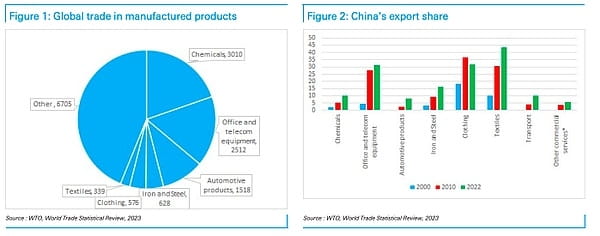
Figure 1: Global Manufactured Goods Trade Figure 2: China's Export Share
Observing the major categories of international trade, China occupies a share in all categories except clothing (which China dominated before expanding its business overseas). In key commodity categories, China's scale is larger than that of the United States and often by several multiples. The only exception is automobiles (which refers to value rather than quantity), but China is likely already ahead — Ford's CEO drives a Xiaomi car, and it’s hard to see how this trend will change. Even in the service sector, China is catching up, for instance, in transportation services, with a share increasing by about 0.5 percentage points each year.
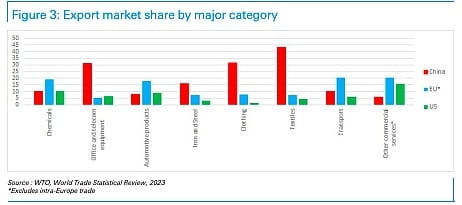
Figure 3: Major Category Export Market Shares
Using patents as a proxy indicator for intellectual property
China has a complete value chain and has formed professional clusters locally, possessing multiple specialized fields similar to Silicon Valley in key industries and closely collaborating with domestic universities in research.
In the electric vehicle sector, China holds about 70% of patents, and is similarly positioned in 5G and 6G telecommunications equipment.
In 2023, China's patent applications accounted for nearly half of the global total. With the number of STEM graduates in China exceeding that of all other countries combined, except India, this trend may continue. Furthermore, many graduates from other countries are also Chinese. Therefore, unless extraordinary circumstances arise, the rise of Chinese companies' dominance is unlikely to be halted in the short term.
China does face trade barriers, as evidenced by tariffs on electric vehicles imposed by the U.S. and EU, but the West is constrained in its actions because it needs to consider the potentially more severe consequences (such as inflation, decreased competitiveness, and retaliation). In the 1980s, the U.S. attempted to suppress Japan's development and achieved some success, but we believe China's situation today is not that of Japan in 1989, but rather more like Japan a few years prior.
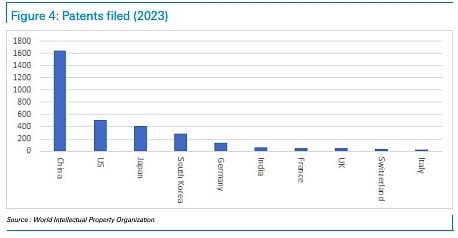
Figure 4: Number of Patent Applications in 2023
China vs. Japan in the 1980s
Throughout the 1970s, Japan's Gross National Product (GNP) ranked second in the world, only behind the United States. After consulting Wikipedia, we were surprised to find that Japan's actual GDP annual growth rate in the 1980s was only 4%, but this was still regarded as an important component of its economic 'miracle'. In contrast, today people are anxious about whether China's economic growth rate is 4% or 5% and consider this growth rate 'slow', but in retrospect, this view may evolve into seeing it as a 'miracle'.
(Plaza Accord) required a 40% appreciation of the yen, which slowed Japan's industrial leadership advantage. This led to an economic slowdown, and the Japanese government responded with loose monetary policy. From 1987 to 1989, economic growth recovered to 5%, during which the stock market rose sharply, resulting in a bubble. The recovery of economic growth spurred a revival in the steel and construction industries, increasing wage levels and employment. By the late 1980s, domestic demand rather than exports became the driving force of economic growth. This could also happen in China.
Japan in the 1980s
According to Wikipedia, Japan's economic growth was achieved through the input of a large amount of cheap labor, intensive use of capital, and improvements in productivity. Domestic investment accounted for over 30% of GDP, and financial repression kept interest rates low, facilitating investment. Japan acquired new technologies through joint ventures. In the early 1970s, Japan's savings rate reached 40% of GDP, dropping to nearly 30% by the early 1980s. In the 1970s, Japan began to set up factories overseas to avoid trade friction. China only began to take similar measures recently.
The question is: At what stage is China on this development path? Like Japan, China has experienced a real estate bubble, but to a far lesser extent. Furthermore, it has been six years since credit tightening began and the real estate industry started to decline. House prices have fallen by a third, mortgage rates have halved, and nominal GDP has grown by about a third, restoring housing affordability to a level not seen in years. Due to lower profit margins and lower price-to-earnings multiples, stock market valuations are also low. Thus, this is not Japan in a bubble in 1989 (when the Japanese stock market's market value grew 50-fold over 20 years).
It is commonly believed that China will not follow Japan's consumption-driven economic development path and will only fall into economic stagnation like Japan. But in reality, China is on a path traversed by the U.S., Japan, Singapore, Hong Kong, Taiwan, South Korea, Spain, and many countries and regions in Eastern Europe. Other countries and regions struggle in the middle income trap, but unlike them, China has become a leader in global manufacturing and an increasing number of service sectors.
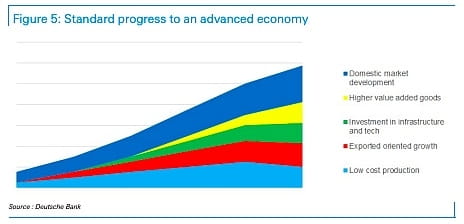
Figure 5: Progress Towards Developed Economy Standards
Japan achieved financial system liberalization around this time.
Chapter 12 of the 2013 report from the International Monetary Fund (China's Economic Transformation) mentions that Japan in the 1980s shares similarities with China's future development path. Before the Plaza Accord, Japan's financial system was highly regulated, interest rates were controlled, and capital controls were strict. Due to ample corporate funding, demand for bank credit was limited. Japanese investors held a large amount of U.S. assets, and coupled with the depreciation of the yen, this led to calls for Japan to open its financial markets and enhance the attractiveness of yen-denominated assets. This, in turn, resulted in capital inflows to Japan, an increase in money supply, thus driving economic growth and asset bubbles.
China may also be moving in a similar direction. President Trump may follow President Reagan's approach, pushing for financial liberalization in trade agreements with China, and China may also be ready to accelerate the internationalization of the renminbi. We believe this is good news for the stock market, as the renminbi may depreciate, which from a foreign exchange perspective, would enhance corporate profitability and the attractiveness of Chinese assets. Why would the U.S. push this? Reasons may include: 1) Political considerations in reaching an agreement; 2) The belief that renminbi depreciation can offset the impact of tariffs, allowing trade to continue and tariffs to be collected, rather than crowding out trade; 3) The belief that financial liberalization would lead to renminbi appreciation, thus weakening China's competitiveness.
Regardless of external pressures, if China wants to promote consumption, financial system liberalization would help by normalizing interest rates and ending the wealth transfer from savers to companies. This would reduce over-investment and vicious competition as capital would be reasonably allocated, benefiting corporate profitability and alleviating fiscal pressure, as the return rates of state-owned enterprises would improve. We expect that large enterprises, investment firms, and households will increasingly pressure the government to alleviate vicious competition to enhance stock market value. Just as the government previously slowed down excessive investment in infrastructure and real estate, curbing industrial over-investment will clearly be the next step and may occur sooner than expected. We anticipate this will be a key topic in 2025, calming the U.S. and meeting the demands of the situation, and we expect this will drive a significant bull market.
But what impact does the decline in China's population have?
The decline in China's population poses a drag on economic growth, but many countries face this issue. We believe this completely overlooks an important fact: China has two advantages: 1) automation leadership, with about 70% of the world's industrial robots installed in China, bringing productivity advantages and thus enhancing per capita wealth; 2) a vast potential market, with the 'Belt and Road' initiative incorporating Central Asia, West Asia, the Middle East, and North Africa into its development trajectory, expanding market potential.
The Central Asian region, with a population of only 80 million, is resource-rich; the population of West Asia is 310 million and is relatively affluent. South Asia has 2.1 billion people (though two-thirds of them are in India, which currently largely restricts trade and investment with China, but this may change in the medium term). Additionally, there is Africa, with 1.4 billion people. In other words, the potential consumption population in Africa is comparable to that of China, while the potential consumption population in Central Asia, West Asia, and South Asia (excluding India) is comparable to that of ASEAN and Latin America. If China-India relations improve, India's potential consumption population will also become a massive market. Therefore, focusing solely on China's domestic population situation may lead to erroneous conclusions about China's future.
In 2024, China's exports grew by 7%, with exports to Brazil, the UAE, and Saudi Arabia increasing by 23%, 19%, and 18% respectively, and exports to ASEAN countries along the 'Belt and Road' growing by 13%. Currently, China's exports to ASEAN and BRICS+ are comparable to its exports to the U.S. and EU, with market share in these destinations increasing by nearly two percentage points each year over the past five years. Even in Latin America, China is rapidly expanding its market. Therefore, while high tariffs imposed by the U.S. would harm China, Deutsche Bank's economic team believes that if the U.S. imposes a 10% tariff in the first half and the second half of the year, given that U.S. exports account for 3% of China's GDP, this would bring a controllable shock of 0.5% downward pressure on China's GDP.
The downside of China's export dominance is that many major countries, even within BRICS+, have taken protectionist measures, thus limiting China's export growth to some extent. However, due to its advantages in intellectual property and manufacturing value added, Chinese companies are likely to expand their international influence through setting up factories in other markets or exporting components for assembly. The weaponization of the dollar makes investing in overseas infrastructure and factories more attractive than investing in U.S. Treasury bonds, so the future direction is quite clear.
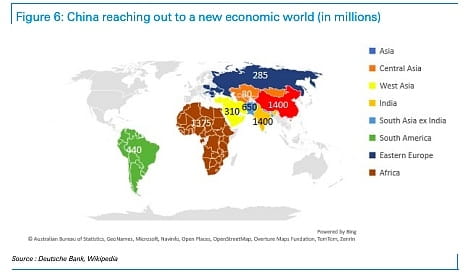 Figure 6: China's Expansion into New Economic Markets (Unit: Millions)
The China-U.S. trade issue may welcome unexpected benefits.
The market generally expects that the U.S. tariffs on China will be higher than Deutsche Bank's expectations (we anticipate a 20% tariff implemented in two steps by 2025, with one step already announced). However, the actual situation may be much more optimistic than this pessimistic expectation.
The Trump administration was clearly keen on using tariffs as a source of fiscal revenue and viewed China as a primary source of tariff income for economic and strategic reasons. However, President Trump seems to place more emphasis on tactical victories than on ideologically difficult-to-support positions. In our industry, there are investors and there are traders. In recent years, the influence of traders has been increasing. Perhaps President Trump is more of a political 'trader' than an ideologically steadfast 'investor'. If so, it is expected that he would set strict stop-loss points.
'DeepSeek's' emergence shatters the Western fantasy that it could contain China. The U.S. would be better off stimulating business development by lowering regulations, providing cheap energy, and lowering import barriers for intermediate products that cannot compete domestically. The last point may take longer to achieve, but we expect that members of the U.S. House of Representatives, Senators, and business leaders will generate internal demands that prompt the U.S. to return to traditional Republican positions on trade issues. This may require some back-and-forth negotiations, but this analyst expects that a more trade-friendly stance will eventually become part of the 'America First' agenda before the midterm elections.
We believe a political 'trader' will seek to lock in results early, thus a China-U.S. trade agreement may be reached in the first half of 2025, shifting focus to affairs in the Western Hemisphere. A quickly reached agreement could include limited tariffs (as anticipated by Deutsche Bank), the lifting of some existing restrictions, and some large contracts between Chinese and U.S. companies. If this occurs (this analyst believes it will), the Chinese stock market is expected to climb.
Trade and market trends are not closely related.
Historically, trade and economic power have always been complementary. Therefore, we were surprised to find that few studies link exports to stock market performance. However, China's exports are closely related to global money supply growth, which has been rising but is currently slowing. When we prompted Deutsche Bank's AI platform to search for relevant research, it told us: 'Some studies suggest that export growth can enhance corporate earnings, thereby boosting stock valuations... (but) some studies also indicate that focusing solely on export growth may sometimes come at the expense of domestic demand, potentially hindering overall economic growth and negatively impacting the stock market.'
Thus, paradoxically, a decline in exports may actually drive stock markets up for a time. China's rise in various industries is accompanied by over-investment in many fields. In the solar energy sector, efforts are currently underway to reduce supply, and if other industries follow suit, this could be good news for the stock market and may release some funds for domestic consumption.
The growth rate of Chinese household deposits has slowed to twice the nominal GDP growth rate, but since 2020, Chinese household savings have increased by $10 trillion, and we expect these savings will be largely used for consumption and investment in the stock market in the medium term. Therefore, Hong Kong/Chinese stocks have significant upside potential in terms of accelerated earnings growth and price-to-earnings ratio revaluation.
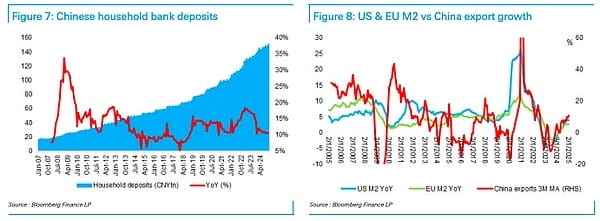
Figure 7: Chinese Household Bank Deposits Figure 8: Comparison of U.S. and EU M2 with China's Export Growth
Valuation for market leaders
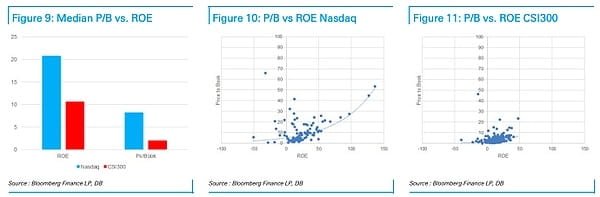
Figure 9: Comparison of Median Price-to-Book Ratios and Return on Equity Figure 10: Comparison of NASDAQ Price-to-Book Ratios and Return on Equity Figure 11: Comparison of CSI 300 Price-to-Book Ratios and Return on Equity
The problem with investing in the technology sector is that profits tend to be concentrated in the hands of market leaders, leading companies to compete fiercely for that position. Chinese investors are fully aware of this issue, but leading tech stocks like Amazon have also faced similar situations. If we compare the CSI 300 Index with the NASDAQ Index, both of which contain globally leading companies in their respective fields, we find that the return on equity (ROE) of U.S. companies is twice that of Chinese companies, but investors pay four times the price-to-book ratio (P/B) for U.S. companies (8.2 times compared to 2.0 times). Most large Chinese stocks are also listed in Hong Kong, where they are typically about 40% cheaper, close to a P/B of 1. If we look at the MSCI China Index, it is at a record discount of 10 percentage points compared to the world index, also nearing the lower end of its valuation range.
As Chinese companies expand in global markets, this valuation discount seems poised to shift to a premium at some point in the future. We believe that investors must significantly pivot towards investing in Chinese stocks in the medium term, and it may be difficult to acquire these stocks without pushing up their prices. We have always been optimistic about the Chinese stock market, but previously struggled to find the factors that would awaken the world to buy Chinese stocks, and we believe that China's 'Sputnik moment' (or events like dominance in the electric vehicle sector) is that factor. We anticipate that the Hong Kong/China stock market will continue to lead in the medium term, as it did in 2024.
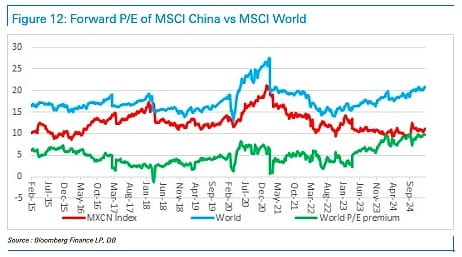
Figure 12: Comparison of MSCI China Index and MSCI World Index Expected Price-to-Earnings Ratios
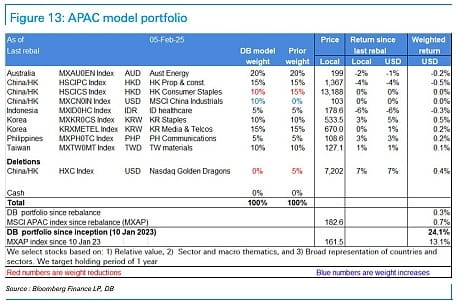
Figure 13: Asia-Pacific Portfolio Model