


In a recent interview with Fox News, President Trump’s appointed “cryptocurrency czar” David Sacks discussed the possibility of establishing a Strategic Bitcoin Reserve in the United States. The move comes amid growing interest in cryptocurrencies in political circles and follows discussions between Sachs and Senator Cynthia Lummis, one of the most prominent advocates of cryptocurrency legislation. .
NEW: President Trump’s Crypto Czar, David Sacks, confirms on Fox News that they are exploring a Federal Strategic#BitcoinReserve. pic.twitter.com/vNiGouSZkT
— Swan (@Swan) January 30, 2025
United States: Actively studying strategic Bitcoin reserve proposals
Sachs stressed that the government is studying the plan, which could constitute a major policy shift, and described the strategic Bitcoin reserve as a move that would allow Bitcoin to become part of a country’s reserves, similar to gold or other commodities. He said the move could serve as a hedge against inflation, while also acknowledging the growing importance of digital currencies in the global financial system. "We view Bitcoin not only as an asset, but also as a strategic reserve of the country," Sachs said in the interview.
Senator Cynthia Loomis, who has been active in promoting the integration of cryptocurrencies into the U.S. financial system, has worked with Sachs to promote the initiative. Loomis has expressed optimism in multiple forums and hopes that legislation related to Bitcoin reserves can be passed within the first 100 days of President Trump’s term. She is currently drafting a bill to advance the plan, emphasizing that the United States should adapt to the development trend of the digital economy.
EU: Rejection of Bitcoin Reserves
In stark contrast to the United States, which is discussing the establishment of a strategic Bitcoin reserve, the European Central Bank (ECB) is strongly opposed to including Bitcoin in its reserves. European Central Bank President Christine Lagarde recently made it clear that she is confident that Bitcoin will not enter the reserves of any EU member state.
Lagarde stressed that "reserves must be liquid, safe and stable," and that Bitcoin's high volatility and its potential link to illegal activities (such as money laundering) make it unable to meet these standards.
Asia: Bitcoin reserves have emerged
Asia is showing a more diverse and increasingly positive stance on Bitcoin reserves.
Hong Kong: Legislative Council member Ng Kit-chung called for the inclusion of Bitcoin in Hong Kong’s financial reserves to enhance economic resilience and stability and make full use of the flexibility provided by the “one country, two systems” framework.
Japan: Member of Parliament Satoshi Hamada proposed the idea of establishing a strategic Bitcoin reserve to the Japanese parliament, emphasizing that Bitcoin can play the role of a financial safety net during economic challenges.
Thailand: Thailand has also begun to use Bitcoin as one of its reserve assets to support the development of digital currency, with Phuket Province as a pilot province to conduct trials, demonstrating the Thai government’s positive attitude towards cryptocurrencies.
Bhutan: Bhutan became the first country to officially adopt a strategic Bitcoin reserve. This move has attracted the attention of other Asian countries and may even set off a wave of "national FOMO (fear of missing out)" effect.
These regional developments show that Asia’s acceptance of Bitcoin as a legitimate asset class is growing, which contrasts with the EU’s conservative stance and may also push the global economic landscape toward a more diversified digital currency.
Current Status of Bitcoin Reserves in El Salvador
El Salvador has been a pioneer in the Bitcoin space, officially making it legal tender in 2021. Recent developments have revealed a significant increase in the country’s Bitcoin reserves, with the government now holding around 6,000 Bitcoins, valued at around $569 million. The accumulation is part of President Nayib Bukele’s push for Bitcoin as a means of economic diversification and financial inclusion, despite pressure and criticism from international institutions such as the International Monetary Fund (IMF). Reliance on cryptocurrencies should be reduced.
However, in a significant policy shift, El Salvador has recently reached an agreement with the IMF to scale back its Bitcoin program, especially in the context of seeking to obtain a $1.4 billion loan. This includes making bitcoin adoption voluntary for businesses and phasing out government involvement in the Chivo digital wallet. Despite these concessions, El Salvador has reiterated that it will continue to purchase Bitcoin for its strategic reserves, and Stacy Herbert, director of the country’s National Bitcoin Office, even hinted in a post on the X-platform that the country might Speed up your purchases.
Polymarket Prediction Market Betting
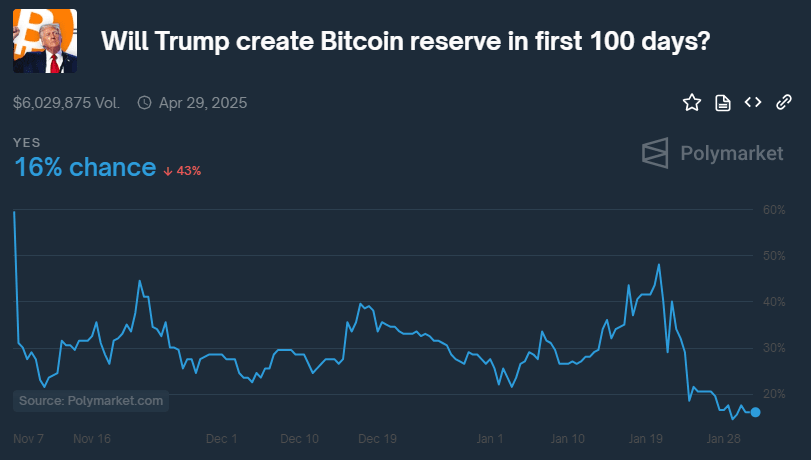
The prospect of a strategic Bitcoin reserve has generated a lot of attention in the prediction markets. On the Polymarket prediction platform, the odds on President Trump ordering the creation of a Bitcoin reserve within his first 100 days in office currently show the market predicting a 16% chance of this happening. This figure reflects the market's cautious optimism about the policy, but also acknowledges the complexity and political obstacles of cryptocurrency regulation and policy making.
Market reaction and future impact
The cryptocurrency community and financial markets reacted differently to this development. Bitcoin prices have fluctuated as some investors bet on the legitimacy and stability that official U.S. support for the digital currency could bring. At the same time, the EU’s explicit rejection of Bitcoin reserves has introduced new variables into the market, while Asia’s positive attitude may lead to a gradual shift of the global cryptocurrency market’s center of gravity to the East.
Cryptocurrency analysts point out that while establishing a strategic reserve may increase the credibility of Bitcoin, it also brings a series of problems such as supervision, security, and reserve management methods. "This is not just a question of holding Bitcoin, it's also about infrastructure, policy framework, and how to ensure it is in the national interest," said an analyst at a leading crypto investment firm.
Political and economic background
The United States' push for a bitcoin reserve plan comes as it seeks to reshape its global influence in the tech sector, especially in emerging technologies. Critics say it could be a political ploy to appeal to tech voters or a way for the U.S. to gain a leading position in the global cryptocurrency market. Supporters, however, see it as an important step in embracing the future of finance.
At the same time, under the leadership of Lagarde, the European Union has adopted a more conservative regulatory stance on digital assets, emphasizing stability and compliance. This divergence in U.S. and European policy, combined with Asia’s growing activism, could lead to a bifurcated regulatory environment for the global cryptocurrency market, with one side promoting innovation and the other tightening regulation.
Conclusion: The trend still needs to wait and see the attitude of the United States
The discussion about a strategic bitcoin reserve, prompted by Sacks’ interview and Loomis’ legislation, highlights the possibility of a major shift in U.S. cryptocurrency policy. However, the EU's firm opposition and the different strategies of many Asian countries have put the global cryptocurrency market at a critical moment. Polymarket’s market forecast reflects the expectations and caution of market participants, and future policy decisions may become a decisive factor in shaping the global cryptocurrency landscape.
"Is national Bitcoin reserve possible? Learn about the progress of cryptocurrency reserves in countries around the world in 2025" was first published on (Block Guest).