
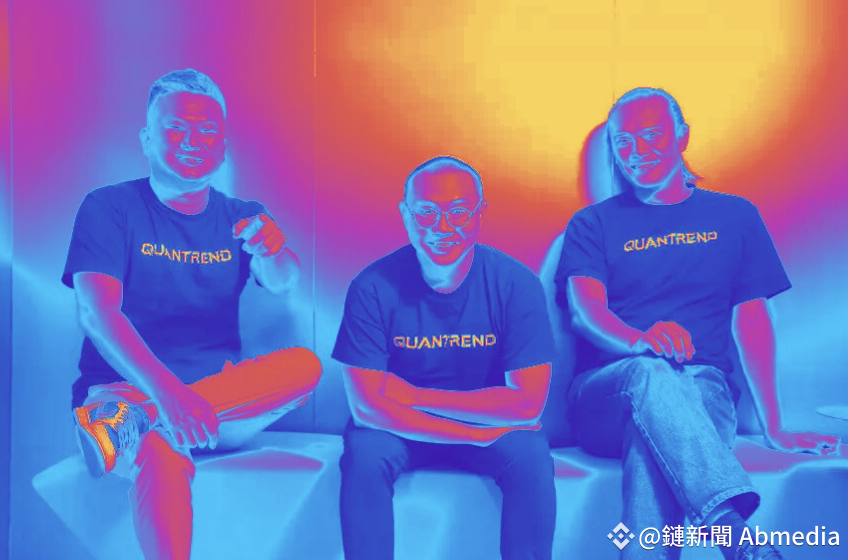


Chen Taiyuan, a continuous entrepreneur who founded the Taiwanese exchange Cobinhood, has recently sparked controversy again after going through ups and downs. The protocol supported by Quantrend, Quantland, issued a liquidation announcement on January 24, causing investors to believe that the platform tokens purchased through ICO incurred losses due to the product's termination. Quantland also released a corresponding announcement.
Quantland issued a liquidation announcement, the low-priced buyback of QLT tokens has attracted controversy
Quantland claims that due to the stricter compliance requirements implemented from November 30, 2024, under the revised (Anti-Money Laundering Law) and related regulations, the Quantland team initiated the project liquidation process on December 1, 2024, and ceased all virtual asset services in Taiwan. This liquidation is managed by a professional accounting and legal team, aimed at maximizing the protection of QLT holders' interests.
Quantland financial overview and buyback mechanism
The announcement claims:
Financial status: As of November 30, 2024, the fund balance is 2.83 million USDC, with a net asset of 990,000 USDC after costs.
Buyback price: After liquidation is completed, all circulating QLT will be bought back at a price of 30.36 USDC each, based on net assets and post-liquidation circulating supply.
QLT buyback process
Preparation phase:
Claim airdrop rewards and release QLT staking.
Submit information (deadline February 9, 2025):
Fill out the liquidation participation form, providing a contact email, QLT wallet address, and identity verification information.
Return QLT and sign the agreement (deadline February 24, 2025):
After receiving identity verification approval, return QLT to the designated wallet address, confirm the quantity, and sign the buyback agreement.
Review and fund distribution:
After liquidation is completed, equivalent USDC will be distributed to QLT holders' wallets at the buyback price, and the airdrop rewards for November 2024 (a total of 50,000 USDC) will be distributed.
User dissatisfaction: Buy at 120, buy back at 30?
In response to this announcement, some users expressed: 'Quantland announced liquidation rules today, with each QLT being bought back at a price of 30 USDC. The ICO price for QLT was 120 USDC. Currently, the holder group has exploded, and according to group members, a reasonable buyback price should be 86 USDC. The team is suspected of transferring Quantrend's expenses onto Quantland's account. The Quantland team has not yet responded directly.'
Community questioning: Does this mean we can only take a loss?
Quantland claims it is a decentralized asset growth platform based on Ethereum, centered around its native token QLT, and the value is supported by stablecoins USDC in the Quantland treasury. Through diversified investment strategies, it manages assets to maximize profits and distributes a portion of the fund's growth to QLT holders in the form of airdrops each month.
Its public documents state that Quantland collaborates with Quantrend Technology, utilizing AI-driven trading strategies to achieve an annualized asset return of 40-80%, further enhancing the foundational value of QLT.
Faced with the delisting of QLT (the official does not actively support liquidity), the community expressed, 'Does this mean we can only take a loss?'
Quantland responds: Based on regulatory compliance
Quantland stated to Chain News: 'The Quantland team clarifies that the decision to liquidate this project was not intentional, but a response to the recent implementation of anti-money laundering regulations in Taiwan. To ensure comprehensive legality and compliance, we regrettably had to halt all services. At this moment of gradual market recovery, making such a decision truly saddens us. We have announced the cessation of operations on December 6, 2024, on the official Discord platform and have initiated relevant liquidation procedures. Currently, the liquidation operations are being advanced by a professional accounting and legal team, with the latest updates expected to be announced by the end of January. Thank you once again for your patience and understanding.'
The flood of private equity funds packaged as DeFi: a major regulatory loophole, do investors just have to consider themselves unlucky?
Centralized operations under the guise of 'decentralization'
Quantland positions itself as a 'decentralized asset growth platform based on Ethereum', but it still has the following centralized features in its operational model:
Fund management: Quantland's financial situation shows that the treasury is supported by the stablecoin USDC, which is essentially centralized management.
Decision-making authority: Buyback prices, liquidation procedures, etc., are decided unilaterally by the team, lacking community governance or automated mechanisms that should be present in decentralized protocols.
Return promises: The official claim of achieving an annualized return of 40-80% through AI-driven trading strategies is a characteristic typically associated with private equity funds rather than the typical risk narrative of on-chain protocols.
These factors indicate that Quantland is more like a traditional asset management institution packaged with blockchain technology, rather than a true decentralized protocol.
Token functionality design: More like a security
Does the QLT token have actual functionality? Or does it serve more as a role similar to private equity fund shares? Here are the relevant observations:
Insufficient functionality: According to the announcement, the value of QLT is supported by USDC in its treasury, with no mention of unique functions or governance rights for QLT in the protocol.
Revenue sharing: The 'monthly airdrop income' received by QLT holders resembles the dividends of limited partners in private equity funds, with tokens serving merely as a medium.
Buybacks and liquidation: The method of ending operations through token buybacks is very similar to how private equity funds distribute remaining assets at the end.
This indicates that the QLT token may be more of a security token rather than a true utility token.
It seems like a private equity fund
The operation of Quantland is similar to several characteristics of private equity funds:
Centralized management: Funds are controlled by the team and operated using professional trading strategies.
High return promises: Claiming an annualized return of 40-80%, consistent with typical methods used by private equity funds to attract investors.
Limited transparency: Although some financial data has been provided, the details are insufficient, with no public disclosure of specific fund operations or audit reports.
Risk concentration: Changes in market or policy directly affect investors' interests, rather than dispersing risk through smart contracts and decentralized mechanisms.
Is it really based on regulatory risk?
Quantland cited compliance pressure from Taiwan's (Anti-Money Laundering Law) during liquidation, which may be true, but could also be:
Excuse for avoiding responsibility: Is the company using regulations as a reason to prematurely end projects to avoid further financial and operational pressure?
Cover for packaged financing: Using blockchain technology and decentralization as a facade to attract investors to participate in high-risk investments.
If Quantland indeed uses ICO as a means to raise funds for centralized management and attracts investors with returns, then this is closer to the operations of unregulated private equity funds, which may involve legal and compliance risks. A deeper investigation (such as audit reports and legal documents) will help further confirm its nature.
This article discusses the controversies surrounding continuous entrepreneurs in Taiwan! Quantland platform token QLT is being delisted during liquidation, with DeFi covering private equity fund regulatory loopholes. First appeared in Chain News ABMedia.