


Original author: Jiang Haibo
Original source: PANews
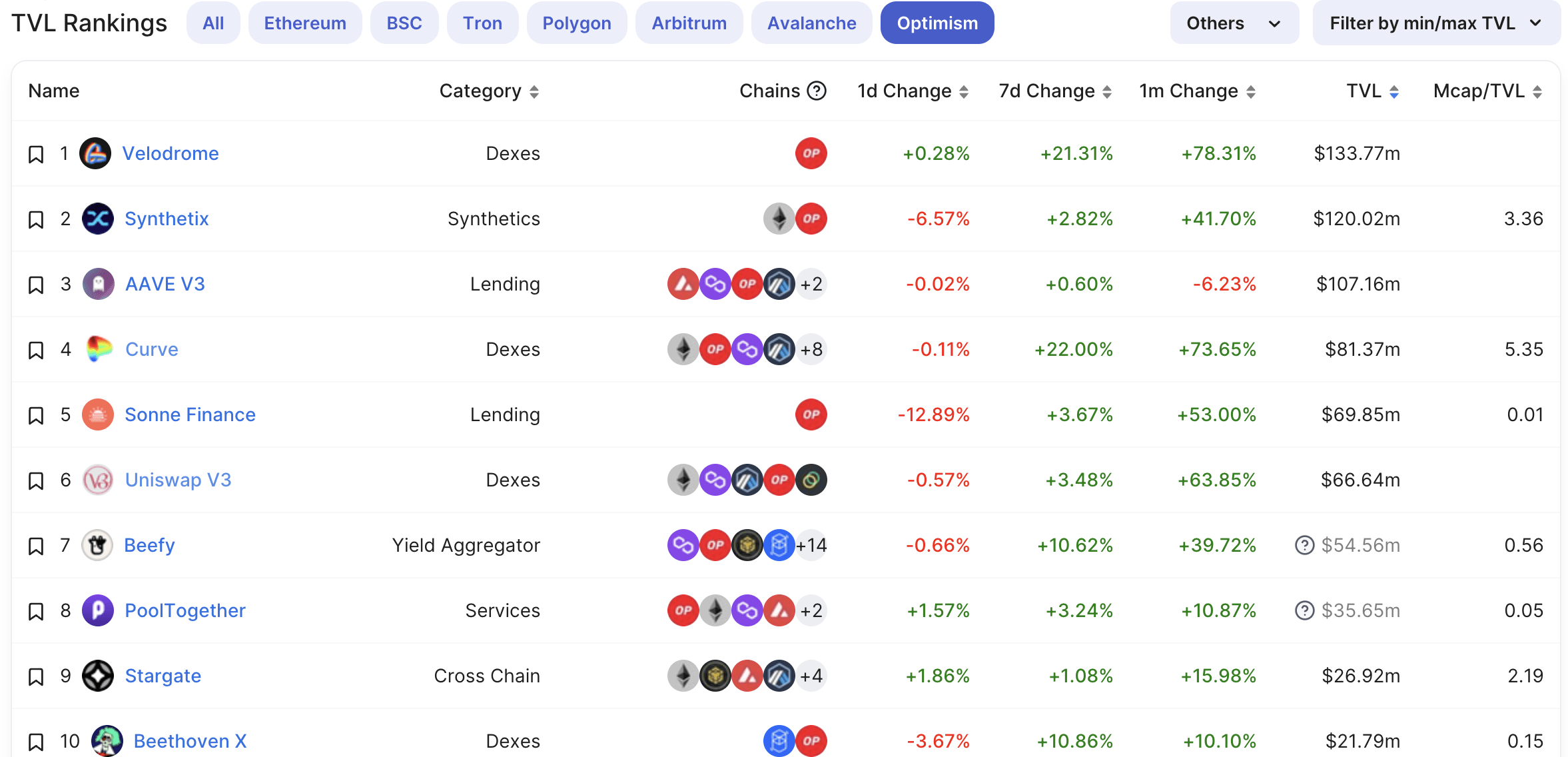
Velodrome, a native DEX on Ethereum’s second-layer Optimism, had a TVL of $133 million as of January 29, an increase of 78.31% in the past month. Both in terms of TVL quantity and growth rate, it has surpassed top multi-chain DeFi projects such as Aave, Curve, and Uniswap on Optimism. When top projects have moats, it is increasingly difficult for native projects to develop. So what gives Velodrome such an advantage?
Velodrome’s ve(3,3) mechanism
Velodrome was adapted by the veDAO team from Solidly launched by Andre Cronje's team, with some modifications made on this basis. The token design also refers to Solidly's (3,3) mechanism.
There are two tokens in Velodrome: VELO is an ERC-20 token used to reward liquidity providers; after locking VELO, you will get veVELO (also known as veNFT), which is an NFT governance token . The ve prefix comes from vote-escrowd in Curve veCRV, which means vote hosting. Designing veVELO in the form of NFT also solves the problem that pledged tokens cannot be traded, but veVELO NFT has no liquidity in the secondary market.
The ve mechanism was first adopted by Curve to strengthen incentives for long-term token holders; (3,3) Game theory was designed by Olympus DAO. When everyone pledges tokens instead of selling, everyone’s income will be higher. high.
Among the major players in Velodrome, traders’ transaction fees in Velodrome are only 0.02% to 0.05%. Even without the liquidity aggregation of Uniswap V3, traders may have a better experience due to lower fees.
For liquidity providers, there is no transaction fee income in common AMMs, and they completely rely on Velodrome’s mining reward VELO.
Holders of veVELO can obtain four rights: governance rights, which determine the weight of VELO allocated to each liquidity pool; all transaction fees; all bribery rewards; and reducing the dilution of voting rights through rebase.
Then, the more bribes and transaction fees there are in Velodrome, the higher the income of veVELO holders, the price of VELO may rise, the increased income of liquidity providers attracts more liquidity, and better liquidity further improves Transaction fee income creates a flywheel effect.
The initial supply of VELO tokens is 400 million, 60% of which are allocated to the community, including WEVE holders, Optimism users and DeFi users on other chains. The remaining 40% is allocated to partner projects, the Velodrome team (part of the tokens are used to lock and vote for the VELO trading pair), the Optimism team, and the initial liquidity pool.
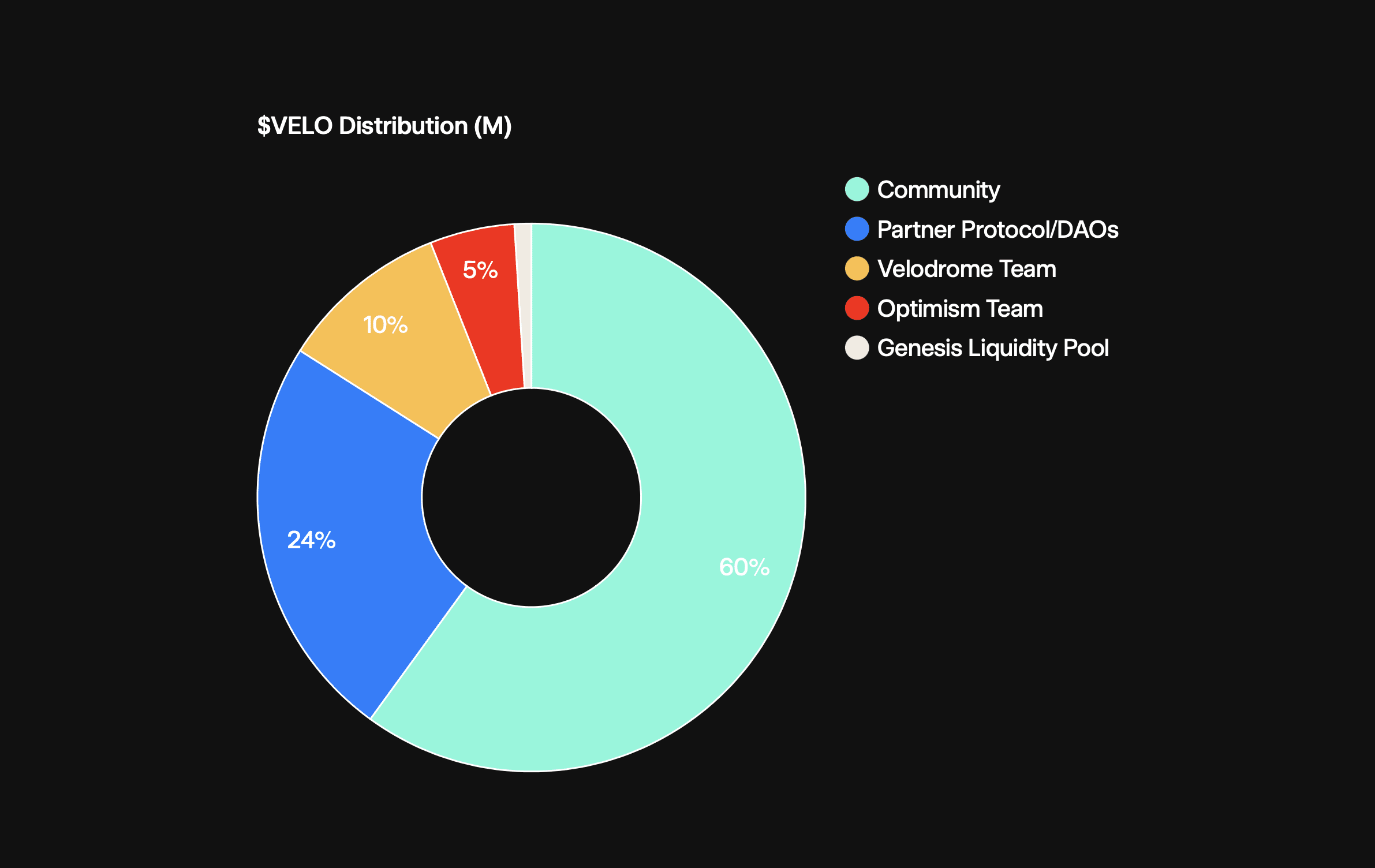
Tokens allocated to liquidity providers decrease weekly, starting with 15 million VELO (3.75% of the initial supply) in the first week, with the total supply expected to reach 1.8 billion VELO over 200 weeks.
VELO pledge and veVELO holding status
From the above situation, we can know that VELO, like CRV, is an asset that will experience long-term inflation. Curve is crucial to stablecoins, liquid staking tokens, anchor coins and revenue aggregator projects, so each project competes to accumulate CRV, forming a "Curve War". If there is insufficient demand for VELO from participants, Velodrome will inevitably go into a death spiral. However, judging from the current situation, Velodrome is still the project with the highest TVL on Optimsim and has a tendency to form a “Velodrome Race”.
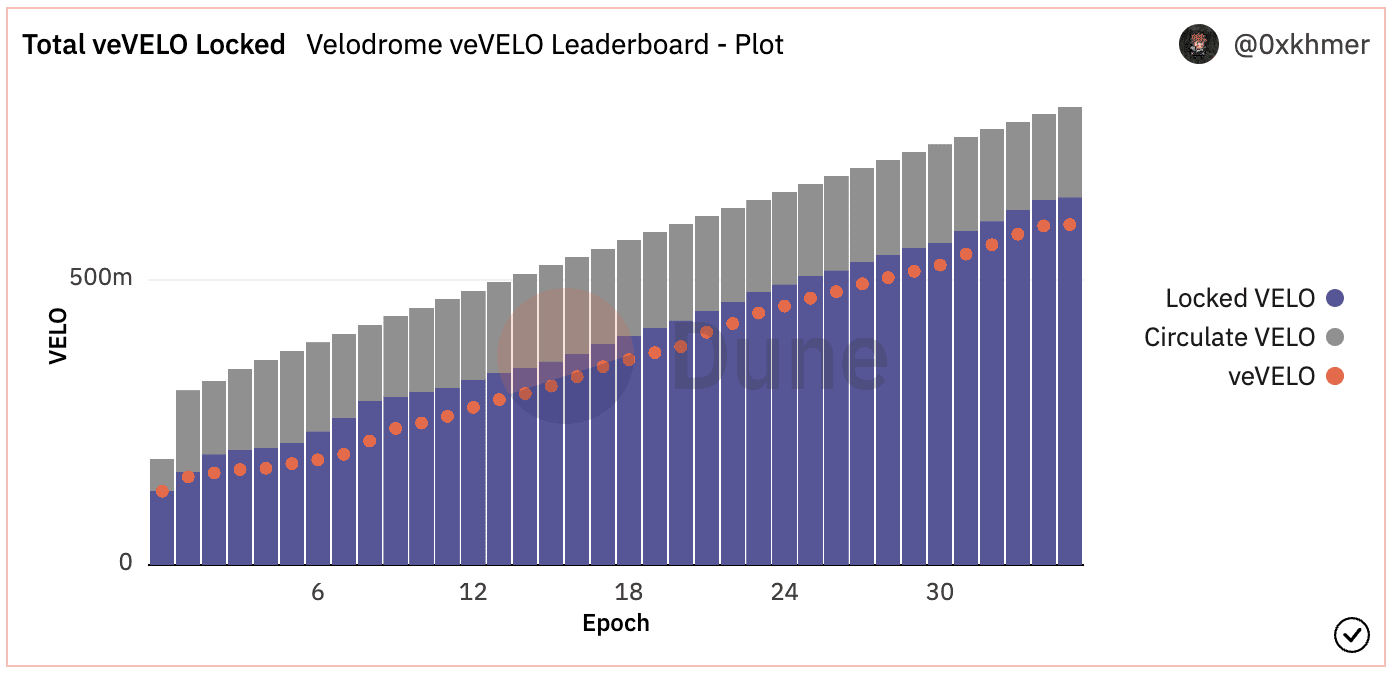
According to statistics from Dune Analytics @0xkhmer, from Epoch1 to the current Epoch35 (one Epoch per week, the start time of each Epoch is every Thursday at 8 a.m.), although the supply of VELO continues to increase, new Almost all of the VELO is used for lock-up, and the number of VELO in circulation has almost remained unchanged. At Epoch 1, the locked VELO was 163 million and the circulating VELO was 141 million; while at the current Epoch 35 stage, the locked VELO is 645 million and the circulating VELO is 157 million.
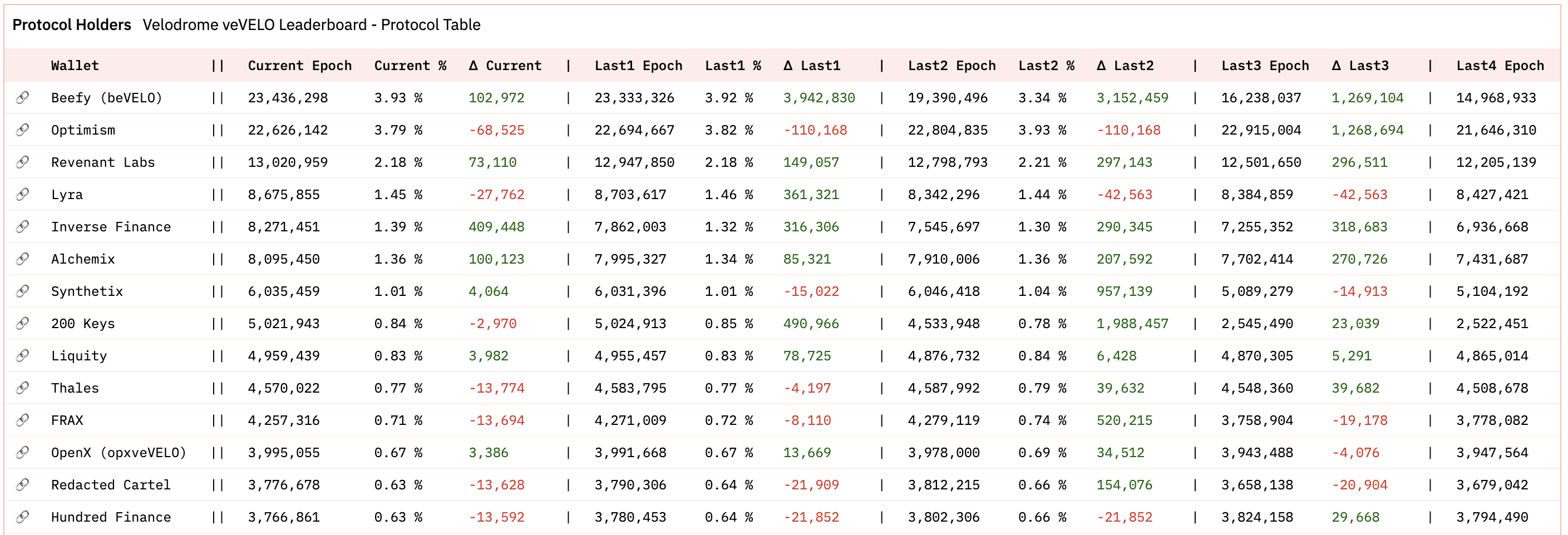
Apart from the Velodrome team, the largest holder of veVELO is Beefy, a multi-chain yield optimizer. Beefy has been accumulating veVELO since about Epoch 20. Its beVELO vault helps users automatically obtain VELO rewards and reinvest, and charges a certain fee from it. After staking VELO, users can obtain tradable beVELO tokens, which can be traded on the secondary market. Beefy also usually reserves a portion of VELO to facilitate user withdrawal. The pledge APY of beVELO is usually higher than 100%.
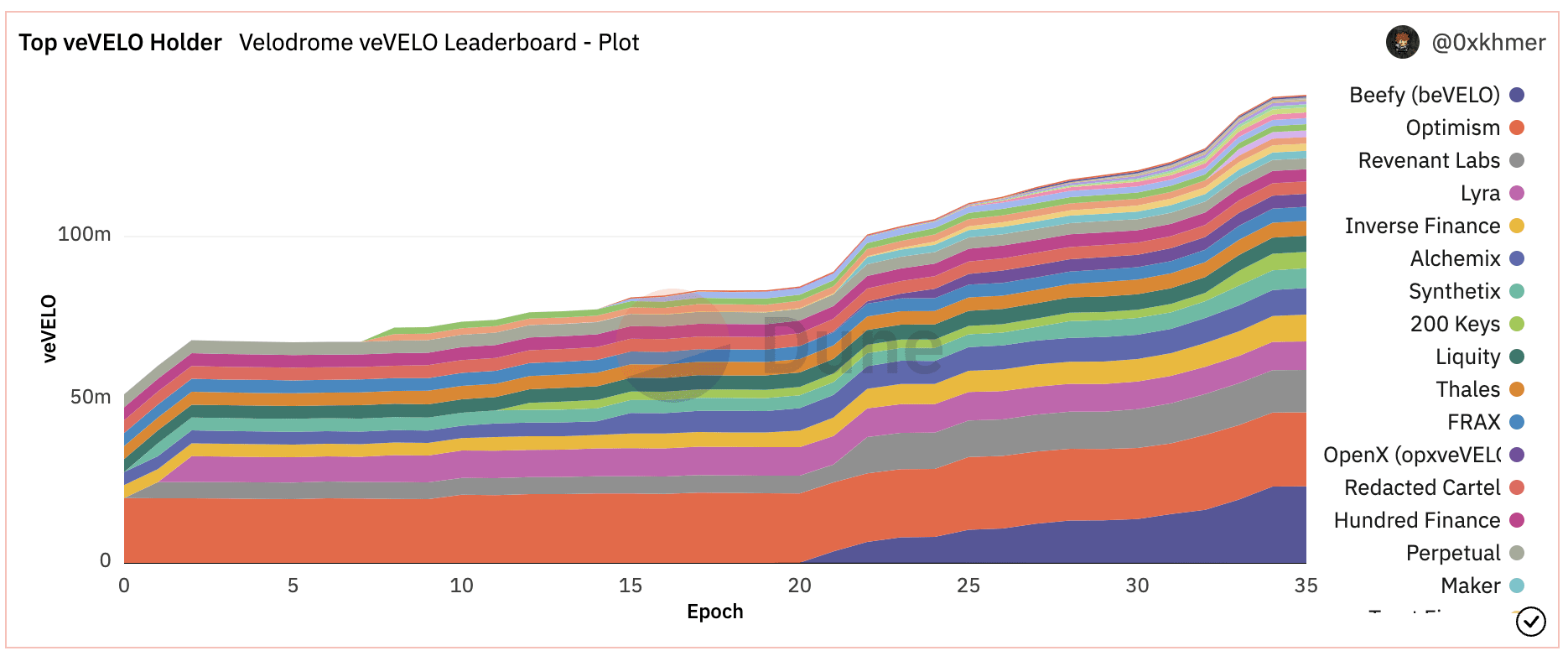
In addition to Beefy, veVELO holdings that have increased significantly in the last two Epochs include 200 Keys, Synthetix, Frax, Inverse Finance, Revenant Labs, etc. However, no project has yet obtained a relatively large proportion of veVELO voting rights.
veVELO’s revenue structure
Among the three incomes of veVELO holders, the highest source of income is bribery, with transaction fees and rebase income being relatively small. Why are more and more projects willing to use bribes instead of initially using governance tokens issued by themselves as mining rewards? Because the form of bribery is more effective, according to Velodrome’s calculations, every USD 1 bribe will bring about USD 1.5-2 in VELO rewards to the corresponding trading pair.
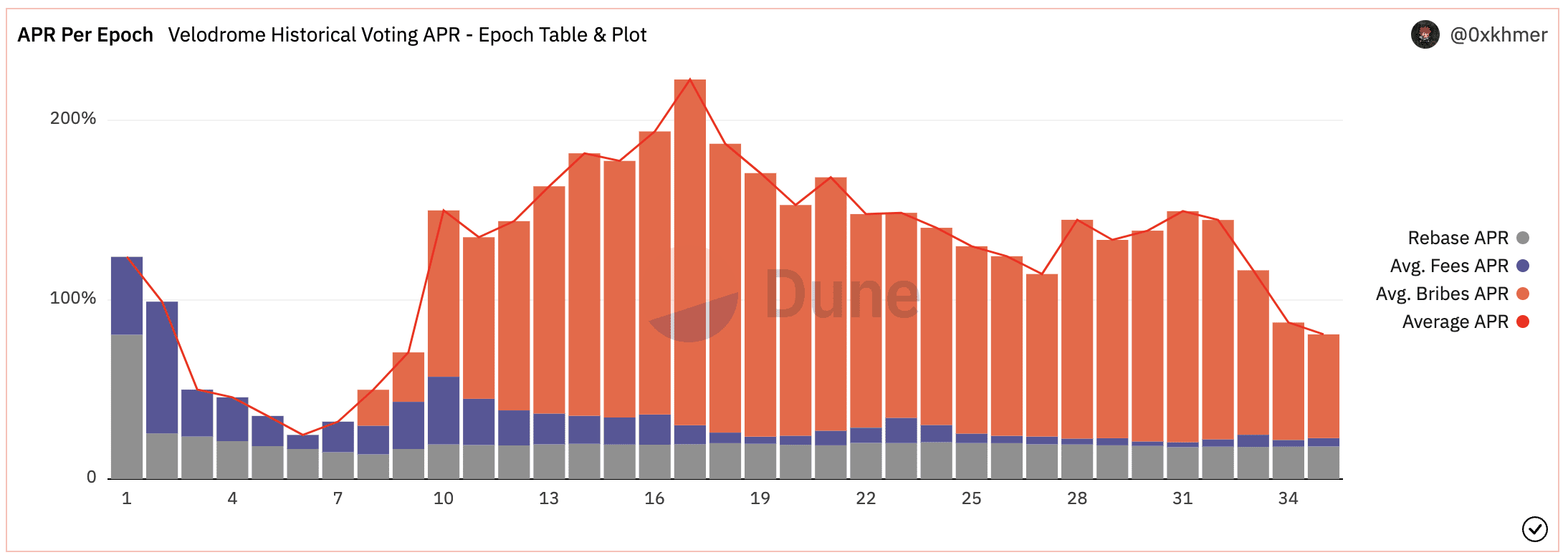
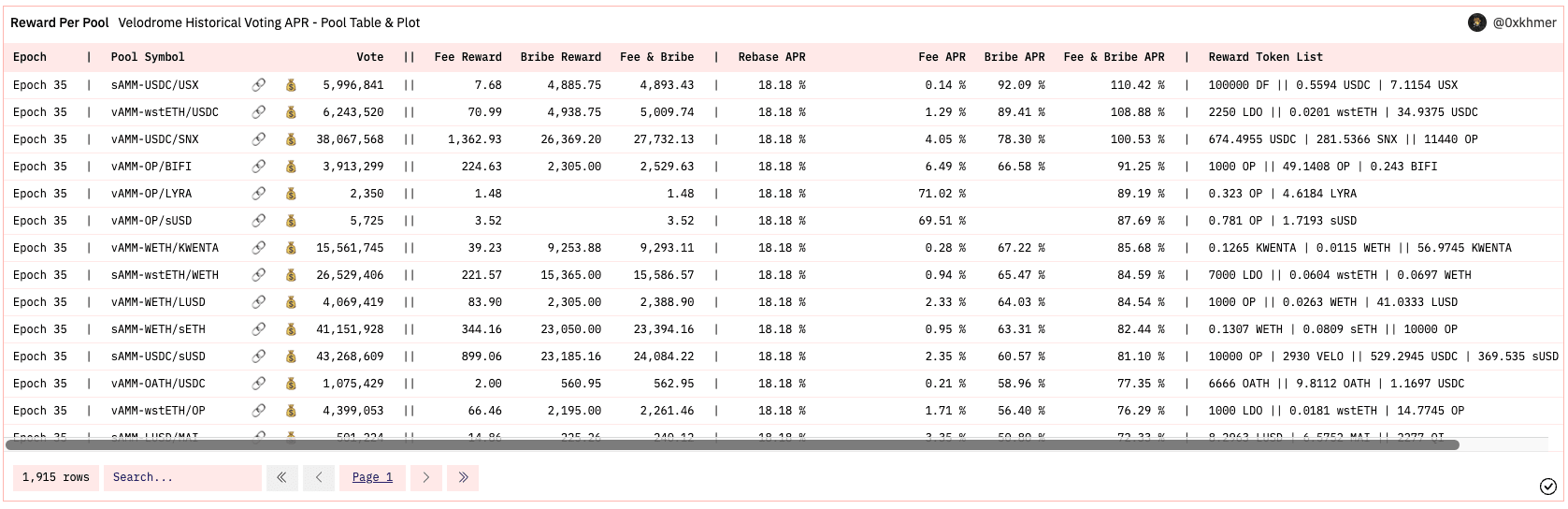
In the ended Epoch34, the Rebase APR was 18.06%, the average bribe APR was 65.47%, the average transaction fee APR was 3.76%, and the total APR was 87.29%.
As shown in the figure below, during the period from Epoch10 to Epoch33, the average APR was higher than 100%. On Epoch34, the APR dropped because the price of VELO rose too quickly relative to the funds being bribed. Since the transaction fees and bribes collected come from the voting trading pairs, different veVELO holders receive different bribes and transaction fees due to different votes, while the rebase rewards are the same.
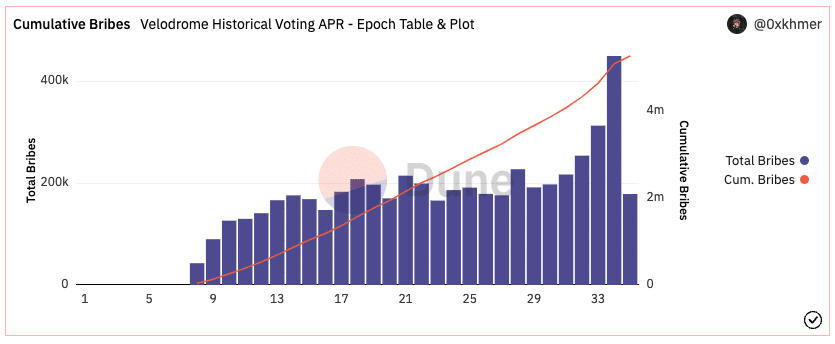
As you can see, Velodrome’s bribery funds set a record in Epoch34, with the bribe amount that week being $449,104, and the total historical bribe amount being approximately $5.1 million.
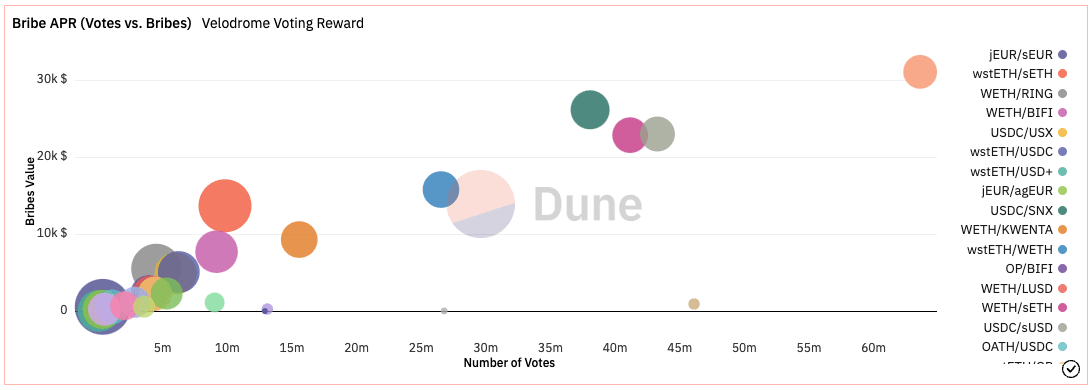
Synthetix is one of the important sources of Velodrome bribes, with multiple trading pairs including SNX/USDC, USDC/sUSD, WETH/sETH required to attract liquidity on Velodrome. The bribe funds given by Synthetix are the OP officially rewarded by Optimism. In addition, Liquidity's WETH/LUSD, Beefy's WETH/BIFI, Alchemix's alETH/WETH, Inverse Finance's DOLA/USDC, etc. all use OP as bribe funds. , almost no projects use stablecoins for bribes, and OP prices have increased more recently, which explains why bribery funds have hit new highs recently. However, the OP tokens that Optimism gives to ecological projects are limited, which also foreshadows whether Velodrome’s mechanism can continue.
It is worth noting that Lido, the top liquidity staking track, has also begun to bribe in Velodrome recently. The weekly bribery fund for wstETH/WETH is 7,000 LDO, and the weekly bribery fund for wstETH/OP is 1,000 LDO. This creates a new source of income for veVELO holders.
summary
Velodrome adopts Solidly's (3,3) mechanism. Although the supply of VELO continues to increase, in the past half year, almost all the newly added VELO has been used for lock-up, and the number of VELO in circulation is basically the same as in Epoch1. , which illustrates the effectiveness of this mechanism. Projects such as Beefy are actively accumulating more veVELO.
The main income of veVELO holders comes from bribery, which makes the project party more efficient in attracting liquidity. Recently, bribery funds have reached a record high, but part of the reason comes from the increase in the price of bribery tokens. Synthetix, Liquidity, Beefy, Alchemix, Inverse Finance, etc. all use OP tokens officially given by Optimism for bribery, which also makes the price of Velodrome and OP tokens, the number of OP tokens given by Optimism to ecological projects and other factors highly bound.
(The above content is excerpted and reprinted with the authorization of our partner PANews, original text link)
Statement: The article only represents the author's personal views and opinions, and does not represent the objective views and positions of the blockchain. All contents and opinions are for reference only and do not constitute investment advice. Investors should make their own decisions and transactions, and the author and Blockchain Client will not be held responsible for any direct or indirect losses caused by investors' transactions.
This article Velodrome’s TVL Alchemy: Interpretation of ve(3,3) mechanism, veVELO distribution and bribery first appeared on Blockchain.