

Sovereign Labs is using the Sovereign SDK to build an open and interconnected Rollup ecosystem. Instead of building Rollups themselves, it is developing a framework for building secure and interoperable ZK Rollups for others.
Written by Karen, Foresight News
Rollup is undoubtedly a major breakthrough in scaling solutions. Its advantages of high scalability, low cost, and security from the Ethereum mainnet make it the most promising scaling path. However, the existing design is relatively complex to build, the bridge speed is not satisfactory, and there are also some problems with the interoperability between Rollups.
Today, Foresight News is introducing a Rollup Internet called Sovereign. Sovereign attempts to open up interoperability between Rollups and provide developers with a simpler building environment, allowing developers to deploy secure, scalable, and interoperable Rollups on any blockchain.
Sovereign Team Background
Sovereign Labs is building software to create native (local) connections between Rollups, allowing people to send transactions between Rollups quickly, securely, and cheaply.
Yesterday, Sovereign announced the completion of a $7.4 million seed round led by Haun Ventures. Haun Ventures is a Web3 venture capital firm founded last year by former a16z executive Katie Haun, which also launched a $500 million early-stage fund and a $1 billion acceleration fund.
Other investors in Sovereign include Maven 11, 1kx, Robot Ventures, Plaintext Capital, former Coinbase CTO Balaji Srinivasan, and Ethereum core developer Tim Beiko.
Sovereign Labs has also hired Ekram Ahmed, head of communications at Celestia Labs, Jonny Rhea, co-founder of Element Finance, and others as advisors. Sovereign Labs co-founder and CEO Cem Özer and another co-founder Preston Evans (CTO) told TechCrunch that the Sovereign SDK hopes to help Rust (and eventually C++) developers use ZK technology on any blockchain without having to become cryptography experts.
Sovereign builds frameworks through the Sovereign SDK
Cem Özer, CEO of Sovereign Labs, said that most ZK Rollups solutions are independent products built and run by teams, but Sovereign Labs does not build Rollups itself, but builds a framework for others, allowing them to easily use this framework to create their own ecosystem.
The framework that Sovereign is developing is the Sovereign SDK, which is a free, open-source toolkit for building ZK Rollups currently under development. The Sovereign SDK is somewhat similar to what the Cosmos SDK does for Layer 1 chains, specifically:
The Sovereign SDK will provide a standard interface that allows Rollup to communicate with the Data Availability Layer (DA). This standard interface will make it easier to deploy Rollup on new DAs.
The Sovereign SDK will be integrated with a cryptographic compiler. Developers will then be able to write code in a standard programming language and the SDK will automatically convert the business logic into a cryptographically verifiable form.
The Sovereign SDK will also provide default implementations of common blockchain primitives such as tokens, NFTs, and bridges.
That is, the Sovereign SDK provides all the boilerplate that typically goes into a blockchain, such as P2P networks, databases, and RPC nodes, allowing builders to focus on the business logic of their chain. It will also provide a set of default modules that operate efficiently in a zero-knowledge environment, such as token implementations, authenticated data storage, and bridge modules.
What are the properties of the Sovereign SDK?
Sovereign SDK has obvious advantages in interoperability. In addition, Sovereign SDK Rollup can also run on any blockchain.
In terms of interoperability, Sovereign SDK uses a new bridging technology based on proof aggregation, allowing the Sovereign SDK Rollup on the shared Layer1 to bridge back and forth without a trusted third party. In addition, with the help of zero-knowledge proof, the blockchain will be able to expand without sacrificing end-user verifiability.
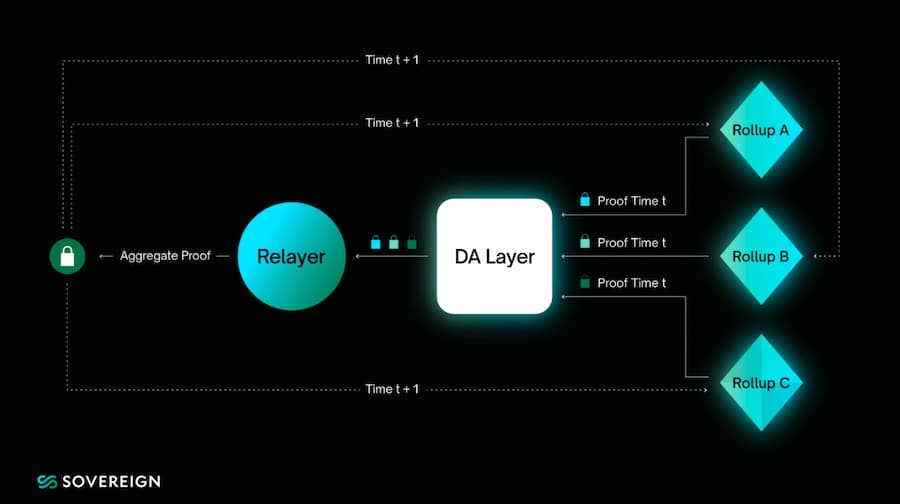
Bridging based on proof aggregation
According to the Sovereign roadmap, the Sovereign SDK is still in the research stage. The default storage module, cryptoeconomics, and core API are currently being designed. The current prototype integrates Celestia for data availability and Risc0 for proof. This phase is expected to be completed around the second quarter of this year. The second phase (initial implementation) will implement peer-to-peer networks, RPC nodes, core APIs, and default storage and sorting modules. The third phase (enhancement) will carry out code cleaning, testing, fuzz testing, and auditing, and will also begin developing the first use case of the SDK.
In terms of tokens or platform economic models, CoinDesk quoted a Sovereign Labs co-founder as saying that Sovereign has no plans to launch tokens and will focus 100% on building the SDK framework. TechCrunch quoted another Sovereign co-founder as saying that the Sovereign team will develop different monetization strategies, but its SDK framework will always be open source and free.
Judging from the way the Sovereign product is built, it can be understood as a Layer0 that aims to build a Rollup Internet ecosystem, which will allow developers to easily deploy ZK Rollup on any chain and connect these ZK Rollups.
Reference: https://mirror.xyz/sovlabs.eth/V-nUycehpu-cwCRaStz7984mYGOKpRGMyC-tTDaQIsk
https://www.sovereign.xyz/learn
https://techcrunch.com/2023/01/30/haun-ventures-leads-sovereign-labs-7-4m-seed-round-to-help-scale-blockchains/