
Bitcoin only recovered and broke through $100,000 on January 6, but it collapsed again after only one day. It rushed forward the day before yesterday, and it fell back last night. Affected by a series of strong economic data, the market's expectations for interest rate cuts have cooled, US bond yields have soared, and US stocks have also fallen back. Bitcoin suffered the biggest drop in two weeks and once again lost the $100,000 mark. So much so that it continued to fall during the day today, plummeting to a low of $95,250.
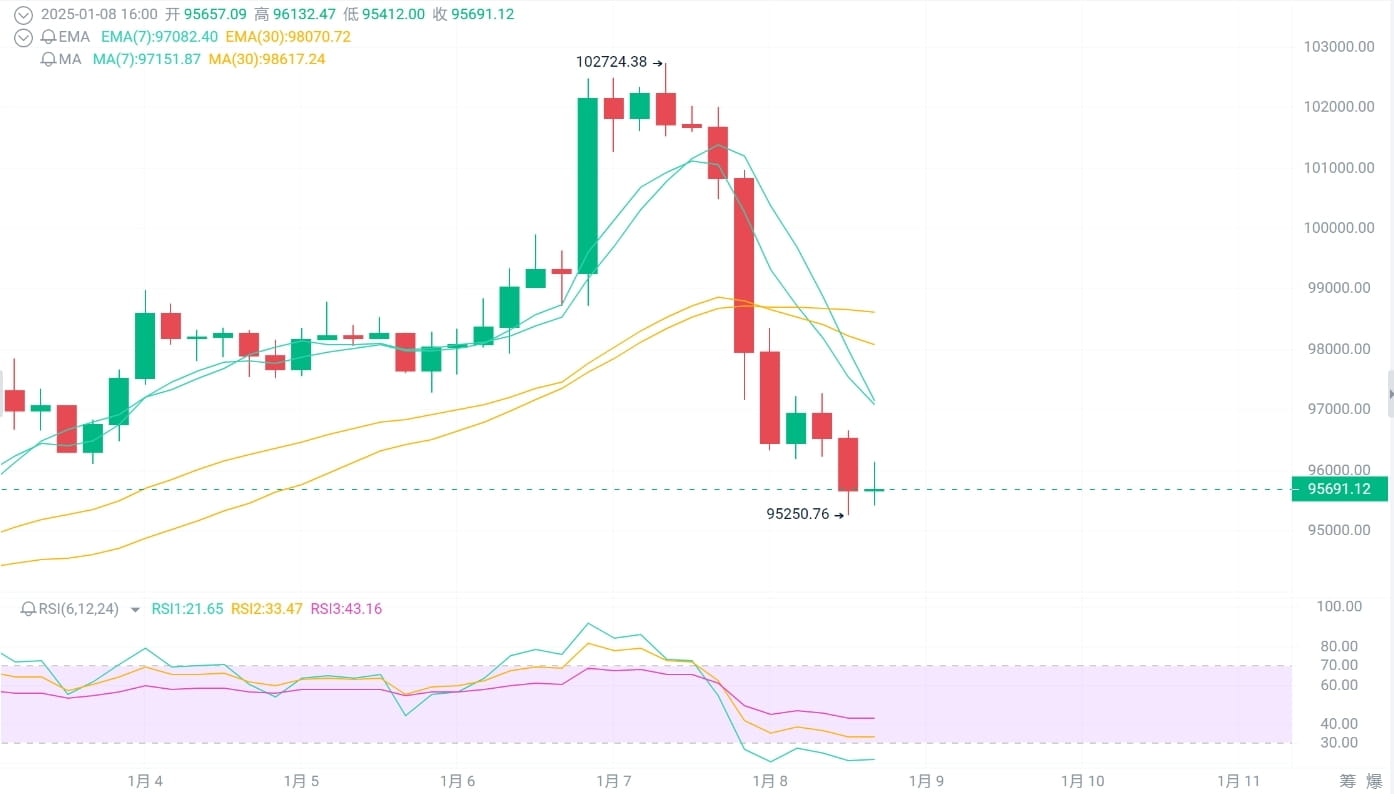
The market decline started last night (7) due to negative ISM non-manufacturing PMI and JOLTs job vacancy data.
According to data from the Institute for Supply Management (ISM), the performance of the U.S. service sector in December exceeded market expectations, with the input price index rising to a near two-year high.
At the same time, according to the employment data released by the United States, the job market is hotter than expected, with an 8 million recruitment gap. It seems that business conditions are quite good, which also means that the previous conclusion that "interest rate cuts are needed to save the US economy" is not so important.
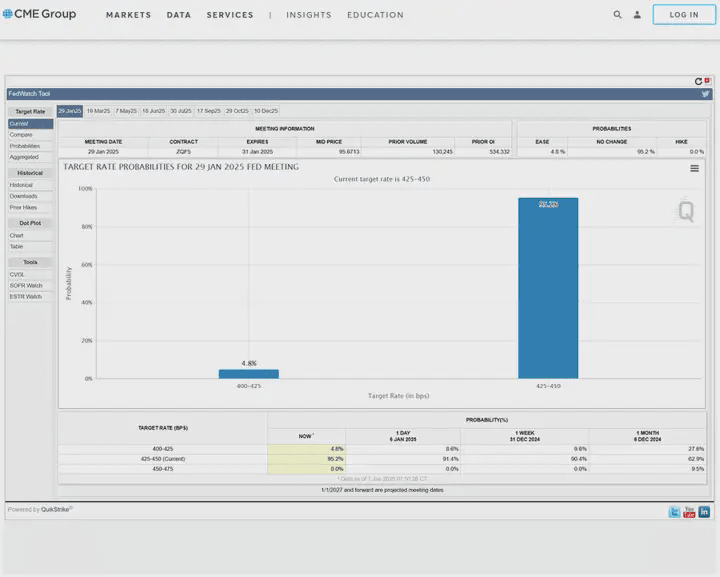
The two data lowered the market's expectations for interest rate cuts, mainly because the rate cuts predicted in March and June also became smaller, which was contrary to the previous expectation of 2-4 rate cuts in 2025. The market expects that the Federal Reserve will not cut interest rates in January with a probability of more than 95%, and Bitcoin plummeted in response.
In plain words: the decline yesterday and today is due to the slowdown in interest rate cuts. The slowdown in interest rate cuts is also related to Trump's policies (expelling low-end immigrants and raising taxes on the United States, Mexico and China). Recently, the rise and fall of Crypto are all due to the United States and Trump. In a sense, this is also the same source of profit and loss.
This also caused Bitcoin to break through the $100,000 mark yesterday, but it only lasted for about 24 hours and then quickly fell back. Bitcoin has reached a high of nearly $103,000 as many companies have increased their investment and institutional investors have withdrawn funds recently. However, the bulls failed to continue the upward trend. It happened to coincide with the release of the employment report and the employment was better than expected, which led to a gradual decline in prices, and finally fell to the $95,000 level.
The next thing to pay attention to is, to what level will Bitcoin fall?
Bitcoin has fallen back to the range of 90,000-100,000. If it cannot hold 95,000, the structure will retest the 90,000 support. It has been said before that the 90,000 support cannot be broken. It will be fine as long as it does not break 90,000. If it falls below 90,000, Bitcoin will experience a stampede and a large number of people will die!
If it rebounds today and rebounds to around $99,000, that will be our position to lighten up. If it does not rebound, or falls below $97,000 again after the rebound, then the next target will be $91,000. A further target may be $86,000, which is also the starting point for the rise.
If we reduce our positions, we will reduce them significantly at $99,000, and the same is true for other currencies. This round of Bitcoin is different, and it will not repeat the previous cycle theory. It is more likely that BTC will alternate between callbacks and rebounds, and it is unlikely to feel like the previous bear market that continued to fall.
However, BTC has fallen to around 95,000, but it has not fallen below the bottom, so it may not be the bottom yet. If it really falls below 95,000, you can basically buy in batches with your eyes closed! If you don’t have a position yet, don’t rush to chase the rise and fall!
Next, we should pay attention to the economic data and Federal Reserve meetings at the following time points:
1, January 8
The U.S. ADP employment data for December (21:15) and the U.S. initial jobless claims data for the week will be released (21:30). Last night's job vacancies and PMI data have made traders no longer fully price in a Fed rate cut before July.
2, January 9
The Federal Reserve releases the minutes of its December monetary policy meeting (03:00)
3. January 10
U.S. December seasonally adjusted non-farm payrolls (10,000 people) (21:30)
U.S. unemployment rate in December (21:30)
4. January 15
US releases CPI data
5. FOMC meeting on January 29
If these data and meetings convey a more hawkish message (low likelihood of rate cuts), Bitcoin could fall further below $91,500, and risks need to be noted.

Is the altcoin bull still there?
This wave of decline had no signs at all and there was no way to judge. When Bitcoin broke through 100,000, the altcoins did not follow the rise. On the contrary, when it fell below 100,000, the altcoins were unable to recover!
But you have to know that the market is still in the recovery stage, and the rebound of altcoins is relatively limited. There are several reasons for this:
Bitcoin is a bloodsucking currency: all the funds are sucked away by Bitcoin.
Primary market diversion: AI projects have absorbed some funds.
Lack of new narratives: There are no new hot spots in the market.
This market is very frustrating, but don't worry, it doesn't mean that the opportunity is gone! Remember that you need to be patient and strategic to trade cryptocurrencies, rather than just following the crowd. Right now, we have to wait for Ethereum to rise before the sentiment of altcoins will be fully opened. So don't panic now. The key is to make a good layout, hold the chips, and wait patiently for the opportunity!
There are actually quite a lot of macro data this week, and these data will affect the market trend to a certain extent, especially the data on Thursday and Friday. Pay attention to timely profit-taking.