


The day before yesterday, Sun Ge said on Twitter that he would go all in on AI, so I reminded everyone of the risks in my article.

As expected, today the first batch of AI Agent concept coins virtual, ai16z, arc, and swarms continued to pull back, and the market attention was on Swarms and HYPER. Most of the new concept coins have begun to trap investors.
This article will focus on Swarms
Swarm was attacked by AI16Z founder Fud
The capitalization of $ELIZA at that time already showed that Shaw was not a good person.
Yesterday, AI16Z founder Shaw launched a Fud on the X platform to an AI Agent project Swarms. He said on his X platform that the founder of Swarms was a liar and could not write code. Faced with the fast-growing project Swarms, he was restless and panicked. His own product technology was not good, so he went to Fud his peers.
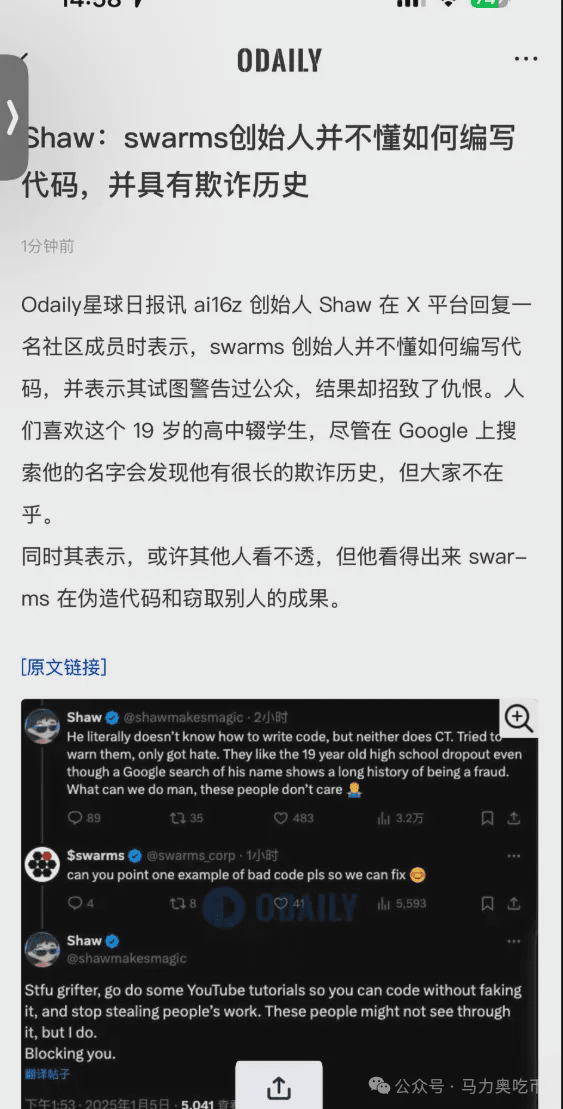
As a result of this news, the project token SWARMS experienced a drop of over 20% in 24 hours, but it still maintained a rise of over 400% in the past 7 days, with a current market cap of nearly $300 million.
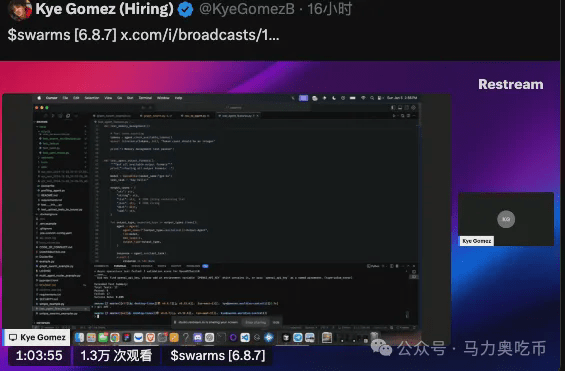
In response to Shaw's remarks, Kye began live streaming his coding sessions to prove that the claim of 'not being able to code' was a rumor. He released $mcs to demonstrate that Swarms' code was not the 'non-functional fake code' that Shaw described. His persistence in building and continuous updates on GitHub have pushed the token's market cap to $400 million, while Shaw has yet to provide any actual issues with the Swarms code repository.
Aside from the public backlash sparked by the founder of AI16Z, there has been ongoing controversy between Swarms and AI16Z on Twitter, with significant discussions arising from their differing technical architectures and applications.
Currently, while the AI Agent space is a blue ocean, competition is also very fierce, especially with leading projects like Virtuals Protocol and AI16Z dominating over 50% of the market cap in this field. How did Swarms manage to break through as a project not reliant on these two major 'AI Agent groups'? What innovations and unique features does the project itself possess?
Transitioning from Web2 to Web3 with Swarms
Swarms is a multi-agent LLM framework founded by 20-year-old Kye Gomez in 2022. It enables multiple AI Agents to collaborate like a team through intelligent orchestration and efficient cooperation, addressing complex business needs. The framework supports integration with external AI services and APIs and provides long-term memory features to enhance contextual understanding.
According to the latest white paper, the core of Swarms is multi-agent collaboration, which differs from monolithic large models (like GPT-4). While large models are powerful, they are limited in handling complex tasks, whereas Swarms enhances efficiency through agents specializing in their strengths.
The Swarms algorithm addresses issues such as task allocation and resource management, allowing agents to quickly exchange information and automatically assign tasks based on needs, ensuring that each task is executed by the most suitable agent. This concept draws on the collective intelligence of swarms of bees and ants, introducing this model into the field of artificial intelligence for efficient collaboration.
The token SWARMS serves as the universal currency for transactions and collaboration between agents, used for paying service fees, purchasing data resources, and participating in trades. In the future, users will also be able to buy and sell agents with SWARMS tokens.
As of now, the Swarms framework has generated over 45 million AI Agents, widely applied in industries such as finance, insurance, and healthcare. The project initially started as a Web2 AI Agent, and after three years of operation, it is set to launch its token on December 18, 2024, officially transitioning to Web3.
Swarms has garnered widespread attention in the AI Agent field, becoming a popular community project due to its innovative concept of group collaboration (Agent Swarms) and trend-following product design. Meanwhile, founder Kye Gomez also brings additional heat to the project due to his controversies.
The controversy behind the genius founder
Kye Gomez, the founder of Swarms, is referred to as a 'genius boy' in the field of artificial intelligence. After dropping out of high school, he spent three years developing Swarms and successfully ran 45 million AI Agents, garnering widespread attention.
In addition to Swarms, he is involved in multiple AI projects: at Agora Open Source Lab, he explores the intersection of AI with biology and nanotechnology; develops Pegasus for natural language processing; and contributed to the open-source implementation of AlphaFold3, supporting biological research.
Kye describes growing up in Hialeah, Florida, a place with high crime rates. Expelled from three high schools, he did not complete his education or attend college, but became self-taught through his skills in PyTorch, achieving models in hundreds of academic papers. However, he also faced attacks and controversies from industry elites, including accusations that OpenAI plagiarized the Swarms framework.
At just 13 years old, he developed his first AI model to hack into his mother's Gmail account, which ignited his passion for artificial intelligence. He later developed an AI assistant based on Slack and achieved further results through the APAC AI project. However, his first 'breakout' was due to questioning OpenAI's plagiarism of Swarms, but this did not garner public support and he was instead accused of opportunism.
Kye's turning point was Swarms' transition to Web3, which allowed him to truly realize the 'monetization of talent.' The market cap has now reached $300 million. He transformed from a 'small-town boy' into a standout in the AI field, proving the immense potential of talent combined with effort.
The entanglement between Swarms and AI16Z
Currently, projects in the AI16Z ecosystem are undoubtedly the hottest in the AI Agent space, with its founder Shaw holding significant influence in the industry and being referred to as the 'Godfather of AI.'
The skepticism surrounding Kye Gomez has undoubtedly sparked enthusiastic discussion. The community's discussions not only focus on Kye Gomez himself but also involve comparisons between the two products. The comparison primarily centers on Eliza and Swarms, with Eliza being an open-source modular architecture developed by Shaw, mainly designed for creating AI Agents that can seamlessly interact with users and blockchain systems.
AI16Z was designed based on this framework and has itself become a representative project of the AI Agent framework.
The most significant difference between these two products lies in the fact that Eliza is aimed at a single AI Agent, while Swarms focuses on coordination among multiple AI Agents. To explain their differences in development terms, Eliza is a framework for developing an AI Agent, allowing developers to quickly build an AI Agent project according to this framework.
Swarms, on the other hand, provides developers with tools. Developers who want to create AI Agents using Swarms can leverage these tools and experiences to freely create their own, less standardized AI Agent projects. Swarms focuses on enhancing collaboration among AI Agents.
It can be said that Eliza represents the current state of blockchain AI Agents, while Swarms represents the future development of AI Agents. This is also the imaginative aspect of Swarms.