

Preface
As the time for the Shanghai upgrade of Ethereum is getting closer, the volume of discussions is getting louder and louder. On the one hand, they are looking forward to the functional improvements brought by each upgrade of Ethereum, and on the other hand, they are worried about whether there will be any inconveniences after the upgrade. The problem of falling currency prices due to the lack of ideals; especially this time is related to the unlocking of beacon chain pledges, so many people began to care about the Shanghai upgrade of Ethereum.
So, what exactly does this Ethereum Shanghai (Capella) upgrade include? What impacts will it have? This article has done some sorting for those who are interested.
Ethereum core developers (Core Team)

But before talking about the Shanghai upgrade, I have to talk about the core developers of Ethereum. After all, it is this group of people who discuss and decide the development direction of Ethereum. So before discussing the content of the Shanghai upgrade, I hope to get to know this group. Who is the person?
The name "Core Team" of Ethereum can be traced back to a "Question and Answer" post on the Reddit forum in July 2014, which was answered by the early Ethereum team. In the post, the Ethereum team added a word to their name and became the "Ethereum core team." By the end of 2015, Ethereum co-founder Gavin Wood created a Gitter channel called "AllCoreDevs" where Ethereum's core developers could communicate on protocol development matters.
Ethereum core developers are those who are making important contributions to the development of the underlying protocol of Ethereum. An example of a significant contribution would be submitting multiple pieces of code to the Ethereum software (at a lower level than the dApp layer, such as client code); another example would be someone who is writing the protocol specification for Ethereum 2.0. However, "Core Developer" is not a title conferred on someone, and it is by no means permanent. If you no longer contribute, you are just a "former Ethereum core developer". Like Ethereum co-founder Gavin Wood.
Current progress of Shanghai upgrade
The Ethereum Foundation held its first ACD meeting in 2023 on January 5, confirming plans to launch a "public testnet" for the Shanghai upgrade in early February, and tentatively planning to launch the "mainnet" for the Shanghai upgrade sometime in March.
The Shanghai upgraded mainnet shadow fork (Shadow Fork) has also been completed and started at 22:30 on 1/23. The "shadow fork" will serve as a testing environment for the Shanghai upgrade, allowing developers to identify bugs and any potential issues.
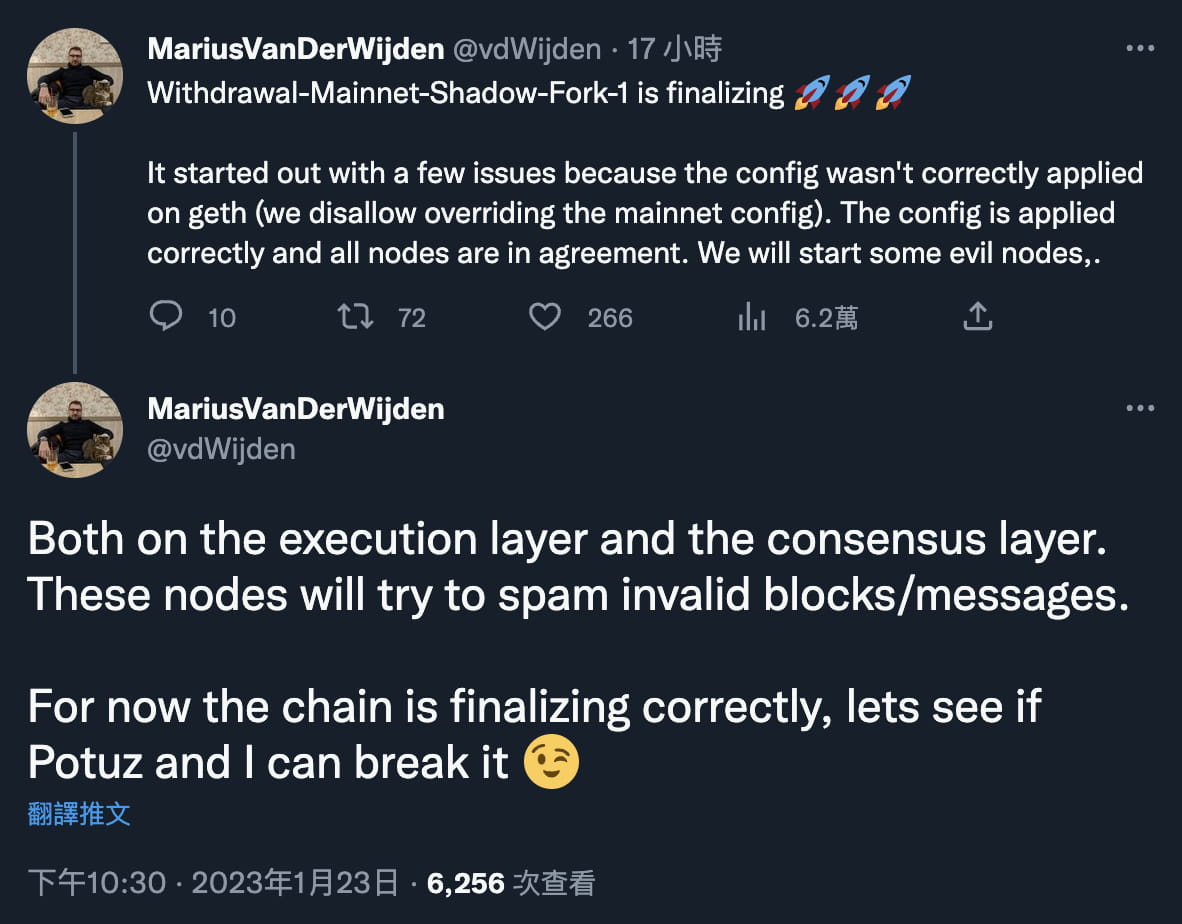
All EIPs included in the upgrade include:
EIP-3651:Warm COINBASE
EIP-3855: PUSH0 instruction
EIP-3860: Throttling and metering initcode
EIP-4895: Beacon chain pushes withdrawal operations
The EOF (EVM Object Format), which was originally included in the main upgrade of this upgrade, was confirmed to be deleted during the meeting, and subsequent discussions will focus on the subsequent Cancun upgrade.
🔰 EIP-3651:Warm COINBASE
This EIP fixes an oversight in EIP-2929 that changed the gas cost of accessing certain data fields based on whether the client has stored the data fields in memory (WARM) or needs to retrieve them from disk (COLD) cost.
EIP-2929 At the beginning of each transaction, two pieces of data in client memory are set to WARM: the sending address and the receiving address. EIP-3651 adds a third address to this list, the COINBASE address (aka feeRecipient), since it is also the address that the client has in memory when processing block transactions.
🔰 EIP-3855: PUSH0 instruction
As the name suggests, EIP-3855 introduces an opcode that pushes the value 0 onto the stack. Pushing 0 is often used to populate values in the EVM, and this opcode will provide a more efficient and cheaper way to do this.
🔰 EIP-3860: Throttling and metering initcode
This EIP increases the maximum size of initcodes and introduces gas metering based on their length. The size limit adds an invariant to the EVM that will make it easier to reason about and propose changes.
A 2 gas/32 byte initcode overhead has been introduced to account for the jumpdest analysis that the client must perform before execution, which was not accounted for in previous gas plans.
🔰 EIP-4895: Beacon chain push withdrawal operation
This EIP provides a way for validators on the Beacon Chain to withdraw funds into the EVM. The architecture is based on "push" rather than "pull", where withdrawals need to be processed at the execution layer once they are dequeued from the consensus layer.
Withdrawals are represented as an "operation" in the execution payload, and the EL client will apply these withdrawals after the transaction is executed when constructing or processing the block. In other words, withdrawals are processed similar to how proof-of-work rewards are credited, and do not compete with user transactions for block space.
This approach is more involved than the previous approach of introducing new transaction types, but it clearly separates this "system-level" operation from regular transactions. This separation facilitates security by simplifying testing by reducing the interactions that arise from mixing such system-level concerns with user data.
Additionally, this approach is more complex in terms of the core protocol than "pull"-based alternatives, but does provide for tighter integration of key functionality into the protocol itself.

Upgraded selling pressure problem
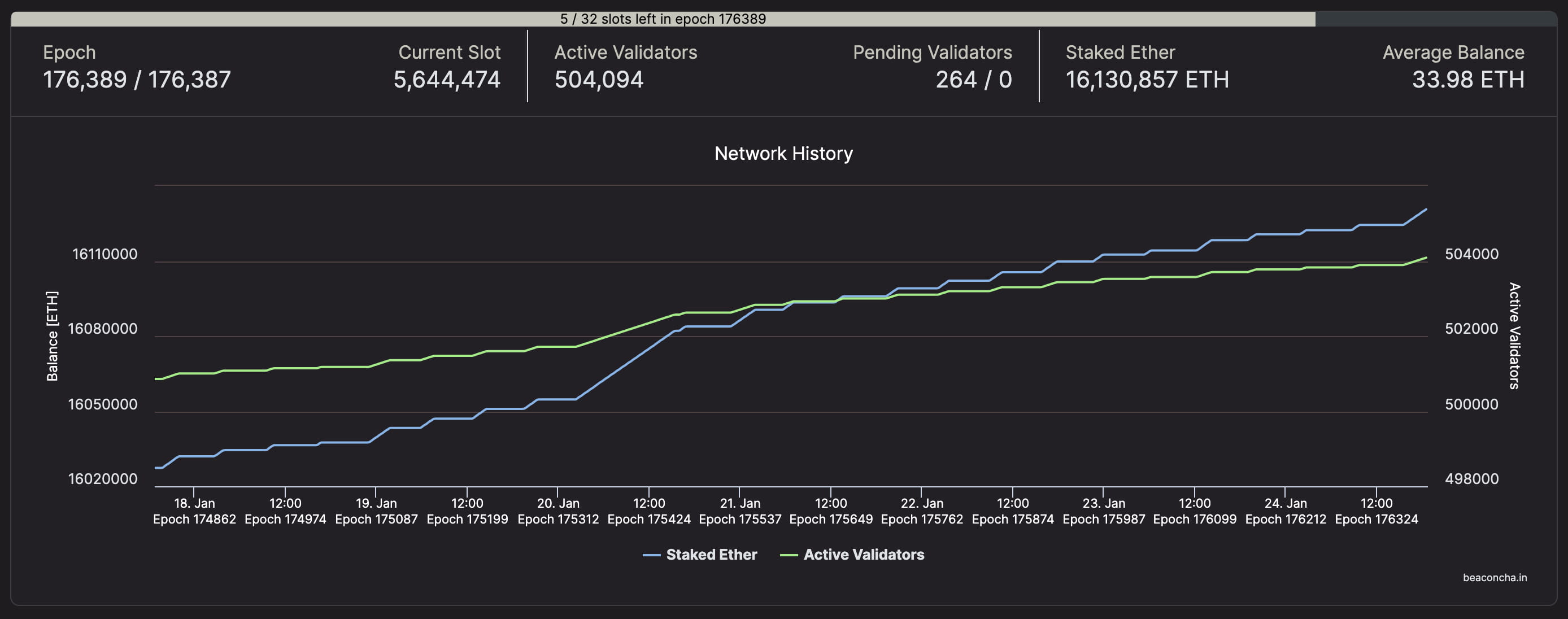
I believe this is an issue that many people are concerned about. After all, according to data from Dune Analytics and the official website, there are more than 16 million ETHs that can be withdrawn after this unlock, which is equivalent to 26.6 billion US dollars. Although this is not a It’s a small amount, but everyone may have overlooked the following points:
🔰 Early staking users are long-term supporters of Ethereum
These early users who are willing to take greater risks are those who are already long-term supporters of Ethereum. Due to their current position in the market, they are also more likely to be willing to sell their ETH in the future.
🔰 It may be more attractive to institutions or large investors
With the opening of pledge unlocking, it is possible to attract more institutions or large investors to enter; on the one hand, this function itself brings confidence to more users; on the other hand, it can provide a better exit mechanism for some users , without worrying about exit liquidity or discount exit; finally, some users also need to obtain relatively stable income in the bear market. The current annualized income of ETH currency can reach 4.2%, although it is not comparable to DeFi during the bull market. , but given the current market conditions, this yield is still attractive for long-term supporters.
🔰 Ethereum’s community consensus
Ethereum itself has a developer base, an ecological base, and a user base. Based on this, a relatively strong community consensus has been formed. This community consensus, as the Ethereum ecosystem continues to develop, including Layer 2 gradually surpassing the vast majority of public chains, Ethereum's role as the most basic settlement layer and security provider in the encryption field will only strengthen its moat.
🔰 In addition to ETH staking unlocking, the upgrade also has other function optimizations
This upgrade not only includes ETH staking unlocking, but also other upgrades, which are also beneficial to the long-term development of its ecosystem. For example, EIP-3651 can help miners save gas costs and speed up miner transactions; for example, EIP-3855 can also reduce gas consumption; EIP-3860 can support larger contracts and support the deployment of contracts with richer functions, which can help developers launch more Imaginative dAPP.
JP Morgan analysts also said in a report that the Ethereum Shanghai upgrade is expected to surge Coinbase's staking revenue; according to estimates, Coinbase already earns about $50 million in revenue each year through Ethereum staking, and after the Ethereum Shanghai upgrade Afterwards, it is expected that 95% of retail investors on Coinbase may participate in Ethereum staking, which will bring Coinbase annual revenue of US$225 million to US$545 million.
🔰 Summary
Based on the above four points, I personally believe that the immediate opening of pledge unlocking will have minimal impact on selling pressure. Even this "upgrade event" will be beneficial to the long-term development of the entire Ethereum, so don't worry too much.
in conclusion
As mentioned before, the Shanghai upgrade of Ethereum is positive for the long-term development of the entire Ethereum. It means that the members of the Core Team have been discussing better ways to optimize the services of the entire Ethereum, although EOF was not included in this round in the end. The upgrade is a bit of a pity. After all, from the developer's point of view, unifying the EVM format will help reduce the number of "parallel EVMs" to be maintained. However, it did not work out as expected. I can only continue to pay attention to the follow-up ACD meeting and look forward to the next upgrade. Got into it.
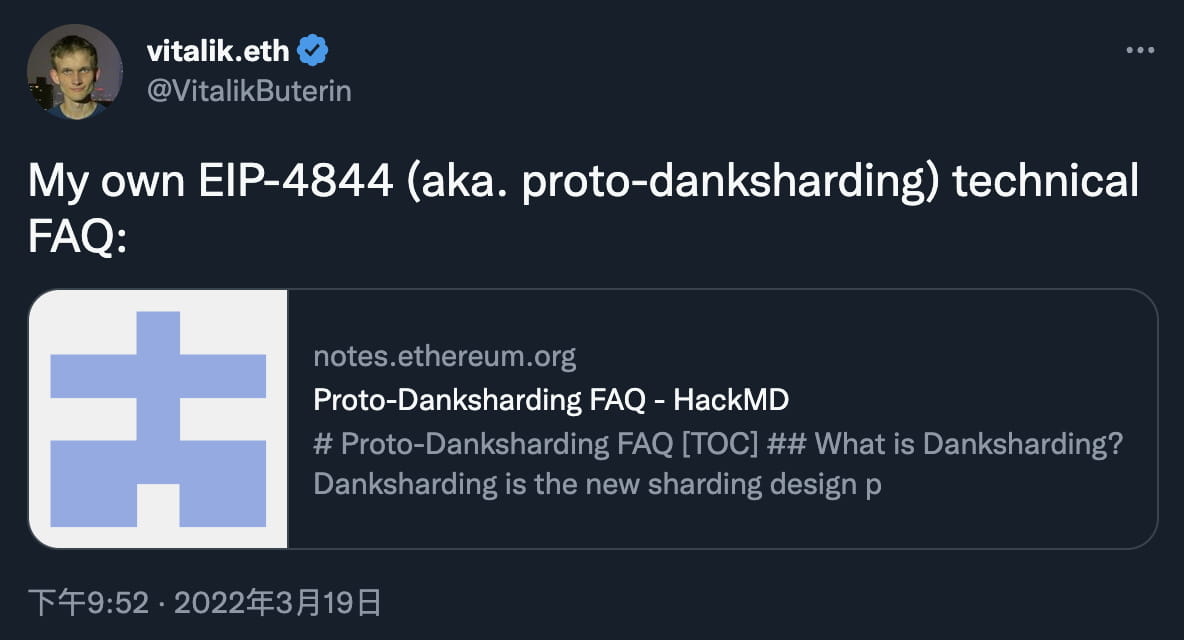
Ethereum has been in just over nine years from 2013 to now. To be able to achieve such performance, I really want to thank every developer for their contribution and dedication; currently, in terms of the Consensus Layer Conference (CL), EIP-4844 has been Designated as the first upgrade in the future, I am very much looking forward to the changes and development that this proposal published by V God can bring to the next upgrade.
References
Ethereum Builder's Manual
https://ethereum.org/zh-tw/developers/
Hudson Jameson《What is an Ethereum core developer?》
https://hudsonjameson.com/2020-06-22-what-is-an-ethereum-core-developer/
Execution Layer Meeting 152 #700
https://github.com/ethereum/pm/issues/700
Shanghai Update Could Brighten Outlook for Coinbase: JP Morgan
https://decrypt.co/119735/shanghai-update-could-brighten-outlook-for-coinbase-jp-morgan
EIP-4844: SHARD BLOB TRANSACTIONS
https://www.eip4844.com/
#whycrypto #Ethereum