

After completing The Merge and Shapella (Shanghai + Capella) upgrade, Ethereum has successfully transitioned from POW to POS mechanism. The next important milestone in Ethereum's development roadmap is EIP 4844, or simply “Proto-Danksharding” - the name of two core Ethereum developers, Protolambda and Dankrad Feist. EIP 4844 introduces a new transaction type called “blobs,” designed to improve the scalability of roll-ups built on Ethereum. The proposal has been officially included in Dencun, the next upgrade of Ethereum. So what is Dencun upgrade? Let's learn more through the article below!
1. What is Dencun upgrade?
The Dencun upgrade is the next Ethereum upgrade, immediately following the Shappela event on April 12, 2023. If Shapella is a combination of Capella and Shanghai, then Dencun is also named by combining the words “Deneb” (consensus layer) (CL) and “Cancun” (execution layer) (EL). This means there will be two upgrades happening at the same time.
“Deneb” represents the upgrade of the Consensus Class, the brightest star in the constellation Cygnus. “Cancun” is the name of the upgrade to Ethereum's Execution Layer and was the host city of the Devcon 3 conference in 2017.
The Cancun upgrade has now been completed and progress on the Deneb upgrade is still being discussed by the core developers. There are two major conference series in the Ethereum community, including:
ACDE Conference: focused on code changes to the Ethereum Execution Layer
ACDC Conference: focused on coordinated discussions on changes to the Ethereum Consensus Layer.
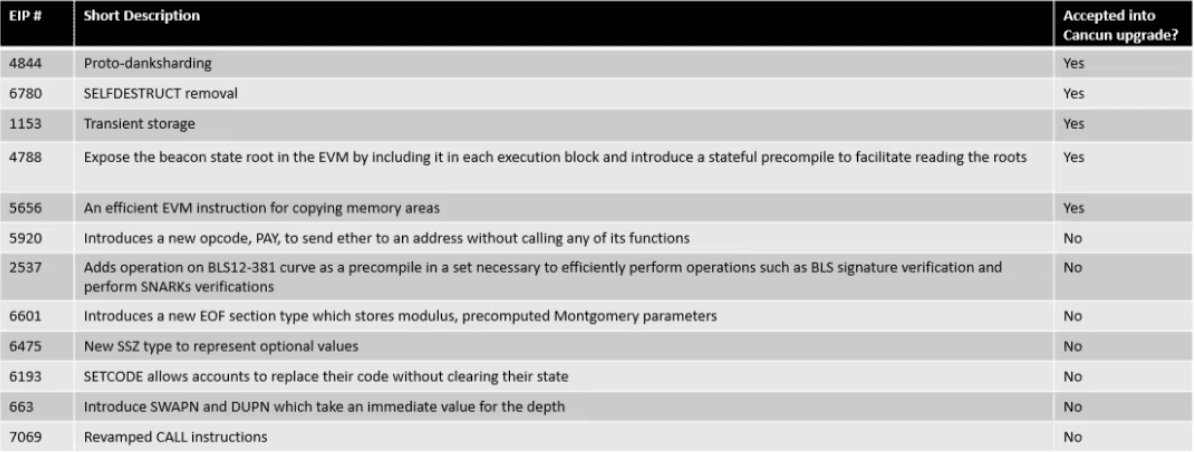
During ACDE conference call#163on June 8, there will be five code changes. Along with EIP 4844, the following four EIPs will also be activated in Cancun: EIP 1153, EIP 4788, EIP 5656 and EIP 6780.
The list of EIPs proposed for inclusion in Cancun and their status as of June 2023 are as follows:
2. What are the 5 proposed Ethereum improvements in the Dencun Upgrade?
2.1. EIP4844
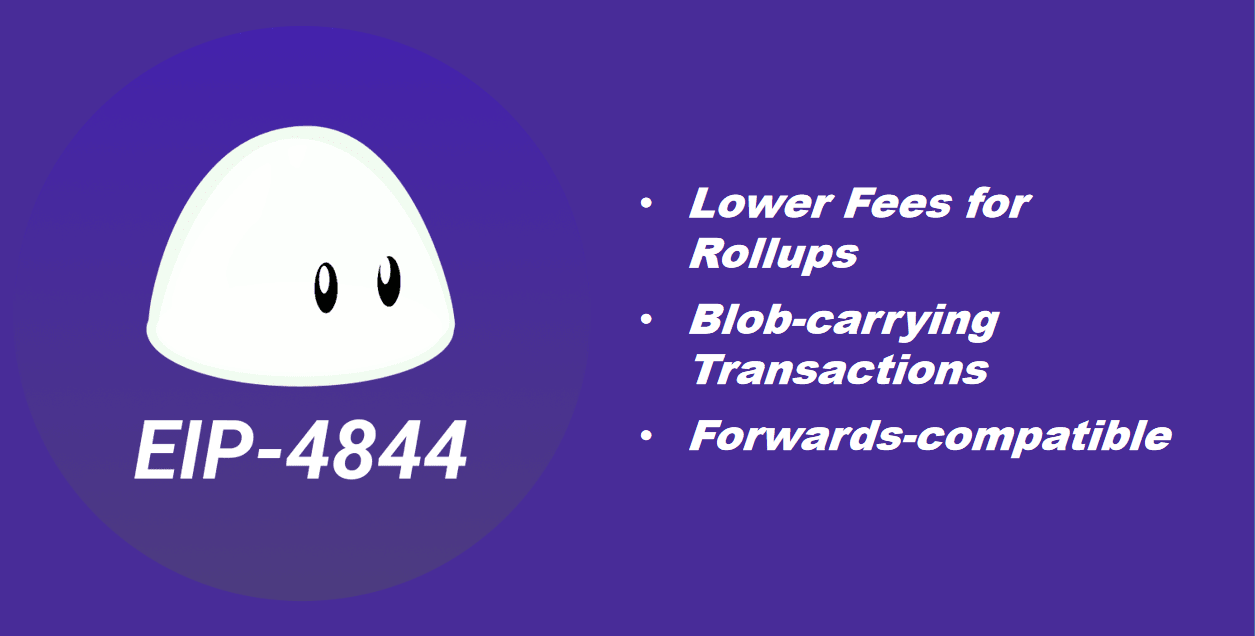
EIP 4844 (aka Proto-Danksharding) is a simple implementation of the full version of Danksharding. Proto-danksharding is intended to implement most of the logic and “scaffolding” (e.g. transaction formats, verification rules) that make up the full Danksharding specification.
The main feature of EIP 4844 is the introduction of a new type of transaction called blob-carrying transaction. A type of transaction that carries a blob is like a regular transaction, except that it also carries an additional piece of data called a blob.
Blob allows each block to carry 1MB-2MB of data. In addition to introducing blob-bearing transactions, EIP 4844 will also implement execution layer logic, verification rules, multi-way fee markets, and other system changes needed for full Danksharding in the future.
Proto-danksharding will reduce the cost of publishing large amounts of data to Ethereum, which in turn can reduce the overhead of compilations. EIP 4844 is considered an improvement in Ethereum scalability as it can provide more cost-effective support for Layer-2 projects.
2.2. EIP 1153
EIP 1153 is a proposed improvement in the Dencun upgrade that introduces cache opcodes, which control the operational state identical to storage, except that the cache is discarded after each transaction.
Temporary storage is cheaper because it never requires disk access. This introduction could open up new use cases, such as ERC-20 single transaction approval, increasing block space availability, implementing counter keys, and reducing associated operating costs. regarding on-chain storage.
2.3. EIP 4788
EIP4788 promises to be a proposed edit of the Dencun upgrade that could make communication between different protocols and applications in the Ethereum network more efficient and secure, and would help improve pool security staking, restaking works, bridges, MEV protocol, etc.
2.4. EIP 5656
EIP 5656 will introduce a new EVM instruction for efficient copying of memory regions, supporting more accurate code copying, improving the performance of memory copies by approximately 10.5%. This will be useful for many computationally intensive operations and is quite useful for compilers to generate more efficient, smaller bytecode, as well as save on gas fees.
2.5. EIP6780
EIP 6780 allows the creation and deletion of contracts within a single transaction. This proposal allows the SELFDESTRUCT opcode to be deprecated with minimal impact to existing smart contracts.
In an analysis of the impact of EIP 6780 during the ACDE conference in late May, blockchain security firm Dedaub noted that most dApps on Ethereum will be able to operate without modifications when implementing EIP 6780 .
The scope of the Deneb upgrade (CL upgrade) has not yet been finalized. On June 15, during the latest ACDC meeting (#111), hosted by Ethereum Foundation Researcher Alex Stokes, CL client groups discussed the final scope of the Deneb upgrade and its plans. Plans to incorporate EIP 7044, EIP 7045 and EIP 4788 into Deneb specifications in the coming weeks.
EIP 7044: Code changes to improve staking user experience. EIP will ensure that signed validator exits are permanently valid. The EIP proposed by developer Lodestar (CL) “Dapplion” has been incorporated into the Deneb specifications.
EIP 7045: Code changes to enhance chain security. EIP will extend the scope of one epoch to 2 epochs. The EIP proposed by Ethereum Foundation researcher Danny Ryan is under further discussion and final review.
3. What impact does the Dencun upgrade have?
The Dencun Upgrade is another important fork of Ethereum after the Shapella Upgrade and is the beginning of “The Surge”, a new phase of the Roadmap proposed by Vitalik, after “ The Merge ”.
The core issue of the Surge phase is to significantly improve Ethereum's performance and reduce transaction costs by introducing technologies such as sharding and rollups.
The core element of the Dencun upgrade is EIP 4844, which itself is called the “Rollup-Centric Sharding Scheme” and which is also the pre-release of Danksharding, Ethereum's final sharding model.
Through EIP 4844, Ethereum can scale by modularizing and offloading transaction execution to other protocols.
Since the data does not need to be permanently stored by the blockchain, it is cheaper to use the data than to store it on-chain (such as CALLDATA currently used by rollups).
Rollups (L2) can use this storage to post transaction data or proofs back to Ethereum (L1), which reduces rollup costs and primarily benefits users and rollup operators.
In addition to EIP 4844, EIP 1153 and EIP 6780 are already integrated, as well as 5 EIPs that may be integrated into a future upgrade that also focuses on reducing transaction costs (Gas), enhancing security, Improved developer experience and other improvements.
All of the above proposals serve as a good technical foundation for implementing future intensive operations or introducing new large-scale features (such as account abstraction) in Ethereum.
4. Conclusion
Overall, the successful upgrade of Dencun will be an important improvement for Ethereum, helping to contribute to the long-term development of the ecosystem as well as strengthen its market position.
Additionally, the near-term implementation of technical improvements such as EIP 4844 will bring significant performance improvements and reduced transaction costs for Ethereum, which will help develop new applications on top of Ethereum. existing Layer 2 infrastructure and accelerate the continued development of Layer 2 aggregation projects led by Optimism and Arbitrum.
Above is all the information TheBlock101 wants to bring to you. Hopefully after reading this article, you know what Dencun upgrade is and fully understand what we want to convey.
Source: Theblock101.com


