
A pump and dump scheme is a term used to describe a type of securities fraud. This involves spreading false information (“pumping”) and inflating security prices through misleading and exaggerated statements. Fraudsters then profit from price inflation by selling the securities in question at high prices (“dumping”).
Fraudsters use pump and dump schemes to create a buying frenzy that aims to “pump up” the price of a stock or cryptocurrency and then “dump” the stock or crypto by selling it at an inflated price. After making a profit, fraudsters stop the hype and the price of the stock or crypto falls, causing investors to lose money.
Spreading false or misleading information about crypto tokens can occur through a variety of channels, including social media, investment newsletters, investment research sites, emails, online advertisements, internet chat rooms, newspapers, cold calling, and fake news releases.
How does the Pump and Dump scheme work?
Pump and dump schemes are common among penny stocks, also known as micro stocks. These shares belong to companies with small market capitalization and are usually traded over-the-counter (OTC) at low prices. They typically do not follow strict requirements for public record keeping.
This makes it easier for fraudsters to manipulate and spread information about these securities. Limited public information creates very favorable conditions for fraudsters because potential investors have limited resources to verify all information about the stock or token and the company from which it originates.
Additionally, microcap stocks are illiquid securities that have very low trading volume. Therefore, even relatively small transactions can significantly increase the price of securities.
Basics of Pump and Dump activities
Typically, fraudsters involved in pump and dump schemes use cold calling to woo investors. Currently, the presence of the internet has made most activities move online. Scammers often use hundreds or thousands of email messages and other enticing messages to entice investors to quickly buy a particular stock or cryptocurrency.
Typically, these messages claim to have inside information about certain upcoming developments that could trigger a major increase in stock prices. With limited sources to verify the truth behind the information and projects, buyers often jump in as the stock price increases significantly.
After many buyers entered and the price rose significantly, the initiators of the pump and dump scheme sold their shares, and because of the large sales volume, the share price fell drastically. In the end, many investors experienced big losses.
In addition, pump and dump schemes can be carried out by anyone who has an online account and is able to convince investors to buy shares. These actors can fuel their actions by buying large amounts of shares at low volume, ultimately driving up prices.
Pump and Dump schemes in crypto
With cryptocurrencies there are two most common types of pump and dump schemes.
In the first type, insiders promote a particular token and generate all the hype, while on the reverse side, they sell it slowly. By the time other holders realize that something strange is happening, the fraudster will have made a profit and the token price will fall;
The second type targets cryptocurrencies when using community members or holders of specific cryptocurrencies to purchase them. This action triggers the robots used by fraudsters to buy as well while the perpetrators continue to sell at inflated prices. Ultimately, prices fall and some members end up losing money.
The first example of a pump and dump scheme can occur on any token. However, the second scheme works with smaller and less popular cryptocurrencies, whose prices are easier to raise.
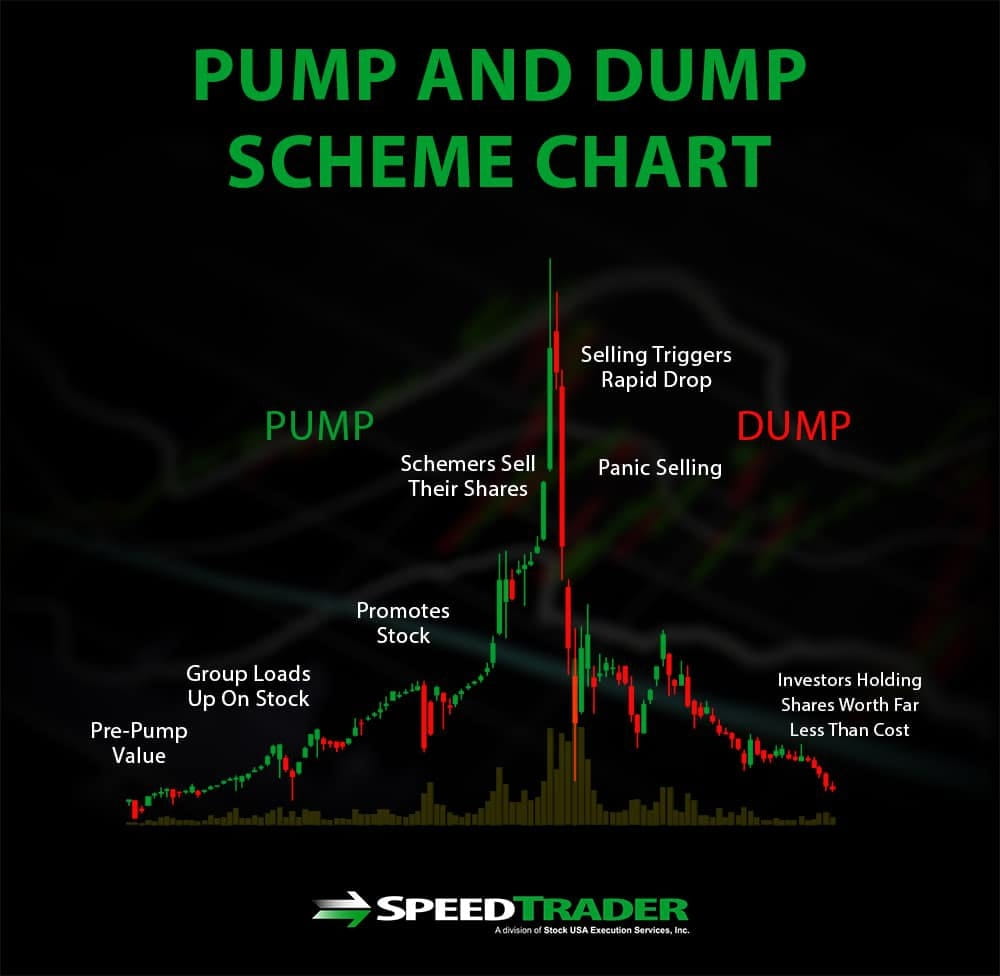
Pump and Dump scheme chart timeline: Source: SpeedTrader
The cryptocurrency field is becoming more attractive for pump-and-dump schemes due to the lack of regulation in the crypto market and the technical complexity of crypto assets.
According to a 2018 study, which investigated the prevalence of pump-and-dump schemes in the cryptocurrency market, researchers found more than 3,400 such schemes in a six-month period when looking at two group messaging platforms related to cryptocurrency investments.
As of April 2022, the number of coins that may participate in pump and dump schemes has increased to 1,705 according to data obtained by Finbold. Some of the coins mentioned include BitConnect (BCC), VegasCoin (VEGCOIN), and Storeum (STO).
These coins are believed to be counterfeit, underfunded, or failed due to other reasons rendering them inoperative or inactive.
Pump & dump
Large pump and dump crypto groups use a complex structure consisting of the following layers:
Organizer;
Inner circle;
Outer rim;
High level pumping.
Usually, the organizer and a few individuals from the inner circle take over the entire process. They decide what type of cryptocurrency or token they want to use and how they want to promote the asset. Apart from that, they also choose the time. Organizers and people in pump-and-dump schemes often take the lion's share of the profits earned from the scheme if everything goes according to plan.
Members of the inner circle knew what cryptocurrencies they would ditch immediately after the organizers' decision. Other members of the community, including last-minute pumpers and the outer ring, only learned of the details much later, after most of the transfers had already been made, making it difficult for last-minute pumpers to gain substantial benefits from the scheme .
How to identify a pump and dump scheme?
There is no single rule to identify whether a cryptocurrency or token is used in a pump-and-dump scheme. Investors need to research and apply their best judgment when deciding to take a risk on a token or coin. However, the following indicators are often red flags:
Huge hype
Excessive hype surrounding a particular coin or project can be a strong indication of pump-and-dump activity. Mass marketing emails and social media posts with enticing messages like “this coin is the next big thing” or “ Bitcoin 2.0 is here” followed by a rapid price increase can signal a pump and dump.
When there is unusual optimism surrounding a cryptocurrency or token without a valid reason, this may raise a red flag. In this case, potential investors should investigate further.
A spike in token or crypto prices
All pump and dump schemes are characterized by sharp price increases in a short period of time. This can happen to any coin, but usually targets coins that were previously unknown, ignored, or forgotten.
Publicity cycle
This follows the hype and “news” about a particular coin or project, which often coincides with purchases made by insiders. This creates the illusion that something big is happening, and this publicity cycle attracts more potential buyers to see what is going on. This pushes prices up further until the bubble bursts.
Pump and dump type of scheme
Pump and dump schemes occur in various forms, including the following:
Classic pump and dump scheme
This type of pump-and-dump scheme involves any kind of manipulation of information about a company and its shares, tokens, or coins. Perpetrators use telephone calls, fake news releases, as well as distribution of some kind of “inside” information that can help drive stock or token prices. Additionally, some dishonest promoters may provide false information to lure investors into the project.
Boiler room
A boiler room is a term used to refer to a small brokerage firm with several brokers who use dishonest sales practices to sell questionable products to investors. Brokers often use cold calling to sell micro-cap shares of companies, with the goal of selling as many shares as possible to boost the share price. Once the stock price rises significantly, the company sells its shares to make a big profit.
“Wrong number” pump and dump scheme.
This type of pump and dump scheme is where fraudsters use short text messages (SMS) and voice messages accompanied by “hot” investment tips to lure their targets into believing that the messages were accidentally left on the recipient's cell phone. However, this is a calculated move to attract the attention of potential investors to a particular stock, coin or token, thereby increasing demand.
Four tips to avoid pump and dump schemes
Pump and dump schemes are common in the crypto world and can happen at any time. Here are some tips to help investors avoid becoming victims, as suggested by the Securities and Exchange Commission:
#1 Be wary of unsolicited investment offers
Investors should be especially careful if they receive unsolicited communications regarding “investment opportunities”. With multiple avenues for virtual communication, these messages can reach investors in a number of ways, including email, comments, or posts on social media pages.
#2 Watch out for obvious danger signs
As an investor, this is where you need to trust your instincts. The investments touted may sound too good to be true, promise “guaranteed” large returns, and come with the pressure to “buy now.” These are all common red flags for pump-and-dump practitioners.
#3 Do your own research and due diligence
Before investing in a high-yield project, investors need to do their own research and due diligence. They can utilize reliable online information sources to learn about the company, business prospects, management, and financial reports. Additionally, they can get reviews from third-party websites to understand what others are saying about the project in question. Any company or digital asset that does not have this information could be considered a red flag.
#4 Reflect on the source of the hype
Pump-and-dump schemes rely on hype and a heightened sense of urgency. Hype often comes from third parties, perhaps through newsletters or social media accounts. If you don't trust the source of the information, it may be part of a fraudulent activity.
Additionally, investors should be wary of “hot tips” often promoted by pump-and-dump planners. They often persist with a growing sense of urgency and fear of missing out ( FOMO ), which drives many potential investors to jump in without verifying the truth behind a project.
Are pump and dump schemes illegal?
Pump and dump schemes are considered illegal under various statutes and statutes because their activities involve manipulation of securities prices through misleading information. For example, the Securities Act of 1933 and the Securities Exchange Act of 1934 both provided segments that criminalized misleading statements and fraud related to securities.
Regulatory bodies have even indicted pump-and-dump violators to ensure that the investment field is safe for innocent investors who are often targets of price manipulation.
Final thoughts
Crypto pump and dump projects are just some of the challenges investors have to face in the crypto space and stock market. With the right information available in this guide and other sources, investors can know how to separate hype from fact and choose worthy investment opportunities.
Some altcoins have fallen victim to pump and dump schemes, and although such schemes are unpredictable, the red flags mentioned in this guide can help avoid falling into their trap.