

Author: Michael Nadeau, Token Terminal Research; Translation: Golden Finance xiaozou
Arbitrum is a layer 2 blockchain built on Ethereum. Its developer, Offchain Labs, launched the platform on August 31, 2021, with the goal of improving the user experience with lower fees and faster throughput. We like to think of L2 as "broadband for Ethereum." YouTube, game streaming, and SaaS businesses wouldn't have been possible before broadband came to the internet. Similarly, we believe L2 can inspire the next generation of use cases for Ethereum - catalyzing a new era of development as the ecosystem matures.
In this article, we will take you to learn the following:
- question
- Solutions
- Business Model
- Applications that bring the most value to Arbitrum (and its competitors)
- Potential Market
- product
- Team, Investors, Community
- Financial status
- Token Economics
- compete
- Why now?
- Risks
- in conclusion
1. Problem
Ethereum sells block space. That’s the product Ethereum offers — but there’s only so much of it. Supply is inelastic to demand. So when demand increases, Ethereum becomes slow and expensive. This is a problem if you’re a developer trying to find the right product/market fit for your new app. Additionally, Ethereum’s lack of flexibility and customizability limits the range of use cases for application developers.
Let’s take a step back. In many ways, the development of the Ethereum technology stack is very similar to the development of the Internet. In the early days, if you wanted to host a website, you had to run your own physical server. Then, Geocities came along, which enabled developers to use shared servers. Over time, innovation was limited by the lack of flexibility of Geocities. When AWS came along, virtual servers became the answer. Along with AWS came e-commerce, SaaS businesses, and social media — all of which would have been impossible in the early days of the Internet.
2. Solution
Arbitrum expands the supply of block space available to application developers while enhancing the user experience - it brings greater throughput and 95% lower fees compared to L1. It's a win-win for developers and users. This is done while maintaining the interoperability and security of Ethereum as a shared settlement layer, thanks to Arbitrum.
Meanwhile, solutions like Arbitrum Orbit and Arbitrum AnyTrust enable application developers to build customizable blockchains that serve specific niche use cases. These L2 solutions, combined with data availability networks like Celestia, look a lot like the early days of the internet, from Geocities (Ethereum) to AWS.
In short, solutions like Arbitrum are laying the foundation for the next wave of blockchain-based applications. The “broadband moment” of the Ethereum ecosystem!
3. Business Model
Arbitrum is essentially an Ethereum blockspace reseller. Think about the last time you tried to send a bunch of large documents via email. Due to restrictions on the amount of data you can transfer, you probably had to put the files into a zip folder - compressing the data in the process.
This is how L2s like Arbitrum work. Arbitrum processes many transactions at a low fee, packages them together, and then publishes the “call data” to Ethereum in one transaction.
Here’s how the revenue generated (fees paid by users of applications using Arbitrum) compares to the Arbitrum “call data” fees paid to Ethereum validators:
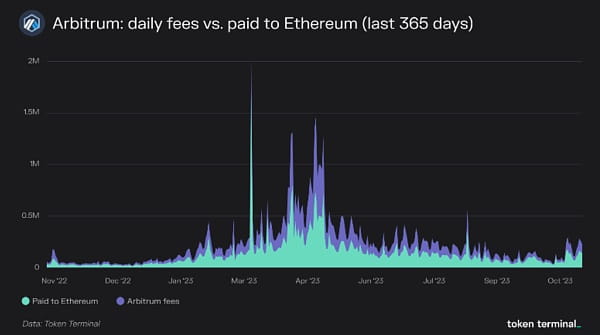
365 days of “calldata” costs paid to Ethereum: $34.2 million
Net worth to Arbitrum: $13.2 million
Gross profit margin: 27.8%
4. What applications bring value to Arbitrum?
Where is Arbitrum’s product-market fit? Is it DeFi? Is it NFT, gaming, payments, bridges? Or something else?
Let’s start with 365 days of gas fees and take a deeper look.
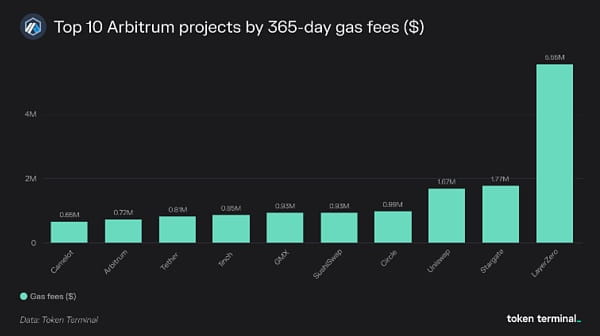
Today, bridges (Stargate and LayerZero) generate the most gas fees for Arbitrum — which makes sense since users must first transfer their assets from Ethereum to Arbitrum. In addition to bridge activity, DeFi and payments are what drive the most activity on Arbitrum.
Let's compare this to the trend of the last 30 days:
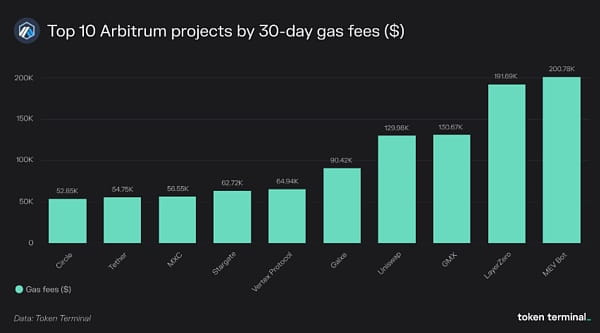
“MEV Bot,” a “high-frequency trader” on the DEX, has driven the majority of Arbitrum’s activity over the past 30 days, nearly surpassing Uniswap and GMX combined.
What about the situation from the perspective of 365 days of trading?
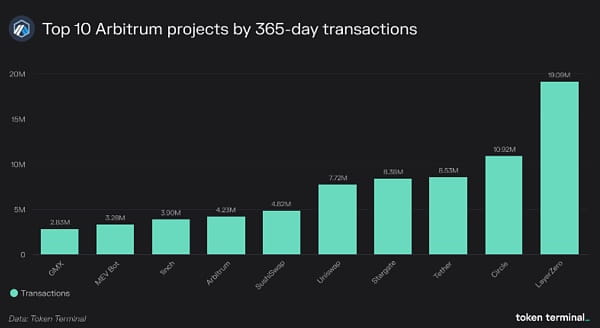 As expected, we see a lot of the same names.
Arbitrum vs. L2 Competitors
Let’s first look at OP Mainnet, the second largest TVL L2:
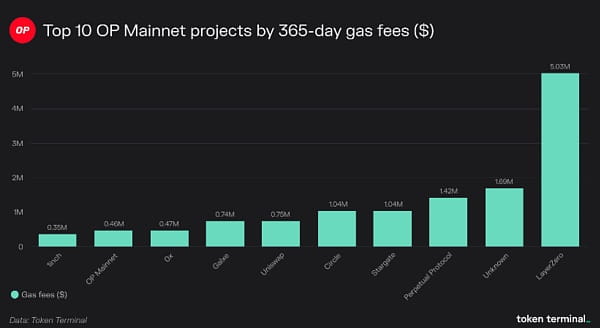
Similar to Arbitrum, LayerZero (bridge) consumed the most gas last year.
Most of the activity on OP Mainnet is DeFi and payments - with the exception of Galxe - a protocol that helps businesses build customer loyalty programs using on-chain data. Note that there are still a lot of "unlabeled" contracts on the mainnet - we hope to learn more about them in the near future.
Here is Coinbase’s recently announced L2, Base:
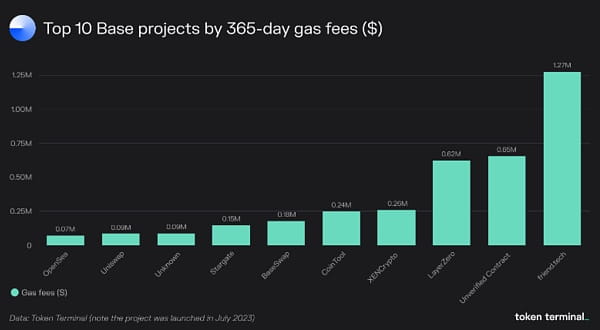
Base shows something different. Just 3 months after launch, the project that shows the strongest product/market fit is friend.tech, a new web3 social media platform that has already generated over $1 million in gas fees.
[Note that “unverified” refers collectively to the many on-chain contracts that have not yet been tokenized, not to any individual project.]
Polygon (a sidechain, not an “L2 rollup”. Polygon uses its own token to pay users):
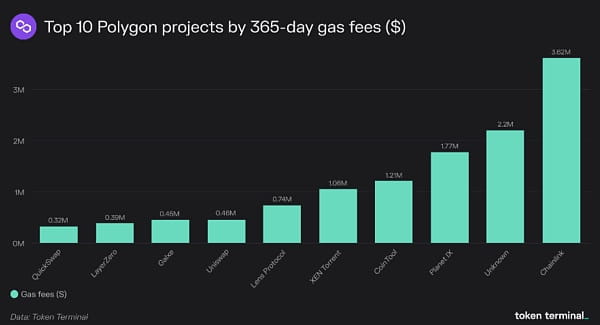
It’s great to see Chainlink (web3’s largest data oracle network) making a strong appearance here. Planet IX is a crypto game. CoinTool is an “online crypto toolbox.” Finally, it’s great to see Lens Protocol (social media) on the list. It’s nice to see the difference with Polygon.
Finally, let’s look at a competing L1, Avalanche:
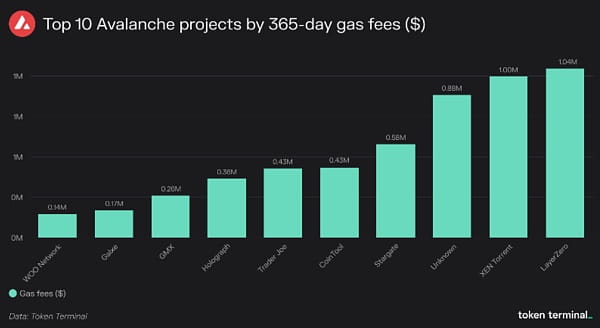
What about Avalanche? Its top 10 projects generate less gas fees than any of the L2 projects listed in this article - by a large margin.
Arbitrum: Top 10 projects generated $14.8 million in gas fees
Polygon: Top 10 projects generated $12.2 million in gas fees
OP Mainnet: Top 10 projects generated $11.9 million in gas fees
Base: The top 10 projects generated $3.6 million in gas fees ($14.4 million annualized)
Avalanche: Top 10 projects generated $5.3 million in gas fees
5. Potential Market
Generally speaking, more value (market cap and locked value) has accumulated to the base layer network (L1) so far. We think this will continue. In the future, higher returns may accrue to the protocols and applications built "on top". Please note: potential high returns also mean risks.
Some rough calculations:
Let’s assume Ethereum will reach a $2 trillion market cap in the next cycle. Let’s assume L2s collectively account for 10-20% of Ethereum’s market value. This would put the potential valuation of L2s at $200 billion to $400 billion. Given the power laws we’ve observed in crypto so far, the vast majority of that value will likely flock to a few general-purpose L2s. Currently, Arbitrum has a market cap of $1.4 billion.
Again. L1 is more valuable, but the rewards (and risks) of the layers above L1 are likely to be higher.
Take a look at the revenue multiples for 365 days:
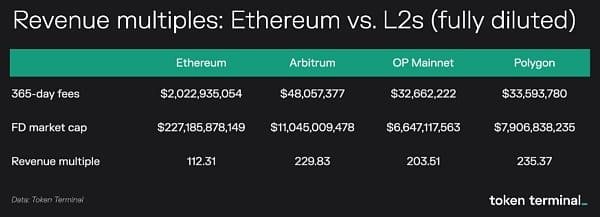 From a fully diluted perspective, Arbitrum (and OP Mainnet) appear to be priced for perfection.
Here is an overview from the perspective of circulating market capitalization:
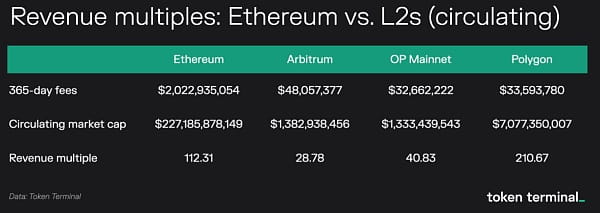
Suddenly, the valuation looks a lot more reasonable. However, investors should be aware that 3.3 billion ARB tokens will be unlocked over the next two years.
For the sake of brevity, we only provide a high-level analysis here. Of course, there are many unknown and unexplored nuances. We believe investors should ask the following key questions:
- Can GM L2 maintain a 28% profit margin? We believe the margin will decline in the next few years.
- How many transactions will move from L1 to L2 in the future? We believe that most transactions will move to L2, but value will remain on L1 (for security guarantees).
- How much weight does the market place on settlement guarantees (security and decentralization, i.e. Ethereum) vs. execution services (L2)? So far, the market has placed more weight on settlement than execution.
- How does value accrue to the token? The utility of ETH is obvious, as is its token economics. The same cannot be said of today’s L2 tokens.
- Where do the structural advantages of L2 tokens come from? ETH is needed to access services on L1 and L2. In addition, users can lock tokens to earn returns. Why do you need to hold L2 tokens today? What rights or benefits can it provide in the future? It is not clear yet.
6. Products
Arbitrum One is the primary rollup chain. When we say “rollup,” we mean an L2 that inherits Ethereum’s security (like Arbitrum), not a sidechain like Polygon. This is where DeFi and other use cases that require maximum security will live.
Arbitrum Nova is a secondary network focused on games, NFTs, and social applications, all of which require greater flexibility and throughput. Since these use cases are less financial in nature, the trade-off is that less security is required. Released in August 1922, Nova leverages the AnyTrust protocol, which introduces additional trust assumptions in the form of the Data Availability Committee (DAC), which consists of Reddit, Google Cloud, Consensys, Quick Node, and OpenSea, among others.
Finally, in March this year, Arbitrum released Arbitrum Orbit. Arbitrum Orbit is a product that allows anyone to easily create their own blockchain (application chain/L3) and manage it themselves, with transactions settled to Arbitrum One or Arbitrum Nova (publishing all "call data" to Ethereum).
There’s a lot going on here. The key takeaway for us is that Arbitrum’s network effect is growing. Their customers are application developers. Their product is infrastructure that enables developers to easily build, while inheriting Ethereum’s network effects and security. The more developers they can attract, the faster and bigger the network effect will grow.
7. Team, Investors, and Community
team:
Arbitrum was born at Princeton University when Professor Ed Felton (who served as Deputy CTO in the Obama White House) convinced some of his PhD students, Steven Goldfeder and Harry Kalodner, to solve Ethereum's scaling problems. It all started in 2015 with a video you can find on YouTube where the technology was first discussed. In 2018, a research article proposed a deeper vision, and Princeton University later licensed the team to develop the technology now known as Arbitrum. Today, the Offchain Labs (developer of Arbitrum) team has 73 employees. The Arbitrum Foundation currently has 62 employees, and its mission is to support the development of the ecosystem.
Investors:
The team raised $120 million in August 21 at a valuation of $1.2 billion. The main investors are Lightspeed Ventures, Polychain Capital, Pantera Capital and Mark Cuba. The team has raised a total of $143 million in three rounds of financing.
Community:
Twitter: 886,000 members
Reddit: 9,000 members
Discord: 21,000 members
8. Financial Status
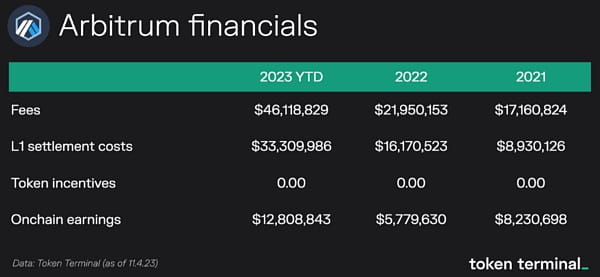
9. Token Economics
Circulating Supply: 1.275 billion
Total supply: 10 billion (12.75% in circulation)
A quick look at the token distribution and release schedule:
- Offchain Labs (Arbitrum development team): received 26.9% of the allocation. The team’s tokens have not been released yet. 25% (673.5 million tokens) will be released on March 19, 2024, and thereafter on a linear schedule until March 2027.
- Arbitrum DAO and Treasury (to support ecosystem growth): received 42.8% of the allocation. 105.8M tokens (3%) have been released. The remaining tokens will be released on a linear schedule until March 2027.
- Investors: receive 17.5% of the allocation. The first 25% (438.25 million tokens) will be released on March 19, 2024
- Individual users: receive 11.6% of the allocation. Arbitrum airdropped this supply to users in March 2023, and it constitutes the majority of the circulating supply today.
- DAO within the ecosystem: Received 1.1% of the allocation, which has been distributed.
Please note: Arbitrum was released in August 2021. Considering that the team and investors have not had a chance to liquidate their holdings, we can expect liquidations to occur in the next cycle. Over 1.1 billion tokens (11% of the supply) will be unlocked on March 19, 2024 (about 5 months later). The remaining internal tokens will be unlocked linearly on a monthly basis over the next 3 years. In total, over 30% of the token supply will be unlocked in the next two years.
10. Competition
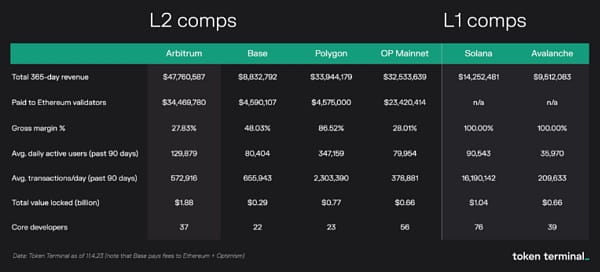
We consider Arbitrum’s main competitors to be OP Mainnet and Base (both are rollups). For simplicity, we classify Polygon as L2, even though it is a “sidechain” that uses its own token to charge gas fees — making Polygon less consistent with Ethereum.
L2 is working hard to solve the key challenges of Ethereum L1: cost and throughput. Alt L1 is also looking to solve the same problems - making them competitive with L2. As we can see in the data, Arbitrum is not only the strongest L2, but also surpasses Alt L1 in many important metrics.
We believe that Arbitrum’s main competitive advantage comes from its alignment with Ethereum and the flexibility of use cases provided by its diverse product suite. But this market is still young.
In our view, the winning L2/Alt L1 will achieve a moat through massive network effects, creating a flywheel effect of permissionless innovation in the coming years.
11. Why now?
- Expanding network effects (application chains and new consumer use cases) through Arbitrum Nova and Arbitrum Orbit.
- EIP4844 (Extensions): A major Ethereum upgrade planned for Q4 will reduce L2 fees by an order of magnitude.
- Considering L2’s strong fundamentals but smaller market cap relative to Alt L1, L2 has the potential to outperform in the next cycle.
- Bitcoin halving will occur in April 24, and has always been the beginning of a bull market.
12. Risks
- Technical risks.
- Value capture risk. It is unclear how value will be returned to token holders in the future and where the structural advantages of the ARB token will come from.
- Competition risk. L2 is a complementary product with the potential for commercialization.
- Centralization risk. Arbitrum is now centralized.
- Tied to the success of Ethereum. Arbitrum is strategically aligned with Ethereum. Therefore, if Ethereum fails, Arbitrum will also fail.
13. Conclusion
What we like about Arbitrum:
- Aligned with Ethereum.
- A strong mission-driven team and community.
- Build tools that cover a wide range of use cases today — which can lead to strong network effects in the future.
- It ranks first among L2 on many important metrics.
The big unknown is getting the token to capture value, and where the structural advantages come from. It’s clear that Arbitrum is one of the most important projects in crypto.
As always, if you’re investing in the Ethereum tech stack, you need to have a clear thesis as to why your chosen token is superior to ETH.
That's for you to decide. We hope that this article will provide you with a framework to help you form your own opinion.