


FUD is a term that anyone participating in the Crypto market will see and may even experience at least once. Moreover, FUD can directly influence investment decision-making.
What is FUD?
FUD is an acronym for Fear - Uncertainty - Doubt, referring to the fear, uncertainty, and doubt of many people when negative information about a project, individual, or organization... is disseminated from unidentified sources.
In the crypto market, FUD occurs when people spread negative, misleading, or exaggerated news about an asset, project, or platform… with the intent of scaring investors, often referred to as FUD news, FUD coin, FUD crypto... This leads to the asset or token of the project being sold off and significantly decreasing in value in a short period.
In addition to FUD, FOMO (Fear Of Missing Out) is also a common psychological effect, and depending on the severity and the party affected by FOMO, it can have a substantial impact on the cryptocurrency market.
The psychology of experiencing FUD syndrome
Typically, those experiencing FUD syndrome will be inexperienced traders or investors in the crypto market. They often exhibit signs such as:
Feeling afraid due to the spreading negative information, leading to hasty decision-making without proper investigation or research to determine what the accurate source of information is.
Impatience while trading, continuously checking open orders and positions.
No plan or strategy before investing or trading.
Trading based on news but not updating the market quickly enough or lacking a comprehensive view of a piece of news.
Easily swayed and indecisive in their opinions due to lacking technical and fundamental analysis skills.
For example: Trader A bought token B and is waiting for a price increase to sell. A few days later, suddenly there is news that token B will be delisted from the exchange, along with evidence in the form of a fake notice from the exchange. This will cause Trader A to panic.
Immediately, A checks in various crypto communities on Telegram and sees that this news is being discussed a lot. At this point, A is likely to fall into a state of fear, because if token B is indeed delisted, A's chances of losing money are very high.
At that time, Trader A's mindset shifted solely to preserving their assets by selling token B at the least possible loss. When many people think this way, the lack of buying demand combined with excessive selling demand will cause the price of token B to drop significantly compared to before being FUDed.
In the above case:
Token B is the party affected by FUD (also known as being FUDed).
Trader A is the party experiencing FUD syndrome.
Who creates FUD in crypto?
FUD is a strategy often employed by organizations and influential individuals (KOLs) in the crypto market to serve their own interests.
Social media platforms have become powerful tools for projects to communicate and provide information to their communities. However, this is also fertile ground for the rapid spread of FUD.
Accordingly, those who create FUD will use social media or news outlets to disseminate misleading information about a project, such as information related to government regulations, loss of peg, scam projects, rug pulls… The most common purpose is to drive the token price down to buy in as much as possible. Afterwards, they will use their 'tricks' to trigger FOMO in the community and take profit.
However, sometimes FUDing a coin, project, or team can severely affect the targeted party, causing significant damage, even making it impossible to 'revive' in the crypto market.
Or more simply, some individuals or organizations may create FUD out of 'personal vendettas' to negatively impact the projects or tokens they target.
The impact of FUD in crypto
For the projects, FUD can cause their tokens to drop sharply due to the imbalance between supply and demand. In fact, some small projects could be completely 'wiped out' if they do not have a reasonable solution to 'clear their name' and regain investor trust.
For the community of investors and traders, FUD can greatly affect their emotions and spirits due to fear and doubt, leading to hasty and ill-considered decisions. As a result, their assets will gradually decrease over time after each bout of FUD.
Moreover, FUD also causes investors and traders to lose faith in their own assessments and in the cryptocurrency market in general, as they have been 'deceived' and incurred significant losses. This can lead them to develop a negative view of crypto and abandon the market. Therefore, it can be said that FUD is one of the barriers preventing crypto from achieving mass adoption.
6 ways to avoid FUD mentality when investing in crypto
In reality, the mindset of FUD cannot be entirely avoided, regardless of how experienced a person is in the crypto market. We can only minimize the likelihood of experiencing FUD as much as possible based on the following methods:
Equip yourself with knowledge and conduct thorough fundamental and technical analysis to make accurate assessments of a project or asset. This helps investors and traders identify solid investment opportunities and gain long-term vision, thereby resisting fear and uncertainty in the short term caused by FUD.
Always have a trading plan before entering a trade. There must be a stop-loss point, an entry point, a target point, and a capital allocation plan before trading.
Evaluate risks to compare the risk ratio with potential profits when making decisions.
Be steadfast in your strategy, but still combine it with observing market psychology to assess risks and make flexible, reasonable adjustments.
Stay alert against FUD and take the time to do your own research (DYOR - Do Your Own Research), seeking information from reliable sources. This will help investors and traders distinguish between misleading and exaggerated information, thereby avoiding being influenced by FUD.
Limit making investment or trading decisions based on a specific piece of news or event.
Some notable FUD incidents in the crypto market
In crypto, a project is considered to be affected by FUD when it faces some negative information. Most major FUD incidents are created by authorities or communities within the market.
Some typical FUD incidents in crypto include: Bitcoin being FUDed by China. Binance being FUDed by the SEC, Tether being FUDed by the community.
Bitcoin FUD: China and a decade-long persistent FUD
Since its inception in 2009, the Chinese government has actively imposed a series of bans on Bitcoin and cryptocurrencies. Over the past decade, China has continuously sought to create FUD around Bitcoin, and each time, the cryptocurrency market has witnessed a significant downturn.
Here are some notable events related to how China created FUD for Bitcoin and cryptocurrencies:
In 2013, the People's Bank of China prohibited banks from using Bitcoin and cryptocurrencies as a means of payment.
In 2014, China ordered a ban on domestic cryptocurrency exchanges.
In 2017, China banned ICOs (Initial Coin Offerings) and required cryptocurrency exchanges to close.
In 2018, the Chinese government imposed restrictions on cryptocurrency mining and trading activities.
In 2019, Chinese banks began freezing accounts related to cryptocurrencies and obstructing payment activities involving Bitcoin.
In 2021, China launched a strong crackdown on cryptocurrency mining activities, leading to a decline in the scale and capacity of domestic Bitcoin mining. They also declared that cryptocurrency trading in China was illegal.
The ban on cryptocurrency trading in China had a significant impact on the global market. Previously, this was home to many exchanges and miners worldwide. However, at this point, most cryptocurrency exchanges in China have moved their headquarters to other countries, such as Binance, Huobi, Gate.io, OKX (formerly OKEx)...
China's negative perception of cryptocurrency continues, and the battle is far from over. However, with the power of this nation, the final decision regarding cryptocurrency could lead to a domino effect and influence other countries. Therefore, this topic attracts significant attention from the entire crypto community.
Binance FUD: SEC accuses Binance of violating the Securities Act
On June 5, 2023, the SEC filed a lawsuit against Binance, the world's largest cryptocurrency exchange, accusing it of violating federal securities laws. According to the SEC, Binance's token BNB and stablecoin BUSD are a type of security, yet this exchange did not register for a securities trading license with the SEC.
In addition to Binance, exchanges like Coinbase and many other coins have also faced similar accusations as Solana (SOL), Cardano (ADA), Polygon (MATIC), Coti (COTI), Algorand (ALGO), Axie Infinity (AXS), Filecoin (FIL), Cosmos (ATOM), Sandbox (SAND), and Decentraland (MANA).
Immediately after this news, the entire cryptocurrency market was engulfed in red as it witnessed the widespread price drop of various coins. Bitcoin (BTC) fell by 5% to 25,800 USD, and Ether (ETH) dropped by 4.5% to 1,811 USD.
Additionally, according to a summary from Coindesk (here), just 4 days after the SEC's accusations (on June 9, 2023):
2 million USD in net cash flow on the Ethereum blockchain was withdrawn from Binance, including both ETH and tokens on the Ethereum blockchain.
The amount of BTC withdrawn from exchanges exceeded the amount deposited by approximately 838 million USD (equivalent to 31,868 BTC).
On June 7, 2023, a net cash flow of 13,953 BTC was withdrawn from Binance. This was the largest daily withdrawal on the exchange since December 2022, when Binance faced FUD related to Proof of Reserves, shaking investor confidence.
We can see that the total net withdrawal value over the week is quite significant, but in reality, it only accounts for about 5% of the total assets on the exchange. Moreover, along with Coinbase, Binance has won the lawsuit and reached an agreement to continue operating in the United States.
Tether FUD: USDT loses its peg
On June 15, 2023, USDT slightly deviated from the peg of 1 USD and fell to about 0.9972 USD. This caused fear in the crypto community as USDT is the largest market-cap stablecoin. Many FUD rumors arose claiming: USDT lost its peg and would become the second UST, Tether does not have enough reserves to bring USDT back to the 1:1 peg with USD…
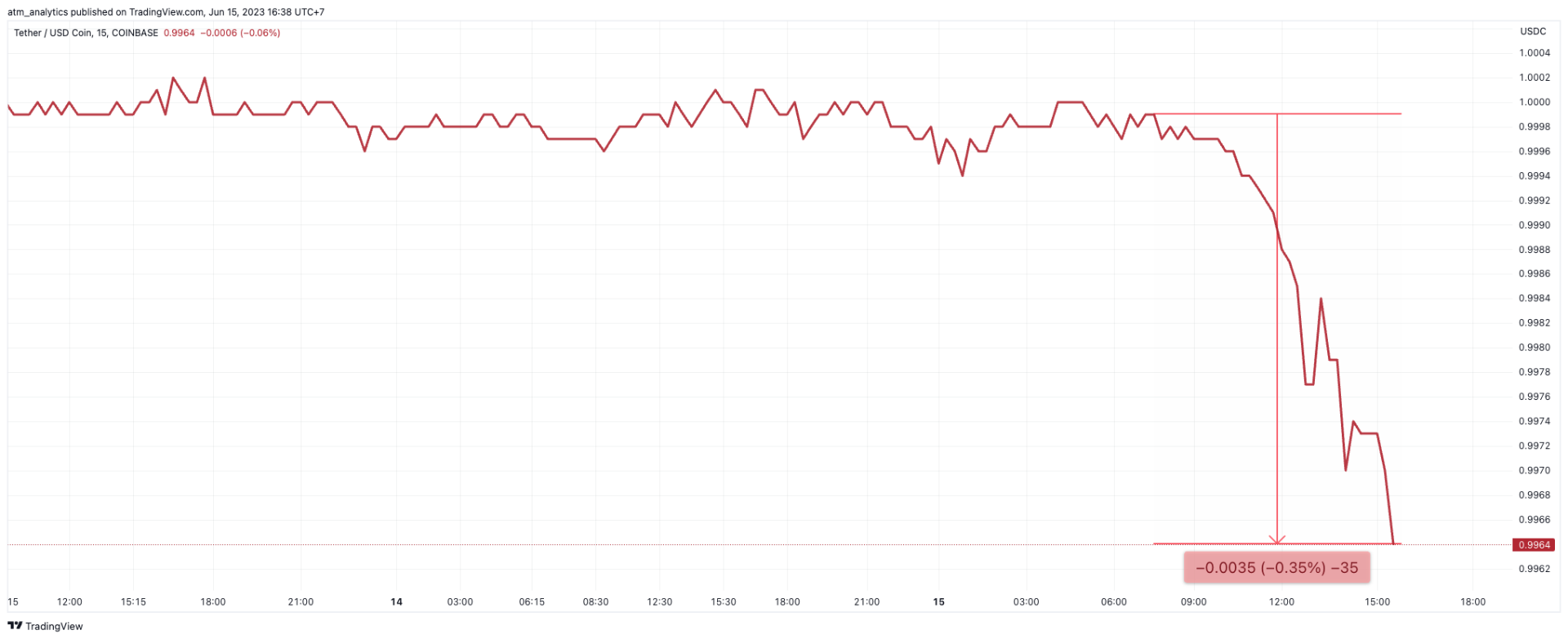
At this moment, 'faint-hearted' investors rushed to sell USDT for USDC to ensure the safety of their assets. On Binance, the exchange rate for the USDC/USDT trading pair reached 1.0030, meaning USDC was priced 0.3% higher than USDT.
Many whales also seized this opportunity to profit by shorting USDT through lending platforms like Compound, Aave… or buying USDT to arbitrage.
However, the reason for the price drop of USDT is due to the emergence of a large volume of USDT being sold in the 3pool (the largest stablecoin liquidity pool of Curve Finance), causing the proportion of USDT to become too high (nearly 75%) and the exchange rate of USDT to become unbalanced in the market.
A deeper reason for this massive sell-off came from misleading information provided by Coindesk. Specifically, Coindesk shared Tether's financial report, which included information that Tether held many commercial papers (high-risk), and during 2017 - 2018, USDT was not fully backed…
However, Tether immediately responded, asserting (here) that the reports held by Coindesk are from 2021 and are outdated. Additionally, Tether stated that the company operates transparently with reserves capable of redeeming assets for all users.
About 7 hours after losing its peg, USDT quickly recovered to 0.99826 USD, and the proportion of USDT in Curve Finance's 3pool also decreased from over 73% to 68.71%.
DYOR! #Write2Win #Write&Earn $BTC
