

Author: Michaellwy, Source: Author's Blog; Translated by: Songxue, Golden Finance
Preface:
Web3 wallets serve as the primary gateway to on-chain services, enabling users to interact with dapps and store their digital assets. With over 350 wallets listed on the WalletConnect website, wallets have clearly become one of the most saturated segments of the cryptocurrency space. The reason for this saturation is obvious: wallets represent the initial touchpoint for everything on-chain.
In this article, I will not delve into the technical nuances by categorizing wallets into EOA, AA, MPC, ERC-4337, etc. While these technical categorizations are important, they generally only represent differences within a specific layer of wallets. Instead, my focus here is to introduce three frameworks that provide insights into the business and strategic positioning of web3 wallets. These frameworks will give developers and investors a clearer understanding of the wallet ecosystem, addressing questions such as: How can existing projects in this saturated market capture additional value? What strategies can newcomers adopt to carve out their own space among the established giants? And, which segments of the wallet market are still up for grabs? These are the considerations that will guide our discussion.
1. “Wallet Master” and “Niche Master”
For this analysis, I have profiled the major wallets by two criteria: functional specificity and breadth of blockchain ecosystem coverage. While this categorization is not strictly quantitative or scientific, it is based on my hands-on experience with these products. Rather than focusing on the exact position of a wallet on the grid, it is more useful to observe the general quadrant they occupy. For example, wallets that cater to the Move-based chain and Bitcoin ordinal ecosystems rank lower in the chart due to their ecosystem-specific focus. On the other hand, wallets tailored for niche use cases such as trading, staking, and socializing skew toward the right, indicating their specialization.
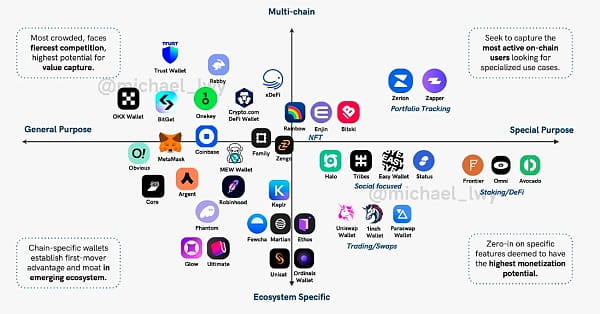
The framework divides wallets into four different categories:
Top left: A highly competitive area where wallets strive to be all-inclusive. Here we find wallets aiming for a “one-size-fits-all” strategy, seeking to offer all major features, utilities, and chains. Typical players in this quadrant include CEX-affiliated applications such as Trust (Binance), Coinbase Wallet, OKX, Bitget Wallet, etc.
Top right: While these wallets maintain broad chain ecosystem coverage, they are not chasing every available feature. Instead, they focus on use cases that cater to the most active user base. For example, Zerion and Zapper offer integrated DeFi portfolio tracking capabilities. For its part, Rainbow is more NFT-centric, with features such as in-app minting.
Bottom left: Here are wallets with a clear ecosystem bias. Although they may support multiple chains, their loyalty tends to be to a specific chain, such as Phantom's bias towards Solana, or Core Wallet's bias towards Avalanche and its subnets despite supporting other EVMs. Their goal is to gain an early foothold in an emerging space and build a loyal user base from the beginning.
Bottom Right: “Niche Masters”, these wallets focus on specific features and have clearer goals for desired user activities (such as staking and swapping). They are selective in the chains they support, directing their resources to supporting chains with the most activity/liquidity that can offer promising ROI.
2. Wallet Stack
In the second framework, I drew inspiration from @kelxyz_ of Messari. He divided the wallet stack into four parts: 1) key management, 2) blockchain connection, 3) user interface, 4) application logic. Building on this, I delved deeper into the strategic implications of the different stacks. In Kyle's analysis, these four dimensions are described as different elements that, when combined, determine the accessibility, specialization, and business focus of a wallet.
In my version, the wallet stack is more like a layered cake, with security and key management being the most important dimensions at the bottom of the stack. Building on solid design in the lower layers, wallets can focus on more cosmetic UI tweaks to improve user retention at the top layers. The functionality of each layer has specific implications for product strategy regarding onboarding, conversion, monetization, and retention.
Web3 wallets offer a variety of features and compete on four different sides of the wallet stack
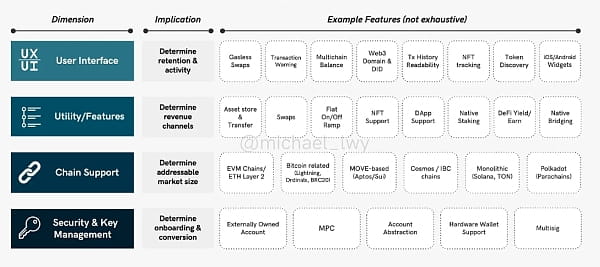
Security and Key Management: Self-custody is the most important feature of web3. This dimension focuses on how wallets manage private keys and keep them safe. Features here include multi-party computation (MPC), hardware wallet support, multi-signature capabilities, and social logins supported by account abstraction. Elements centered around key management shape the wallet's onboarding journey and its success in converting new users.
Chain support: Wallets can differentiate themselves by the chains they support. Some focus on the Ethereum ecosystem (L2 and EVM), while others cater to Bitcoin-related protocols (BRC-20 and Ordinals), the Cosmos chain, or monolithic chains like Solana and TON. Essentially, a wallet’s chain compatibility determines its potential market reach.
Utility: This dimension emphasizes the core functionality that differentiates a wallet. Examples include facilitating basic asset transfers to support dApps, native staking, and NFT management. The scope of a wallet’s utility determines its revenue stream. Most wallets now offer staking products such as swaps and fiat on-ramps. Therefore, standing out depends on the next layer of improvements.
UI/UX: As the initial interface, UI/UX coordinates how users interact with the wallet. This layer includes elements such as gas-free swaps, transaction alerts, multi-chain balance display logic, and integration of web3 domains with decentralized identities (DIDs). This dimension determines the main user activities within the application.
Now let’s look at two examples: one from the top left quadrant, Trust Wallet, and another from the bottom right quadrant, Uniswap Wallet.
Trust Wallet is the epitome of a "fat wallet". It has a comprehensive set of features that cover almost all four aspects of the stack. Particularly noteworthy is its strong support for almost every chain ecosystem. In contrast, the Uniswap wallet takes a "leaner" approach. Its design and functionality are tailored specifically for the trading experience, making it a more professional tool.
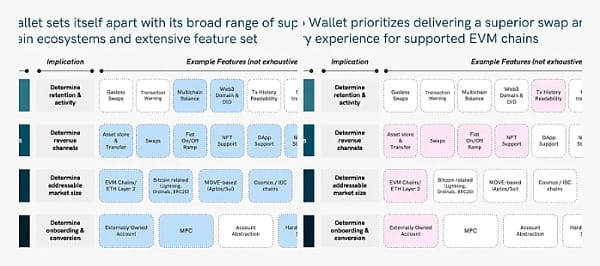
Here we have more examples to illustrate how different wallets uniquely position themselves within specific dimensions.
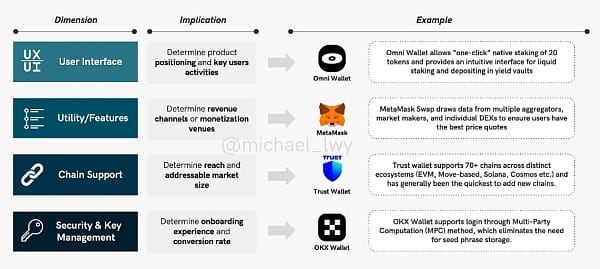
Omni Wallet, formerly known as Steakwallet, emphasizes native staking. It provides a simple user experience that facilitates native staking for over 20 tokens. From the beginning, Omni’s mission was clear: to carve out a unique space focused on DeFi yield opportunities in staking, liquidity staking, and yield vaults.
Metamask operates its exchange functionality as a meta-aggregator, sourcing liquidity from DEXs, DEX aggregators, and market makers. This strategy ensures that users get the best quotes. In return, users pay Metamask a 0.875% transaction fee for the aggregation service.
Trust Wallet stands out for its wide chain support. It supports more than 70 chains across different ecosystems, including EVM, Move-based chains, Cosmos, and independent chains such as Solana and TON.
OKX Wallet’s strategy has been to enhance user onboarding and conversion. They introduced MPC-based social login, allowing users to create a wallet using email. This feature bypasses the step of writing down a 12-word seed phrase, which is a common hurdle for cryptocurrency newbies.
3. Monetization and fungibility
Another useful framework for evaluating wallet products is to look at the monetization and fungibility of their functionality.
Monetization capabilities refer to the revenue-generating potential of in-wallet features. For example, certain features such as fiat on-ramps, token trading, and bridging can easily generate revenue by incorporating additional platform fees. Features related to staking and DeFi revenue can allocate a portion of rewards as platform fees. Beyond the asset management space, dapp-related features such as dapp discovery/marketplaces offer another revenue stream: platforms can charge advertising fees to increase visibility of certain dapps.
Fungibility highlights the competitive differentiation of features. It measures how a product or service is different from competitors and how substitutable it is. Basic utilities like token transfers, transaction history, and swaps are staking products offered in most wallets. However, specialized features like staking and gas subsidies provide a stronger moat — when users decide to stake assets with a specific wallet, they are more likely to return to the same wallet for subsequent on-chain fund management. Social features are another example: features like community feeds and web3 profiles (as seen in Halo Wallet and Easy Wallet) facilitate user connections. Once users are socially connected within a platform, they are bound by its network effects.
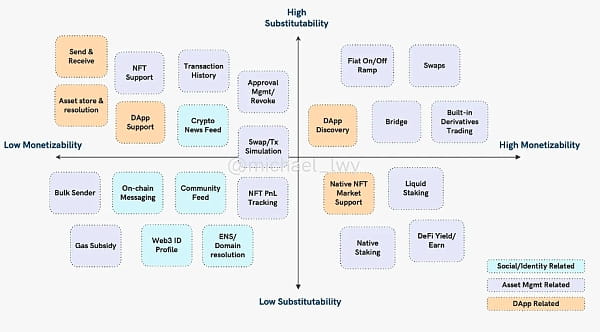
Based on the above 3 frameworks, we can see how important it is for builders and investors in the wallet space to ask the following questions:
Where does the wallet stand in terms of ecosystem coverage and functional specificity? Approximately which quadrant does it occupy in the first framework? Is it focused on certain blockchains or use cases? Who are the important competitors in adjacent areas of the map?
Which layer of the wallet stack does the project emphasize? Does it introduce meaningful differentiation and superior features to expand the scope of each layer? Which factors are prioritized among user conversion, market reach, revenue generation, and user retention?
Finally, when plotting based on monetization and fungibility, how does the wallet functionality set the fare? What level of competitive moat does the functionality possess?
IV. Two trends worth paying attention to
Finally, I want to highlight two key trends that are still in play. These developments could significantly change the wallet landscape in the future.
1. Embedded wallet.
One of the developments worth noting is the rise of embedded wallets - many dapps are increasingly choosing to vertically integrate wallet functionality. Take the recent rise of Friend.Tech and its forks as an example. Traditionally, they would have users connect to the dapp through Metamask or WalletConnect. But in order to eliminate the requirement for mnemonics for new users, Friend.Tech integrated an embedded wallet using Privy's infrastructure.
This shifts the paradigm from “one wallet for all dapps” to “one wallet for each dapp”. Instead of using a single application to manage assets, users may end up having multiple addresses and balances for the various dapps they use, which challenges the “fat wallet” theory and suggests a more decentralized wallet ecosystem. If we consider Friend.Tech a wallet, it would be drawn somewhere in the bottom right corner in the first frame: its use case is specific to managing friend.tech keys, and its chain focus is only on Base.
As a result, the value proposition of “traditional” wallets may diminish with the emergence of “Wallet-as-a-Service” (WaaS) products such as Privy, Coinbase WaaS, Web3Auth, Magic Link, Ramper, Unipass, Dynamic, Sequence, Particle, ZeroDev, and bionomy. Instead, dapps may encroach on the territory of wallet applications, incorporating wallet functionality as ancillary features and taking market share once dominated by standalone wallets.
2. The role of wallets in the MEV supply chain
This article has primarily explored the landscape of wallets as a standalone space, but it’s also important to consider the role of wallets in the broader context of the MEV (Maximum Extractable Value) supply chain. Wallets are powerful gatekeepers in this ecosystem, compiling user intent into on-chain actions. They determine the routing of transactions — whether through a public memory pool or private RPCs such as MEV-Blocker (used by Uniswap wallets), Flashbots Protect (used by OKX wallets), and Blink, and they regulate the policies of seekers, such as prohibiting front-running and mezzanine trading.
The value of user order flow in the MEV supply chain cannot be underestimated. While the huge transaction fees accumulated by Metamask Swap have received much attention, an often overlooked detail is that the default RPC endpoint of Metamask is Infura. You guessed it, Metamask and Infura both belong to the same parent company, ConsenSys. In short:
Whoever controls the wallet controls the RPC endpoint.
Whoever controls the RPC endpoint controls the order flow.
Whoever controls the order flow controls the MEV extraction.
This cascading control highlights that wallets are strategically important far beyond their user interface or asset management capabilities. They are at the heart of the MEV supply chain and have an impact on the user’s transaction journey. Therefore, competition among searchers for valuable transactions will give wallets leverage to monetize through payment for order flow (PFOF).