


Alex Pack, a partner at Dragonfly Capital, once said: "The goal of DeFi is to reconstruct the global banking system and create an open and permissionless operating environment." In the financial world of DeFi, encrypted assets are structured on the blockchain and passed through various The protocol realizes efficient transfer between assets and real-time circulation of value, such as self-custody of Metamask wallet, asset trading of Uniswap, lending of Aave & Compound, and value anchoring of MakerDAO.
Although we can see the various values of DeFi and the huge imagination brought by the composability of on-chain protocols, before reconstructing the global banking system, we must first open up the global traditional financial market with a value scale of more than 300 times outside the crypto world. . Fiat24 is trying to build a bridge between the crypto world and traditional finance through protocol.
In this article, we had the honor of having an in-depth exchange with Yang, the co-founder of Swiss Web3 Fintech company Fiat24, to sort out how the Fiat24 Banking Protocol (Additional Fiat Layer for DApps), which builds banking logic on the blockchain and is driven by smart contracts, can bring innovation to traditional banking, finance, and payment systems under the background of Swiss crypto-friendly regulation.
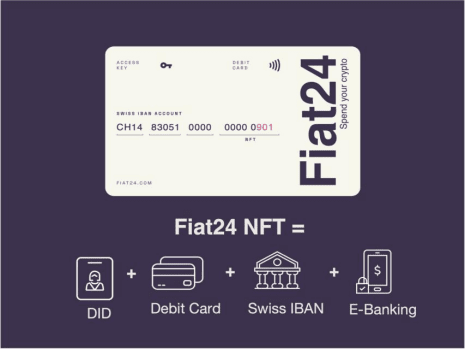 (Fiat24.com)
1. Fiat24 — Web3 Bank
SR Saphirstein AG is a fintech company regulated by Swiss banking law. Its Fiat24 is the first decentralized application (DApp) that fully structures banking logic on a public blockchain (Arbitrum) and is driven by smart contracts. It provides users with a series of Web3 banking services such as deposits and withdrawals, encrypted consumer payments, savings, transfers, and currency exchanges.
 (https://twitter.com/Fiat24Account/status/1716356543073923523)
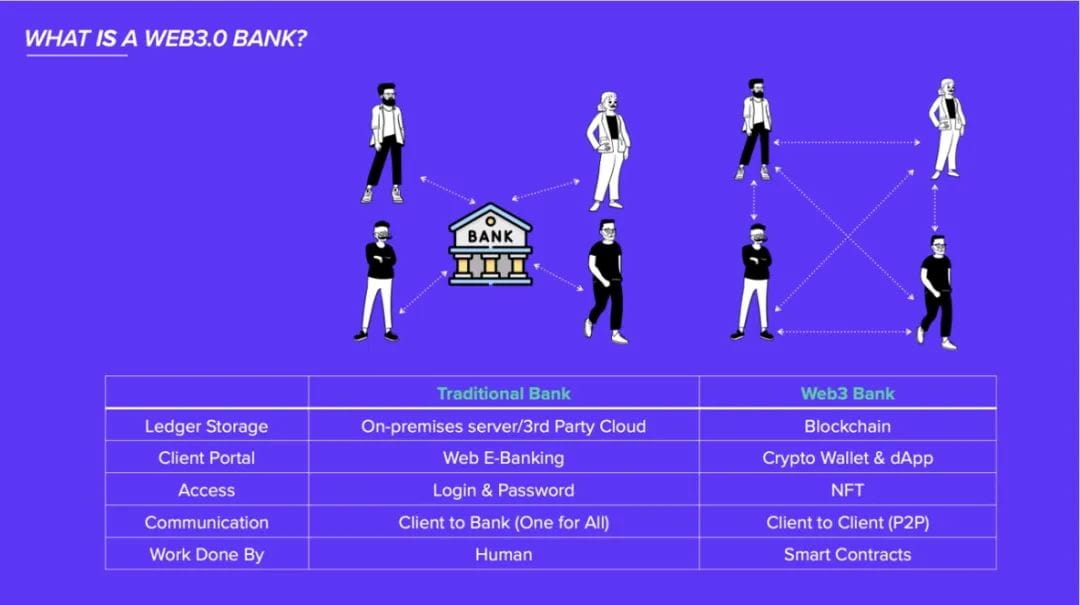
Unlike any other traditional bank, Fiat24 serves a large number of non-custodial wallet users and uses NFT to identify user information. You can think of Fiat24 as an Additional Fiat Layer for DApps, such as the Fiat Layer Banking Protocol under Uniswap.
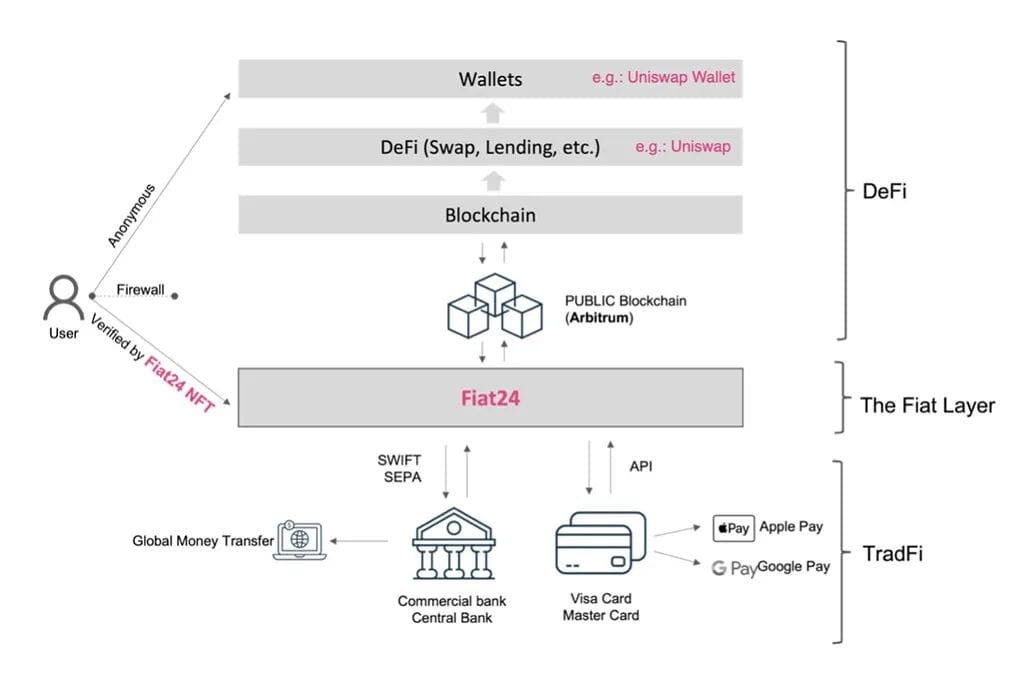
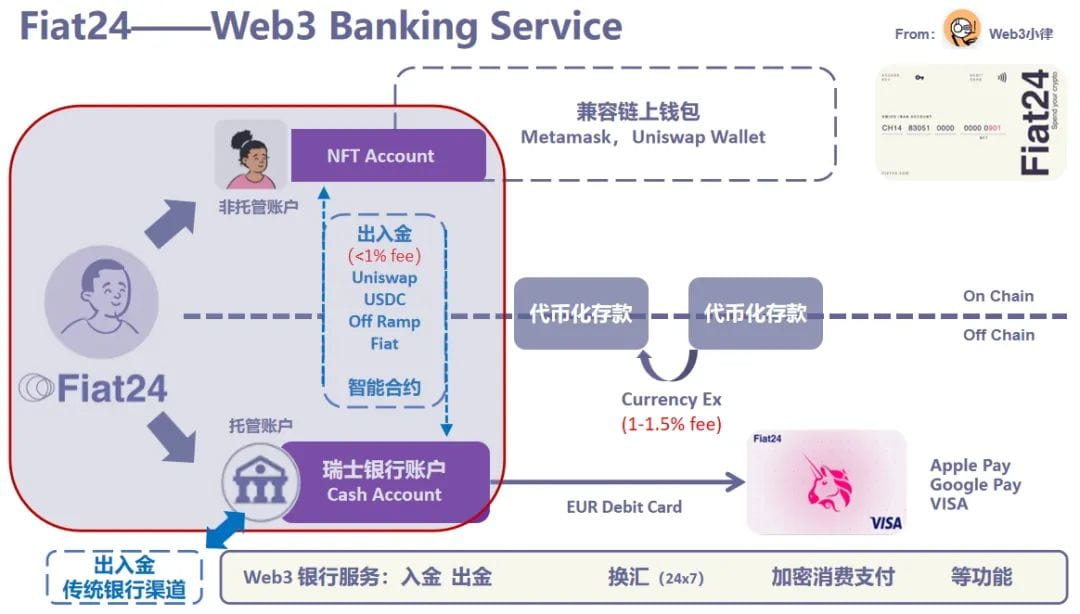
At the fiat currency protocol layer, Fiat24 provides Fiat24 NFT Account and Fiat24 Swiss bank account (Cash Account) to users who have passed KYC. On the one hand, it can integrate Web3 payment services. For example, users can make deposits and withdrawals as well as crypto consumer payments through the Fiat24 NFT Account connected to a crypto wallet. On the other hand, Fiat24's Swiss bank account is directly connected to the Swiss National Bank, the European Central Bank and the VISA payment network, enabling traditional banking services such as fiat currency savings, currency exchange, merchant settlement, etc.
 (Temperature Check - [Issue a Visa Card with Uniswap Logo ])
Fiat24's innovative blockchain banking architecture seamlessly integrates traditional banking services and Web3 blockchain payment innovations, enhancing convenience while also strengthening security and avoiding the risk of single point failure. Through Fiat24, customers can use their crypto assets stored in MetaMask or any other non-custodial crypto wallet to withdraw and exchange fiat currency, as well as daily crypto consumer payments, making their crypto assets available anywhere VISA is accepted.
For users who want to put crypto assets into daily use, this revolutionary ability to transform crypto wallets into payment solutions is an innovation to traditional banking, finance, and payment systems.
2. Fiat24 was born under Swiss crypto-friendly regulation
On January 1, 2019, the Swiss Federal Parliament launched a separate Fintech license under the existing banking regulatory system to encourage financial innovation. This license can be simply understood as a "simplified version" of the high-threshold traditional banking license, which aims to lower the market entry threshold for innovative companies interested in engaging in fintech business, allowing licensees to absorb public savings, but cannot use these public deposits to engage in investment, lending and other interest-bearing businesses.
The FinTech license launched in the context of Swiss regulatory friendliness, the guidelines on the regulatory framework for ICO activities, and the Distributed Ledger Act (DLT Act) have all brought huge room for innovation in the business model of FinTech, especially in the field of blockchain and crypto assets. Fiat24 was born in this context.
 (Fiat24.com)
The founding team of Fiat24 was engaged in traditional banking business in the early days and always paid attention to the development of blockchain and crypto assets. It was not until the launch of the fintech license that they came up with the bold idea of whether the traditional banking logic architecture could be built on the blockchain in 2018.
Yang said: "Blockchain technology, also known as decentralized ledger technology, is designed for bookkeeping. When we worked in banks, each bank had a back office team of hundreds of people to reconcile payments. Because there are tens of thousands of banks in the world, each bank has an account book. How to perfectly and error-free synchronize these tens of thousands of accounts requires very high system requirements. The atomic swap property of blockchain perfectly solves this problem, thereby eliminating the need for internal reconciliation departments in banks, which will greatly improve the work efficiency of banking and financial institutions and save manpower. It's like, with the same daily trading volume, Uniswap only has dozens of employees, while centralized exchanges need hundreds or even thousands of employees. It's the same principle."
As the crypto asset market continues to develop, the Fiat24 team also sees that DeFi, as a natural on-chain financial infrastructure, can make up for the limitation that financial technology licenses cannot operate loan interest-bearing businesses, and Switzerland's regulatory-friendly DLT bill can also pave the way for the compliant development of crypto assets.
After three years of continuous communication with regulators and the practice of converting the bank's core operating logic (Core Banking System) into smart contracts on the chain, Fiat24 finally obtained the fintech license issued by the Swiss Financial Market Supervisory Authority (FINMA) in 2021, becoming the first Web3 bank with banking logic driven by smart contracts and completely built on the public blockchain, providing users with deposits and withdrawals, encrypted consumer payments, savings, transfers, currency exchanges and other services.
Fiat24's innovative blockchain banking architecture seamlessly integrates traditional banking financial services and Web3 blockchain payment innovations, which has won the favor of many top capitals. It has also won the 2022 Best Neobanks & Specialized Players award from Qorusand Accenture.
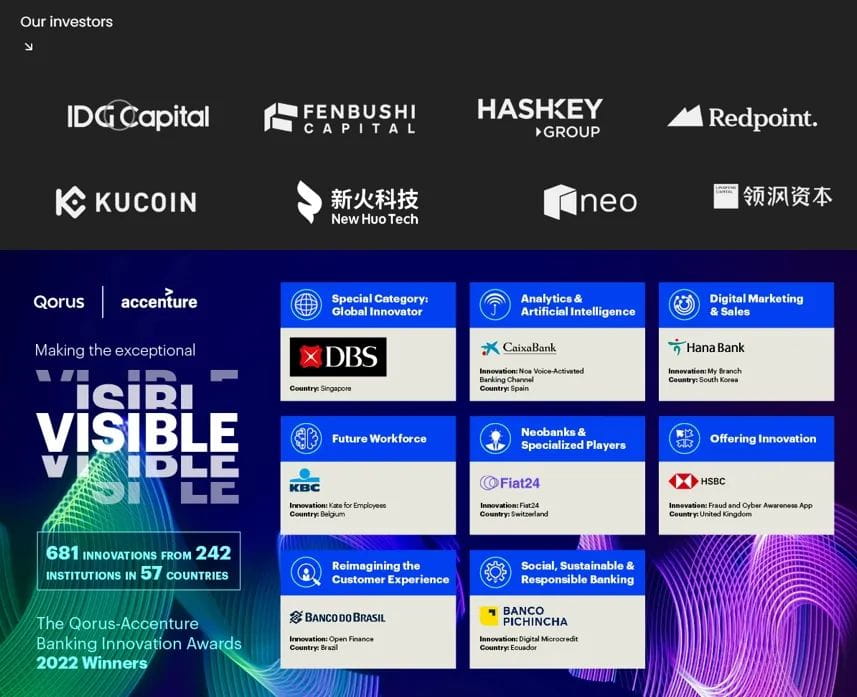 (Qorusand Accenture Announce Winners of 2022 Banking Innovation Awards)
3. Web3 banking services based on blockchain smart contracts
In the previous Web3 payment research report, we started from the underlying logic of Web3 payment and saw that various financial infrastructures of Web3, led by payment, are gradually taking shape - payment, custody, wallets, and stablecoins. As industry giants such as Paypal, Coinabse, VISA, Metamask, and Telegram deeply integrate their businesses with Web3 (especially payment), how to connect legal currency and cryptocurrency and how to use the advantages of Web3 payment to build business scenarios have become the key.
Fiat24 makes full use of the advantages of the Swiss Fintech license and innovatively builds banking logic on blockchain and smart contracts, connects the on-chain wallet account with the off-chain bank account, and accesses most of the payment scenarios in the real world through the VISA payment channel, building Web3 banking, finance, and payment business scenarios. Fiat24's core account system includes the on-chain NFT Account and the off-chain Swiss bank account (Cash Account).
3.1 Channels between NFT Account and Swiss Bank Account
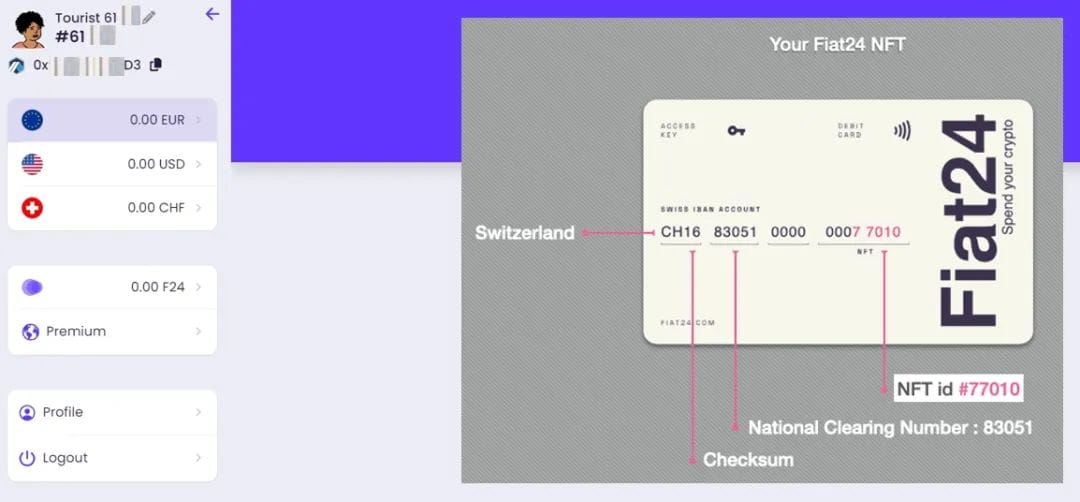
Users can access Fiat24 through a crypto wallet and obtain a Fiat24 NFT (unregistered visitor mode). Only Fiat24 NFT users who have passed the registration and KYC review can connect their Swiss bank accounts through this NFT Account. This practice of setting KYC real-name parameter operations at the NFT level and using NFT Account to represent user identity completely abandons the traditional bank account and password. For traditional banks, this is undoubtedly revolutionary.
After this NFT Account completes registration and passes KYC, Fiat24 will also open a Swiss IBAN bank account starting with CH for the user. This account is managed by Fiat24 and is regulated by Swiss Banking Law. It can provide the same basic functions as traditional bank accounts, such as deposits, transfers, currency exchanges, etc.
 (Fiat24.com)
3.2 Implementing Web3 Payments through Smart Contracts
Fiat24 binds the NFT Account to a Swiss bank account, further integrating blockchain technology into the traditional financial system.
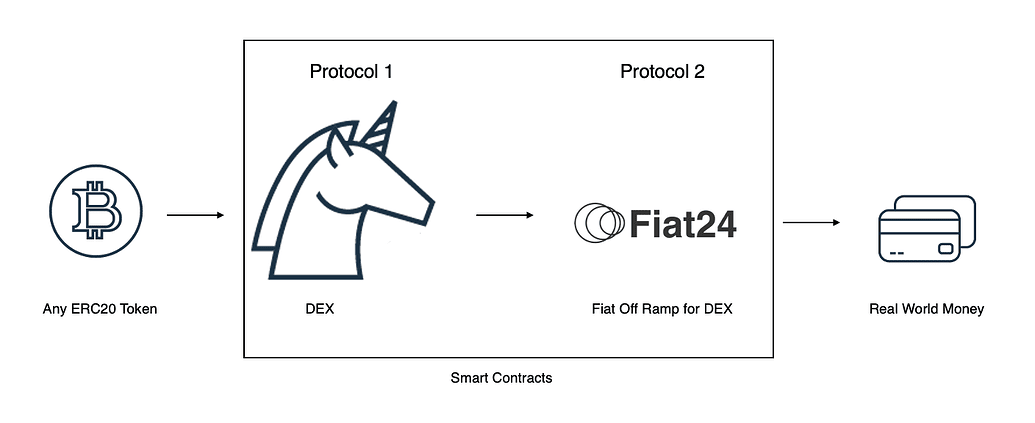
Deposit and withdrawal payment: In a business scenario of ETH withdrawal, there are roughly two steps: (1) ETH is converted into USDC; (2) USDC is withdrawn as USD through a payment channel. Fiat24 first calls the Uniswap protocol to swap ETH and USDC. Since Fiat24's banking logic is built on the blockchain, the next step is to directly call its own withdrawal channel to realize withdrawal. The above two steps are implemented through smart contracts.
Crypto consumer payment: Because Fiat24 provides a debit card co-branded with VISA for users who have passed the KYC registration, it has opened up the payment channels of more than 40 million VISA merchants, as well as third-party payment channels such as Apple Pay and Google Pay. Therefore, in the further ETH crypto consumer payment scenario, Fiat24 can directly convert ETH into USDC through smart contracts, and after withdrawing USD to a Swiss bank account, it can be used for the merchant's legal currency settlement through payment channels.
 (Temperature Check - [Issue a Visa Card with Uniswap Logo ])
Fiat24, a crypto consumer payment scenario that connects crypto wallets and bank accounts, can be said to be an iteration of traditional banking and payment services, because it integrates multiple services, such as Uniswap's Swap, USDC to fiat currency withdrawals, fiat currency to merchant settlement payments, etc., and drives the entire process through smart contracts, thereby achieving a smooth user experience from crypto assets to fiat currency.
3.3 Compatible with traditional banks and payment channels
Fiat24, relying on its fintech license, has been approved to join the Swiss Interbank Clearing (SIC) payment system and has a settlement account in the Swiss National Bank (Switzerland's central bank). At the same time, it can also be connected to global payment settlement systems such as SWIFT, SPEA, and VISA. All real-world payment interaction data is recorded on the Arbitrum blockchain.
In addition to making payments and settlements through Swiss bank accounts, Fiat24 users can not only transfer money to their Fiat24 Swiss bank accounts or transfer money out to other bank accounts via international remittances, but users can also sell their crypto assets and withdraw them as fiat currency to be deposited in Swiss bank accounts. All of these deposit and withdrawal methods are implemented by smart contracts.
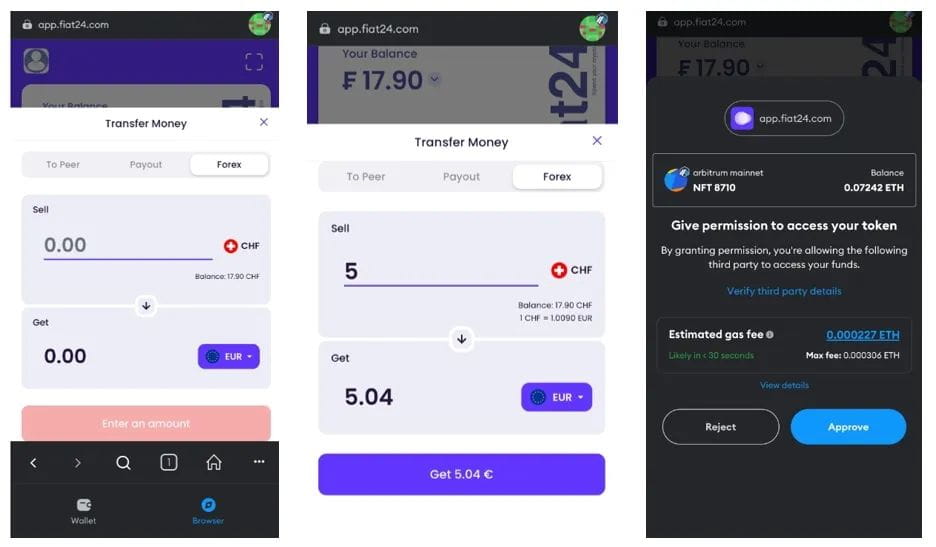
Interestingly, Fiat24 is able to provide currency exchange services (Foreign Exchange) through its Swiss bank account, and these foreign exchange fiat currency conversions are achieved through tokenized deposits.
According to Yang, Fiat24 created a USD/EUR trading pair on Uniswap to support its currency exchange business. However, due to the need to combine the oracle to anchor the exchange rate in real time, as well as factors such as transaction volume and currency type restrictions, Fiat24 finally decided to tokenize its own bank deposits and capture the interbank exchange rate through Chainlink to achieve 24/7 real-time currency exchange. We can see in the introduction of Fiat24 that currency exchange requires the payment of Gas.
 (Fiat24.com)
The architecture used by Fiat24 seamlessly integrates banking financial services and blockchain innovation. By building the bank's logic on the blockchain and driving it with smart contracts, it fully realizes the operation of the traditional bank's back-end system. On the business level, on the one hand, it can achieve the perfect connection of Web3 payments (including deposits and withdrawals, encrypted consumer payments) through its NFT Account and Swiss bank account system, and on the other hand, it can also connect to important functions such as payment, currency exchange, and transfer in traditional banking finance through Swiss bank accounts.
4. Build a Fiat Currency Protocol Layer for DApps
"Just like Chainlink's decentralized oracle network infrastructure positioning, Fiat24 is positioned as a decentralized digital banking network infrastructure - the fiat currency protocol layer of DApps." Yang said, "We believe that DEX will replace CEX in the future. However, compared to CEX's ability to realize deposits and withdrawals through its own payment channels, the biggest disadvantage of DEX lies in this. As a protocol, traditional banks cannot be compatible with a protocol, nor can they open APIs or open accounts for a protocol. Fiat24 can provide a perfect solution through the combination of its NFT Account and Swiss bank account, connecting the protocol on the chain through the protocol, and connecting traditional finance through the bank off the chain."
Since Fiat24 is a DApp that runs through a protocol, users can easily access the Swiss Bank electronic portal by visiting www.fiat24.com directly through a non-custodial wallet (such as MetaMask or Uniswap wallet), and this operation of setting KYC real-name parameters at the NFT level allows users to remain anonymous in other DApps.
For DApps developers, since it is a protocol-to-protocol collaboration, they can directly call Fiat24's protocol to achieve integration, which is equivalent to opening a Fiat24 Swiss Bank online banking account for their own DApp, making up for the lack of legal currency services in many DApps.
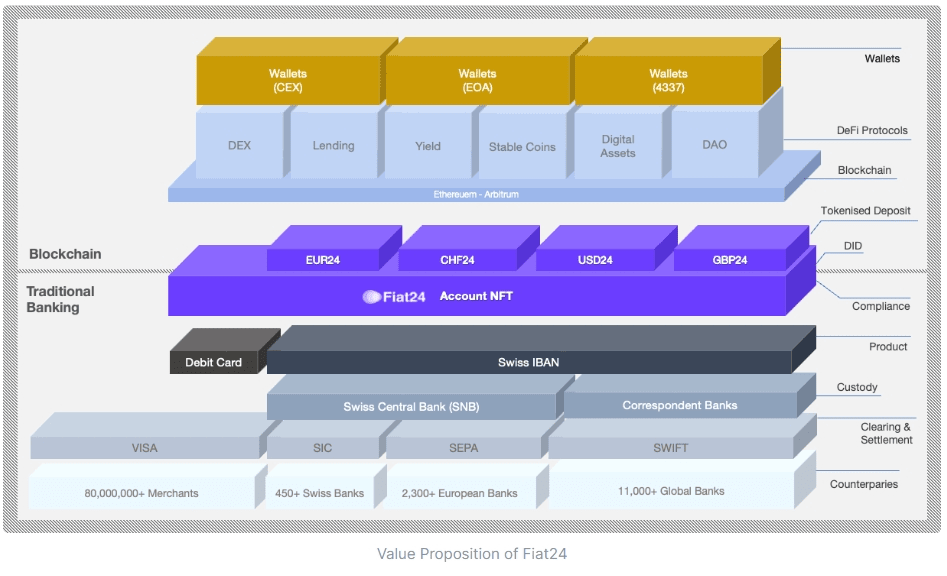 (Fiat24.com)
Currently, Fiat24 is actively working with crypto wallet teams to add a fiat currency protocol layer to these non-custodial crypto wallets to achieve seamless connection from on-chain crypto assets to off-chain Swiss bank assets.
This is a very urgent need for wallet users. On the one hand, they can obtain a noble Swiss bank account (the threshold for opening an ordinary Swiss bank account is a deposit of at least 500,000 Swiss francs) and enjoy banking services. On the other hand, they can also realize convenient encrypted consumer payments through the VISA payment channel provided by Fiat24.
Fiat24 (the fiat currency protocol layer for DApps) can seamlessly integrate various DApps through the form of a protocol, and is also applicable to DeFi, DEX, GameFi and other scenarios.
Imagine a daily consumption scenario: through Fiat24's DApp (accessed through its signed NFT), users can use crypto assets stored in MetaMask or any non-custodial crypto wallet to buy Starbucks coffee before work in the morning, or they can go to any bar that accepts VISA payments after get off work to make any purchase, thus achieving C in the morning and A in the evening.
Fiat24's innovative Web3 banking architecture design and seamless Web3 payment solutions are revolutionary for users who want to put crypto assets to use in everyday life.
5. Future prospects of Fiat24
Currently, Fiat24 only covers users in the European Union and Switzerland, and only supports 3 currencies. However, Yang said that with the recent market expansion and the surge in user demand, it will cover user groups in Southeast Asia and the Americas in early 2024 and support more currencies.
5.1 Outlook for wallet entry
Fiat24 will, based on its positioning as a decentralized digital banking network infrastructure - the fiat currency protocol layer of DApps, graft more crypto wallet entrances, and seamlessly connect B-side crypto wallets and other partners through protocol-to-protocol cooperation, similar to building a Fiat24 Swiss Bank online banking for DApps.
In addition, Fiat24 can also provide co-branded crypto payment cards (Debit Cards) for crypto wallet service providers to help users open up more crypto consumption payment scenarios, while helping crypto wallet service providers provide more empowerment to users.
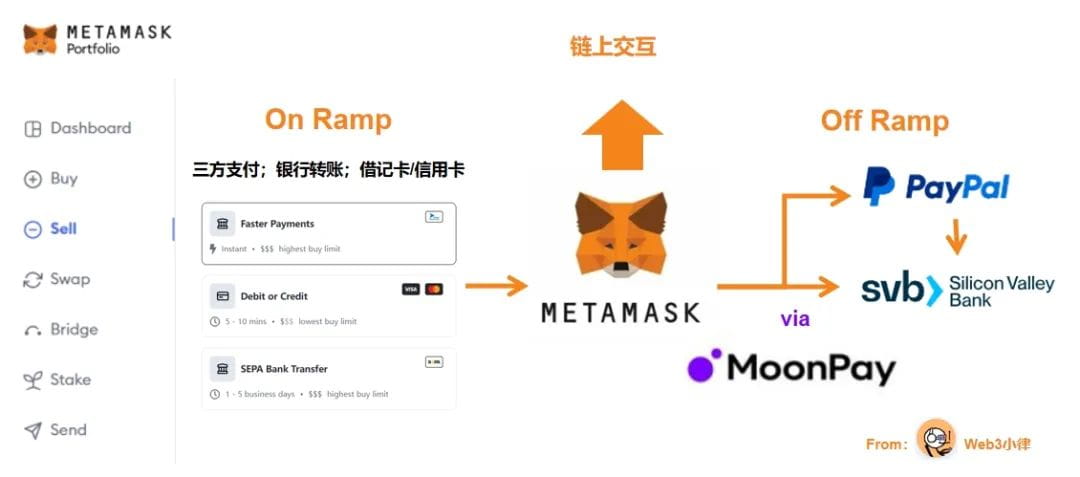
In fact, we can already see huge wallet portals like Metamask, which have integrated many Web3 financial infrastructures and can realize all basic functions similar to exchanges, such as Buy, Sell, Swap, Bridge, Stake, Send, etc. In the future, after the crypto wallet improves the user experience, it will be possible to overtake others. This is why OKX attaches so much importance to its OKX Wallet.
5.2 Planning of Token Economy
While continuously connecting with crypto wallet service providers and expanding product coverage, Fiat24 will start the token round of financing at the end of the year or early 2024. By then, Fiat24's positioning will be clearer - the fiat currency protocol layer of DApps, becoming an important infrastructure of the Web3 ecosystem.
The launch of F24 Token is to further connect the many participants in the Fiat24 ecosystem. As a functional token, F24 Token can empower its ecosystem participants. For (1) customized individuals and corporate customers, F24 Token can provide them with customized bank card number segments, and by consuming F24 Token, it can bring more generous payment limits and preferential rates; for (2) wallet service providers, it can provide its users with the convenience of opening accounts and online banking by consuming F24 Token.
In terms of token economy, F24 Token is a deflationary token model. According to its white paper, 50% of the future token supply will be allocated to community participants to support the sustainable development of the Fiat24 ecosystem, 20% of the supply will be allocated to early teams and investors, and the remaining 30% will be retained in the project's treasury to support the project's operations, development, compliance, external cooperation, etc., and jointly drive the long-term development of the Fiat24 ecosystem.
6. Final Thoughts
It is undeniable that a revolution is unfolding in the field of global financial payments. The transformative power of Web3, led by blockchain technology, is gradually penetrating into traditional banking, finance, and payment infrastructure through payments, wallets, custody, and stablecoins, just like the current all-out attack by industry giants on Web3 payments.
For the traditional banking industry, digital banking has become a catalyst for the digital development of traditional finance, but there are still many shortcomings that can be improved by blockchain technology. Users access their bank accounts based on outdated usernames and passwords, and transaction confirmation codes are usually obtained via text messages. These cumbersome processes make the system prone to human errors and manipulation, which undermines security. In addition, ledger records and processing logic are usually managed in the bank's back-end system, which is prone to single point failures and exposes sensitive information.
Innovative financial technology companies like Fiat24 are trying to change the underlying principles of traditional banking, finance, and payment systems. Similarly, traditional financial giants such as Paypal and VISA are also making various attempts in Web3 Fintech. Through joint efforts, the basic principles of banking, finance, and payment systems will change, using breakthrough technology architectures to enhance security, efficiency, and permissionless access to global banking, finance, and payment networks.
The transformation of traditional banking, finance, and payment systems cannot be achieved overnight, as the interests of too many participants are involved. Fiat24 is creating a new way of value transfer through the advantages of blockchain and smart contracts, and connecting the on-chain and off-chain through a DApp. Fiat24 is promoting and redefining the meaning of global banking, finance, and payment applications through blockchain Web3.