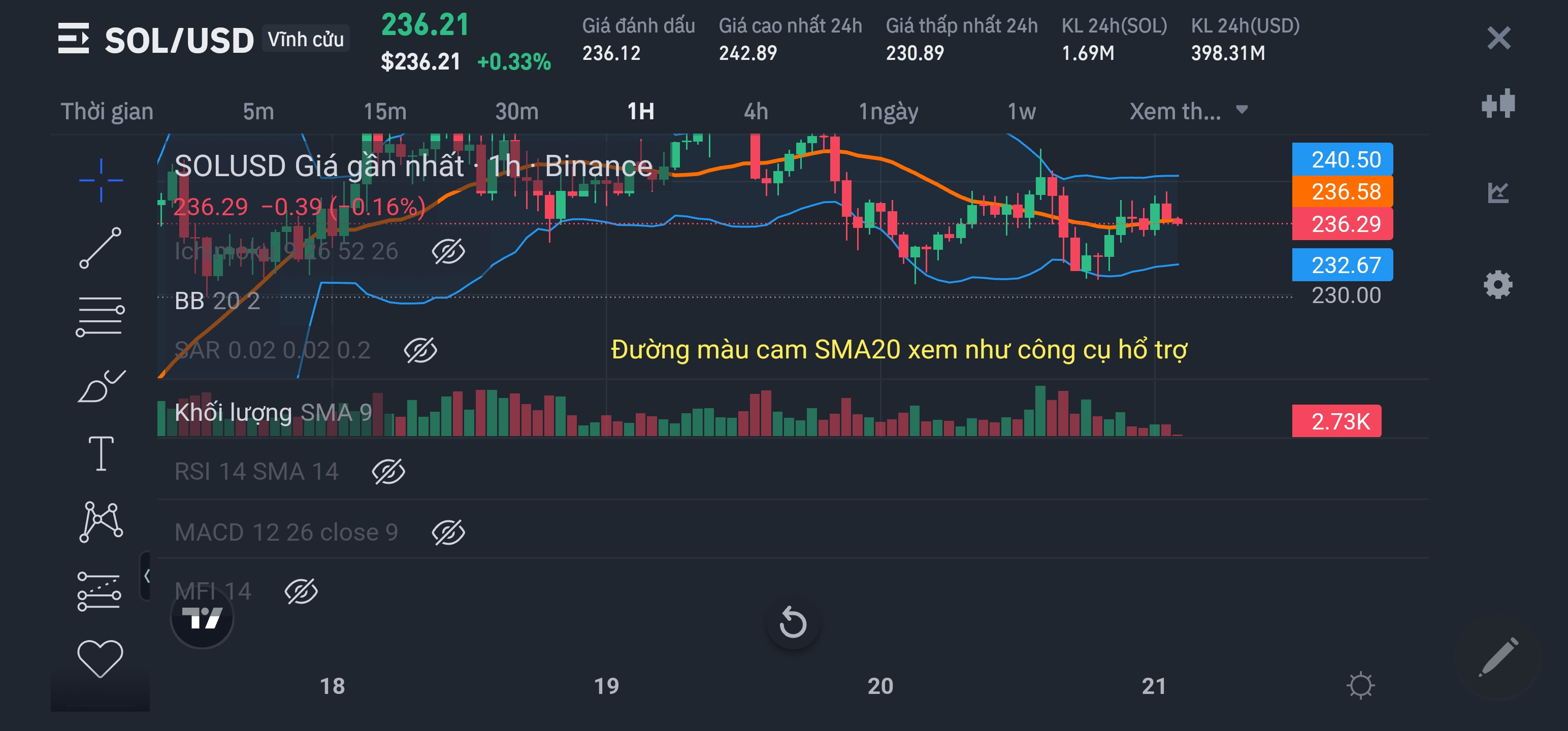
SMA20 (Simple Moving Average 20) is a technical indicator in price action analysis, commonly used in financial trading, especially in stock and forex markets. SMA20 is the average of closing prices over the last 20 trading sessions. Below is a detailed analysis of this indicator:
I 1. The Significance of SMA20
- Identify trends: SMA20 helps traders identify the short-term trend of the market. When the price is above SMA20, the market tends to rise; conversely, if the price is below SMA20, the market tends to fall.
- Buy/sell signals: SMA20 can be used to generate buy or sell signals. For example, when the price crosses above SMA20, this can be seen as a buy signal. When the price crosses below SMA20, it can be considered a sell signal.
2. How to Calculate SMA20
Formula for calculating SMA20:
$$SMA_{20} = \frac{(P_1 + P_2 + P_3 + ... + P_{20})}{20}$$
Where $P_n$ is the closing price of the n-th trading session.
3. Characteristics of SMA20
- Lag: SMA is a lagging indicator, meaning it reflects past information and may not respond quickly to price changes. This can lead to delayed signals in some cases.
- Smoothing: SMA20 helps smooth price data, reducing market noise. This helps traders more easily identify trends.
- Different from other SMAs: SMA20 is shorter-term compared to longer-term SMAs like SMA50 or SMA200, thus it may respond more quickly to market changes.
4. Combine with other indicators
- RSI indicator: Combining SMA20 with the RSI (Relative Strength Index) can help identify overbought or oversold conditions in the market.
- Volume: Considering trading volume when the price crosses SMA20 helps increase the reliability of the signal.
5. Disadvantages of SMA20
- Used in non-trending markets: SMA20 can create many false signals during sideways market phases.
- Depends on past data: As a lagging indicator, SMA20 may not reflect sudden changes in the market in a timely manner.
Conclusion
SMA20 is a useful tool for traders in determining trends and entry/exit points. However, to optimize effectiveness, it should be combined with other indicators and analysis methods, as well as considering the market context. Understanding how SMA20 works and its limitations will help traders make more accurate decisions.