

As the designer of the token economic model, we have already clarified which basic model the release of our tokens will follow. Inflation? Deflation? Dual tokens? Or is it a more interesting basic form that comes from other combinations. Then you have basically determined the general purpose of the token. You need to always remind yourself that the ultimate goal of token economic model design is to create the correct flow direction and profit path between supply and demand. The design can provide positive feedback to all stakeholders. Mechanisms.
Then, in the specific implementation of the distribution process, there are also some basic rules and common sense, such as the supply and distribution objects of tokens. Some rules are close to a certain consensus.
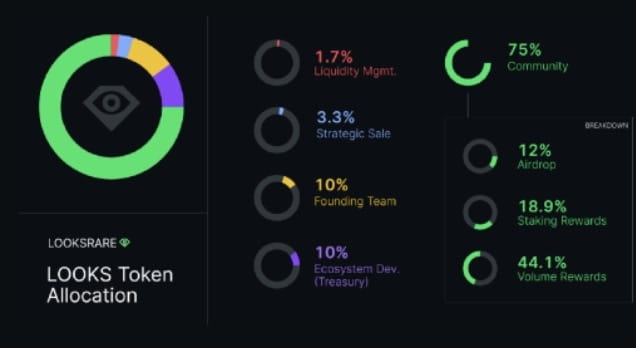 上图,是LooksRare向他的投资者和用户展示未来代币的供应和分配规则一览图,算是一种典型万金油的设计思路。一般情况,供给和分配对象大体上可以分成以下几类角色:
1. Core team/early project initiators, etc.
The division rules of this part are usually directly bound by the protocol and are used to incentivize the core team to obtain a linearly released fund pool.
In order to show the entire community that the project is launched fairly, that the team is serious about its work, and that there is absolutely no possibility of short-term selling pressure or runaway, the project team will design the minting and distribution of these tokens to be written in the contract in advance. Even if the project's tokens have been issued, no one can directly obtain access rights to the tokens from the agreement. "Code is the law" ensures orderly progress according to the rules of the game from beginning to end. The size of this pool usually accounts for 10% to 20% of the maximum supply of tokens.
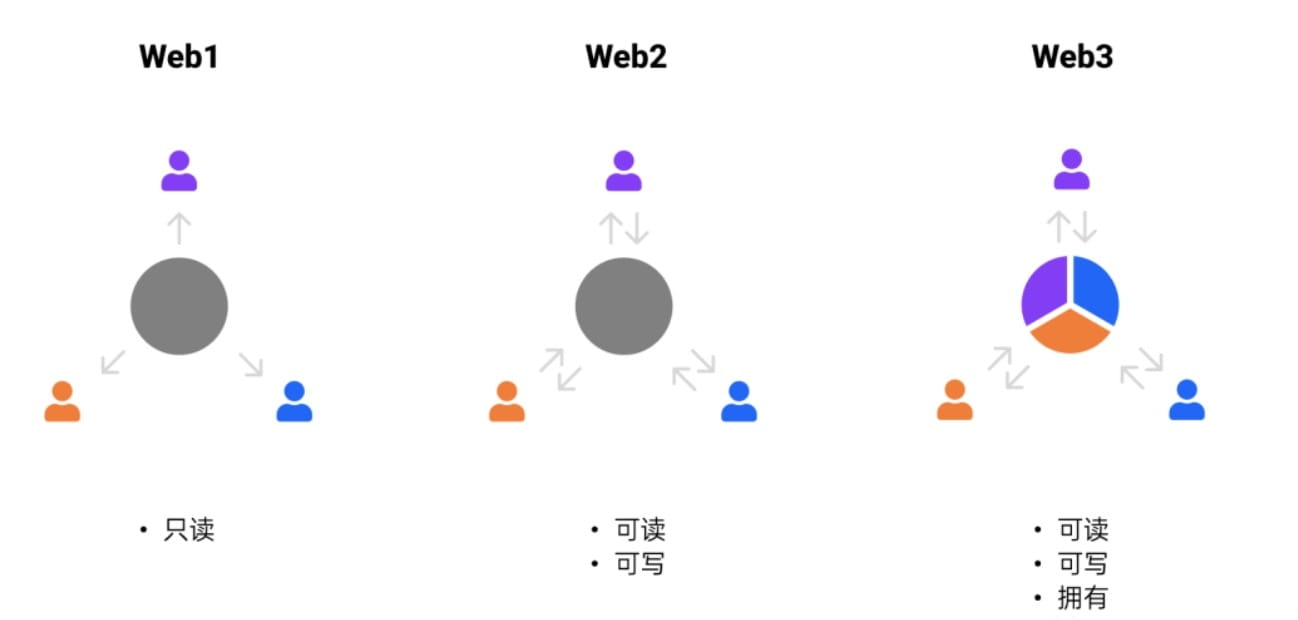
The difference from traditional entrepreneurial projects on team shareholding issues is that in the Web2 era, in order to ensure absolute control of the project and facilitate the subsequent entry of more capital, the founding team will be extremely cautious in selling 15% to 25% of the shares in the angel round. shares to early investors. However, in Web3, in order to demonstrate sufficient decentralization and distribution, the team (including early investors) only accounts for a small part of it, and the vast majority of the maximum supply is promised to belong to the entire community and DAO. Otherwise, when community members discover that the control of the project is actually in the hands of a small group of people, and they are likely to end up becoming a leek under the control of the banker, it will be difficult to form a consensus, and the project will easily enter a death spiral.
2. Early strategic investors/strategic sales/consultants, etc.
Prior to the public offering, investors gain equity by purchasing an equity-equivalent number of tokens. In order to achieve this goal, the project team needs to mint a certain number of tokens from the agreement in advance, and then directly award them to investors, or lock them into other contracts. For the latter, contracts usually have security features such as time locks and multi-signatures. It is clear that the corresponding number of tokens can only be obtained at a certain point in the future and confirmed by multiple parties at the same time. This protects the interests of investors and avoids pressure from the sell-off. This part will account for 10% to 15% of the maximum supply in design planning, or less.
For any Web2 start-up team, a seed round valuation of 20 million US dollars is probably a very scary thing, but it is very common in Web3. This does not mean that many people in the Crypto circle are stupid, but that a lot of people are stupid. A unique culture and consensus. Usually, the 10% token share of the $2 million in the early stage of the Web3 project is not held by just a few funds, but there may be a dozen or more Token Funds or individuals participating together, and the subscription fee for each company is also Just about 100,000 to 300,000 US dollars. On the one hand, this follows the distributed rules of the game in the Crypto industry; on the other hand, it is also closely related to the current situation of the industry: "Pangu opened up the world, and chaos began to emerge". Investors' FOMO emotions also forced the company to expand under the constraints of limited capital. Cast the net to catch the big fish. Fortunately, the charm of this circle is that it has a more flexible and faster exit path than equity investment. There are many cases of hundreds of times returns in one year or even less.
3. Treasury/foundation affiliated with DAO, etc.
Treasurys and foundations are essentially fund pools used to collect and allocate tokens. The tokens may be minted in advance and locked in contracts and periodically released through multi-signature plans; they may also be used later based on It is formed by the aggregation of handling fees paid by other users for interactions on the chain. In my opinion, there is no strict distinction between "treasury" and "foundation". In order to have higher recognition and more focused goals, some project parties will make more detailed divisions according to their own understanding and use them for different businesses. Scenes. These are not important, you can completely regard it as the personal preference of the project party. What is important are some consensus parts:
First: Tokens are increasingly flowing in a direction that is beneficial to the community, whether it is airdrops, market operations, or rewards based on business, choosing to pledge or participating in governance. In principle, DAO is the most important driving force behind it. There is no one.
Second: No matter what kind of token economic model is designed, the portion of tokens allocated to the community and DAO will generally account for more than 50% to 70%. This fully reflects the difference between Web3, Web1 and Web2 - user talent It is the subject that truly controls and determines the value of the agreement, not the first person or team to create the agreement.
 不同于前面代币供给和分配是流向某一类固定群体(团队成员和投资者),国库中的代币,将会更多的围绕某些事务、用例或者目标进行分配,虽然最终受益的依然是协议中不同角色的群体,但分配会更加灵活。具体来说,国库中的代币总结下来应该会有三个流向:
a) Expenditure to create initial liquidity
I think there are two important steps in creating initial liquidity, namely: discovering and setting prices and providing sufficient liquidity. This section reserves about 2% to 10% of the token share. This is the token economic model or, more accurately, it is another interesting and challenging part of the cold start phase of the project. I will not go into it here for the time being. I will dig a hole first and will discuss it in the subsequent "NFT, IXO and Liquidity" More details are given in the article. You have a rough idea of where these 2% to 10% of the tokens are most likely to go: some will be used for public sales, introductory auctions, etc., to initially capture users’ judgments on the value of the protocol in the community; the other part will be used for fundraising The incoming funds together form trading pairs that contribute liquidity, and are then invested in decentralized exchanges such as Uniswap and Balancer.
b) Expenses for IDO/airdrop/operation, etc.
Whether it is Web2 or Web3, traffic and attention are always scarce resources. Web2 acquires customers mainly through a large number of advertisements, while Web3 adopts a new paradigm - new organizational form, new distributed technology, new viral marketing concept, and dialogues with the market and users in advance. MEME, AMA, airdrops and even FOMO emotions have become a means to spread and build consensus. The result is that all efforts are ultimately converted into the purchasing power of tokens and NFTs.
Of course, the detonation of this new paradigm is not inexplicable. It requires a fuse. The project team has to use a part of the tokens for targeted publicity and marketing in the community. Usually, the proportion is 10%~15%. No wait.
c) Expenses for various rewards (based on business, choosing to pledge or participating in governance)
This part will become the main expense of the treasury, and it is also the cornerstone that can really help the protocol capture users and value. After the concept of DAO emerged, more than 50% to 60% of the tokens are usually reserved in this pool. The methods of participation and how to obtain rewards have been discussed in the chapter "How to become a protocol user and obtain benefits" For a more complete introduction, we will not go into details here.
The above are all methods and methods for designing token distribution from the perspective of the project side, such as the core team, investors and different roles in the ecosystem. From the perspective of an individual investor, the design of this part of the project is worthy of study and consideration:
First of all, if a token is locked in a large amount, we need to pay attention to its release schedule, that is, the time lock part. When the token is released, it will most likely affect the price and market value of the token. Secondly, you also need to care about how many tokens have been minted in advance and how many people are in their hands. If these tokens are too concentrated and large compared to the maximum supply, it means that the price of the tokens can easily be reduced by a small amount. Manipulated by a few people.