

* Table of Contents (Introduction)
*I. Introduction
*Second, cloud giants frequently experience failures. Are centralized cloud services still reliable?
-Cloud services are developing rapidly (I)
- Reasons for the emergence of cloud services
2. The number of cloud service providers increases year by year
-Cloud service failure analysis
1. Overview of domestic and overseas cloud service failure incidents
*3. Web2 Model of Centralized Cloud Service Provider Web3 System
- Concentration of power
- Strict review
- Lack of pricing power
- Single point of failure
*Web3 technology development background and market size forecast
The decentralized storage market is growing at a rate of over 100%.
Web2 technology has security threats, cloud computing monopoly, insufficient computing resources, and high costs. Against this background, Web3 came into being.
Decentralized cloud computing market background
Decentralized cloud computing application areas
·The development prospects of decentralized cloud computing
*Fourth, Oort Web3 decentralized cloud service infrastructure
The original capacity of mainstream public chains is small and it is difficult to carry a large amount of data and storage needs, and centralized cloud services cannot meet the needs of Web3 users for security, openness, and anti-censorship. At present, most Dapps have only achieved decentralization at the logic layer, while the storage and calculation of a large amount of data are still running in centralized cloud computing services under the chain, such as "AWS", "Google Cloud", "Alibaba Cloud", "Huawei Cloud", etc.
Oort aims to build a low-cost, low-latency decentralized cloud infrastructure to support general Web2/Web3 and metaverse applications.
*What problems does Oort solve in the industry?
Provide a low-cost, high-efficiency, and more secure decentralized computing network, including storage, computing, network bandwidth, and other computing power.
The first problem is that, globally, about 68% of data centers, supercomputing centers, and super servers are idle every day.
The second problem is that due to the centralization of storage and computing, a large number of government and enterprise organizations rely on one platform. When there are operational problems on the centralized platform, it will affect almost all service providers. The larger the scale of centralized cloud computing, the greater the hidden concerns about operational security issues. The "downtime" and "data loss" incidents of those large cloud computing platforms can always become "big news" in the industry. It is difficult for companies that put 100% of their lives and lives on third-party servers to withstand such accidents, but accidents are endless and are difficult to avoid fundamentally due to the centralized mechanism. At this time, the advantages of decentralized cloud computing emerged. Oort (Oort Cloud) provides independent and decentralized nodes from server suppliers in 25 countries around the world, so that decentralized cloud computing can theoretically never go down (while avoiding the one-size-fits-all policy of a single country and anti-censorship), which is an inherent advantage in the mechanism.
The third problem is that most Web3 and metaverse applications are still built on the current centralized infrastructure. Just like many NFT, Defi, GameFi, Dex and other projects, in form, even if they are built on EVM-compatible blockchains, their data content is still stored in centralized cloud services-data centers.
The fourth problem is the waste of computing power resources caused by “empty mining” of mining machines in the crypto market.
*What exactly is the core technology used for, or what can Oort Cloud users (computing resource supply side and business demand side) do on this platform?
·Core technology, optimize idle computing power, increase miners' income (aggregate multi-mining/dual mining + commercial order profits, differentiated competition in the same track, empower compatibility in the same track, and dig deep into the demand side).
Oort Cloud is designed not only as an infrastructure to support Web3 and metaverse applications, but also to support general services required by enterprises and ordinary users. Dynamically configure neighboring networks of decentralized clouds to support computing for end users (such as VR/AR games) to enhance the immersive experience.
Oort (Oort Cloud) computing power resource supply data①: More than 210,000 computing power nodes from 25 countries around the world (international and completely decentralized), the global meta-computing power once exceeded 100 billion
Oort (Oort Cloud) community data ②: total data exceeds 150,000 people (non-real-time), twitter and telegram communities in 7 different languages, discord, facebook, youtube, instagram, medium, medium, linkedin, etc.
Oort (Oort Cloud) business needs and ecosystem data ③: Dozens of crypto-native Web3 ecosystem projects have settled in, and multiple Web2 giant enterprise demand parties {Dell computer products will be pre-installed with DSS's decentralized storage, and a considerable number of users will use Oortech DSS (market reports show that in the first quarter of 2022 alone, Dell's notebook sales reached more than 13 million), Finstreet (India's first crypto education platform, with 4.5 million community members and nearly 100,000 students), Africa2.0 (Africa needs 700 new data centers), etc.}.
Oort (Oort Cloud) product development progress: 1 DSS: decentralized storage service (already launched),
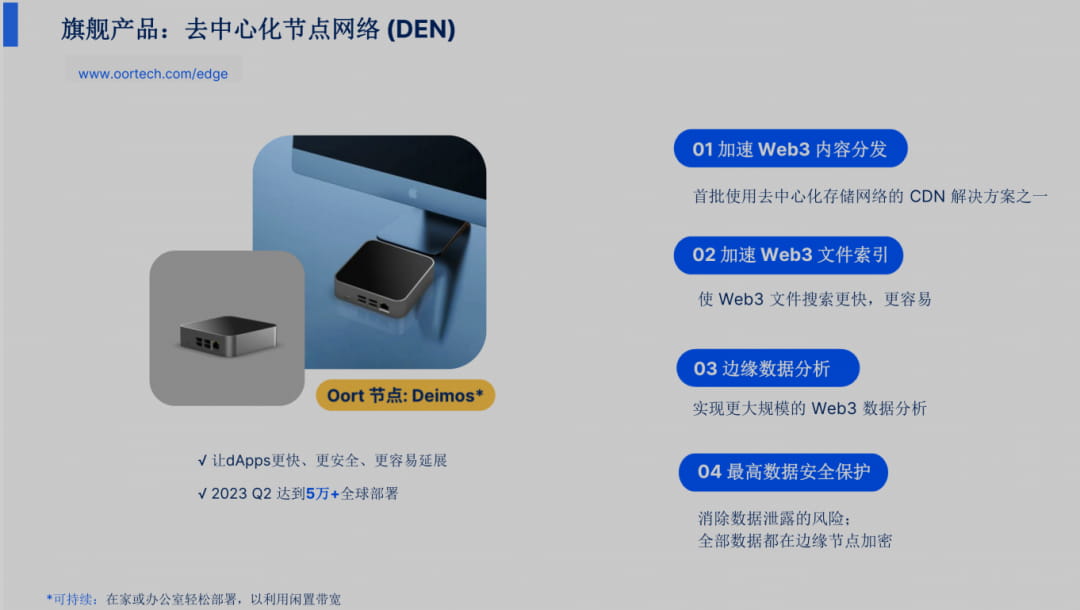
2DEN: decentralized node network (already launched, expected to reach 50,000+ global deployments in the second quarter of 2023)
3 DCS: Decentralized Computing Service (expected to be launched in Q4 2023)
*Blockchain provides economic momentum and market incentives for the cloud computing market
Token economic incentive model solves the problem of insufficient user participation
Based on blockchain, distributed computing power, algorithms and data can achieve market separation.
A large number of IDCs and personal computing node resources distributed around the world have not been fully tapped. How to organize idle computing resources to participate in market operations and make idle resources generate market value - distributed computing power will become a new business model. Blockchain is the basis for data privacy protection, and more importantly, it provides basic collaborative support for the separation of computing power and data - distributed computing power leasing can obtain the required market returns in the blockchain network.
*V. Summary
I. Introduction
Let us go back to 14 years ago.
On November 24, 2006, the e-commerce giant Amazon experienced the craziest "Black Friday" in history. The website traffic increased several times and the transaction volume continued to soar. Fortunately, Amazon founder Jeff Bezos had already made advance preparations. He not only purchased a large number of computing devices, but also pre-purchased network bandwidth to cope with the traffic peak during the promotion.
However, after the brief excitement of "Black Friday", Jeff Bezos was worried, because as the transaction volume returned to normal levels, a large number of computing resources began to be idle, which would undoubtedly bring huge costs to Amazon's operations. However, this problem did not stump Jeff Bezos, and he soon decided to sell these idle computing resources on a lease basis to improve asset utilization, so a new concept of "cloud computing" was born! In the same year, Amazon officially released Amazon Web Services (AWS), which initially only provided users with basic services such as "computing resources, namely computers" and "storage resources, namely network cloud disks", but soon penetrated into databases, real-time processing of enterprise transaction logs, as well as multiple industry fields such as AI and deep learning.
The same thing happened to Alibaba. The huge computing resources invested in "Double 11" will be sold to other companies when they are redundant at other times - this is actually the "Alibaba Cloud" service we are familiar with.
Time flies, and cloud computing has been developing for nearly 15 years.
In the blink of an eye, 2020 will soon be over. Looking back at the beginning of the year, the sudden outbreak of the new coronavirus has become an unforgettable memory in everyone's heart. This crisis has also brought about tremendous changes to the operation of the entire society. For example, companies began to require employees to work remotely from home, schools taught students live classes through the Internet, and doctors used remote video to consult patients, etc. - you will find that all of these are inseparable from the support of cloud computing.
According to data disclosed by China Report Network, the total revenue of the domestic cloud computing industry reached 2.115 billion yuan in the third quarter of 2020, an increase of 18.53% year-on-year, and the growth rate increased by 11.34% compared with the second quarter. The reason for this trend is mainly because the demand for cloud computing by organizations such as enterprises, schools and governments has begun to rise sharply.
However, looking at the global cloud computing industry, you will find that there are serious monopoly problems in this field. According to the analysis of the well-known market analysis agency Forrester and the network giant Cisco, cloud infrastructure suppliers will account for 53% of global Internet traffic in 2020, and 80% of the global Internet payload is provided by only a few technology companies, which means that the Internet will face the risk of being integrated and manipulated by a few oligarchs in the future. According to data from the British research agency Canalys, the current cloud computing market share is almost divided among Amazon, Google, Microsoft and Alibaba:
In the global market, Amazon AWS accounts for 31% of the market share, Microsoft Azure accounts for 20%, Google Cloud accounts for 6%, and Alibaba accounts for 5%.
In the Chinese market, Alibaba controls 40.1% of the domestic cloud infrastructure market share, Huawei accounts for 15.5% and Tencent accounts for 15.1%.
The harm of monopoly needs no elaboration, and it has already brought a series of negative impacts to the cloud computing industry, such as reduced competition, price increases, low utilization of computing resources, low security and transparency, and insufficient user participation. So, how can we solve these problems?
Second, cloud giants frequently experience failures. Are centralized cloud services still reliable?
This paper has incompletely sorted out 17 failure incidents of 8 domestic and foreign cloud giants, from which we can get a glimpse of the main stages in the development of cloud services, as well as the frequency and causes of failures at different stages. Combined with the background and advantages of cloud services, it is pointed out that even if cloud services will have failures and downtime incidents during the development process, with the continuous improvement and progress of the service, it is expected to enter a better next stage of development.
Cloud services are growing rapidly
1. Reasons for the emergence of cloud services
With the continuous development of the Internet, the number of network users has increased sharply, and the demand for network services has gradually diversified. In order to support traditional applications to cope with the above situation, enterprises have greatly increased their demand for hardware equipment and related databases and other software. Correspondingly, users also need to form an operation and maintenance technical team to install, configure, run, and upgrade these equipment and software to maintain the normal security services of related applications. The final result is that the operating expenses of the enterprise increase, and huge overhead costs need to be paid for this; at the same time, the enterprise spends a lot of effort and money to operate the services it provides, but it still cannot meet the growing needs of users. Therefore, cloud services came into being.
Cloud services are the increase, use and interaction patterns of related services based on the Internet, usually involving the provision of dynamically scalable and often virtualized resources through the Internet. Cloud computing is another major change after the great transition from mainframe computers to client-server in the 1980s.
2. The number of cloud service providers increases year by year
Since the introduction of cloud services, domestic and foreign cloud service providers have increased year by year. Major foreign cloud service providers include the world's most comprehensive and widely used cloud platform - Amazon AWS cloud service; Microsoft's cloud computing-based operating system - Azure; Google Cloud server Google Cloud, etc.
In recent years, my country's cloud services have also developed rapidly. According to the cloud computing development survey report of the China Academy of Information and Communications Technology, driven by technological progress and favorable policies, more and more corporate entities are deploying digital systems and value-added technical services in the cloud. China's total expenditure on cloud service technology solutions increased from RMB 89.3 billion in 2016 to RMB 322 billion in 2020, with a compound annual growth rate of 37.8%. Among the many cloud service providers, Alibaba Cloud, Tencent Cloud, JD Cloud, Huawei Cloud, and Baidu Smart Cloud occupy the top position and have a large market share.
Huawei Cloud has also been developing well in recent years. According to data released by market research firm Gartner, Huawei Cloud ranked fifth in the world in 2021. The top four are Amazon, Microsoft, Alibaba, and Google.
Cloud service failure analysis
1. Overview of domestic and overseas cloud service failure incidents
According to incomplete statistics from Zero One Think Tank, since 2010, QingCloud, the first hybrid cloud listed company, has experienced about four failures and downtime incidents, Alibaba Cloud, the world's leading cloud computing and artificial intelligence technology company, has experienced about five failures and downtime incidents, and Tencent Cloud, the cloud computing brand under Tencent, has experienced about eight failures and downtime incidents.
Among the many failures that occurred in domestic clouds, the multiple failures that occurred in Qingyun in 2015 are worth mentioning, from which we can draw relevant rules for cloud service failures. It is understood that on June 6, 2015, all hardware equipment in Qingyun Guangdong District 1 unexpectedly shut down and restarted, and the failure period was from 13:48 to 16:30. On July 22, 2015, a large number of Qingyun users in Beijing District 2 (PEK2) were disconnected from the network, and the failure lasted from 12:47 to 15:15, after which user services gradually recovered. On July 23, 2015, Qingyun PEK 2 experienced network failure again, and the failure time was from 13:15 to 13:30 and 13:50 to 18:50 respectively. The latter two failures occurred in Beijing District 2, especially on July 23, the network failed again after a brief recovery, and lasted for 5 hours. These three frequent large-scale failures all occurred two years after Qingyun went online. At the same time, Qingyun also experienced a failure that lasted more than 4 hours in 2017. The accident also occurred in Beijing District 2, where two failures occurred in 2015.
From this, we can see that due to the lack of technical maturity, the relevant cloud service providers are in the stage of technical exploration and improvement. In the early stage of cloud service establishment, the probability of failure is relatively high. The failure of some components that occurred before may occur again.
Research on other cloud service providers found that most of the failures that occurred in Alibaba Cloud and Tencent Cloud over the past ten years occurred between 2018 and 2019. That is, although cloud services have entered a stage where technology is relatively mature, there is still a high probability of downtime incidents.
Table 1 Incomplete statistics of some domestic cloud service failures in the past five years

 Source: Public information, Data Training Institute, Zero One Think Tank
Table 2 Incomplete statistics of some foreign cloud service failures in the past five years

Source: Public information, Data Training Institute, Zero One Think Tank
3. Web2 Model of Centralized Cloud Service Provider Web3 System
As we all know, the Internet relies heavily on large service providers to provide computing infrastructure to run large data center networks and cloud-based operations. The Node-as-a-Service (or RPC-as-a-Service) market is becoming increasingly competitive with emerging server infrastructure providers. VCs and established technology companies are investing hundreds of millions of dollars in this field.
In addition, as the size of blockchains and the number of transactions per second grow, the technical requirements for running nodes are also increasing.
Centralized providers have the funds needed to purchase influence and Web3 infrastructure, but we also need to reflect: is it right for the organizations that dominate Web2 to decide the future of Web3?
Concentration of power
If one or more centralized providers, through the number of nodes they run, eventually gain control over the majority of the infrastructure of a blockchain (or multiple chains), while being confined to a single country, this could spell disaster for the policy, security, and continuity of decentralized systems.
Strict review
Centralized providers can directly or indirectly prohibit users from using their dApps based on geographic location (a single country) or other factors. Centralized providers will clearly state in their terms of service that they must comply with all laws and regulations, which means that dApps that rely on their services are also subject to relevant scrutiny.
Lack of pricing power
Users' hopes for Web3 are to be as accessible as possible, with lower fees and barriers to entry when interacting with node infrastructure. However, centralized providers lack community governance, and pricing power is in the hands of the providers.
Single Point of Failure
Centralized Web3 providers such as Infura and Alchemy use AWS data centers to house their nodes. This limits the global distribution of nodes and results in higher latency. Even more, if AWS fails, it will cause all dApps that rely on these nodes to communicate with the blockchain to fail.
Decentralized infrastructure is often the best choice for the following reasons:
* Running your own node requires a lot of manpower, time, capital, and specialized technical skills.
*Centralized infrastructure is antithetical to Web3, providing vulnerabilities for censorship, failure, and manipulation while rewarding VCs and centralized corporations.
*Decentralized infrastructure provides solutions consistent with the original intention of blockchain technology. Developers incentivize node operators, users and communities while providing lower latency, more stable and high performance standards to form a decentralized, independently operated node network.
*Web3 technology development background and market size forecast
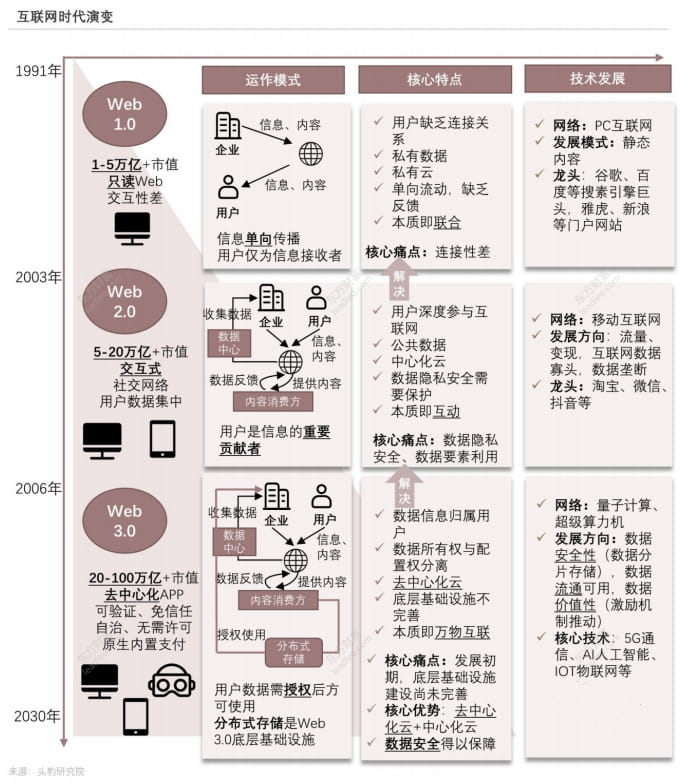
From 1990 to today, the Internet has experienced a wave of development from Web1.0 to Web3.0, and is currently in the stage of large-scale infrastructure construction of Web3.0. In the era of Web1.0, the network provided information to users in the form of one-way advertising. In the stage of Web2.0, the network gradually changed from the role of information provider to the role of a platform for information exchange between users. Users have become the main contributors of information. With the development of technology and the popularization of applications, the transmission and storage of data are rapidly expanding. In the 2.0 era, most of the data generated by users belonged to the platform and large cloud computing vendors. In the 3.0 era, the characteristics of decentralization allow data to return to the users themselves, while reconstructing the original centralized computing, storage and network to achieve more decentralized and intelligent independent nodes, thereby bringing more efficient and secure information exchange.
Compared with 2.0, in the 3.0 ecological structure, the ownership of data information belongs more clearly to the user. At the same time, because data information is stored in a distributed space rather than a centralized storage space for a specific service, the protection of user data privacy and security is strengthened. On the other hand, it also promotes the circulation of data elements and the realization of the value of the data itself. At present, the 3.0 wave has been implemented in the decentralized financial and social fields, and has also formed a certain impact on the existing fixed pattern of the Internet.
From the perspective of business model, 3.0 advocates data-centricity, data value and privacy protection, and its core value lies in the effective sharing of elements. The report analysis believes that under the Web3.0 ecological structure, the business model is mainly reflected in four aspects: data privacy and ownership; data circulation and availability; data security; data value. The circulation of data means that information from different websites can interact, and security is based on the technical characteristics of blockchain, which realizes the slice storage method. In this mode, data can be applied on a larger scale while ensuring user privacy security. The value lies in the Web3.0 token incentive mechanism, which promotes users to share and trade more data elements. In addition, the report emphasizes that Web3.0 does not mean a complete replacement for Web2.0, but more of a complementary and co-progressive one. In the short term, the cloud computing market will coexist with the Web2.0 centralized model and the Web3.0 decentralized model.
The decentralized storage market is growing at a rate of over 100%.
The report points out that decentralized cloud computing is the infrastructure of the Web3.0 era because it has many market advantages. First, in terms of construction cost, since decentralized cloud computing does not require the construction of data centers, the overall construction time will be very short and the capital cost investment will be lower. At the same time, the network construction of decentralized cloud computing can win token incentives by providing storage space, which greatly reduces capital investment.
The decentralized application market has benefited from the development of technologies such as 5G, IoT, and artificial intelligence, and has great potential in the future. It is expected that the global decentralized application market will exceed 1 trillion US dollars in 2025. In the field of distributed storage, the report shows relevant market data, and it can be seen that the global cloud storage market has shown a relatively stable growth trend in the past five years, with a CAGR of 28%.
With the development of 5G, the Internet of Things will be promoted towards large-scale replication. The scale of global centralized cloud storage will reach nearly 8ZB in 2025. Relatively speaking, the overall volume of decentralized storage is still small, but the growth rate will exceed 100%. It is estimated that the amount of decentralized storage data will reach 320EB in 2025.
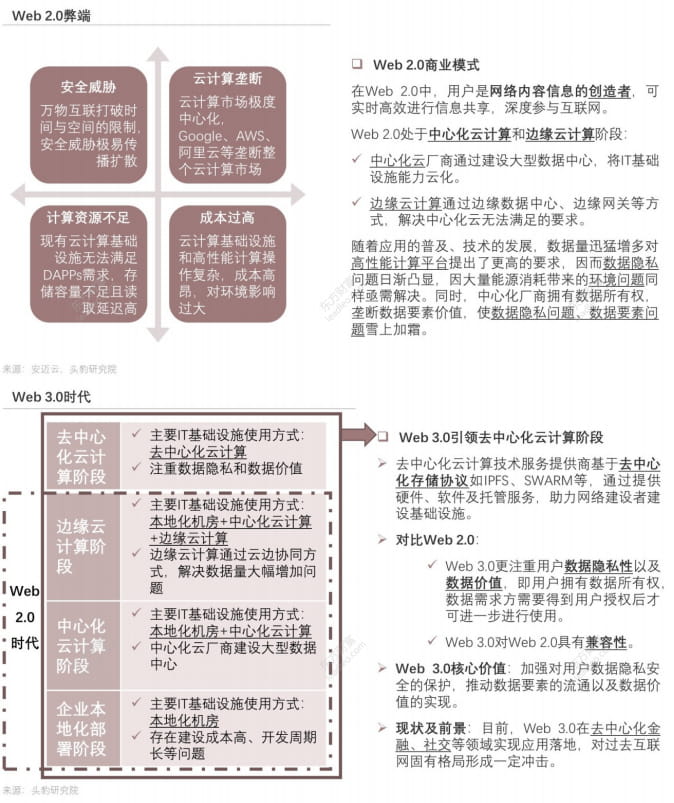
Web2 technology has security threats, cloud computing monopoly, insufficient computing resources, and high costs. Against this background, Web3 came into being.
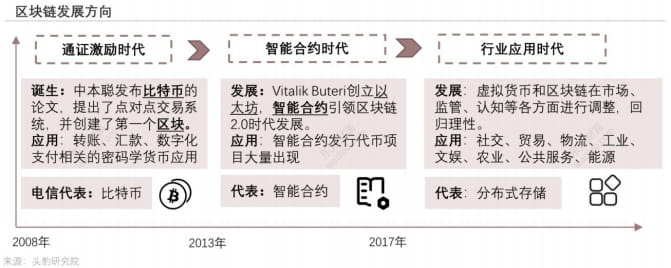
Development direction of blockchain technology
The core content of blockchain is decentralization, its application areas are more diversified, and its development direction extends to industry applications.
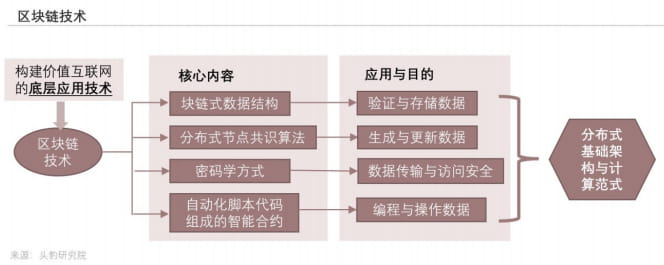 Blockchain storage technology
Compared with enterprise-level storage and cloud storage, blockchain storage has the advantages of high reliability, high service availability, low cost and strong disaster recovery in different locations.
√ High reliability: redundant coding mode is used to store data on tens of millions of nodes around the world, avoiding the negative impact of single point failures
√ High service availability: Blockchain storage distributes the load to each node, and the service availability is at least twice as high as cloud storage.
√ Lower cost: Blockchain technology can effectively solve the problem of data duplication and reduce costs by 5-10 times
√ Strong off-site disaster tolerance: The centralized feature of blockchain storage "thousands of centers around the world" can significantly improve the level of disaster tolerance
Blockchain technology development
After thirteen years, blockchain has developed from the initial token incentive era (represented by Bitcoin) to the current industry application era, with new concepts emerging one after another, such as ticket reform, non-coin blockchain (consortium chain led by mainland China), chain reform, same-certificate economy, and empowering the real economy. Many industries have begun to try to use blockchain technology, including distributed storage, electronic invoices, copyright, goods traceability, judicial evidence storage and other applications.
 Decentralized cloud computing market background
The Web3 era promotes the development of decentralized cloud computing, and the huge amount of data drives the global market to move forward in the field of decentralized cloud computing.
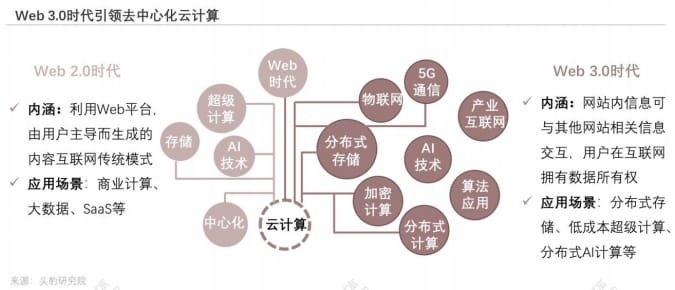 Background of decentralized cloud computing
The Web 3.0 era has brought about a data explosion. Traditional centralized cloud storage has cost issues, privacy and security issues, and energy supply issues. Decentralized cloud computing came into being in this context.
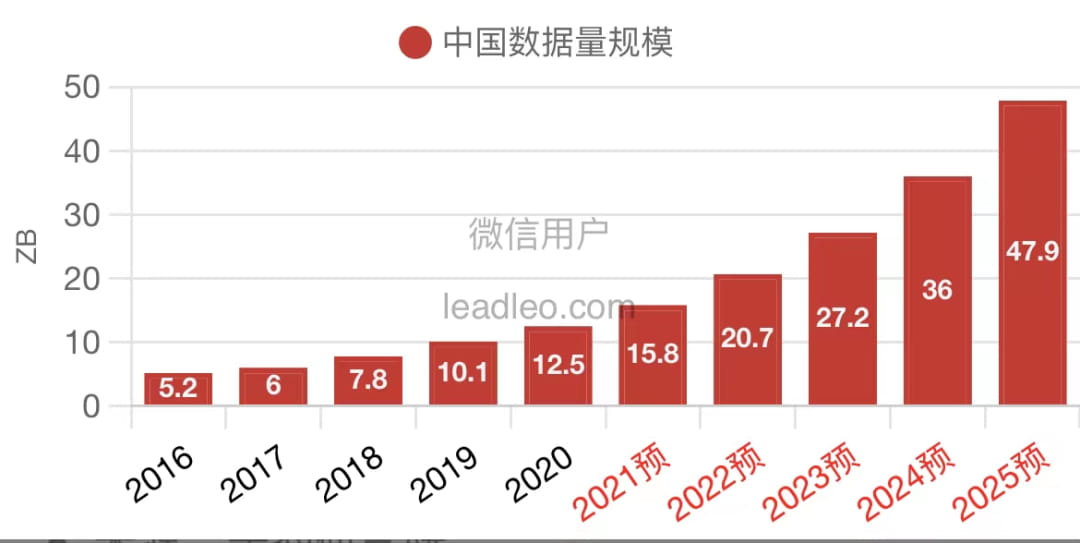
Example: China has a large amount of data and a fast growth rate
Large scale: China's data scale reached 12.5ZB in 2020, and is expected to reach 47.9ZB in 2025. China's data volume is huge.
Fast growth: China's data volume has grown by 24.5% in the past five years. In the future, with the promotion of national policies, Chinese enterprises will accelerate their pace of cloud computing. New technologies such as artificial intelligence, 5G, the Internet of Things, and virtual reality will further promote the growth of China's data volume. It is expected that China's data volume will have an average annual compound growth rate of 31.9% in the next five years, which is faster than the growth rate in the past five years.
 Decentralized cloud computing market size
The global cloud storage market is showing a steady growth trend. The decentralized cloud storage market currently accounts for a small proportion of the global storage market, but it is expected to double in the next five years.
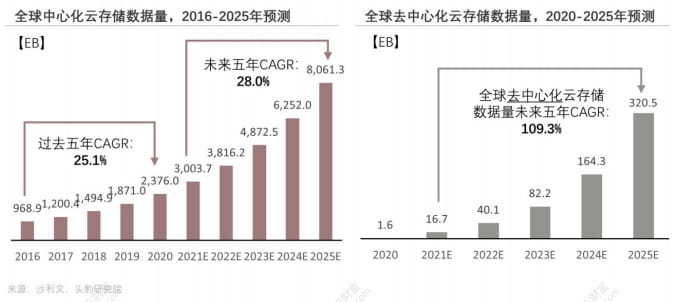 Global Cloud Storage Market
The scale of the global cloud storage market has shown a steady growth trend (CAGR in the past five years has reached 28%), mainly due to the explosive growth in data volume brought about by the development of mobile Internet, which has led to an increase in demand for storage space by individuals, enterprises and governments.
It is expected that with the promotion of the future Web 3 era and the introduction of various policies by countries around the world to accelerate the pace of enterprise cloud migration, the global cloud storage market size is expected to maintain an average annual compound growth rate of 25%. In 2025, the global cloud storage market size is expected to be close to US$171.9 billion.
> Global centralized cloud storage market
In 2020, the global centralized cloud storage data volume reached 2.376.0EB, accounting for 99.9% of the global cloud computing storage data volume, and its CAGR in the past five years reached 25.1%. It is expected that with the development of 5G in the future, the Internet of Things will be promoted to scale replication and the traditional enterprise cloud migration rate will increase. The global centralized cloud storage data volume will maintain an average annual compound growth rate of 28%, and the global centralized cloud storage data volume will reach 8.061.3EB in 2025.
> Global decentralized cloud storage market
The amount of decentralized cloud storage data is still relatively small, mainly because decentralized cloud computing technology is still in the stage of infrastructure construction. In the future, with the development of new technologies and increased recognition, it is expected that the amount of decentralized cloud storage data will achieve a high growth rate of 109.3%. In 2025, the global decentralized cloud storage data volume will reach 320.5EB, accounting for 3.8% of the global cloud storage data volume.
Advantages of decentralized cloud computing
Compared with traditional centralized cloud computing, decentralized cloud computing has outstanding advantages in construction cost, security performance, user experience and operation mode.
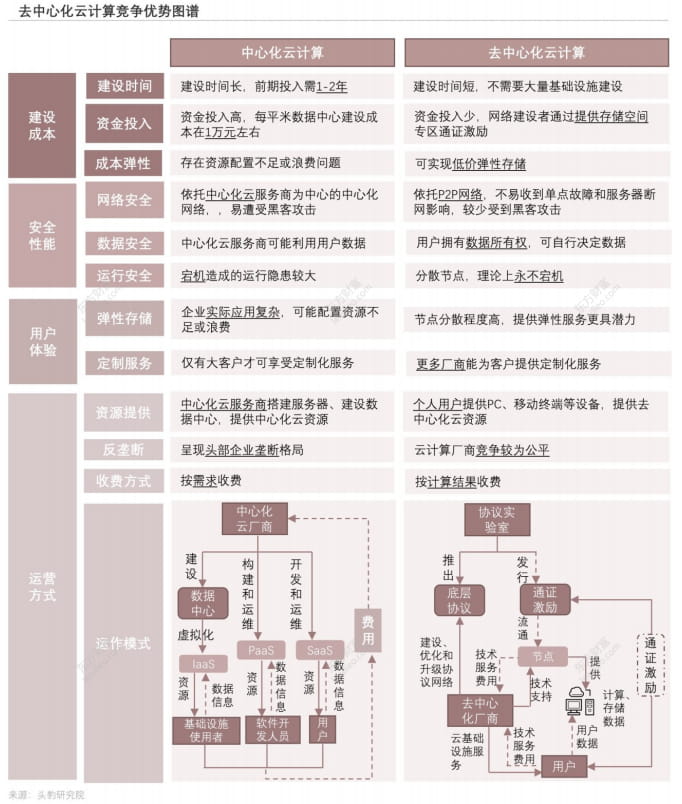 Decentralized cloud computing applications
Decentralized cloud computing is applied to many fields such as finance, medical care, social communications, games, energy, etc., and its application scope is constantly expanding.
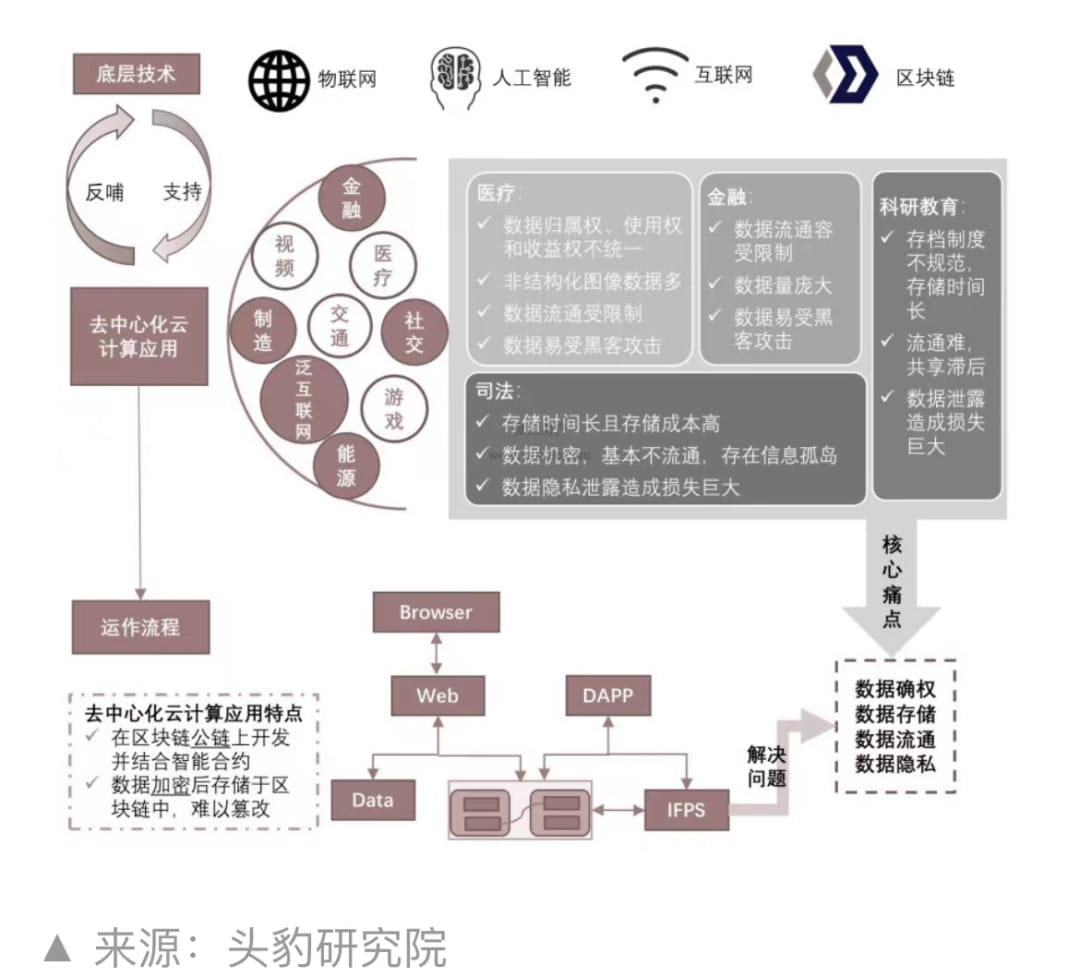 Decentralized cloud computing application areas
Decentralized cloud computing can be used to solve data rights confirmation, data storage, data circulation and data privacy issues in various fields such as finance, medical care, scientific research and education, justice, and social networking. For example, many judicial data in the judicial field involve confidential data such as court trial notarization materials and prisoner privacy information. The information systems between courts are relatively closed, and judicial data involve state secrets and case privacy information. Once data privacy is leaked, it will cause great losses.
The development prospects of decentralized cloud computing
In the future, with the in-depth development of new Internet technology applications and the further expansion of data volume, the decentralized application market will have broad development prospects.
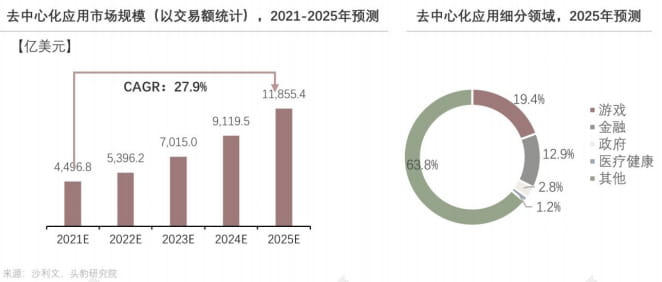 The development prospects of decentralized cloud computing
The decentralized application market has great potential for future development thanks to the development of 5G, Internet of Things, artificial intelligence, and Internet technologies.
It is expected that the decentralized application market will achieve an average annual compound growth rate of 27.9% from 2021 to 2025, and the global decentralized application market size (based on transaction volume) will reach US$1.18554 billion in 2025. Among them, the game field accounts for the highest proportion (accounting for 19.4%), followed by the financial field (accounting for 12.9%), and medical and health and government agency applications also occupy a certain scale. This is mainly because compared with centralized applications, decentralized applications focus on user-centricity, reduce users' dependence on huge data servers controlled by cloud vendors, and attach importance to personal data security and privacy.
Decentralization has brought unprecedented data innovation value. Users have become contributors and beneficiaries of value creation, which will inspire everyone's innovation ability. As the bottom layer of the entire environment, infrastructure can better protect everyone's privacy and data security through decentralization. This new wave of Web3 is driving a new round of IT transformation. The era of digital innovation is extending from mobile phones to all things in the ecosystem, radiating to various fields with data as the core.
4. Oort Web3 decentralized cloud service infrastructure
The original capacity of mainstream public chains is small and it is difficult to carry a large amount of data and storage needs, and centralized cloud services cannot meet the needs of Web3.0 users for security, openness, and anti-censorship. At present, most Dapps have only achieved decentralization at the logic layer, while the storage and calculation of a large amount of data are still in the centralized cloud computing services under the chain, such as "AWS", "Google Cloud", "Alibaba Cloud", "Huawei Cloud", etc.
What problems have been solved in the industry?
Oort provides a low-cost, high-efficiency, and more secure decentralized computing network, including storage, computing, network bandwidth, and other computing power.
*The first question is that globally, about 68% of data centers, supercomputing centers, and super servers are idle every day.
The second problem is that due to the centralization of storage and computing, a large number of government and enterprise organizations rely on one platform. When there are operational problems on the centralized platform, it will affect almost all service providers. The larger the scale of centralized cloud computing, the greater the hidden concerns about operational security issues. The "downtime" and "data loss" incidents of large cloud computing platforms often become "big news" in the industry. It is difficult for companies that put 100% of their lives and property on third-party servers to withstand such accidents, but accidents are endless and are difficult to avoid fundamentally due to the centralized mechanism. At this time, the advantages of decentralized cloud computing emerge. The dispersed nodes make decentralized cloud computing theoretically never down, which is an inherent advantage in the mechanism.
The third problem is that most Web3 and metaverse applications are still built on the current centralized infrastructure. Just like many NFT, Defi, GameFi, Dex and other projects, in form, even if they are built on EVM-compatible blockchains, their data content is still stored in centralized cloud services-data centers.
The fourth problem is that mining machines in the crypto market are idle and computing resources are wasted. Oort's meta-computing power supplier market aggregates global computing power and storage resources through backward compatibility and dynamically configures distributed clouds (such as existing Filecoin, DFINITY and traditional data centers) to coordinate resource providers and scheduling to provide decentralized computing power storage support and operating power for applications in the metaverse and web3. At the same time, with the support of core technologies, it is easier to expand the incremental market with the current development of the metaverse, web3, and digital transformation.
The decentralized version of "Amazon Cloud" + high-performance underlying public chain-Oort (CCN) was born based on the concept of "aggregator"
Started in 2018 and headquartered in New York City, USA, it started as a research project at a university. It currently has a global team of more than 50 people from New York, Silicon Valley, Chicago, Montreal, Beijing, Shanghai and Bulgaria, and has received support from top international scholars and researchers.
Oort (Oort Cloud) is positioned as a decentralized cloud computing and storage platform aimed at building the cornerstone of the Metaverse. It owns the underlying consensus algorithm POH and distributed computing patents. The self-developed public chain MCP based on the DAG architecture can achieve more than 20,000 TPS and almost zero transaction fees. It has a very great role in promoting the integration and commercial use of decentralized cloud computing power and storage resources required by the Metaverse.
The idea of cloud service "aggregator" was first proposed, and an aggregation model that can integrate traditional IDC and various mainstream computing resources has been built to solve problems such as insufficient computing resources, uneven computing power distribution, limited number of users, and over-centralization of cloud service environment. It has been commercially used to generate profits from landing orders. It has downward compatibility in the industry. In the crypto mining industry, it solves the "empty mining" and realizes multi-mining or dual-mining, horizontally expanding the incremental traditional market; at the ecological application level: the application of Web3 and Metaverse track provides a friendly decentralized cloud service development environment.
Track tags: Web3, Metaverse, Infrastructure, Public Chain, Layer-0.5, Layer-1, Decentralized Computing and Storage, Multi-Physical Machine Aggregator, etc.
Team tags: The founder is the former R&D director of Qualcomm (engaged in 4G LTE and 5G system design) - the main research areas include artificial intelligence, blockchain technology, information theory, cybernetics, distributed systems, etc., professor at Columbia University, chairman of the Science and Technology and Economic Committee of the US-China International Chamber of Commerce, AvesLair New York Venture Capital Fund, N&T Labs, USA, the founder has more than 200 international/US patents (granted or pending), McGill University professor, IEEE Fellow, Canadian Academy of Engineering Fellow, Dell, Samsung, JPMorgan Chase, Fidelity, DFG University President, Ethereum Classic Laboratory Director, PoH consensus algorithm, fourth and fifth generation mobile communications, Forbes Top Ten Most Influential People in Africa, Africa2.0, etc.
Community data: Total data exceeds 150,000 people (not real-time), Twitter and Telegram communities in 7 different languages, Discord, Facebook, YouTube, Instagram, Medium, Medium, LinkedIn, etc.
The on-chain data is open and cannot be tampered with, solving the problems of low security and transparency.
In the traditional cloud computing market, Amazon, Google, Microsoft and Alibaba are still playing the role of "middlemen" and controlling the formulation of the "rules of the game" of the entire industry, which has also caused great dissatisfaction among users, especially when personal and corporate information is "stored" on the servers of cloud computing providers, which also makes people feel uneasy about data privacy issues. Some industry experts have said that the major cloud computing providers in the market have not done enough in terms of telemetry and transparency, and need to disclose the collection of metadata behind the scenes.
In contrast, blockchain technology can effectively solve this problem because the underlying protocol and consensus mechanism of blockchain ensure the highest level of security for each transaction and underlying data, thereby establishing transparency and accountability for each participant. Distributed ledgers can support a permanent audit trail system, protect the anonymity of each participant and keep records of every transaction. Taking the Oort blockchain as an example,
Solve the problem of low computing resource utilization
It is an indisputable fact that the computing resources of traditional data centers are underutilized. Since the development of cloud computing infrastructure, it has only provided the market with an average of no more than 6% of the maximum computing power each year. Up to 30% of cloud servers are still in a "sleeping" state. It is estimated that 96% of cloud servers in the world's 8.4 million data centers are not fully utilized.
In the past, apart from a few large service operators, organizations or companies did not have many other options in the field of cloud computing. As the demand side of cloud computing resources, they had to pay those oligarchs regularly every week/month/year, but sometimes organizations or companies did not actually need "that much" computing resources. According to data from Alibaba Cloud's official website, the monthly price of the standard catalog of the enterprise-level Windows general-purpose ecs.g6.26xlarge cloud server ECS in North China 1 (Qingdao) is 12,480 yuan. Assuming a 30% "sleep rate", it means that 3,744 yuan may be "wasted" every month. Maybe this doesn't sound like a lot for a company, but what about 100 companies or 1,000 companies? If you look at it from a macro perspective, the problem of low utilization of computing resources may cause global companies to "lose" billions of dollars in expenses every year.
Fortunately, this situation is changing. With the continuous development of blockchain technology, blockchain-based decentralized cloud computing projects such as Oort are solving the problem of low utilization of computing resources.
In the entire network structure of Oort (Oort Cloud),
There are three components:
First, the Web3/Metaverse application layer;
Second, the Oort (Oort Cloud) network, which includes two parts:
①MCP (The Metaverse Computing Protocol) - (The self-developed public chain MCP based on DAG architecture can reach more than 20,000 TPS and almost zero transaction fees). This blockchain protocol is mainly used to solve the trust problem in the computing and storage process. ②Pekka, as a computing and storage aggregator, gathers computing and storage resources in the platform, and dynamically allocates these computing and storage resources;
Third, it is a computing and storage provider.
*Oort (Oort Cloud) system architecture
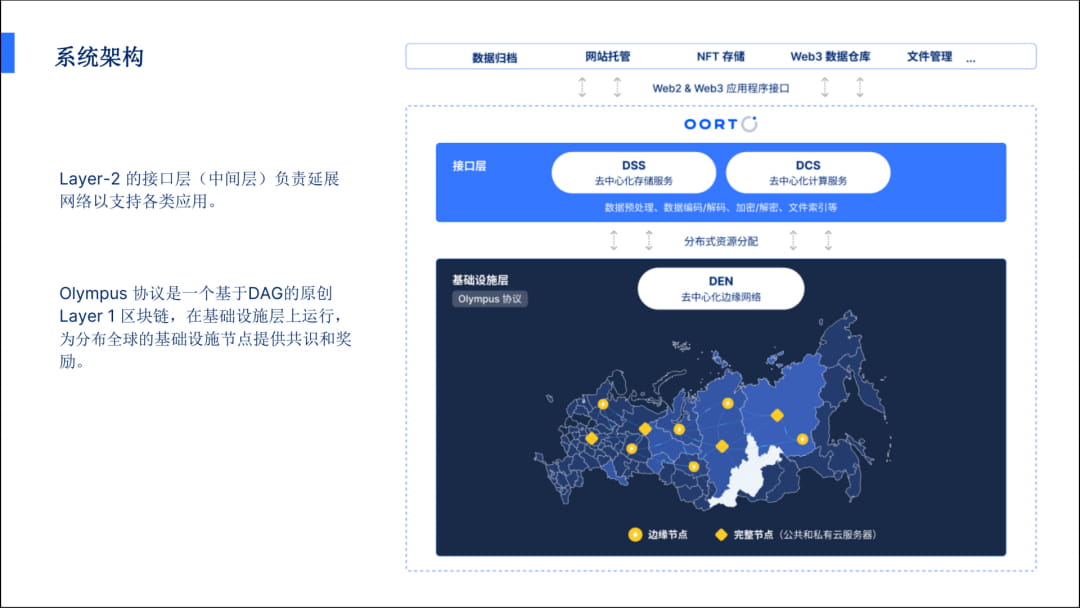
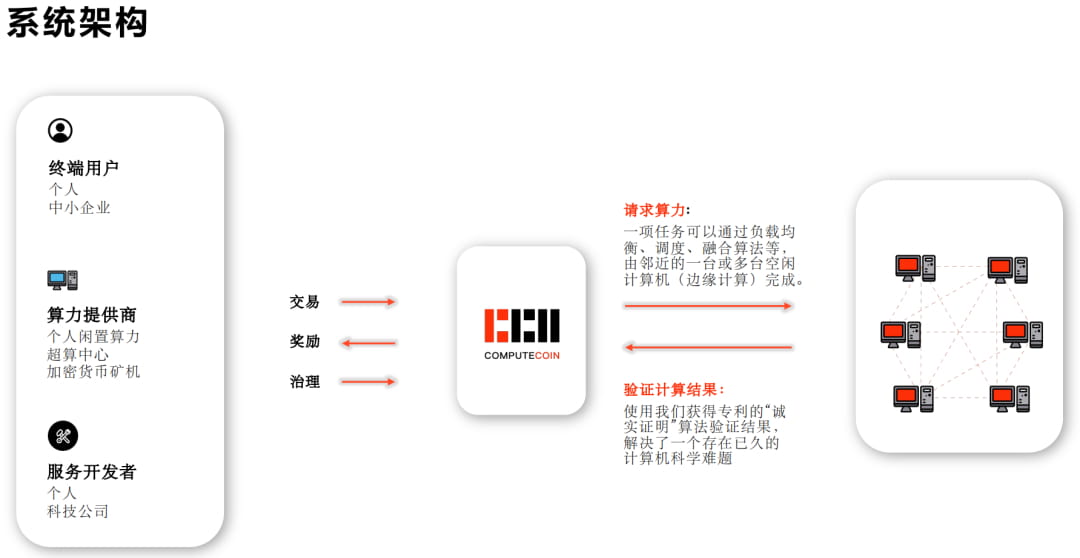
Oort (Oort Cloud) Three Aspects:
(1): Oort (Oort Cloud) is a consensus protocol independently developed and owned by the United States, which has obtained a US patent. The main problem solved by this protocol is a very important one in the current distributed computing power, and it is also an academic problem that has existed in academia for 20 years and has not been solved.
(II) Computing power leasing: use Oort to rent computing power, and obtain Oort by providing computing power; rent computing equipment to obtain CCN. The longer the rental time and the stronger the computing power of the equipment, the richer the reward.
(III): Regarding the incentive layer, the problem to be solved is how players can make profits after entering the platform.
Honesty consensus is the result of three years of research and development by Oort (Oort Cloud), which has obtained a US patent. The significance of such a patent is how to verify the accuracy of the calculation results of outsourced computing power.
Oort (Oort Cloud) uses one of the other party's computers to complete my computing tasks. How can Oort (Oort Cloud) believe and verify that the results he gives me are correct? This is a very core technical issue.
The second patent is distributed computing, how to use blockchain to do distributed computing. This is the first technology completed by Oort.
What exactly is the core technology used for, or what can Oort Cloud users do on this platform?
Core technology optimizes idle computing power and increases miners' income (aggregating multi-mining/dual mining + commercial order profits, differentiated competition in the same track, enabling compatibility in the same track, and deep mining on the demand side).
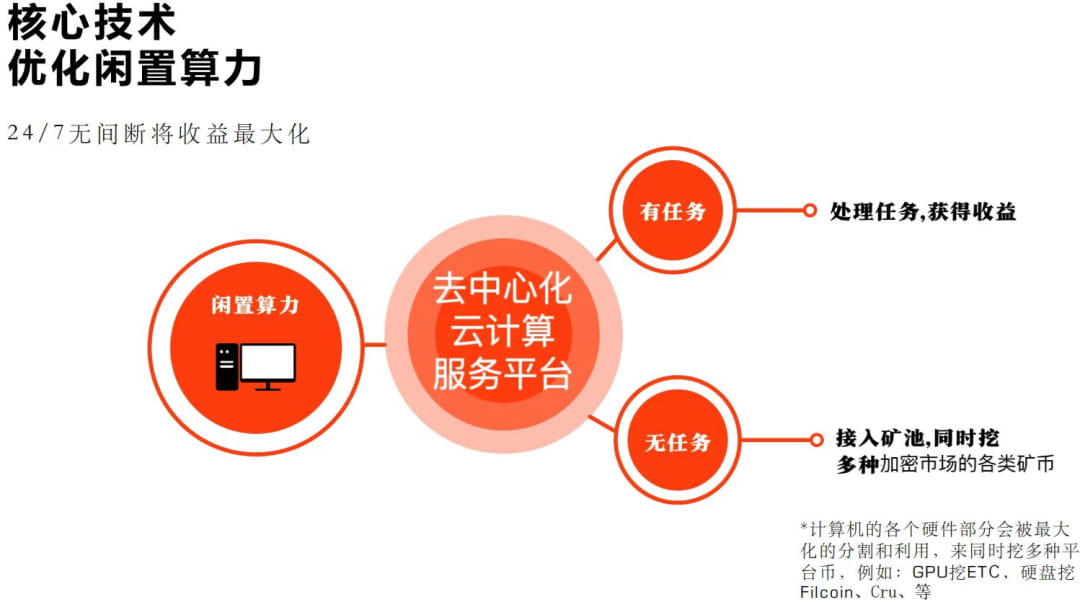 The first is idle computing power, which can be connected to the Oort network through a very simple small interface. The Oort network can do two things, which are very simple.
First, when you can receive tasks, there are some AI tasks and data tasks on the platform, you can receive tasks, and after you receive the tasks, you can receive
One part of the profit, and the second part when I don’t take over the task, I can get the incentive platform currency CCN.
The second is two patents. From the perspective of actual R&D progress, Oort is a technology company driven by R&D.
Oort Cloud has spent a lot of energy and time on R&D and technology public relations.
Oort Cloud attaches great importance to patents, including patent layout, academic research on Oort Cloud, and publication of papers on Oort Cloud.
*Consensus algorithm: PoH
Oort's patented consensus algorithm
Proof of Honesty (PoH) ensures that the results of computational tasks outsourced to neighboring networks can be verified.
PoH effectively solves the verifiable computing problem that has plagued the field of computer science for more than a decade, establishing trust in computing tasks outsourced to trustless decentralized clouds, thus laying the foundation for a trusted Metaverse ecosystem.
Patent number: US 10,970,180 B2
*Distributed computing patent
Core technology: Blockchain-driven distributed computing
First-mover advantage The U.S. patented blockchain-driven distributed computing technology gives Oort a clear first-mover advantage in the decentralized cloud service market.
Verifiable Computation Problem
The problem of outsourcing a computational task to another party so that the client/user can efficiently verify the result without re-executing the task represents a long-standing dilemma in computer science. On the one hand, the provider does not necessarily have a strong incentive to ensure correctness. On the other hand, it is difficult for complex and large-scale providers (e.g., cloud servers) to guarantee that tasks are always executed correctly due to configuration errors, hardware randomness, etc. Computer scientists have been studying this problem, called verifiable computation, for nearly a decade.
How PoH solves the problem: EntrapNet protocol
 In criminal law, entrapment is a practice by which a law enforcement officer induces a person to commit a criminal offense that the person would not otherwise be able to or willing to commit.
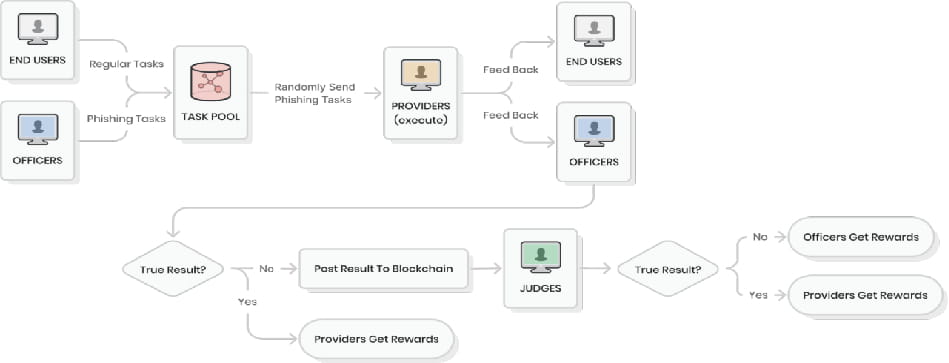
EntrapNet borrows the idea that clients/users in the network play the role of "officers" and aim to catch malicious providers in the network by assigning phishing tasks to the providers. Since the results of the phishing tasks are predictable or known in advance to the officers, the officers will be able to easily detect any computational misconduct.
Read more about the EntraNet protocol in its academic publication.
1. Officials set up a repository of phishing missions
The repository contains one or more computational tasks whose results are known and verified by the network. In addition, the information of each fishing task in the repository is written to the repository smart contract on the blockchain, which will be activated later for the result verification process.
2. Provider pays a deposit to provide idle computing resources
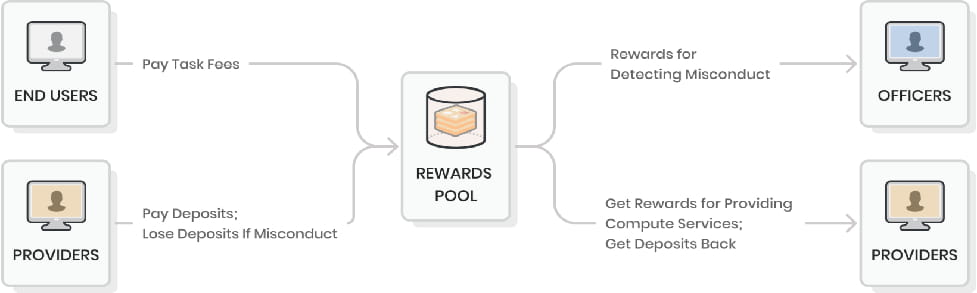
The deposits are sent to an incentive pool on the blockchain. The incentive pool is another smart contract that is responsible for storing the supplier's deposits and rewarding the officers. Importantly, each deposit is always much larger than the reward the provider receives for completing the computational task correctly. This allows the provider to potentially suffer huge losses if they produce invalid results.
3. The network randomly dispatches a task from the task pool to a provider
The task pool contains both fishing tasks and regular tasks submitted to the network at fixed time intervals. The information of all mining pool tasks is written into the task pool smart contract on the blockchain; the task scheduler will call the smart contract that randomly assigns tasks to providers.
How does PoH work?
 How POH works
4. The provider received the phishing task and executed it incorrectly
EntrapNet ensures malicious providers cannot filter out phishing missions
5. Providers provide feedback to officials
The hash value will be recorded on the MCP
6. If the official believes that there is a problem with the result, the official and the provider will publish both results to the blockchain through the verification smart contract.
7. The judge will decide whether the official was correct (e.g. by voting).
If proven correct, the officer will receive a reward from the reward pool, while the provider’s deposit will be forfeited and contributed to the EntrapNet reward pool.
Oort (Oort Cloud) Compute aggregator and scheduler
Oort (Oort Cloud) is a computing aggregator
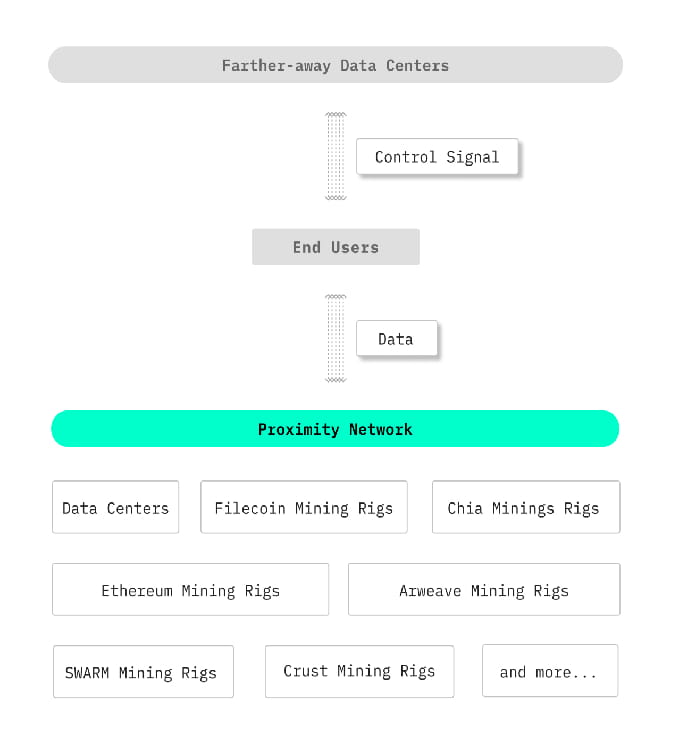
Oort builds a decentralized cloud by integrating geographically distributed data centers and crypto mining equipment such as Filecoin, ETH, Chia, and Arweave. PEKKA provides users with simple and reliable computing and storage solutions at the lowest cost. This is the key to large-scale deployment of Metaverse applications.
Oort (Oort Cloud) API
The Oort (Oort Cloud) API is a unified API that provides access to decentralized networks such as Arweave, Filecoin, and Crust.
It runs cloud selection and computation offloading algorithms by matching user needs with the availability and price of nearby resources. For example, the API assigns cold and hot data to different decentralized storage networks.
Oort (Oort Cloud) provides file storage APIs and retrieval APIs that are compatible with public cloud solutions.
Oort (Oort Cloud) is a computation scheduler
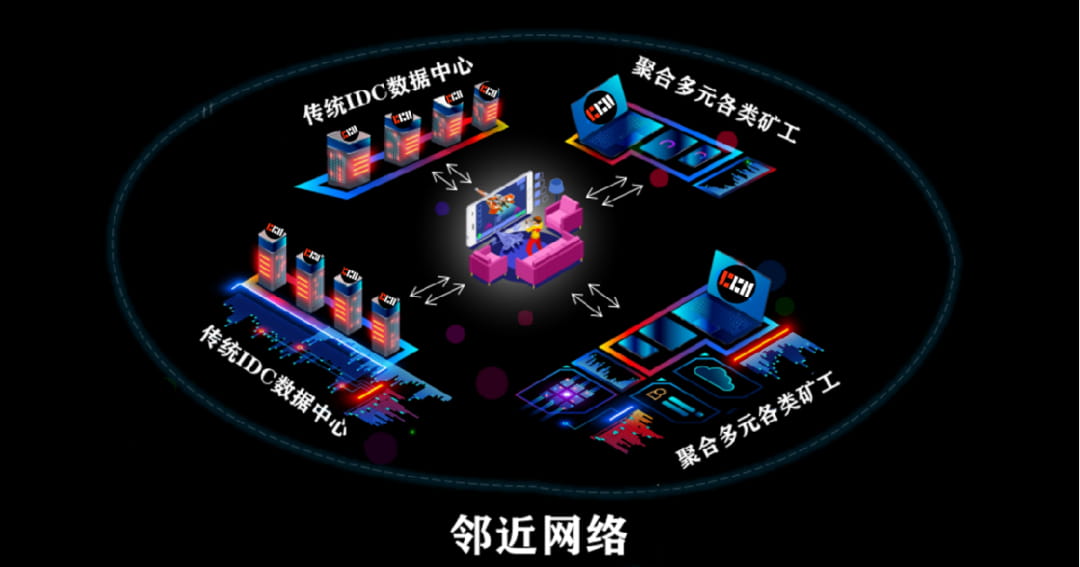 Oort dynamically configures a neighboring network of decentralized clouds to enhance immersive experiences by offloading computation from end users (e.g. VR/AR gaming)
For example:
A VR gamer’s experience can be significantly improved by offloading computationally intensive functions such as real-time motion capture and rendering to his/her neighboring network on the Oort Cloud.
Oort dynamically configures a proximity network at the end user's location and then offloads computation to a proximity network consisting of decentralized clouds to make up for their lack of computing resources, such as VR devices.
In this way, we can meet the demand for real-time interactive responses by enabling low-latency, single-hop, high-bandwidth access to the cloud. In particular, the end-to-end response time of applications executed in the cloud can be as fast as a few milliseconds and predictable.
If no nearby cloud is available, the application can easily degrade to a fallback mode involving a distant cloud. When a nearby cloud is found, the full functionality and performance of the application is immediately restored.
 In terms of security, traditional cloud computing infrastructure cannot make people completely worry-free. For example, Binance, which uses Amazon AWS services, has experienced downtime many times. Last August, Binance founder Zhao Changpeng admitted on Twitter that the exchange had a cache service problem with AWS, which caused the API to send a large number of error messages, resulting in the complete paralysis of user withdrawal functions. In contrast, decentralized cloud infrastructure such as Oort is more reliable. The first test network was launched at 22:00 Eastern Time on September 27, 2021 (10:00 Beijing Time on September 28). From September 28, 2021 to March 31, 2022, in just about 6 months, it attracted more than 210,000 computing nodes from 25 countries around the world. The global meta-computing power once exceeded 100 billion. During the Dome-A1.0 test network, more than 1.7 million US dollars in computing power rental income has been achieved.
*Competing with traditional centralized cloud
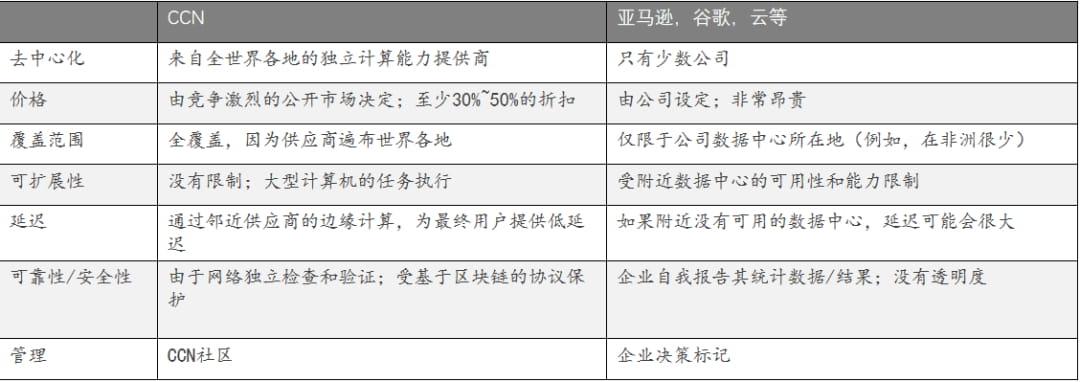 Oort's meta-computing power provider market enables multi-mining (not direct competition) through backward compatibility, aggregates global computing power and storage resources, and dynamically configures distributed clouds (such as existing Filecoin, DFINITY, and traditional data centers) to coordinate resource providers and scheduling to provide decentralized computing power storage support and operating power for applications in the Metaverse and Web3. At the same time, with the support of core technologies, it will be easier to expand the incremental market with the current development of the Metaverse, Web3, and digital transformation.
Oort Meta Hashrate
General computing capabilities: processing general computing tasks, website construction services, etc.
Image computing capabilities: required for tasks such as artificial intelligence, HPC (high performance computing), 3D rendering, AR/VR computing, etc.
Storage capacity: Comparable to current popular storage solutions such as IPFS.
Connection Power: Provides data exchange capability.
What does Oort Cloud offer to businesses, ordinary users, and creators?
Oort Cloud is designed not only as an infrastructure to support Web3 and metaverse applications, but also to support general services required by enterprises and ordinary users.
General computing: website and application development, website/API/video content acceleration, e-commerce solutions, etc.
Target customer groups: Web/application developers, startups, individuals
Image computing: artificial intelligence, machine learning, big data analysis, HPC (high performance computing), 3D rendering, AR/VR computing, etc.
Target customers: AI startups, data analysts, VR/AR developers, motion designers, etc.
Storage: Decentralized cloud storage solution
Target customers: streaming platforms, NFT collectors, ordinary users, etc.
Connection: Bandwidth Service
OORT products: ① Decentralized Storage (DSS), ② Decentralized Node Network (DEN), ③ Decentralized Computing (DCS), ④ Public Chain (Olympus Protocol is a self-developed Layer1 public chain based on DAG, which provides consensus and rewards for infrastructure nodes distributed around the world, and can achieve more than 20,000 TPS and almost zero transaction fees), ⑤ Layer-2 interface layer (middle layer) is responsible for extending the network to support various applications (Web2 and Web3 users).
Development progress: ① DSS: decentralized storage service (online), ② DEN: decentralized node network (online), ③ DCS: decentralized computing service (expected to be launched in the fourth quarter of 2023), ④ public chain test network is online, the main network has been developed, ⑤ Layer-2 interface layer (online)
Oortech DSS (Decentralized Storage Solution) is one of the first products on Oortech Cloud. DSS aims to provide simple, flexible and secure decentralized storage services.
Oortech DSS business cooperation (example)
1. Cooperation with Dell
In the cooperation between the two, Dell's products will be pre-installed with DSS's decentralized storage options, which makes its products far surpass competitors of similar products in the storage solution provider. According to market reports, Dell's notebook sales reached more than 13 million in the first quarter of 2022 alone, and the average sales of PCs exceeded 10 million per quarter. It can be seen that there will be a considerable number of users using Oortech DSS.
2.DSS will provide services for Finstreet
Finstreet is India’s first crypto education platform with 4.5 million community members and nearly 100,000 students, and Oortech DSS will provide services to the platform.
DEN: Decentralized Node Network
① Make dApps faster, safer and more scalable,
② 2023 Q2 to reach 50,000+ global deployments
 Oort Cloud partners and customers (partial)
 In fact, the decentralized security features of blockchain enhance the overall security of cloud computing. As can be seen from the example of Oort, when downtime occurs, the Oort blockchain can activate unused data center capacity around the world to ensure that cloud computing capacity is closest to users and their technology and equipment, thereby reducing delays and speeding up disaster recovery.
*Blockchain provides economic momentum and market incentives for the cloud computing market
Token economic incentive model solves the problem of insufficient user participation
We know that one of the biggest problems caused by monopoly is that market competition becomes smaller, so industry oligarchs have almost no motivation to innovate, which will lead to a decline in user stickiness and low participation over time. The integration of blockchain technology into the cloud computing market can bring a huge advantage. It can use economic incentives based on blockchain native tokens to attract more users to participate. The increase in user activity will inevitably "stimulate" cloud computing resource providers/people to output better services. At the same time, tokens can also bind platform interests with user interests, thereby effectively increasing user loyalty and achieving a win-win situation.
The token economy can create an autonomous economic system that achieves two key goals necessary for a two-sided thriving market:
Reduce demand-side (computing user) costs
Improve the return on supply side (calculating suppliers/people)
*The potential of a large number of IDCs and personal computing node resources distributed around the world has not been fully tapped due to network and algorithm bottlenecks.
Based on blockchain, distributed computing power, algorithms and data make market separation a reality.
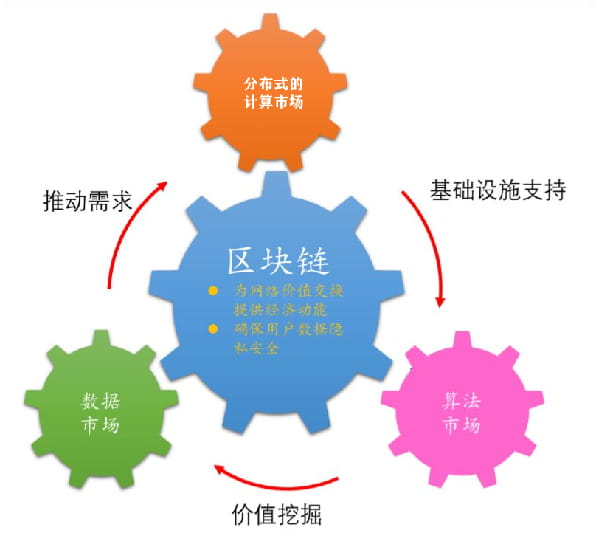 Unlike the traditional Internet giants that combine data, algorithms and computing power, blockchain will promote the market separation of data, algorithms and computing power. For real-time sensitive business data, traditional Internet giants solve it with central cloud + CDN services, but the potential of the Internet will not stop at data transmission and access. There are a large number of data computing and storage services that are not sensitive to latency, and this market is currently blank. The evolution of AI algorithms and the rise of distributed AI will further promote more distributed intelligent services and more innovative business scenario models; further tap the potential of data. In the past, large Internet companies represented by Amazon developed a new business model such as cloud computing based on their own idle elastic computing resources. But this is still a kind of elastic reuse of centralized resources-Internet companies still have data, algorithms and computing power at the same time. In the mobile era, a large number of idle computing power and algorithm resources are distributed in many nodes of the global network. How to organize idle computing resources to participate in market operations and make idle resources generate market value-distributed computing power will become a new business model. Blockchain is the basis for data privacy protection, and more importantly, it provides basic collaborative support for the separation of computing power and data - distributed computing power leasing can obtain the required market returns in the blockchain network.
*The rapid development of mobile terminals and IoT smart devices will inevitably require computing power to be deployed from centralized to distributed terminals.
Network computing resources not only come from enterprises themselves and large cloud computing companies, but also from a wider distributed computing resource market that needs to be further explored. Traditional Internet giants have a large amount of data, algorithms and computing resources. Idle network computing resources are a waste. Cloud computing services were born under the idea of elastic reuse. The investment of traditional IT giants such as Amazon, Alibaba, Tencent and Huawei in cloud computing services has brought these companies considerable returns. But what is more widely idle is computing power - after all, the computing resources concentrated by centralized Internet giants are only part of the network computing power. We should not ignore the computing resources of a wider range of distributed nodes, which may come from individuals, small groups or other companies that have no intention of setting up special departments to output cloud computing services. The model of large cloud computing platforms is still centralized operation, and there are certain bottlenecks in business expansion and data privacy. Building a decentralized computing market that protects the privacy of nodes and enables idle computing power to obtain the market return it deserves is a potential worth exploring in the idle computing market.
The cloud computing business of Internet giants is mainly focused on consumer Internet companies, and they pay more attention to real-time consumer-level business. Distributed computing power is expected to become a newly emerging blue ocean market. From the perspective of the cloud computing market in 2018, it is mainly concentrated in the hands of Amazon, Microsoft, Google, Alibaba Cloud and IBM. According to Cannlys data, the above five giants account for 65% of the global market share, of which Amazon AWS accounts for 31.7% of the global market share, with a scale of up to US$25.4 billion. In second place is Microsoft Azure, with a revenue scale of US$13.5 billion, accounting for 16.8% of the global share. The top customers of Amazon AWS business are mainly consumer Internet companies such as Apple, Adobe, Snap, Lyft and Pinterest. The customers of other cloud computing giants are also concentrated in the fields of social networking and entertainment, with high requirements for real-time and interaction.
The global cloud computing market maintains a steady growth trend. In 2019, the global cloud computing market represented by IaaS, PaaS and SaaS reached US$188.3 billion, a growth rate of 20.86%. It is expected that the average market growth rate will be around 18% in the next few years, and the market size will exceed US$350 billion by 2023.
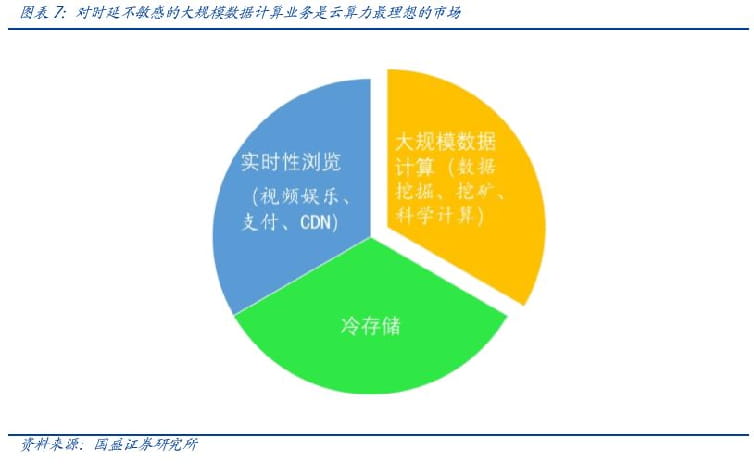
Business side: Cloud computing is expected to create a blue ocean market. Based on the Internet, it can be roughly divided into three categories:
The first category is services with strong real-time requirements, where users need smooth access and browsing, such as web browsing, video entertainment, and payment.
The first category is businesses that require large-scale data computing. These businesses do not require strong real-time performance, but require powerful computing resources to support large amounts of data computing. These businesses are represented by cryptocurrency mining, scientific computing, etc.
Another type is cold data services that do not require high real-time performance and computing power, such as storage backup. The latter two types of business scenarios are the most ideal markets for distributed computing power.
。
Blockchain provides economic momentum and market incentives for the cloud computing market
Blockchain provides economic momentum for the cloud computing market in terms of data privacy protection and market incentives. In addition to data privacy, market incentives are the main bottleneck for distributed computing power to form an independent market. Whether it is an individual or a company, to rent out idle computing resources to obtain market returns, it is necessary to have the ability to output cloud computing services. Many companies are unwilling and unable to set up a special department to output cloud computing services based on cost considerations. This is also the scale advantage of cloud computing platforms of large Internet companies. In essence, market incentives are the fundamental difficulty for distributed computing resources not to be put into the market on a large scale. Blockchain ledgers also provide natural market incentives for the cloud computing market, making the cloud computing market possible. In the cloud computing market, blockchain can ensure that user data is encrypted for computing resource providers. In essence, blockchain, as a decentralized system, supports the market operation of distributed cloud computing supply and user demand. The blockchain network solves the problem of data privacy, and the blockchain ledger also provides natural market incentives for the idle computing market, making the distributed computing market possible for large-scale commercial use.
IDCs in remote areas are expected to rise with the help of cloud computing power, get rid of network restrictions, and take electricity cost + customer acquisition ability as core competitiveness. With the continuous development of the cloud computing market, the network will no longer be a restriction, and the cost advantage of computing power will be highlighted, because the electricity cost of data centers exceeds 50% of the operating cost. In the era of consumer Internet, the market focuses on location advantages, management capabilities, and network bandwidth quality; in the era of industrial Internet computing power, for example; compared with the current mainstream data centers in Beijing, Shanghai, Guangzhou and Shenzhen, data centers in the central and western regions have obvious advantages in electricity cost. According to grassroots surveys, the electricity cost in the central and western regions of my country is more than 50% lower than that in the eastern region. For IDCs in remote areas, customer acquisition capabilities will become the key.
V. Conclusion
Due to the impact of the COVID-19 pandemic, the global digital business transformation has entered a more challenging and urgent stage, and the demand for cloud computing solutions from various organizations such as enterprises, schools, and governments has increased significantly. According to ResearchAndMarkets estimates, the global cloud computing market size will grow from US$371.4 billion in 2020 to US$832.1 billion in 2025, with a compound annual growth rate (CAGR) of 17.5%. Although North America is still the world's largest cloud computing market, the Asia-Pacific region, led by China, is growing the fastest.
Although the cloud computing market is monopolized by a few oligarchs, thanks to the increasingly mature blockchain technology, a new "decentralized track" has been opened up within the industry. Who can stand out in the decentralized cloud computing industry? Let us wait and see.
*The article is compiled from public data from Carbon Chain Value, TouBao Research Institute, and other major media websites.
*Copyright belongs to the original author
*Disclaimer: This article does not constitute investment advice. Users should consider whether any opinions, views or conclusions in this article are suitable for their specific circumstances and comply with the relevant laws and regulations of the country and region where they are located.