

The collapse of FTX has dealt a devastating blow to the credibility of the crypto industry. The multi-billion dollar scam has caused the crypto industry to be strangled by both traditional finance and regulation, while also prompting more cryptocurrency transactions to migrate to the chain.
Faced with surging customer acquisition and compliance costs, centralized exchanges have had to begin guiding users to accept more decentralized trading services based on self-custody. OKX’s Web3 wallet and Cobo’s MPC + AA solution are both attempts in this area.
As the trading end of the most basic revenue layer of the crypto industry and once the source of the highest profits, centralized exchanges have "had to" transform to a non-custodial path in the post-FTX era, which has brought about a fatal new problem - how to monetize?
When users’ funds are on-chain, the assets are no longer completely controlled by centralized exchanges, and they cannot restrict users’ trading methods, locations, and tools. Public chains and DEXs will grab more trading profits from each order. All competitors are guiding users to migrate to the chain, and the increasingly mature regulatory policies do not allow CEX to continue to guard its previous small piece of land.
Obviously, if centralized exchanges want to continue this game, they need to explore new profit points, which may herald a shift in the business paradigm to some extent.
Centralized exchanges can only move further upstream and import the previously accumulated user resources into the starting point and entry point of the entire transaction process - the wallet, just like Alipay and WeChat Wallet, and then build basic trading tools and more important service methods around the wallet.
AI agents may be able to help reshape cryptocurrency trading services.
Price prediction, transaction strategy, stop-loss strategy, dynamic leverage adjustment, KOL smart copy trading, lending... Every service that a centralized exchange used to make money will be packaged into a customizable, self-learning AI Agent in the future, and traders will use AI Agents to execute their own strategies.
Although the word Intent is too abstract, in the future, ordinary retail traders will start with a simple natural language Intent, and then use the semantic translation and intelligent routing selection of AI agents, and finally execute the optimal solution on the chain under the trigger of BOT.
The wallet will eventually become a collection platform that provides various AI agents. Most of the transaction profits will be generated from the execution of AI agents.
The goal of the wallet is to attract more customers, provide a simpler onboarding experience and more comprehensive adaptability; and the AI agent providers can be previous exchanges, securities firms, quantitative institutions, KOLs, etc. The types of AI agents can be more diversified and intelligent according to the usage scenarios.
Take DeFi mining risk control as an example: if smart wallet A has integrated the Cobo risk control robot AI agent, users can call the Cobo risk control robot through instructions in smart wallet A, and the reward rules for calling the Cobo risk control robot have been set through smart contracts.
The user issues an instruction in Smart Wallet A: "I want to dynamically risk control Curve like Cobo." After receiving the instruction, Cobo's risk control robot AI agent will monitor liquidity in real time. When the set condition of "Curve-FraxUSDC pool" and "Frax price" is "reduced by 20% within 10 minutes," the instruction to "withdraw all funds" will be automatically executed and "convert" to "USDC" in the same block. After the transaction is completed, Cobo and Smart Wallet A, as the risk control party, will extract risk control rewards from the withdrawn funds according to the proportion set by the smart contract, and the remaining funds will be transferred back to the user's own smart wallet.
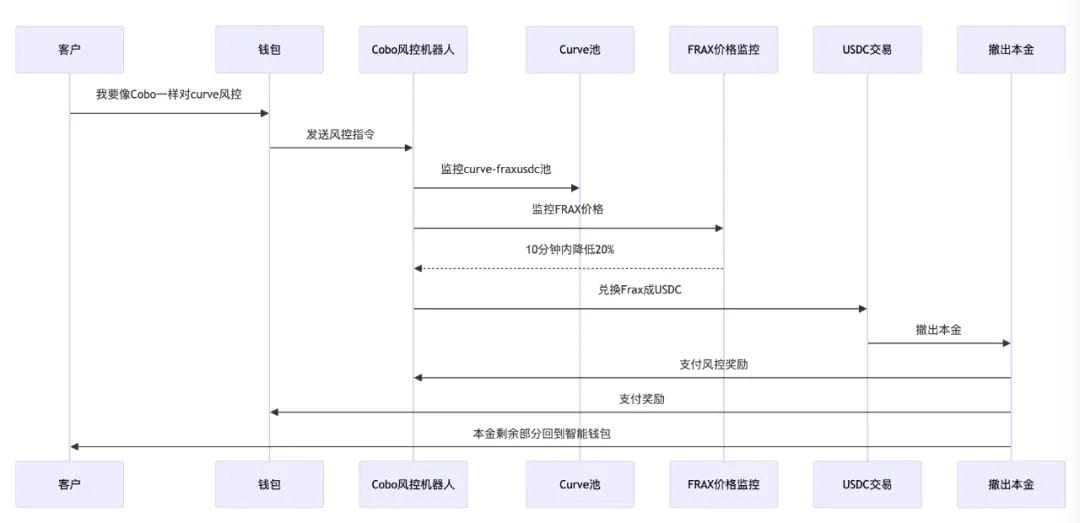
The reason why the AI agent can successfully execute this instruction is that: 1) Under the decentralized system of the blockchain smart contract wallet, it can ensure that the AI agent has only limited permissions and cannot use the customer's principal and other digital assets at will; 2) In the execution of the blockchain public chain, it can ensure that the AI agent executes in order and packages the transaction in the order of the Workflow; 3) After the transaction is completed, Cobo and the wallet party, as the service party, will receive corresponding rewards according to the smart contract. We have been talking about the imperfect infrastructure of the blockchain before, that is, the service of some links in the execution of this chain is unstable. What is lacking here is how to monitor Cobo and the wallet (service party) to prevent evil in the execution link without leaking privacy, and a simpler and more modular AI agent development platform (more engineering development). Of course, the cost of transaction execution is still very high, and the success rate of transactions may be very low under extreme market conditions, but most of the Infra is already available.
Since centralized exchanges can greatly improve the intelligence, efficiency and convenience of transactions through AI agents, and reshape and build serviceability, most services that hope to improve productivity with AI can achieve value capture under the Blockchain + AI agent framework (here valuable personal/company privacy data can be abstracted and equated to the digital currency in the exchange customer wallet).
We can see that OpenAI's plug-in service can be fully adapted to this system. Through natural language, ChatGPT is required to call the service provider AI agent in the Plugin, and the service provider obtains the corresponding reward for the call through the blockchain. In abstract terms, user a proposes an intention to purchase service y with tokens (money/computing power) of value x. The AI Agent of service provider y uses user a's high-value privacy data under limited permissions to provide quantifiable services. After providing the service, service provider y receives tokens of value x, and the service is delivered to user a, while the data remains in the hands of user a.
Of course, most services, if they are not directly To C and cannot generate tens of thousands of dollars in ARPU like transaction services, have no motivation to migrate for the time being, but the overall trend is irreversible. The provision of more services will eventually become an AI agent with execution capabilities that allows people to use natural language within the framework of blockchain restrictions.
We believe that as the technology matures, more industries will adopt the AI agent + BlockChain model in the future, not only in the crypto industry, not just in exchanges. This trend will redefine the way services and data interact in the near future, providing users with a more secure and personalized experience.