

Original | Odaily Planet Daily
Author | 0xAyA
On November 2, DAO solution provider Aragon officially announced its dissolution.
Aragon will provide 86,000 ETH to holders of its ANT (Aragon Network Token) token for exchange for ANT. The exchange price is 0.0025376 ETH/ANT (about 4.55 USDT, which is not much different from the current market price). The remaining funds will be used for product development.
Aragon is one of the earliest DAO projects in the Ethereum ecosystem. It successfully held an ICO in May 2017 and raised 275,000 ETH, which was the fourth largest ICO in history at the time. Aragon provides templates for users to successfully launch their own DAO in minutes and use modular applications to further customize the DAO.
Aragon Association, the administrator of Aragon, said that due to legal restrictions, especially the regulatory risks caused by token speculation and market manipulation, the decision to dissolve could not be submitted to a public vote, but the opinions of the Aragon Governance Forum were taken into consideration. Despite this, the dissolution of Aragon was foreshadowed.
Financial opacity sparks controversy
Just last month, Aragon DAO members launched a proposal requiring the project to update and disclose its $160 million financials or face lawsuits.
Tensions between investors and the Aragon Association date back to June 2022, when Aragon investors voted to transfer control of the project's $160 million in funds to a voting DAO by November 2022. However, the funds have not been transferred, and the Aragon Association has stopped publishing transparency reports that provide information about financial spending. Aragon DAO members said they were frustrated with the Aragon Association's lack of transparency and demanded answers from the organization.
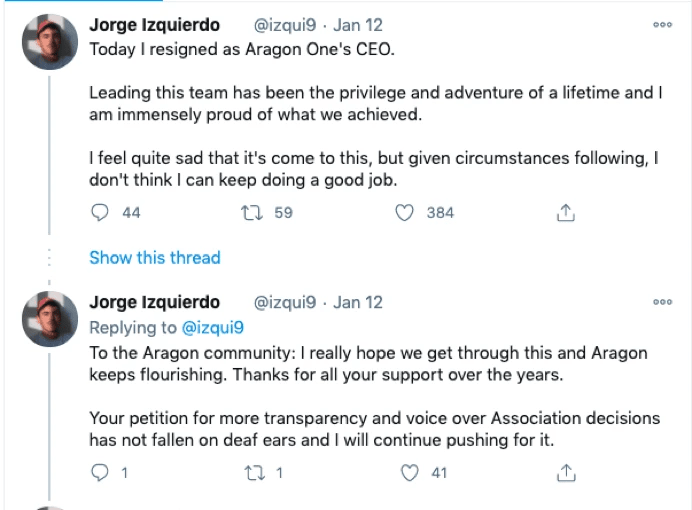
This is not the first time that Aragon has become the target of public criticism due to its financial opacity. In January 2021, Jorge Izquierdo, CEO of Aragon’s parent company, announced his resignation and tweeted: "I have resigned as CEO of Aragon One. I am saddened by the problems on the team, and considering that our proposals will not be implemented, I don’t think I can do better."
A week before Jorge left, 12 people including John Light, who was responsible for the project's autonomous business, announced their departure from the team. John published an open letter on Githup, asking the Aragon Association to disclose its financial and meeting records for external supervision. In addition, he also called for ANT holders to participate in community governance.
Canceling token voting rights poses hidden dangers
In May of this year, the Aragon Association published a statement saying that Aragon DAO was attacked by a 51% attack by a coordinated group called the "Risk-Free Value (RFV) Attacker", which was associated with the dissolution and liquidation of Rook DAO. The group includes a large asset management company, Arca Capital Management. There is evidence that Arca's participation is to obtain economic benefits from Aragon, so the Aragon Association will cancel the voting rights of ANT token holders in response to the "51% attack" launched by investors such as Arca.
In response, Jeff Dorman, chief investment officer of cryptocurrency hedge fund Arca, said in a blog post: "The narrative of a 51% attack is actually incorrect. We are token holders and we want to use our tokens to participate in governance. Arca staking tokens drives active participation from token holders."
In addition, in response to the Aragon Association's claim that "gangs" such as Arca have destroyed many DAOs and their communities, Arca stated that it has not attempted to dissolve Aragon, and that Arca has not invested in Invictus, Rook, Rome or Temple. The Fei Labs team proposed the dissolution on its own, and the Rook team initially proposed to split off "Incubator DAO". These are the best results that token holders are striving for.
Regardless of the facts, it is an indisputable fact that Aragon has revoked the voting rights of ANT token holders, and the relationship between the community and the team has become increasingly tense.
Sell or Dissolve
The Aragon Association considered selling itself to an undisclosed bidder for an unknown price in June, according to screenshots of conversations between an employee of investment firm Arca and other activists.
The proposed acquisition is expected to take several weeks and would be priced above book value, according to a screenshot from June 12. If the deal doesn’t go through, Aragon plans to reevaluate the activists’ proposal. The screenshot comes from a 24-page investigative report on the Aragon Association written by crypto trading firm Patagon Management LLC, which accuses the Aragon Association of years of missteps, including squandering $180 million worth of crypto assets, and questions whether the organization has complied with Swiss nonprofit laws.
The report does not detail the status of any sale negotiations, but suggests activists have explored a variety of mechanisms for handling ANT redemptions.
However, Aragon eventually chose to disband on the spot and used treasury funds to redeem ANT tokens. This marked the end of one of the earliest DAO attempts.
For the current market, the DAO narrative seems to have been forgotten. And the controversial question is raised again: Do people need a truly decentralized and community-autonomous "warrior" or a "dragon" with highly centralized decision-making power?