

It is said that the currency circle lasts three years in one day. Compared with the traditional financial market, one of the biggest characteristics of the cryptocurrency market is that talented people emerge from generation to generation, and the waves behind the Yangtze River push the waves ahead. Except for the two major mainstream currencies, Bitcoin (BTC) and Ethereum (ETH), which have always stood firm, new star currencies emerge almost every year to replace the old value coins.
So, why can the once glorious #sol shine among many public chains? Will SOL coin be the next Ethereum? This article will explore it with you.
SOL introduction/feature introduction
SOL coin is the native token (Coin) of the public chain Solana. It corresponds to the relationship between BTC and Bitcoin, ETH and Ethereum, and ADA and Cardano. The former is a currency and the latter is a chain. Similar to the functions of most native tokens, SOL can mainly be used as gas. In addition, users holding SOL can be used for transfers, staking to mine K, liquidity mining of K, initiating proposals & voting, etc.
Technically, SOL coin/Solana uses a relatively special "Proxy Proof of Stake (DPoS) + Proof of History (PoH)" hybrid mechanism.
This helps Solana transaction fees to be very low, averaging only $0.002, while Ethereum and Bitcoin require about $8 and $15 respectively. However, despite boasting a transaction throughput per second (TPS) of up to 60,000, due to the obvious centralization of nodes, its actual processing efficiency will drop significantly during special periods, and even downtime has occurred many times.
Another notable feature of SOL is the manipulated nature of the currency price itself. As a direct descendant of SBF, there are obvious signs of financial pushers and traders behind its last round of soaring prices. After the SBF era came to an end, SOL also followed it with a sharp plunge.

Advantages of SOL
The main advantages of SOL coin are its speed and encryption technology. Compared with the high transaction fees and slow speed of Ethereum, SOL coin is able to achieve ultra-high-speed transaction processing while maintaining low transaction fees. In addition, SOL coin also uses a data structure that is dynamically modified according to the system memory - Tree Graph to improve the throughput and processing speed of the blockchain.
Disadvantages of SOL
The disadvantage of SOL coin is that its market survival time is relatively short and the community size is not large enough. Although SOL currency has advantages in terms of transaction speed and fees, it will take some time to gain the support and trust of more users due to the short market survival time. In addition, the team of developers developing SOL Coin is relatively small and requires more contributions and investments to expand its ecosystem.
The difference between SOL and Ethereum
In addition to the above-mentioned differences in transaction speed and fees, there are other differences between SOL currency and Ethereum. SOL coin adopts the SOLANA protocol based on the Rust language, which makes it more scalable and has a wider range of application scenarios. On the other hand, Ethereum can develop decentralized applications through smart contracts and can also implement more advanced functions, such as governance and identity verification.
Will SOL be the next Ethereum?
In general, SOL coin is an emerging digital currency, which has its own advantages and disadvantages and differences from Ethereum in different aspects. Although SOL coin has greater advantages in transaction speed and fees, it has not yet reached the same scale and market recognition as Ethereum. Therefore, SOL coin has the potential to become one of the next Ethereum, but it still needs more investment and support during the development process, and needs to increase the community size and practicality so that more people can understand it and use it.
SOL Latest Price Analysis: Near $50, SOL Gives a Strong “Buy” Signal!
With Bitcoin surging above the short-term barrier of $35,000, the altcoin market is flooded with buyers prepared to pay a premium as market sentiment improves. SOL is one of the best performing altcoins this week as its price trend has crossed the $40 mark and continues to maintain strong momentum.
The rally follows a stunning breakout, overcoming multiple resistance levels and approaching the next psychological level of $50. Up 62% in October, Uptober confidence in altcoins is high, with Solana price prediction remaining bullish for 2023.
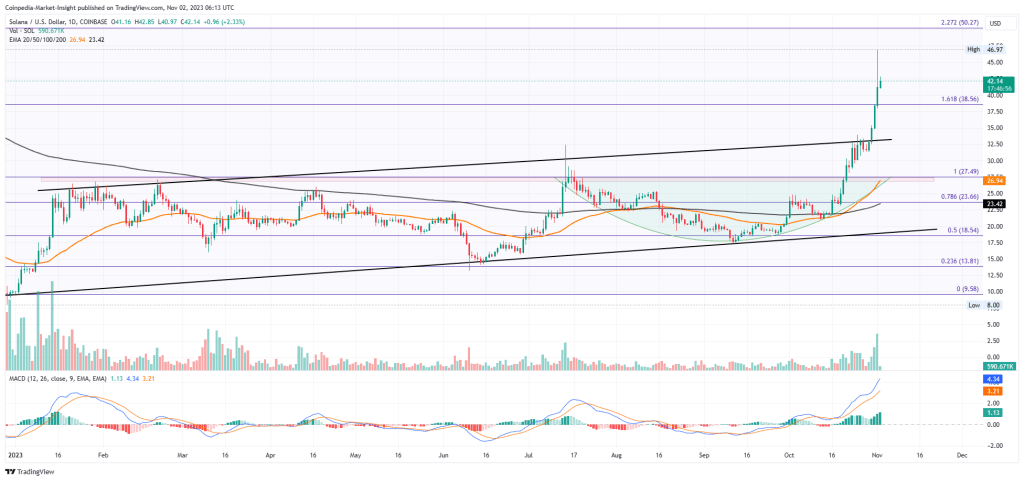
SOL price trend shows a sharp reversal in momentum after a bullish breakout from a round bottom pattern. With the breakout of the $27.5 area, Solana price surged along with the overall market’s moonshot rally.
Additionally, Solana easily broke overhead resistance and hit a new 14-month high at $46.97. High-velocity bullish and volume candles create new skyscrapers and underlying demand is rising.
Currently, SOL price is trading at $42.07 as sellers rejected higher prices to $47, leading to a brief pullback. Nonetheless, the 2.16% intraday gain shows a bullish candle, reflecting continued buying pressure.

Technical indicators:
EMA: Increasing trend momentum has fueled a positive recovery from the 50-day EMA and widened the bullish gap from the 200-day EMA. Positive corrections and bullish trajectories on key EMAs reflect an upcoming bullish trend in SOL price.
MACD Indicator: The MACD and signal lines continue to move higher by avoiding a crossover and the histogram is surging again. The momentum indicator reflects strong buying pressure that could sustain the bull market.
Factors affecting SOL
Whether the ecology is hot and the participation of ordinary participants is one of the core factors in measuring the price of public chain tokens. According to data, there are more than 180 decentralized applications (DApps) on the Solana chain, covering decentralized finance (DeFi), NFT, games and other fields. Solana’s TVL reached US$275 million, ranking tenth among all public chains. There are 108 application protocols (Protocol), ranking ninth.

At first glance, it seems ideal, but upon closer inspection, there are still many doubts. First of all, in terms of DApp, Solana’s popular protocols have all become tepid after falling from their high levels. The highest TVL of the top ten protocols is only 150.41M, and those after that are basically below 50M. This data is far lower than the data of L2 Arbitrum, which was launched on the main network only this year, and there is a huge gap with the data of Ethereum and BSC, which were born earlier.

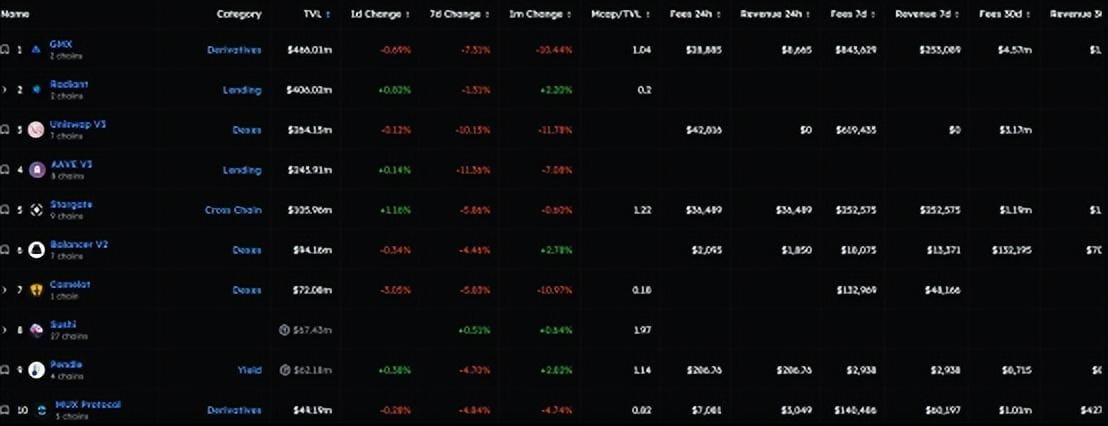
Secondly, due to the weak short-selling effect of Solana, new users entering the currency circle will basically not focus on this outdated public chain, which results in the number of users unable to increase. The data of around 85,000 active users in 24 hours is only better than Avalanche among mainstream public chains.
In addition to poor ecological fundamentals, the sustained damage caused by the SBF incident cannot be underestimated. As a product supported and launched by SBF, after the accident of the largest funder, the participation of external funds in the entire project has become increasingly sluggish. Among the financing projects of several heavyweight categories in 2023, the Solana protocol has not been seen.
Of course, as a product that is still among the top ten in terms of market capitalization, SOL can naturally enjoy the influence of the general environment of the currency circle. Because the BTC halving effect in 2024 is deeply rooted in the hearts of the people. Therefore, the opportunity for a subsequent weak rebound with the help of other mainstream currencies cannot be ignored.
Everyone, please use your little hands to make a fortune. Thank you for your support. See you in the next issue!
I am Brother Ming. I have been in the trading market for more than ten years. If you have any questions, please contact Brother Ming. Welcome to chat!