

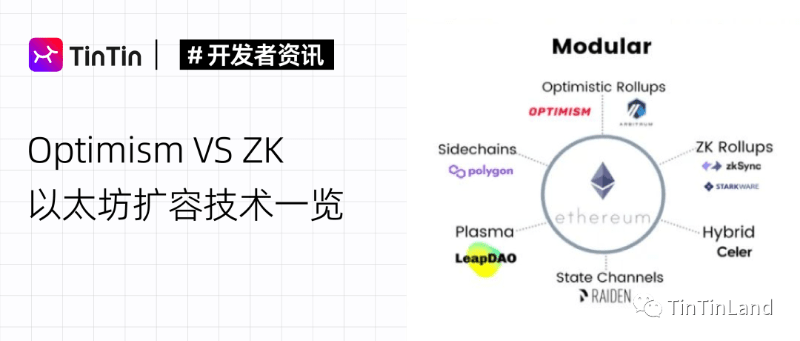
Before we start the comparative analysis between Optimism Rollup and ZK Rollup, we need to understand the background of Rollup.
Rollup is considered the ultimate solution for Ethereum's expansion. It executes transactions outside Layer 1 but publishes transaction data on Layer 1. This allows Rollup to expand the network and still gain security from Ethereum consensus. The whole process is essentially to execute transactions, obtain data, compress the data, and aggregate it to the main chain in a single batch, hence the name "Rollup".
Why do we need a Rollup expansion solution?
In fact, the research enthusiasm of Rollup is closely related to the development of Ethereum in recent years. Ethereum expansion has always been one of the most discussed topics in the crypto field. Whether it is the CryptoKitties craze in 2017, the DeFi summer in 2020, or the cryptocurrency bull market in early 2021, the surge in demand for Ethereum has heated up the expansion debate, and the soaring Gas fees have made the transaction fees paid by users more expensive.
At the same time, with the rapid development of Web3, Ethereum has increasingly become the host of thousands of DApps. The huge transaction volume will inevitably limit the operating speed, making the transaction speed of projects on Ethereum slower and slower, and the user retention rate gradually declines.
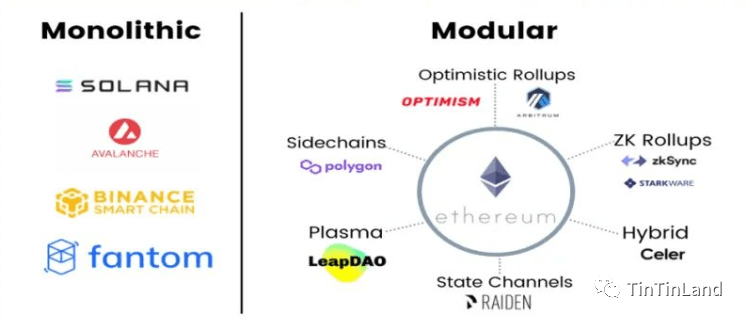
Based on this, finding the perfect expansion solution has become an important goal for multiple teams and the entire Ethereum community. Generally speaking, there are three main ways to expand Ethereum: expanding the blockchain itself - Layer 1 expansion; building on top of Layer 1 - Layer 2 expansion and building side chains on the side of Layer 1.
The scaling principle of Rollup is to aggregate hundreds of processed transactions into a batch and execute transactions on the L2 chain parallel to the Ethereum mainnet. The completed transactions are then published to the underlying (L1, Layer 1) blockchain in batches to increase transaction speed and reduce Gas fees.
Among all the Rollup solutions, Optimistic Rollup and ZK Rollup have performed well. In fact, the execution principles of Optimistic Rollup and ZK Rollup are similar, and the difference lies in the verification method. Today, let us take a closer look at these two excellent expansion solutions, compare their advantages and disadvantages in the specific implementation process, and actively look forward to the ideal model of the next generation of Ethereum expansion solutions.
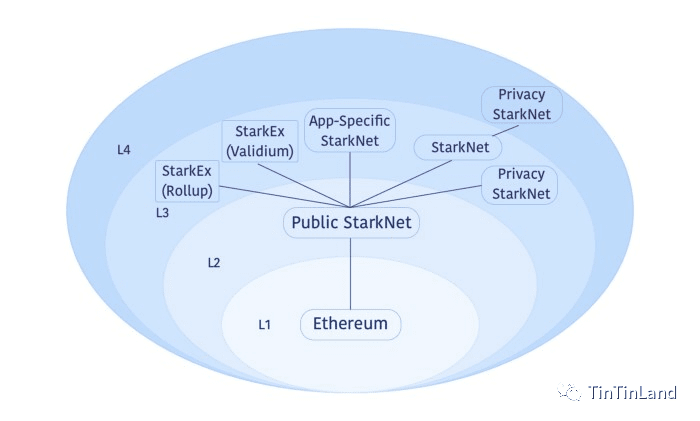
Decrypting the Optimism and ZK Territory System
Optimism
Optimistic Rollup, as its name implies, adopts an "optimistic" mechanism - Fraud proofs. The system defaults to the reliability of transaction data and directly enters the waiting period without effective verification. If any node raises an objection during the waiting period and proves that it is a malicious transaction, the transaction will be canceled; if there is no objection, the transaction will be completed and written into the block at the end of the waiting period. The "fraud proof" transaction solution eliminates large-scale deployment verification, thereby saving computing resources and ensuring the accuracy of transactions.
Among the Optimistic Rollup, the most prominent solutions are Arbitrum and Optimism. Although Optimism is the first Optimistic Rollup protocol that is compatible with EVM, Arbitrum has gained a latecomer advantage due to the delay in the mainnet launch.
Optimism: Single-round non-interactive fraud proofs
Optimism uses smart contracts to transfer transaction data from the Ethereum main chain to Layer 2. The sequencer can bundle multiple transactions into a batch and then submit the batch back to the main chain through a single transaction. The sequencer optimistically executes the corresponding process under the assumption that all transactions are valid. The system sets a one-week waiting period during which any questions can be raised, and if there are any exceptions, a fraud proof will be generated.
Arbitrum: Multi-round interactive fraud proofs
Arbitrum was launched on the Ethereum mainnet on May 28, 2021. The overall execution process is not much different, mainly because Arbitrum's validators and challengers continuously split the controversial steps through a binary method off-chain until the scope of the dispute is reduced to a specific step, and then make a judgment on the corresponding step on the L1 chain to efficiently resolve the dispute. Therefore, compared with Optimism, Arbitrum can carry a higher transaction capacity and achieve a more thorough "tracing back to the source".
ZK Rollup
ZK Rollup (zero-knowledge proof), this concept was introduced by researchers at MIT in 1980 and was once called "moon mathematics."
ZK Rollup is a scaling solution through zero-knowledge validity proofs. It processes off-chain transactions in batches and generates cryptographic validity proofs to verify the authenticity of the transactions. These validity proofs add batches of transactions to the L1 blockchain, which can be quickly verified by L1 contracts, while invalid batches are directly rejected.
If Optimistic rollups assume that everyone involved in a transaction is acting in good faith, then ZK Rollup strives to ensure that this is indeed the case. Currently, the ZK Rollup landscape mainly includes Hermez, ZKSync, etc.
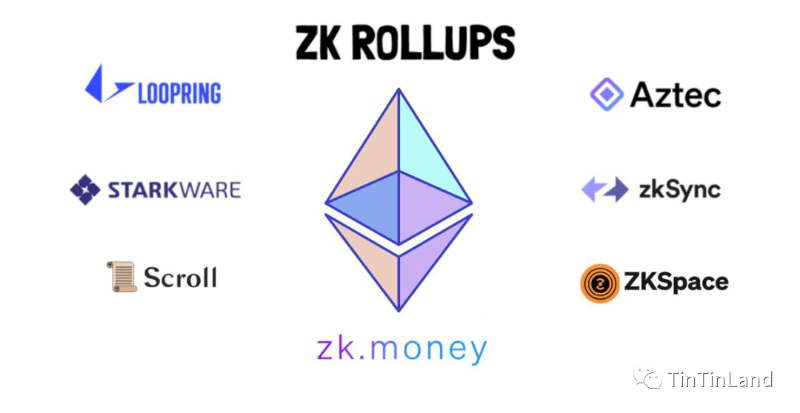
Hermez: Generating Concise Non-Interactive Knowledge Arguments
Hermez can generate cryptographic proofs of SNARKs (Succinct Non-Interactive Arguments of Knowledge) and has the ability to scale Ethereum to 2,000 transactions per second. The system relies mainly on coordinators to process and generate validity proofs. Coordinators are selected through an auction process, and registered network nodes bid to become the next coordinator. Currently, the Hermez team has announced that they are developing a zero-knowledge Ethereum virtual machine (ZKEMV) that aims to achieve full opcode compatibility.
ZKSync: Generating Concise Non-Interactive Arguments of Knowledge
ZKSync describes its project as a scaling and privacy engine that supports low-gas transfers of Ether and ERC-20 tokens in Ethereum. In ZKSync, only one validator processes batches and generates proofs of validity. ZKSync 2.0 has been launched as an off-chain data availability solution that confirms staking and data availability while ensuring that guardians cannot steal funds.
Optimism vs ZK: Which One Wins?
Optimism and ZK have embarked on two different expansion solutions since they entered the market. Fraud proof and validity proof correspond to the different usage needs of developers and users, thus showing their respective "highlight attributes" in terms of throughput, timeliness, cost, etc. Specifically, we can think about different development scenario requirements from the following aspects and make corresponding choices between the two.
Development threshold and usage cost
Optimism does not require large-scale deployment of verification. It saves a lot of development steps and publishes these verification information to the base layer, assuming that all transactions are valid. This is due to the fact that in an optimistic situation, no additional work is required, which greatly reduces the development threshold for technicians and saves a lot of time, energy, and money. If developers want to get started with the Rollup solution in a short period of time, Optimism is the first choice. Data shows that Optimistim can provide up to 10-100 times scalability improvement.
In comparison, ZK Rollup needs to provide proof of validity and submit it to the mainnet one by one. This step brings much higher technical development difficulty than Optimism. Novice developers often encounter numerous errors when trying to use ZK Rollup, which reduces the expansion efficiency and running speed.
Smart Contract Enforceability
Optimism is highly interoperable and can also execute smart contracts. This gives Optimism more room for flexible operations on L2, and the joint participation of users makes Optimism's operations more "trustworthy", thus gaining additional advantages such as better data protection and certain rights of both parties to the transaction. It is worth mentioning that most people in teams such as Fuel, OMGX, and Cartesi are also trying to develop an EVM-compatible version for their Rollups to make Optimism more adaptable and more performant.
ZK Rollup is currently limited to simple transactions, which brings many limitations to the expansion of ZK Rollup. Therefore, ZK can only support any smart contract written in Solidity through the EMV-compatible virtual machine developed by ZKSync to expand its application space. Or it can expand the payment scale and introduce privacy functions by relying on Loopring, Hermez and ZKTube.
Execution efficiency of withdrawing funds
As a mechanism to protect user transactions and provide proof of ownership, the speed of withdrawing funds after transactions is also a key choice for developers and users. From this perspective, ZK Rollup is more advantageous. Optimistim's dispute resolution process is cumbersome, and all participants must be given enough time to submit fraud proofs before finalizing the transaction. This period of time is quite long. After all, even in the worst case scenario, fraudulent transactions may still be appealed. It takes up to one or two weeks to withdraw funds from Optimistim.
In contrast, ZK Rollup does not have the problem of long withdrawal times, because as long as the Rollup batch is submitted to Layer 1 together with the proof of validity, the funds can be withdrawn. This invisibly saves users' time costs, and also accelerates the circulation of more transactions, improving the overall efficiency of the trading environment.
The strength of security and privacy protection
Currently, ZK Rollup uses complex mathematical calculations and cryptography to ensure that transactions are "settled" on the ETH main chain, which is essentially different from Optimistim in terms of verification. Like SNARK, STARK, PLONK, and DARK, these proof strategies deployed on ZK Rollup include their own security strength and risk proofs in terms of data footprint, proof time, verification time, collusion risk, etc.
It can be seen that compared with simple fraud proof, ZK has set up multiple protection and verification mechanisms for security and privacy protection to ensure rigorous and thoughtful transaction verification. There are also companies such as Aztec that are focusing on introducing privacy functions into their ZK Rollup technology to improve the privacy mechanism of ZK Rollup.
Optimism and ZK in 2023
As we can see, Optimism and ZK have their own merits as Rollup solutions. In the new year, they will continue to innovate and iterate on their own paths. Perhaps we can expect that in 2023, these two expansion solutions, Optimism and ZK, will be applied to more actual projects and continue to empower the development of Ethereum.
At present, we can only conclude that Layer 2 will play an important role in making Ethereum more scalable, but there is no clear statement on which Rollup solution is better. There is no doubt that Optmism and ZK will launch more optimization measures towards becoming the "dark horse" in the Rollup direction of the Web3 world.
In the long run, perhaps with the continuous development of ZK-related technologies, the limitations of ZK Rollup will be broken and strong application potential will emerge. We also hope that in the future, these two Rollup solutions can complement each other's strengths, integrate security and privacy, timeliness and cost, development threshold and other factors into better products, and open up a new world. As we can see, Optimism and ZK are "each has its own merits" as Rollup solutions. In the new year, they will continue to innovate and iterate on their own paths. Perhaps we can expect that in 2023, the two expansion solutions of Optimism and ZK will be applied to more actual projects, and continue to empower the development of Ethereum.
references:
Optimistic, zk-Rollups, L3... Where has Ethereum's scalability research come to now?
https://techflowpost.mirror.xyz/DCQiiuK5_p2UhF32jCVk3ZmHy-B15qNXXuvK1guaMZk
Ethereum’s path to scaling
https://juejin.cn/post/7127205065839869959
In-depth | How to understand the prospects and differences between ZK and Optimistic Rollup?
Optimistic Rollups vs. ZK Rollups: Six of the Most Exciting Ethereum Layer 2 Scaling Projects
The future of Optimism: Bedrock upgrade, Rollup decentralization, and ZK integration
Popular Science | ZK Rollup & Optimistic Rollup
L2 Rollup’s competitive status and challenges