

Introduction
In February of this year, Bloomberg columnist Aaron Brown pointed out that four projects should be a focus in the blockchain industry this year: Cosmos, Nervos, NuCypher, and Polkadot.
Amidst the tumult, can the Nervos project, praised by Bloomberg for its strong technical capabilities, layered blockchain architecture, and innovative economic model design, stand out from a multitude of public chains and take on the responsibility of 'designing infrastructure for the future crypto economy'?
Nervos Network (CKB) was established in 2018 as an open-source, decentralized, and secure platform aimed at addressing the scalability limitations faced by traditional networks like Bitcoin and Ethereum.
In this article, we will learn about what Nervos Network is, how it works, what CKB token is, and the price trend of CKB token.
Background
As the largest cryptocurrency, Bitcoin continues to gain adoption and recognition. However, its success has also exposed some limitations and challenges, particularly in scalability. For instance, after the Segwit upgrade, the Bitcoin blockchain limited block size to under 4 MB, constraining the number of transactions that can be processed at any given time. As the network grows, this limitation has led to longer confirmation times and higher transaction fees, diminishing Bitcoin's efficiency in handling large-scale transaction volumes. Compared to other blockchains, Bitcoin's scripting language currently lacks the flexibility and expressiveness needed for developing complex smart contracts, beyond value transfer.
To address these limitations, various Layer 2 (L2) solutions have been proposed, such as payment channels, sidechains, and Rollups. Most of them aim to scale Bitcoin by processing transactions off-chain, attempting to increase transaction throughput without compromising the security of the underlying layer. For example, the Lightning Network created a second-layer payment channel network that allows for near-instantaneous small payments. Another method is sidechains—independent blockchains connected to the Bitcoin main chain, offering greater scripting capabilities and faster transactions. However, these solutions often come with trade-offs, such as increased complexity, trust assumptions, and potential security vulnerabilities.
Nervos Network is one of the scalability solutions for Bitcoin, adopting a more native approach and modifying the UTXO model that underpins Bitcoin. It improves the RGB protocol, providing Turing-complete contract capabilities for Bitcoin without the need for cross-chain bridges. Nervos Network was initiated in Q1 2018 by Terry Tai, Kevin Wang, Cipher Wang, and Daniel Lv, aiming to enhance scalability as a Layer 1 blockchain. On February 13, 2024, Nervos Network announced the launch of a new product: RGB++, marking its transition from Layer 1 to Bitcoin Layer 2, leveraging its own advantages to specialize in Bitcoin's second-layer scaling.
Financing situation:
Nervos Network has raised approximately 100 million USD through two rounds of financing.
Seed round
In August 2018, Polychain Capital led the investment round, with participation from Sequoia China, Wanxiang Blockchain, Blockchain Capital, etc. The amount was 28 million USD.
Series A
On October 16, 2019, Nervos Network completed its ICO on Coinlist, raising 72 million USD.
During the two rounds of financing, Nervos Network raised 100 million USD, with significant investments from renowned institutions such as Polychain Capital, Sequoia China, Wanxiang Blockchain, Blockchain Capital, Dragonfly Capital, Huobi Capital, among others. Nervos Network has garnered the favor of many well-known capital entities.
Development strength
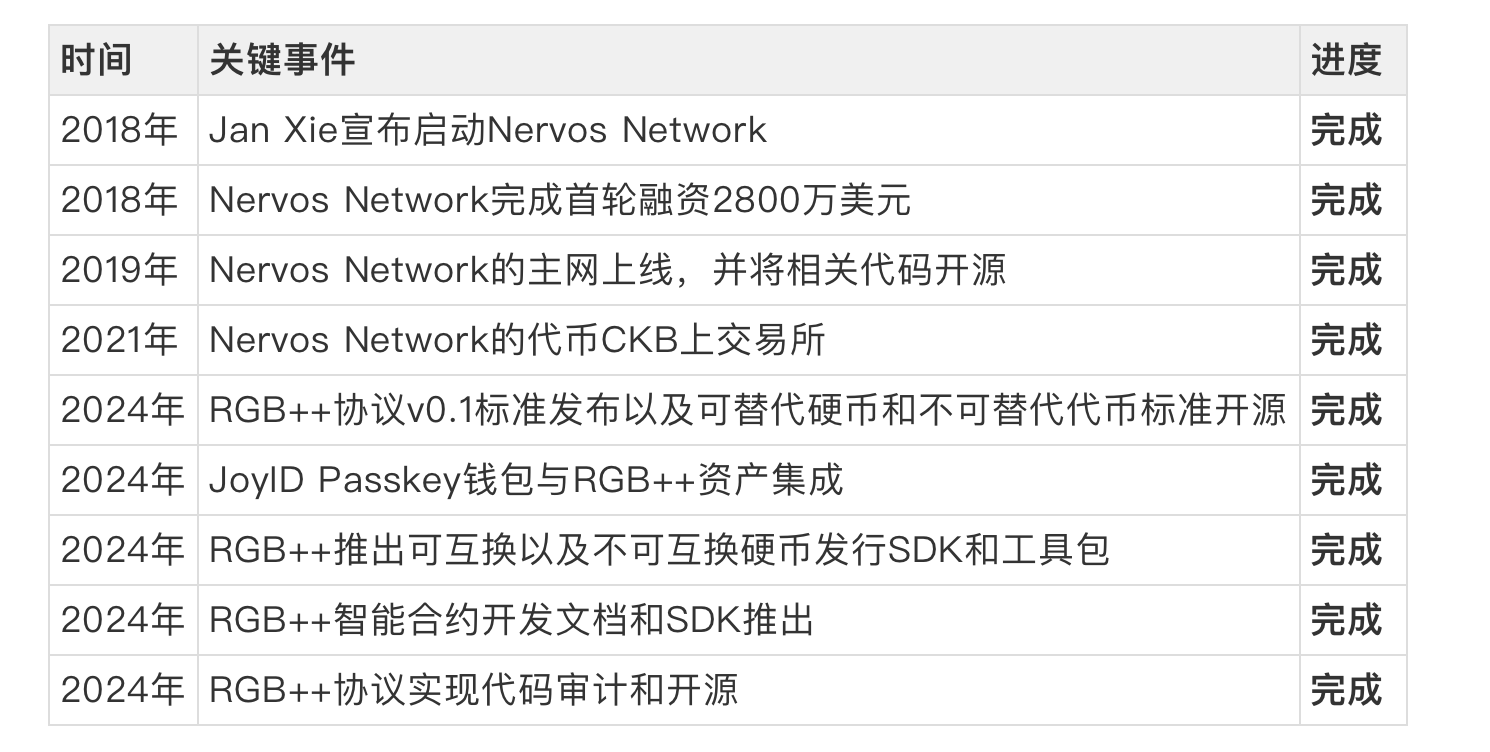
In 2018, Nervos Network was initiated, founded by Jan Xie. Key events in the project's development are shown in the table:
Jan Xie: Founder and Chief Architect. He is also the founder of Cryptape, a former researcher and developer at the Ethereum Foundation, focusing on Casper and Sharding, co-founder of ethfans.org, and a former architect of Peatio.
Introduction to Nervos Network (CKB)
Nervos Network (CKB) is a public blockchain and protocol suite designed to address the scalability limitations faced by traditional networks like Bitcoin and Ethereum, providing a scalable and sustainable ecosystem for developers and users.
Nervos's blockchain is a Layer 1 protocol that uses Proof of Work (PoW) consensus and supports smart contract development. It also includes a series of Layer 2 scaling solutions to facilitate high-capacity use cases. Nervos's native token is called CKByte or CKB, allowing users and developers to request storage space on the Nervos blockchain in proportion.
The Nervos Network also operates a decentralized autonomous organization (DAO). The DAO is a decentralized management entity and a popular component of many cryptocurrency enterprises. The main idea is to entrust management to a group of stakeholders, avoiding a single-person management model. For the Nervos DAO, holders of the blockchain's native token CKB can earn rewards by locking their tokens in the Nervos DAO. The network claims this is a way to ensure sustainable value for CKB tokens and protect them from dilution from secondary issuance.
What is CKB token?
The native token CKByte (CKB) of the Nervos Network plays a crucial role in the platform's operation and has multiple uses such as facilitating the purchase of storage space, supporting smart contract execution, and rewarding miners.
CKB tokens represent state storage units in the Nervos Network. Token holders can create components (Cells) on the Nervos blockchain equivalent to the amount of CKB tokens they hold. For example, a holder with 1,000 CKB tokens can create a 1,000-byte Cell or multiple Cells totaling 1,000 bytes. The unit model of the Nervos Network is inspired by Bitcoin's UTXO model, where used tokens are marked as 'used' instead of being completely removed from the blockchain.
CKB tokens are also used to purchase storage space for CKB layer components, bringing flexibility to the entire ecosystem. An economic model was established through the exchange of CKB tokens, where state storage fees are charged based on the space and time occupied. Additionally, CKB is used to support smart contract execution and reward miners through block rewards and transaction fees.
CKB price trend outlook
The development of the CKB ecosystem should not be underestimated, with the current price around 0.0116. The long-term outlook is optimistic, and holding spot is safe!