



The 2024 U.S. presidential election is about to be announced, and eyes around the world are focused on the political contest. In addition to traditional media and polling agencies, a forecasting platform based on encryption technology - Polymarket - also emerged in this election and became a force influencing public opinion. Polymarket not only provides a decentralized prediction market, but also allows users around the world to participate in predicting the results of the US election. This article will provide an in-depth introduction to Polymarket’s background, how it operates and how it affects this election, as well as explore the challenges and potential risks it faces.
What is Polymarket?
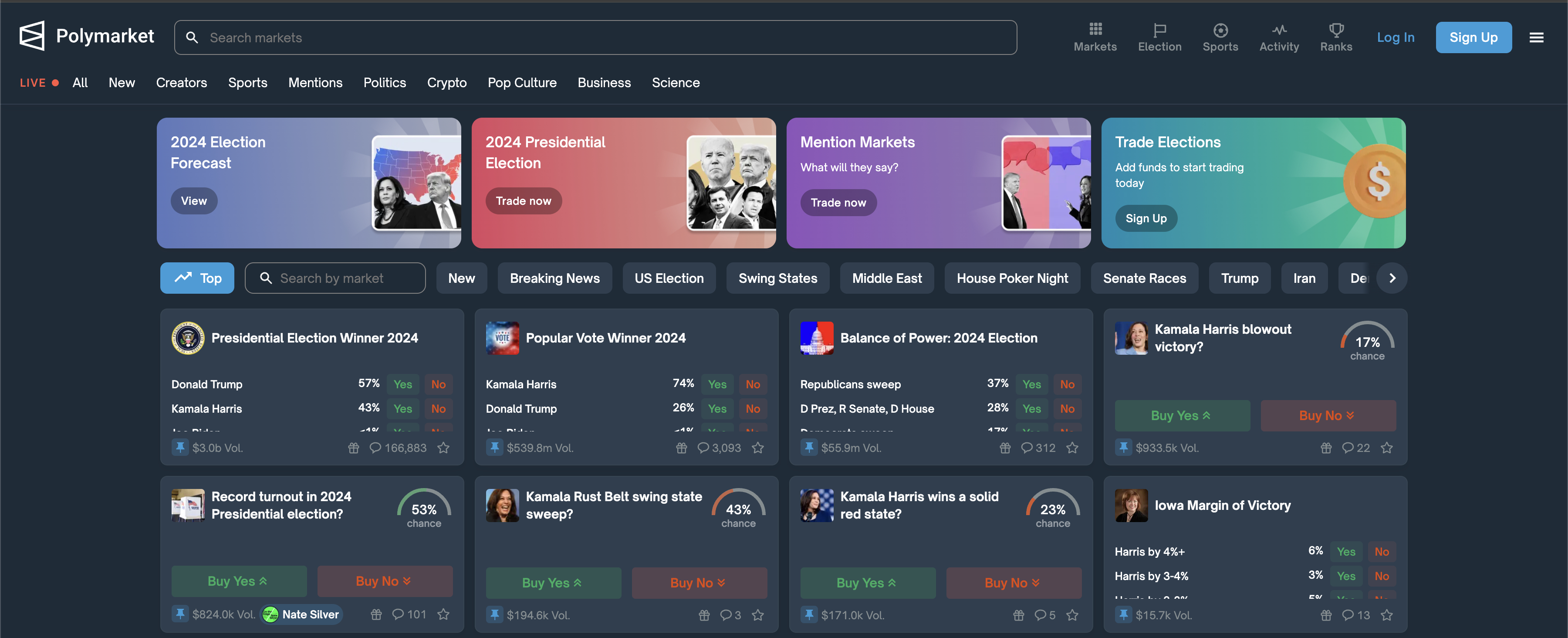
Polymarket is a decentralized prediction platform that allows users to predict the outcome of future events. From political elections to sports events, and even economic indicators and social issues, users on Polymarket can participate in predictions through digital assets. This method not only allows users to participate in the event, but also allows the market price to reflect the current trend of public opinion as the prediction results change.

Polymarket plays an important role in the 2024 US presidential election. Currently, cryptocurrency users around the world are using Polymarket to predict the probability of Donald Trump and Kamala Harris being elected, and observe market trends based on real-time data changes on the platform. The platform operates like a transparent market, not only allowing more people to participate in event predictions, but also allowing the data to be publicly presented so that the public can instantly understand the market's views on the election.
Polymarket’s team and background
Founded by Shayne Coplan, Polymarket was founded to create a transparent and public prediction market. Coplan’s extensive background in cryptocurrency and blockchain technology gave him the ability to develop Polymarket, a platform that uses blockchain technology to ensure transparency. Since launching in 2020, Polymarket has successfully secured multiple rounds of funding and attracted support from high-profile investors.

Polymarket’s investor list includes many heavyweights in the cryptocurrency and technology circles. For example, Ethereum co-founder Vitalik Buterin, DeFi protocol Aave founder Stani Kulechov, and prominent angel investor Balaji Srinivasan have all expressed support for Polymarket. In addition, Peter Thiel, founder of Founders Fund, a well-known investment institution, also led Polymarket’s financing round. The participation of these investors has enhanced the market’s trust in the platform. The support from experts and entrepreneurs in the encryption field has allowed Polymarket to gain stronger resources and industry support, and has increased its influence and become a leader in the decentralized prediction market.

How Polymarket works
The operating principle of Polymarket is based on blockchain technology, which means that all transactions, predictions and results will be transparently recorded on the blockchain, ensuring openness and immutability. This design allows users to safely participate in the prediction of various events without trusting the platform itself.
On Polymarket, users use the stablecoin USDC to participate in predictions. USDC is a digital currency whose value is pegged to the U.S. dollar, allowing users to buy and sell predicted shares of various event outcomes at a stable price. In its predictions for the 2024 US presidential election, Polymarket has set up two different outcome options for Donald Trump and Kamala Harris' chances of winning. Users can choose to support a certain candidate’s victory and purchase corresponding shares.
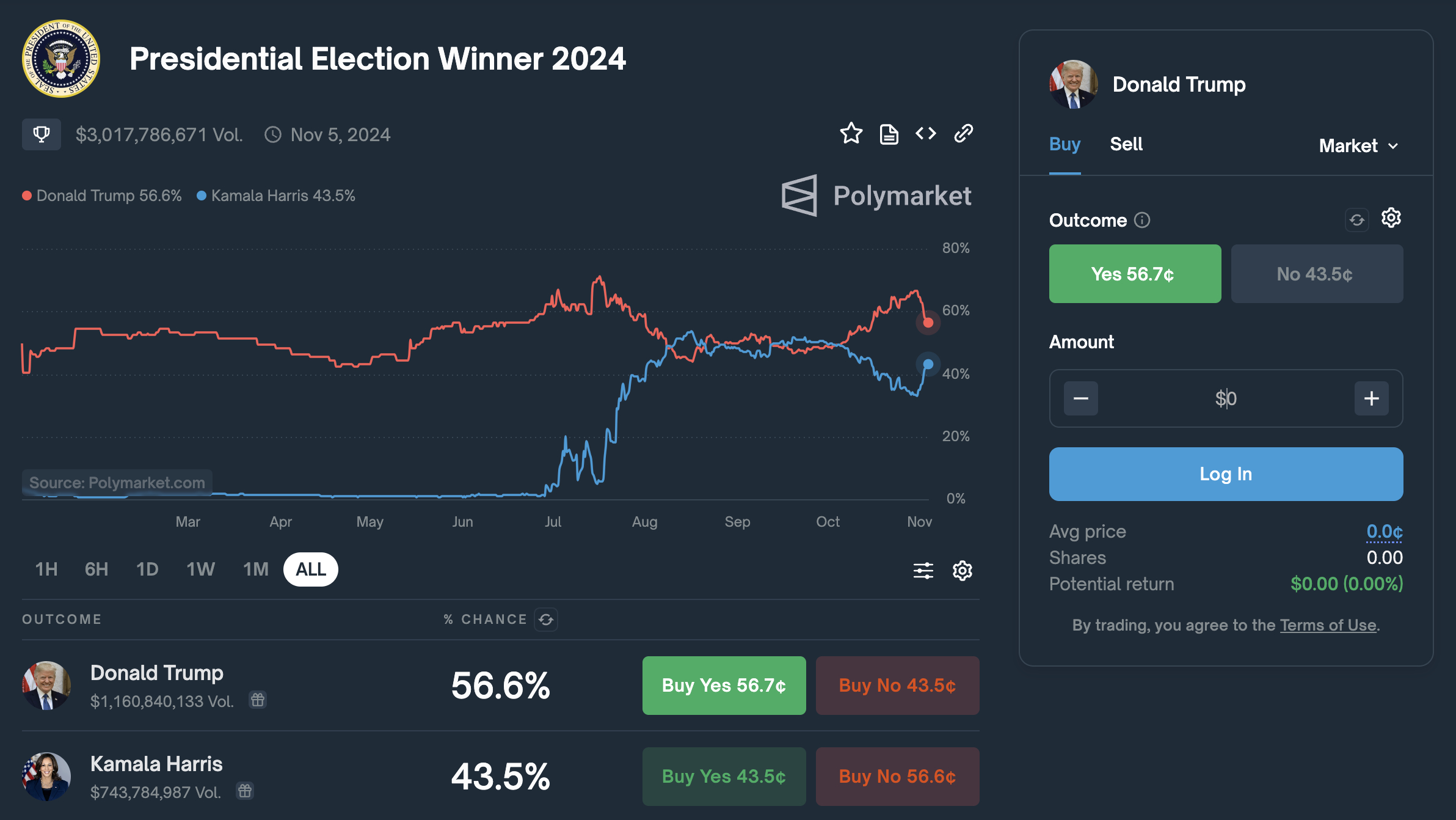
What is unique about Polymarket is the instant price adjustment mechanism. When more users think a certain candidate will win and buy shares of that option, the price of that share will rise. Otherwise, prices will fall. This means that the platform’s price will reflect the market’s expectations of a candidate’s victory at any time, allowing other users to instantly grasp market sentiment.
In addition, Polymarket does not rely on centralized institutions or intermediaries. Users’ funds are managed by smart contracts on the blockchain, avoiding possible fraud and security issues in traditional financial systems. At the same time, this non-custodial approach allows users to have greater control over their assets without trusting a third party to manage funds.
What problem does Polymarket solve?
The emergence of Polymarket solves several key problems in traditional prediction markets:

1. Transparency and impartiality: Traditional prediction markets are often managed by centralized institutions, which can raise concerns about impartiality and manipulation. Polymarket operates based on the blockchain, and all data and transactions are publicly recorded on the blockchain, which is not only transparent, but also effectively avoids manipulation problems.
2. Global user participation: Traditional prediction markets often limit the region or identity of participants, but Polymarket uses blockchain technology to allow global users to participate under equal conditions, breaking the restrictions of geography and identity.
3. Real-time reflection of market sentiment: Polymarket adopts an automatic price adjustment mechanism so that the market can instantly reflect changes in public opinion, providing users with more accurate information reference and helping them make better prediction decisions.
4. Low threshold: For novices, traditional prediction markets may be cumbersome to operate and require a high investment threshold. Polymarket's interface design is simple and intuitive, so even users who are unfamiliar with blockchain and cryptocurrencies can easily participate in predictions.
Potential risks and pitfalls of Polymarket
Although Polymarket provides a more transparent and open prediction market, its operating model also brings some potential risks and challenges:

1. Influence of large funds: Polymarket is an open market, which means that users with large amounts of funds can affect market prices, thereby affecting the predictions and judgments of other users. For example, deep-pocketed users can boost a candidate's chances of winning by buying large amounts of shares, tricking other users into thinking that Donald Trump or Kamala Harris has higher support.
2. User bias: Polymarket’s user group mainly comes from the cryptocurrency community, and this group may have high support for certain candidates, such as Donald Trump. This causes Polymarket's data to be biased toward specific candidates and not representative of the overall electorate. Therefore, Polymarket’s forecasts may not accurately reflect the actual voting intentions of U.S. voters.
3. Legal and regulatory challenges: The operation of decentralized prediction markets involves large amounts of capital flows and may face regulatory attention and restrictions. In 2022, Polymarket was fined by the U.S. Commodity Futures Trading Commission (CFTC) for unauthorized financial operations. In the future, if regulatory authorities further regulate prediction markets, Polymarket may face stricter regulatory restrictions.
4. Accuracy of results: Polymarket’s forecast results rely on the opinions of the majority of people in the market. However, in some cases, the opinions of minority groups may also be accurate. This "herd" mechanism may cause the market to be biased towards mainstream public opinion and fail to truly reflect the actual results of the incident.
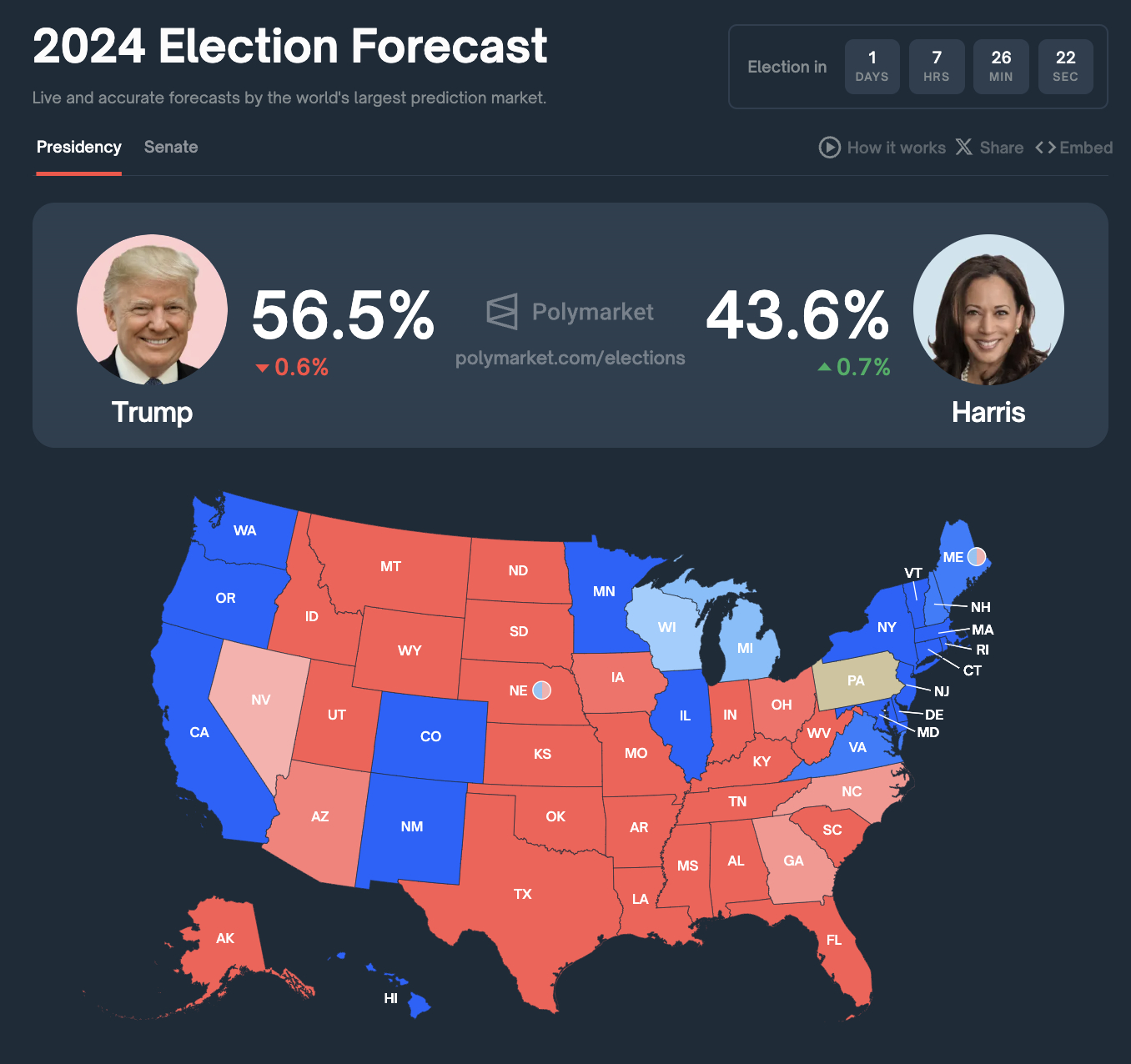
Prediction data for the current US election
According to the latest data from Polymarket, Donald Trump has about a 56.3% chance of winning so far, while Kamala Harris has about a 43.9% chance of winning. However, these ratios will still adjust as the election gets closer and market participants change, with many updating their forecasts based on the latest polls and news. This also means that the data on Polymarket is not static, but changes with people's views on the candidate's support, becoming an important reference that reflects current public opinion.
Polymarket’s data has become the basis for many people to observe the election situation, and even some media and analysts will refer to these data to speculate on the development of the election situation. The advantage of this real-time data is that it can instantly reflect the market's confidence in a candidate's chances of winning, making it an interesting election indicator.
in conclusion
In the 2024 U.S. presidential election, Polymarket, with its decentralized prediction market features, allows users around the world to participate and understand changes in the election. Through the use of blockchain technology, Polymarket provides the market with a transparent, instant and open prediction environment, allowing users to not only predict events, but also understand the current direction of public opinion from market data.
Polymarket demonstrates the value of blockchain technology in prediction markets and makes people rethink the potential of decentralized finance. However, the operation of this platform also faces challenges from the influence of large funds, user bias and legal supervision. These challenges remind us that although decentralized markets can bring a certain degree of transparency, there are still areas that need improvement.
Regardless of the final outcome of the US election, I personally believe that the cryptocurrency market will continue to develop and continue to attract new funds and users. It’s a given that cryptocurrencies will continue to evolve moving forward. As more capital and users enter this field, the potential of the crypto world will continue to be unleashed and it will exert greater influence in future global events. Polymarket is an example of significant value in the cryptocurrency market - allowing everyone to participate in future decisions through a transparent and free prediction platform. Therefore, I am also very optimistic about the subsequent development of the cryptocurrency market.