

Most American cryptocurrency holders own only a small portion of the cryptocurrency and don’t care much about its progress.
Written by JP Koning
Compiled by: Luffy, Foresight News
You may have recently heard about the "America Loves Crypto" campaign sponsored by Coinbase, the largest cryptocurrency exchange in the United States. In an effort to increase the influence of cryptocurrency owners, Coinbase claims that 52 million American adults currently hold cryptocurrency, which is 20% of the adult population in the United States. If true, crypto users will have huge voting power.
Coinbase got its 20% conclusion from an online survey of 2,202 adults commissioned by Morning Consult last February, which asked respondents how much cryptocurrency they currently hold.
If you’ve been following cryptocurrency adoption data from other sources, it’s easy to see that Coinbase’s 20% statistic seems… problematic?
To uncover the truth, let’s dive into the U.S. cryptocurrency adoption data. Here’s a quick overview of the best research on cryptocurrency owners in the U.S. Later in this article, I’ll cover who they are, how much they own, and why they hold it.
1) The originator of the US payment survey is the Federal Reserve's SDCPC (Survey and Diary of Consumer Payment Choice). SDCPC is a long-term data collection effort that aims to gain a comprehensive understanding of US consumers' payment preferences and behaviors. As early as 2014, it began to include cryptocurrencies in the survey, although cryptocurrencies are only a small part of the massive data collected by SDCPC.
The Federal Reserve’s SDCPC is administered by the Understanding America Study group at the University of Southern California. In its 2022 iteration, the SDCPC polled over 4,761 participants. Notably, the SDCPC consists of a survey and a 3-day diary component. Diaries are more labor-intensive to administer than surveys, but can provide more accurate information because they minimize recall bias.
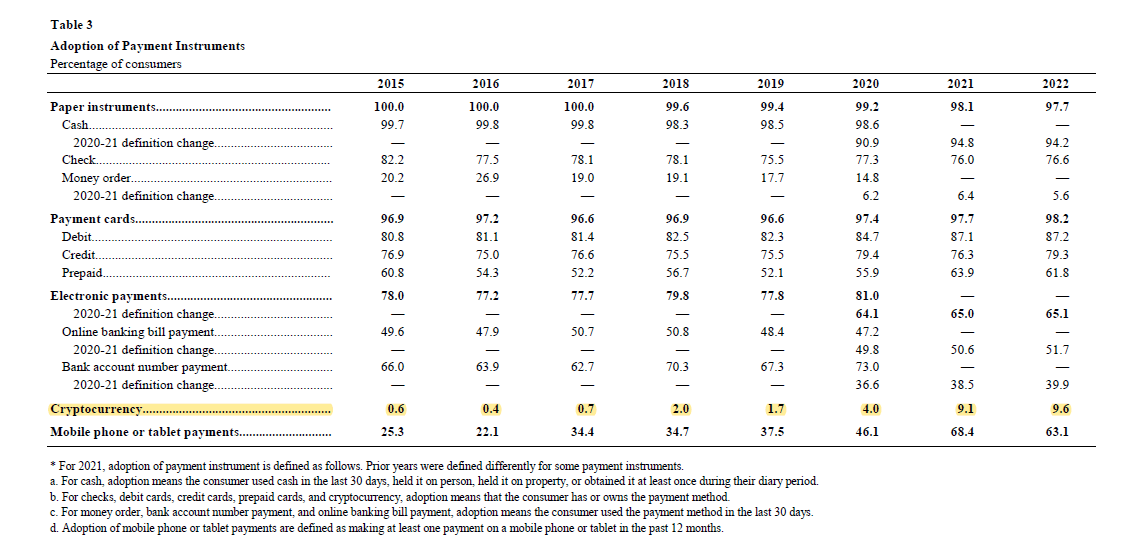
The SDCPC found that 9.6% of US adults owned cryptocurrency in 2022, up from 9.1% in 2021 and well above the 0.6% in a 2015 survey. However, this is far lower than the 20% claimed by Coinbase. Only one of these numbers is correct. Which one is it?
The historical findings of the SDCPC are shown in the table below.
2) Another survey released by the Federal Reserve also sheds light on the adoption of cryptocurrencies in the United States. The Fed’s annual Survey of Household Economics and Decisionmaking (SHED) studies the financial lives of American adults and their households and is therefore more general than the Fed’s SDCPC, which focuses specifically on payments.
The Federal Reserve’s SHED is administered using the Ipsos KnowlegePanel (Note: Ipsos is the world’s leading market research group). In 2022, a total of 11,667 participants completed the SHED.
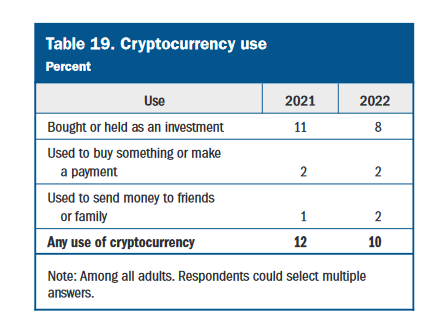
SHED did not begin including cryptocurrency-related questions until 2021. The SHED survey found that 10% of Americans had used cryptocurrency in 2022, with "use" defined as buying, holding, making payments, or transferring money with cryptocurrency. This number is down from 12% in 2021 (see chart below). The number of Americans who hold cryptocurrency as an investment (a narrower definition than "use") fell from 10% to 8% in 2022.
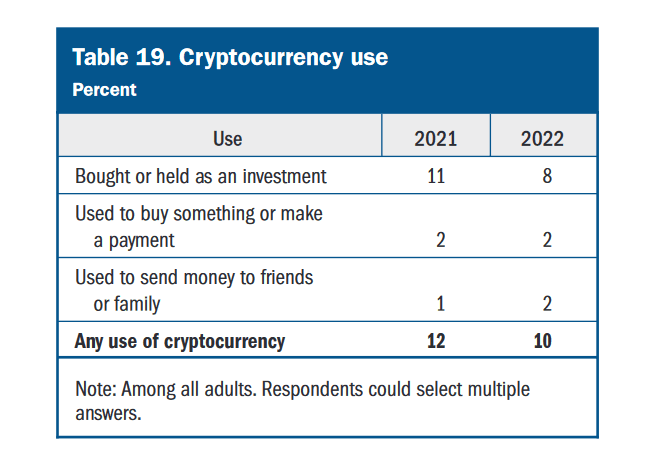
SHED’s 8-10% figure completely confirms SDCPC’s 9.6% findings while disproving Coinbase’s 20% statistic.
3) The next reliable source of cryptocurrency adoption data is produced by a panel of four economic and finance researchers using quarterly surveys from Nielsen Homescan (consisting of 80,000 households). Each survey has a response rate of 20-25%, representing data from 15,000 to 25,000 respondents.
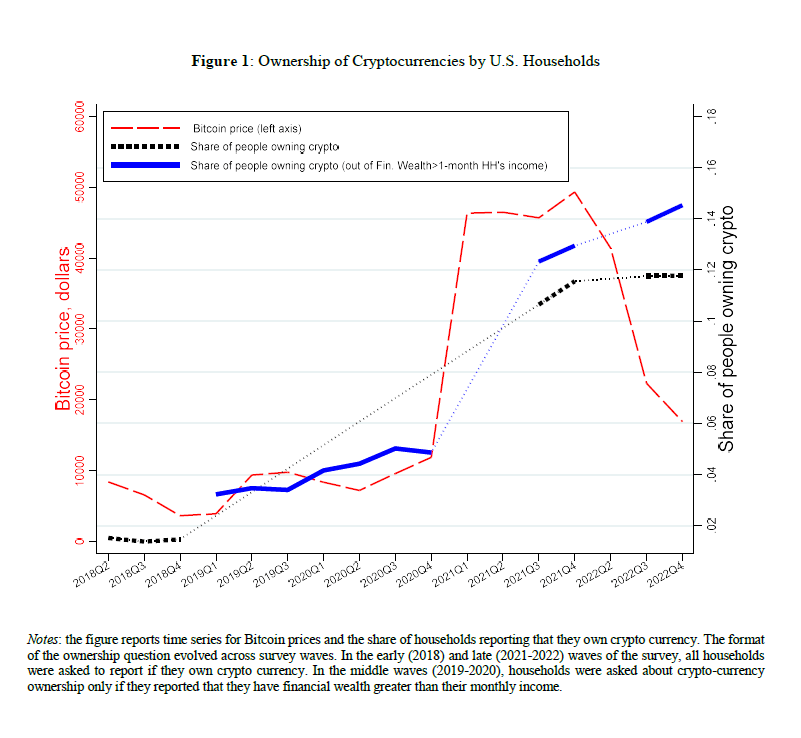
Weber, Candia, Coibion, and Gorodnichenko (Weber et al.) found that the share of households owning cryptocurrency had risen to 12% by the end of 2022. The black dashed line in the figure below shows how the rate has changed over time.
4) The fourth survey was conducted by the Pew Research Center. A March 2023 Pew Research Center survey of 10,701 respondents found that 17% of U.S. adults have “ever invested in, traded, or used” cryptocurrency. This is a very broad category that probably includes someone who casually bought $25 worth of Bitcoin in 2015, sold it three days later, and never touched it again.
Drilling down further, of the 17% who have ever owned or used cryptocurrency, 69% said they currently hold some, which would put cryptocurrency ownership at 11-12% of US adults in 2023. This isn’t far off from both the Fed and Weber et al surveys, but it’s very different from Coinbase’s results.
5) The fifth source of data comes from Canada, which makes for a good cross-check with U.S. data given that the two countries are very similar culturally and geographically. Of the two important Canadian surveys, the first is the Bank of Canada’s long-running Bitcoin Omnibus Survey (BTCOS), administered by Ipsos, which brings together participants from three different panels.
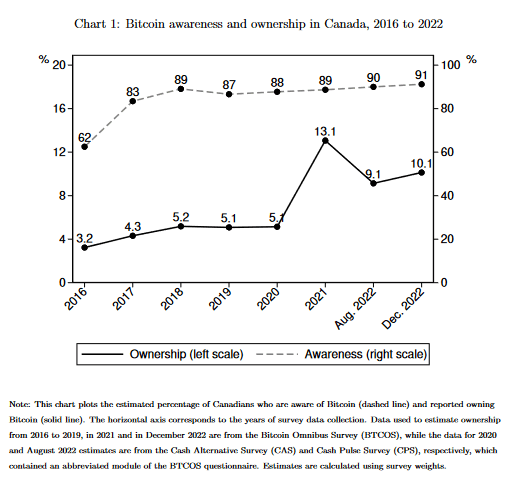
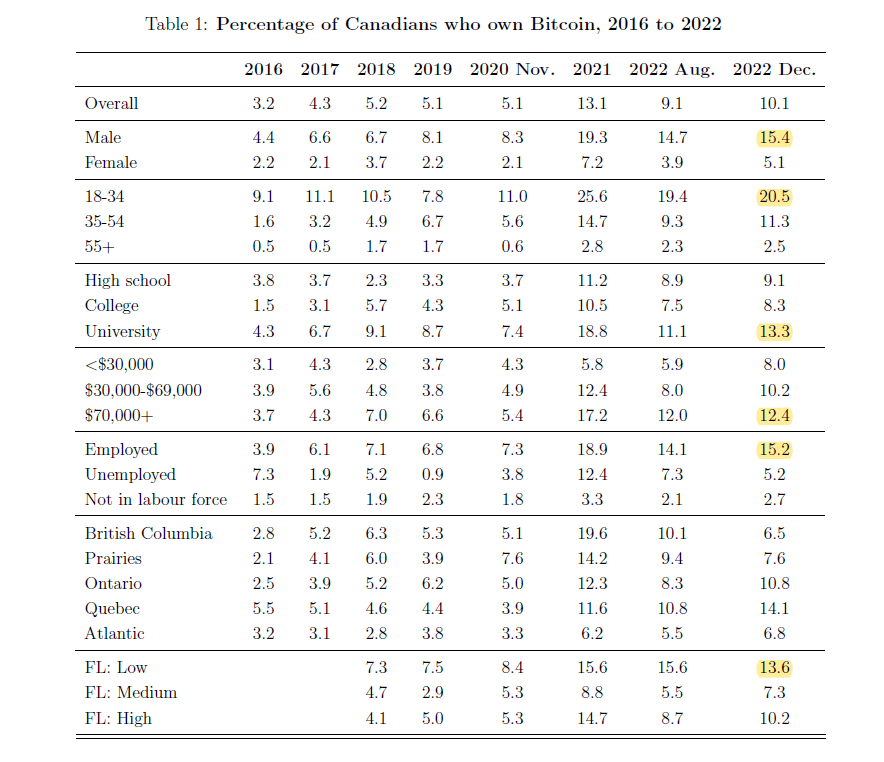
The 2022 BTCOS survey of 1,997 Canadians found that 10% owned cryptocurrency, down from 13% the year before (see chart below). This represents the lower end of the scale as it only includes Bitcoin owners.
BTCOS 2022 also found that 3.5% of Canadians own Dogecoin and 4% own Ethereum. However, it is impossible to directly add these values to the 10% share of Bitcoin owners, as many respondents own multiple types of cryptocurrencies.
The second notable Canadian survey was conducted by the Ontario Securities Commission in 2022 to explore Canadians’ attitudes toward crypto assets. This survey was conducted in conjunction with a survey of 2,360 Canadians conducted by Ipsos in early 2022. The survey found that 13% of Canadians currently own some type of cryptocurrency, including cryptocurrency ETFs, which are legal in Canada but illegal in the United States.
Two Federal Reserve surveys put the percentage of cryptocurrency owners at 9.6% and 8-10% in 2022, respectively, while Weber et al. put it at 12%. Pew Research Center data shows that by early 2023, cryptocurrency owners in the United States will reach 11-12%. In Canada, the Bank of Canada calculates that Bitcoin owners will reach 10% by the end of 2022, while the Ontario Securities Commission puts the percentage of cryptocurrency owners at 13% at the beginning of 2022.
Given this range of data, the 20% adoption rate derived from Coinbase’s Morning Consult survey is a clear outlier and probably needs to be thrown out. U.S. cryptocurrency owners are a potentially sizable voting bloc, but not as large as Coinbase would have us believe.
Regardless, I found a few other interesting things in Coinbase’s Morning Consult survey that further add to my suspicions. Morning Consult reports that 8% of respondents currently own USDC, down from 10% in the previous quarter (more on that here). The survey also shows that 5% currently own USDT. USDC and USDT are stablecoins, and for anyone who follows crypto closely, the idea that one in ten Americans own a specific stablecoin is absurd. Given that Morning Consult must have made a mistake somewhere, perhaps due to sampling error, it makes you question the quality of their overall work. However, even if we ignore Coinbase’s Morning Consult survey, SDCPC’s 9.6% adoption rate is still incredibly high. In just fifteen years, cryptocurrency has gone from a weird niche product to something held by tens of millions of Americans.
What other facts do we know about cryptocurrency owners in the United States?
Holding size
According to the SDCPC, most US cryptocurrency owners have very little cryptocurrency value. Of all US cryptocurrency owners surveyed, 45% only own $0-200 worth of cryptocurrency in 2022. As shown in the figure below. The median value of cryptocurrency held is $312. Given such a small number, I doubt these cryptocurrency owners qualify as lasting cryptocurrency adopters, rather than those who saw Coinbase's Super Bowl ad, bought some Dogecoin, and then stopped paying attention.
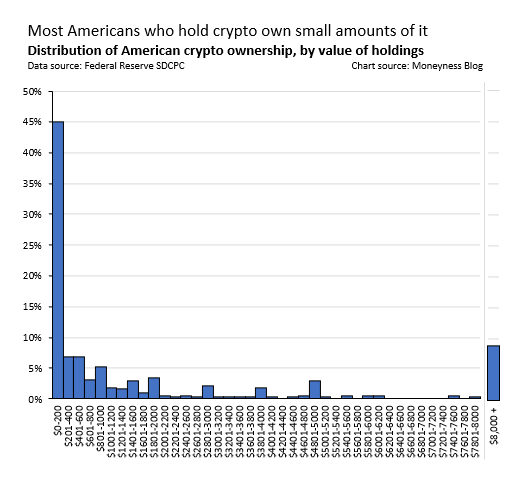
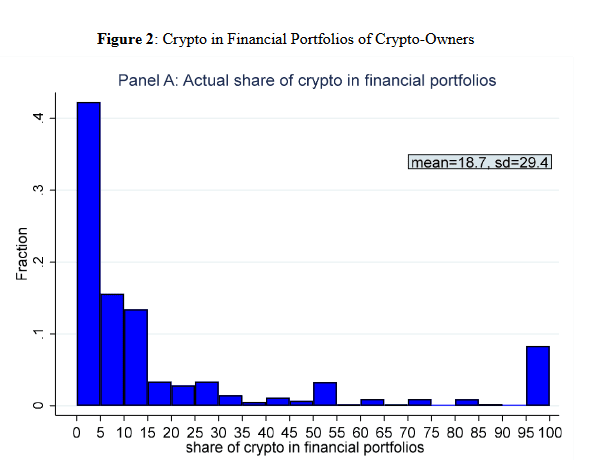
SDCPC data suggests that one in four cryptocurrency owners are what I call crypto fundamentalists, holding more than $2,000 worth of crypto. Given that 90% of Americans don’t hold any crypto at all, two in every 100 Americans would qualify as crypto fundamentalists. Findings from Weber et al. and the Nielsen Homescan panel confirm this skewed distribution of cryptocurrency owners. An outlier group of core owners (about 8% of all cryptocurrency owners) allocate their entire portfolio to crypto (see chart below). By far the largest group of cryptocurrency owners consists of small-time dabblers who have only 0-5% of their portfolio in crypto.
Why hold?
Why do Americans own cryptocurrencies? Despite being called “currencies,” cryptocurrencies are not generally used as a medium of payment. Price appreciation is the primary motivation for owning them. When SDCPC asked participants in 2022 what their “primary reason for owning cryptocurrencies” was, the most popular answer (67%) was investment (see chart below, orange row). The second most common reason (21%) was “I’m interested in new technology.” Respondents rarely listed any type of payment-related use case as their primary reason for owning cryptocurrencies. As for lack of trust in banks, governments, or the U.S. dollar—all common crypto narrative themes—they were rarely mentioned as primary reasons for holding in 2022.
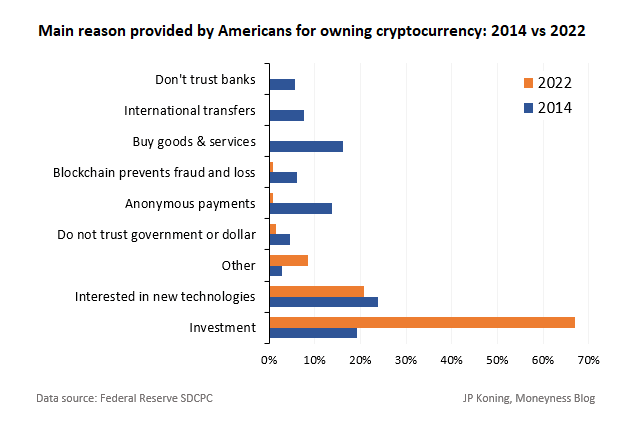
Interestingly, U.S. cryptocurrency owners aren’t always so obsessed with price appreciation. In 2014, the SDCPC found that U.S. cryptocurrency owners had a wide range of motivations, including lack of trust, cross-border payments, and purchasing goods and services (see chart above, blue rows).
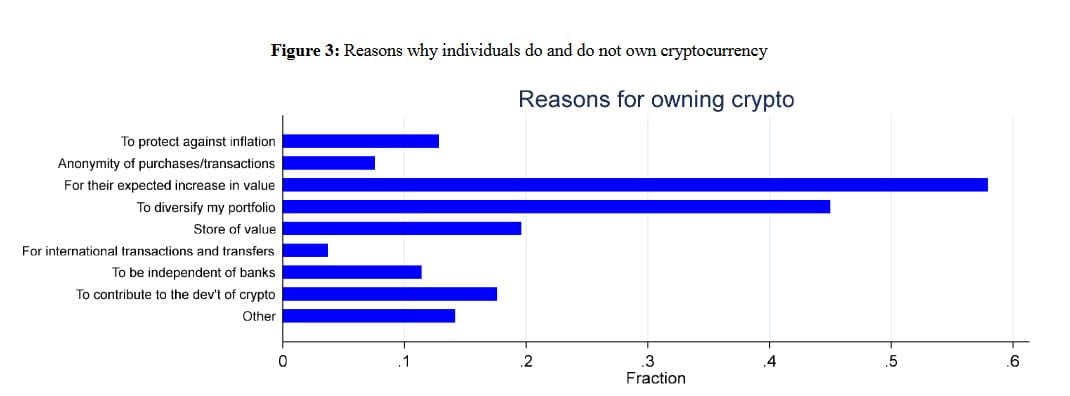
Analysis of Nielsen Homescan survey data by Weber et al. echoes investment as the primary motivation for owning cryptocurrencies. Respondents could give a variety of reasons for owning cryptocurrencies, with the most common reason (see chart below) being “expected growth in value.” The desire to use cryptocurrencies for international transfers was almost non-existent, as was the desire to “get rid of banks.”
The Fed’s SHED survey yielded the same results as the other two surveys (see chart below). Of the 10% of Americans who used cryptocurrency in 2022, most used it as an investment vehicle. One small difference is that SHED reported that about 2% of survey participants used cryptocurrency to send money to family and friends in 2022. This suggests that transactional motivations, while not the primary motivation, may be more prevalent than the first two surveys suggest.
Types of cryptocurrencies held
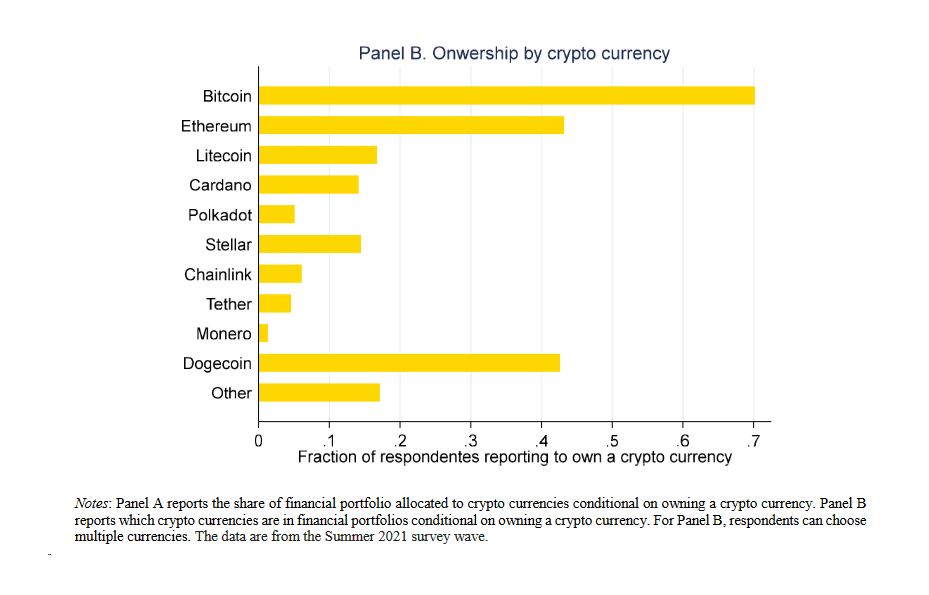
What are the most popular cryptocurrencies among Americans? Weber et al. found that of the 11% of cryptocurrency owners, 70% of respondents held Bitcoin, while just over 40% held Ethereum and Dogecoin, respectively.
This distribution is echoed in the Fed’s 2022 SDCPC. Nearly 65% of all cryptocurrency owners surveyed hold Bitcoin, making it the most popular type of cryptocurrency. Meanwhile, 44.8% hold Ethereum and 38% hold Dogecoin. Dogecoin was originally created as a joke in 2013, and about 4-5% of all Americans are in on the joke.
Crypto Bros
There’s a reason people use the term “crypto bro.” Invariably, all U.S. surveys have found that cryptocurrency holders tend to be younger, male, and higher-income. The same is true in Canada, where by 2022, the ratio of male to female Bitcoin owners was 3:1. The Bank of Canada also regularly tests the financial literacy of Bitcoin owners using the “Big Three” question method and finds that they tend to be less financially literate than non-Bitcoin owners.
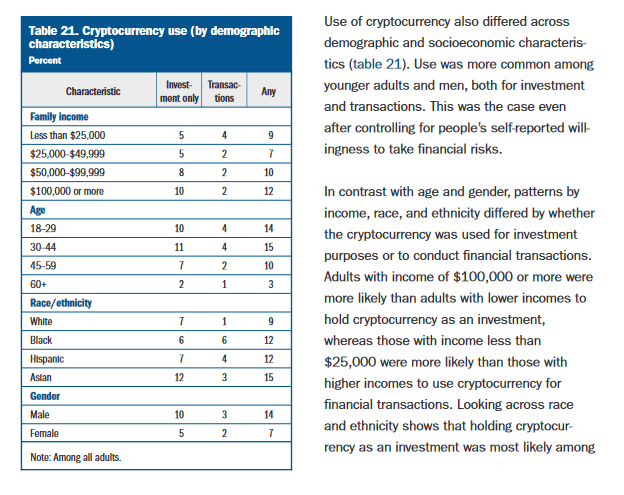
Interestingly, with the exception of the Crypto Bros (whose crypto owner characteristics tend to be younger, male, and wealthy), both the Pew survey and the Fed SHED (see chart below) found that U.S. cryptocurrency owners are more likely to be Asian, followed by Black and Hispanic, and least likely to be white.
The Fed’s SHED found that while “investment” remains a driving factor for owning cryptocurrencies, and the rich use them more than the poor, certain demographic groups tend to rely on it for money transfers more than others. Specifically, SHED found that among low-income households, 5% of households reported an investment motive for holding cryptocurrencies, while 4% had a money transfer motive.
All of this data suggests there are three archetypes of American cryptocurrency holders.
The most dominant crypto holder archetype is a young, wealthy, male crypto enthusiast, most likely non-white, who holds hundreds of dollars worth of Dogecoin or other cryptocurrencies as a bet on price appreciation. Coinbase’s “America Loves Crypto” campaign claims that “crypto owners are key voters,” but I suspect this does not hold true for the dominant players, who likely don’t care much about a casual $50 bet on Dogecoin, Litecoin, or Bitcoin, and therefore don’t constitute a voting bloc for crypto-related reasons.
Another archetype is the more rare crypto fundamentalist, the young male who has invested the majority of his or her savings in crypto. I suspect these are the types of people I encounter on Twitter, evangelizing crypto to anyone who will listen. This may be a small group, but they are also the ones most likely to vote for crypto-related causes.
Finally, there appears to be a small but growing number of low-income people using cryptocurrencies for actual money transfers, which was the use case originally envisioned by Satoshi Nakamoto when he launched Bitcoin in 2008.