


At the recently held Binance Blockchain Week, Binance founder Zhao Changpeng (CZ), who just finished a four-month prison term in the US, appeared as an individual and had a dialogue with Austin from Altcoin Daily.
As the founder of Binance and a key figure in the entire crypto space, this is his first appearance after coming out of prison in the US. The entire venue erupted in warm applause for CZ's presence. They engaged in dialogue around CZ's verdict, life in prison, his relationship with Binance, and the future trends of the market and regulation.
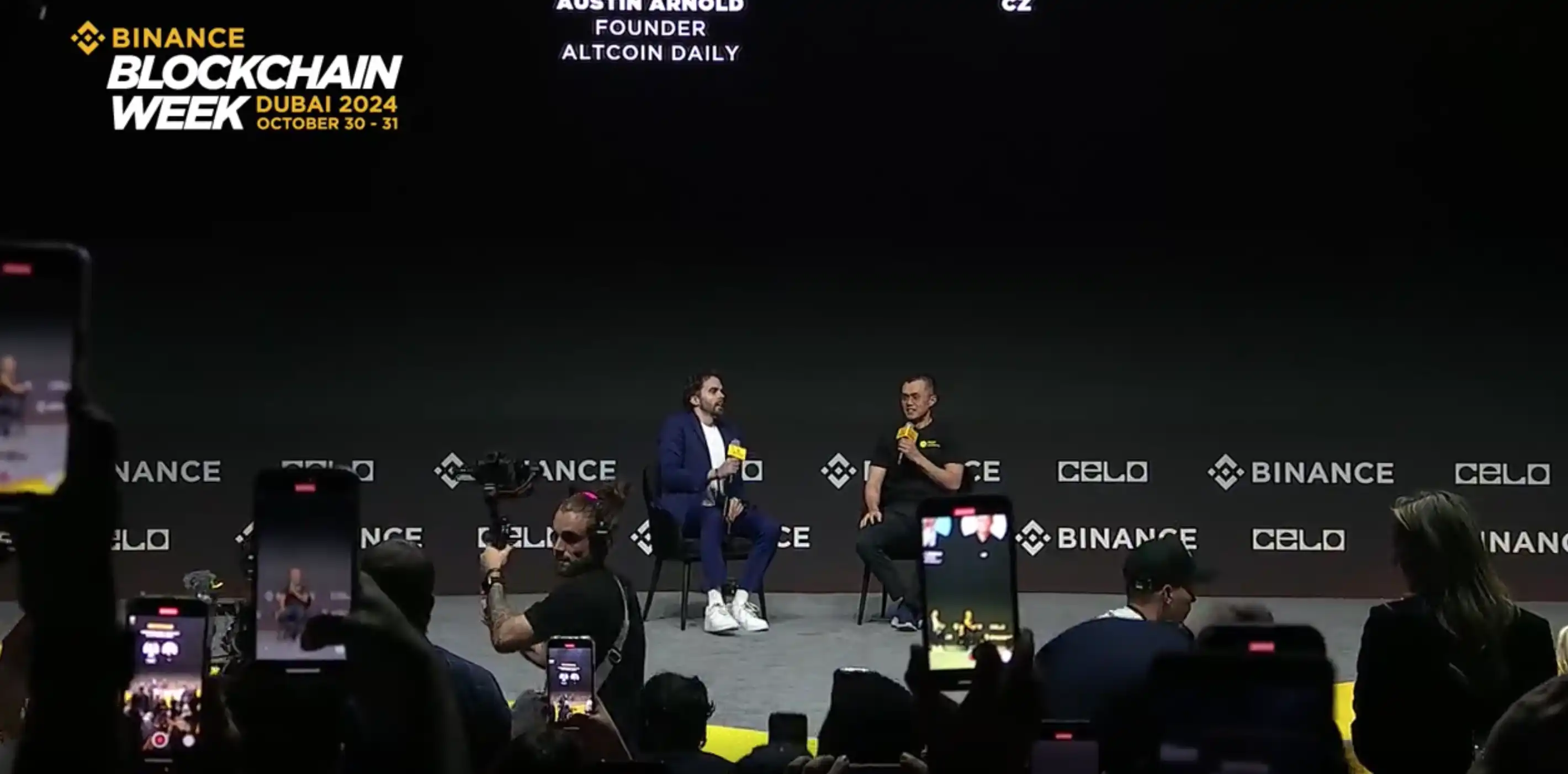
The following is the full text of the speech:
Austin: I am Austin from Altcoin Daily. CZ, this is your first interview after coming out. How was your experience in prison? It must not have been good, right?
CZ: It was indeed not as interesting as now; the whole experience was very limited, freedom was deprived, and there was nothing to do. But it also gave me a lot of time to reflect. I learned many important lessons, like what do you miss the most when everything is taken away? For me, what I missed most was actually the connection between people. I miss my children, family, friends, colleagues, and community. I miss other things too, but not nearly as intensely as I miss people. You do miss food and a comfortable bed, but those things don't affect me much; this experience helped me refocus on priorities in life.
Austin: Do you think this is a fair judgment?
CZ: This is a very subjective question, and different people will have different opinions. Here is a plea agreement; I agreed to some terms of the agreement and do not intend to make negative comments about it. I accept this outcome.
As for sentencing, I received four months of imprisonment. The judge's job is difficult; different perspectives may lead to different opinions. Some people may think it's too light, while others may think it's too heavy. For the crime I committed—violating the Bank Secrecy Act—no one in US history has been sentenced for a single violation, and I am the first.
Just a few weeks ago, a bank was fined 1.8 billion dollars for similar issues, but no one was prosecuted. Whether it's fair is less important to me now; the judge also mentioned many of my merits in court. Despite being sentenced, my sentence is indeed very short compared to others. Most people in prison have sentences of five years, ten years, or even longer. So from this perspective, I consider myself fortunate; the verdict is behind me, and I am looking forward.
Austin: Did you make friends while you were in there?
CZ: Yes, you must make friends; it can be hard to live without support. There were indeed a few prison guards who recognized me and asked what coins they should buy. I could only say that I had no internet access inside and no information about cryptocurrencies.
I made a few friends whom I still keep in touch with. Honestly, there are many good people in prison, and many of them received long sentences for very minor offenses. Most of the peers I encountered were friendly, although a few guards were somewhat indifferent. But I didn’t suffer any physical harm. From this perspective, I consider myself very lucky.
Before going to prison, a prison consultant (which is an industry) gave me a lot of advice. They warned me not to keep too much money in my account, just fifty dollars. However, once I went in, I found that others had two hundred dollars in their accounts, which made me seem like the 'poor one.' Overall, I didn't encounter many problems and even made some friends, and I'm now trying to help them reduce their sentences through legal means.
Additionally, there was a friend in prison named Michael, who was incarcerated for a marijuana possession case from forty years ago and served 27 years, while marijuana is now legal. He also earned a college degree and read six books while in prison. There are indeed some excellent talents there, but it is difficult to realize that in such a harsh environment. Every time I got 15 minutes on the computer, I would be automatically logged off after 15 minutes, and the computer couldn't paste; I could only type manually. So in that situation, if I wanted to adjust the position of a piece of text, I could only rewrite it. Back in Michael's day, there were even no computers. So, although conditions were tough, many people still worked hard to learn, read books, and obtain degrees; there are many good people there.
The relationship with Binance and the judgment on industry trends
Austin: What is your current relationship with Binance?
CZ: I have stepped down as CEO and no longer participate in the day-to-day operations of the company. My shareholder rights have not been affected, so so far, I am still a major shareholder of Binance. I can still request some information but cannot make decisions or give orders. Overall, the relationship is still quite good. Now there is a group of other people working hard, while I have been 'forced into retirement.' The first month was a bit difficult emotionally because I had invested a lot of effort into this company for seven years.
But I have always believed that a CEO's term should not exceed ten years, as the world is constantly changing. Now with AI, I didn't spend much time understanding it before, nor did I have time to delve into the details of DeFi and such. So looking back, being forced to step down actually has many benefits. If I had voluntarily resigned, people might think I couldn't hold on, but now that it was forced, no one complains.
Moreover, I now have more time, and I feel very fortunate. Although my reputation has changed, I still value my past achievements, which indicate that there was no fraud and no user funds were lost. So in some ways, my reputation remains solid. Additionally, I'm not young anymore, but I'm not too old either; I still have the energy to do more. Having the freedom and resources to do what I want now is indeed a blessing.
Austin: I heard you are banned for life from managing any cryptocurrency exchanges. Is that true? Will you continue to invest in crypto projects?
CZ: Of course, first of all, based on my understanding, the words 'lifetime' and 'ban' did not appear in my agreement with the government. The agreement states that I step down as CEO, without any time limit. However, agreements can be updated, and the government can also change. But I have no plans to return to the CEO position; I feel the team is doing well and doesn't need me back. Even if there were an opportunity, I wouldn't want to return. I think the term 'lifetime ban' is just media exaggeration; the actual agreement is public.
As for the second question, I will definitely continue to invest in crypto projects. Right now, I am mainly doing two things: one is Google Academy, and the other is investments. The investments are mainly focused on blockchain, AI, and biotech. I no longer want to personally lead projects; I prefer to help other entrepreneurs develop their companies and provide them with funding, advice, resources, and other support. I have some very important mentors, and I also hope to become a mentor to others.
Austin: Regarding the outlook for cryptocurrencies in 2025, are you still optimistic about the coming year?
CZ: I will try to avoid giving any financial advice. However, history does not represent the future; I cannot predict the future but can analyze history. Historically, Bitcoin has gone through very clear four-year cycles. 2013 was a bull market, 2017 was a bull market, and actually, 2012 was a recovery year, which many people do not trace that far back. 2016 was a recovery year, and 2017 saw a surge. 2020 was a recovery year, and 2021 was a bull market. This year has returned to previous highs.
So based on the existing analysis, 2024 is a recovery year. As for what will happen next year, I’m not sure, but in the long run, I remain very optimistic about the entire industry. I believe there is still much to be built, and as more people use cryptocurrencies, its utility value will increase. I am still very optimistic in the long run.
Austin: What aspects of cryptocurrency do you find most promising? DeFi or Meme coins?
CZ: I don't intend to specify a particular area, as it's very difficult to predict which will become the next hot spot. For example, at the beginning of 2017, I might not have predicted that ICOs would become a hot topic, but by June, the trend was very clear. So it depends on which projects explode in certain niche areas. This morning, I met some entrepreneurs who combined AI with blockchain and came up with some very interesting ideas. If one of those projects takes off, then that area will grow. It's hard to predict, but I will continue to support other builders in the industry and see what happens.
Views on regulation
Austin: Regarding legislation, what do you think the future regulatory direction for crypto will be?
CZ: Current legislation is gradually improving. In some countries, like here, progress is fast. In some major countries, progress may be slower due to the number of departments and personnel. But overall, the trend is positive. I’ll give you an example: in mid-April this year, Elizabeth Warren announced a crackdown on cryptocurrencies, just a week before I was sentenced. By June, Trump publicly supported cryptocurrencies, and by the end of June, both parties supported cryptocurrencies, while I was still in prison. So this shows that when people need cryptocurrencies, the government will respond. Therefore, I believe the overall direction is positive.
Austin: I live in the US, and from my perspective, cryptocurrency has already become an important electoral issue. Who do you think is friendlier to cryptocurrencies, Harris or Trump?
CZ: Oh, I have no thoughts on that at all. I won't comment on any election topics, as I have already dealt with enough US laws. I know there are election interference laws in the US, and anything I say in public could be taken out of context, so I don't intend to touch on this topic or even approach this 'line.' I just want to keep my distance. I think it's great that both parties support cryptocurrencies.
Austin: Well, from the perspective of the United States, which policy or legislation do you think is the most important?
CZ: I think the most basic point is the classification of cryptocurrencies. There is a lot of controversy now; for example, in most other countries, they see cryptocurrencies as currency. Japan has recognized Bitcoin as a form of currency, and many other countries also see Bitcoin as cryptocurrency. Of course, cryptocurrencies come in different types, depending on the specific coin. But in the US, this is indeed a major point of contention, and I don't want to comment too much on it.
About Giggle Academy
Austin: Assuming we meet on the stage of Binance Blockchain Week in 2025, one year from now, not necessarily about prices, but where do you think Bitcoin or cryptocurrencies will be?
CZ: Predicting a year ahead is indeed difficult, but I think history may repeat itself, and our future will be in a relatively good position.
Austin: I really like this prediction, CZ. What are your plans next?
CZ: I now spend at least half of my time on the Giggle Academy project, which I find very interesting and impactful, even though it won't be a highly profitable project.
Austin: Can you explain what Giggle Academy is to someone unfamiliar with it?
CZ: It is a digital education platform specifically designed to serve those who cannot access educational opportunities. Currently, there are about 700 to 800 million adults worldwide who are illiterate, two-thirds of whom are women. Additionally, according to different reports, there are about 300 to 500 million children who do not have the opportunity to go to school. This means that globally, about 1.2 to 1.3 billion people cannot access educational opportunities, mainly concentrated in very impoverished regions.
Many educational applications and projects operate in resource-rich areas, mostly as supplements to existing educational systems. I believe that now we have sufficient technological capability, combined with game developers, graphic designers, teachers, and AI, to create applications or tools that serve those in need of education without relying on teachers.
In those areas, the cost of teachers is high, and there is a lack of teachers. If we want to send teachers there, it takes a long time. But now we can provide education in a digital way through a very interactive application, mainly on the Android platform, because Android devices are cheaper in those regions.
If we can help 100 million people gain education, I think that would be very meaningful to me, regardless of any economic returns, and I believe it doesn't require too much funding.
Today, among the 8 billion global population, about 1 billion people are learning in schools every day, with an average class size of 30 or 50, and there are about 20 million teachers worldwide. But think about how many different ways there are to teach first-grade English? We repeat similar teaching processes millions of times a day, and if we could create these contents into applications, plus AI support to allow it to interactively answer questions. Although the initial investment may be high, requiring millions of dollars, once the AI engine is completed, the cost for each subject may be around one million dollars. With 12 grades, 12 subjects, and 30 subjects, the total is about 300 million dollars. Even with a large buffer, that's only one billion dollars. I believe we can create content that meets all today's educational needs and covers 500 languages.
The US government spends 100 billion dollars on education each year, and we only need less than 2% of that funding to provide education for children who have no educational opportunities, and we can even do it better than traditional face-to-face teaching. In a class of 30, the teaching pace is limited by the slowest student; through a platform, we can dynamically adjust the course content and allow students to progress quickly in their strengths. After accumulating a large amount of data, we can also help students find jobs quickly. For example, an 8-year-old child could do annotation work, which is also a good source of income.
My nephew has managed a flight simulation community with 14,000 gamers since he was 12. A 16-year-old can do customer support work, such as answering frequently asked questions, and children aged 15 or 16 can work as game testers or coders. So I want children to enter the workforce earlier, not just to obtain a college or high school diploma.
We can help employers find the right talent. For example, this child excels in math, ranking in the top 10%, and has completed many projects; other children have high emotional intelligence and volunteer to tutor younger kids through the platform, etc. This way, we can help children find jobs early, thereby helping their families, siblings, and other family members gain more educational opportunities.
Of course, digital education lacks interpersonal interaction, but it also has its advantages. My idea is to have older kids tutor and interact with younger kids to make up for the lack of interpersonal interaction. For example, in physical education classes, online teaching is difficult to implement, but the platform can organize 15-year-olds to lead 7-year-olds in activities, and the 15-year-olds can earn points or credits for this. When employers come to recruit, such children will naturally be prioritized.
We can design many different interactive ways on the platform, but the most pressing issue we need to address is enabling AI to consistently generate coherent video content. This task seems simple but is a challenge for AI. Currently, teachers can quickly produce content, like PPTs, but this content is usually designed for their own teaching.
However, in an environment without teachers, we need platforms or applications to convey these contents on their own. In this case, to capture children's attention, we need very interactive videos, animations, and cute elements, which teachers usually cannot provide, and this is precisely where AI can play a role. Currently, no AI model can generate ideal content. I have discussed this with many top AI experts, and we are working hard to solve this problem. However, this issue should be resolved in the coming months to years. Once we break through this challenge, we can deliver content digitally, hoping to benefit hundreds of millions or even billions of children and people worldwide by providing them with free education.
Austin: In the future, will certain parts of Giggle Academy integrate with Web3 or blockchain? I think everyone here wants to know if there will be airdrop activities to participate in?
CZ: Not in the short term; I don't want to get involved in issuing new tokens or other similar matters. So we may support existing tokens like Bitcoin, Ethereum, BNB, etc.
We will build a reward mechanism to keep the system running well, but we may not need to issue our own tokens. For example, if I want to hire customer support or community forum administrators, I can sponsor some BNB and use that funding to pay the kids, etc.
Additionally, today I discovered another interesting thing, which is that AI companies are actually paying a lot of money to acquire data generated by humans on their platforms. If we get children and parents to agree to provide their data to AI companies for training, then the data generated by these children while learning pronunciation, math, etc., can be used to train AI, and parents might receive compensation ranging from 10 to 100 dollars. For our target users, this is a significant amount. This way, we can achieve a direct payment method of 'learn and earn' without using tokens. AI companies will become sponsors of the platform, so we may not need to issue tokens to realize this model.
Of course, in the long term, I hope to gradually integrate the economic model of Web3 into the platform. This is a platform that accompanies children from the moment they learn to speak until they find employment. They can continue to learn even when they are 70 or 80 years old. By that time, when they find a job, we can propose (rather than force) that they consider donating a certain percentage of their income back to the platform over the next one to three years. Even if only a small number of people are willing to do this, I believe we can build a sustainable platform in the long run. However, this is a long-term plan that may take around ten years. But that's okay, I have plenty of time.