


Author: Delta Blockchain Fund; Translation: Golden Finance xiaozou
1 Introduction
Although blockchain technology is revolutionary, it also brings challenges to systems and ecosystems in various fields due to some nuances. In blockchain, miners and validators act as security supporters to confirm transactions and ensure the security of the chain. This means that they are also independent parties who can reorder transactions in a given block for their own interests.
Maximum Extractable Value (also known as Miner Extractable Value), or MEV for short, is the maximum profit a block producer can earn by arranging, adding, or removing transactions within the blocks they produce. The rewards mainly come from unilaterally excluding, including, or reordering transactions within a block. Despite its name, Maximum Extractable Value applies not only to PoW chains, but also to validators on PoS chains. This article aims to provide a comprehensive analysis of MEV, exploring its origins, its impact on various blockchain networks, and the strategies used by different players in the blockchain ecosystem to exploit or reduce MEV.
2. History and Theory
(1) History
The first documented case of MEV occurred on the Ethereum blockchain in 2014, discovered by a programmer who was very interested and hopeful about the technology until he realized a fatal flaw in the system — the autonomous nature of validators and miners enabled them to extract value from unsuspecting users.
In 2019, a team of researchers at Chainlink Labs published an article titled “Flash Boys 2.0,” which emphasized that MEV is not a theoretical practice, but a feature directly utilized by widely adopted protocols.
(2) Theory
The blockchain was originally designed to be secured by a decentralized network of machines known as block producers. These block producers include validators and miners, who take on the role of confirming transactions on an immutable distributed ledger system. They aggregate pending transactions into a block, which is subsequently verified by the network and then included in the global system.
While there are measures to prove that all transactions are valid and have not been recorded twice, there is no way to ensure that transactions are in the order they were posted on the chain. This is why when block producers select transactions from the mempool (the blockchain's queue of pending transactions), they are able to prioritize transactions with the highest fees before submitting them.
3. MEV’s technical infrastructure
In the current MEV ecosystem, there are third-party bots and parties that manipulate transaction fees to ensure their transactions are prioritized when blocks are submitted. This can be disadvantageous for the average user, as they may not have the necessary funds, resources, or technical expertise to take advantage of MEV.
On the block producer side, there are also third parties involved, including searchers, builders, and relayers. Searchers essentially "search" the memory pool of pending transactions to find potential MEV profit opportunities. They bundle these transactions and send them to builders who "build" complete blocks and send them to relayers. Relays (i.e., trusted aggregators who propose blocks) verify transactions and pass the most profitable one to the validator for submission.
4. Common MEV attacks
As mentioned earlier, MEV attacks are strategies used by miners, validators, or traders to exploit their ability to reorder, include, or exclude transactions within a block in order to maximize their profits. Here are some common types of MEV attacks:
(1) Front-Running Trading
This is when a participant observes a profitable transaction pending in the mempool and quickly creates a similar transaction, but with a higher gas fee. This incentivizes miners to include their transaction first, allowing them to benefit from the price movement triggered by the original transaction.
For example: Alice wants to buy a toy, but Bob pays a small fee to bribe the merchant in order to give priority to his transaction, and finally Bob successfully buys the toy.
(2) Back-Running Trading
Tailing is similar to front-running, but instead of placing their trade before a target trade, the attacker places it after the target trade. This is often used when the attacker intends to profit from the price movement triggered by the original trade.
For example, Alice plans to bid on a painting at an auction. After Alice bids, Bob quickly sells the exact same painting in his hand to someone around him at the high price offered by Alice.
(3) Sandwich Attacks
In this type of attack, the attacker places transactions before and after a target transaction. This allows the attacker to manipulate the price of tokens by buying low and selling high, essentially “sandwiching” the target transaction.
For example: Alice plans to buy a toy. Bob buys the toy first and raises the price of the toy. Alice buys it at this high price, and then Bob sells his toy at this high price, sandwiching Alice's purchase in the middle.
(4) Arbitrage
These attacks exploit price differences between different decentralized exchanges (DEXs). An attacker can buy a token at a lower price on one DEX and then sell it at a higher price on another DEX.
For example: Bob finds out that apples are cheaper in another town. He buys them there and then sells them in his own town at a higher price.
(5) Time-Bandit Attacks
In a proof-of-work network, miners perform so-called chain reorganizations to manipulate previously confirmed blocks. The purpose of this is to extract MEV from transactions that have been included in the block. This is not only a more complex form of MEV attack, but also potentially more destructive because such an attack requires changing the existing blockchain structure.
For example: Bob, a miner, saw Alice discover a gold mine. He used his power to turn back time, arrived at the gold mine before Alice, and took the gold for himself.
5. MEV Case Study
(1) Market sentiment and data
The MEV space in 2023 is a vibrant and diverse space that combines opportunities, challenges, and innovations. Over the past year, the MEV space has been very active, with robots generating at least $307 million in revenue on Ethereum. The most common of these are arbitrage opportunities, which account for more than 47.5% of total revenue, while sandwich attacks and liquidation opportunities also play an important role.
In this context, the data for the week of June 8, 2023 provides a snapshot of the ongoing trend. Arbitrage activities extracted $8.48 million, sandwich attacks extracted $559,000, and liquidation attacks were less common, extracting only $14,000. These numbers partially demonstrate the complexity and dynamics of the MEV ecosystem.
The total amount of MEV involving sandwich robots in 2022 reached a staggering $287 billion, and Uniswap V3 is a gathering place for arbitrage and sandwich robots. Interestingly, MEV opportunities on Binance Smart Chain (BSC) were found to be more cost-effective than Ethereum, indicating that the environment on BSC is more friendly.
The frequency and nature of MEV opportunities will vary depending on market conditions. While arbitrage opportunities are the most common, liquidation opportunities rely more on severe market fluctuations. The revenue generated by different MEV types also shows monthly variation, with revenue in some months increasing significantly due to specific market events.
An oligopoly pattern of MEV also emerged, with the top 2 block builder addresses capturing more than half of the MEV after the Ethereum big merge, even though the builders passed most of the MEV to the proposer in the last transaction of the block. The competitive environment of MEV robots and the profit distribution between different types of robots further illustrate the complexity of the market.
By analyzing specific data, conducting comparative analysis between different blockchain platforms, and understanding broader trends, we can gain a more comprehensive view of this evolving field. These insights help to provide a deeper understanding of the MEV ecosystem, reflecting its multifaceted nature and its impact on the future of decentralized finance. Continuously exploring liquidity data, developing new market-making strategies, and working to address fairness and regulatory issues in the MEV market are critical to navigating this dynamic environment.
(2) MEV vulnerability attack
On April 3, 2023, at Ethereum block height 16,964,664, a group of MEV robots lost $25.3 million due to a vulnerability attack. Analysis of the vulnerability attack showed that a rebellious validator switched the MEV robot's transactions and seized various crypto tokens.
The exploit was a complex operation involving a malicious Ethereum validator and a group of MEV bots. The malicious validator, known as "Sandwich the Ripper," prepared multiple token assets to trick a group of targeted MEV bots into trying to front-run his trades on a low-liquidity V2 Uniswap pool. This process lasted 18 days.
In a typical sandwich attack, a MEV bot reads incoming trades and preemptively executes orders, driving up the price of the original buyer's asset. The buyer then drives the price up further by purchasing the same asset as originally intended. The MEV bot then sells the asset immediately after the original buyer's trade is completed, earning an arbitrage profit from the buyer.
However, in this case, the malicious validator lured the MEV robot with a vulnerable transaction, forcing the robot to arbitrage the bait asset in the low liquidity pool without the attacker having to make an actual purchase transaction. After the MEV robot purchased the bait asset, the attacker immediately modified the transaction order within the same block to sell all tokens (prepared before the attack). The attacker then sold his own tokens at a higher price to drain all the WETH in the low liquidity pool. In the process, the tokens obtained by the MEV robot will become worthless.
The malicious validator used the same strategy to drain five MEV bots in 24 transactions. The stolen tokens were then distributed to three different wallets, with amounts of $20 million, $2.3 million, and $2.9 million.
In response to the vulnerability attack, the Flashbot community has released a patch for all relays to prevent such attacks from happening again. While some people believe that the attack was "malicious," others in the crypto community believe that the attack on the MEV robot was part of the game and did not break the rules of the game.
(3) DeFi Summer
While MEV is often associated with challenges and negative effects, it has also played a beneficial role in some cases. For example, in the DeFi summer of 2021, Ethereum's faster transactions and lower gas fees were not unrelated to the use of MEV.
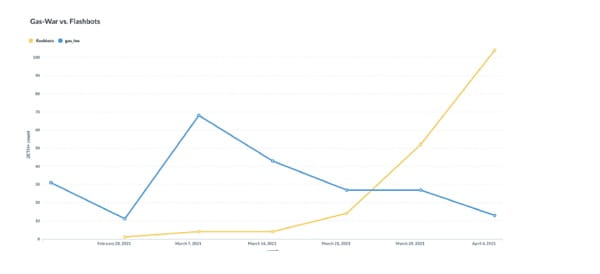
The adoption of MEV extraction software like Flashbots’ MEV-geth has risen significantly, with over 78% of Ethereum miners now using MEV extraction software to bundle serialized transaction bundles and capture MEV profits. This is achieved through features such as miner bribes and rejection of bundles without paying gas fees. As shown in the above chart, the proliferation of MEV bundling appears to be correlated with Ethereum’s lower average gas fees, as MEV software alleviates issues such as the priority gas auction (PGA), where bots drive up fees through transaction fee wars.
In a sandwich attack scenario, miners or validators include certain transactions in a block and discard others. By prioritizing transactions in this way, they can facilitate faster execution and reduce overall costs for users. This selective inclusion allows the network to process more transaction volume, helping to increase the efficiency and effectiveness of the system during periods of high demand.
In summary, MEV-centric software has become dominant in Ethereum, which aligns incentives for miners and traders through transaction ordering techniques, which may also inadvertently ease network congestion and reduce network costs.
6. MEV peripheral products
(1)Flashbots
Companies like Flashbots are helping the ecosystem rebalance by researching and developing protocols to mitigate the negative externalities of MEV. They have built an ecosystem where bots submit transaction packages directly to miners instead of submitting them to a public Ethereum pool, and miners then receive the bids (which are invisible to others) and include them in the blocks they mine.
Protocols like MEV-Boost, created by Flashbots, provide a way for validators to access relay blocks through a marketplace for builders who want to buy block space. By using MEV Boost, validators can choose to include these special blocks that may have higher profitability due to the reordering of transactions. This gives validators the opportunity to earn more from MEV opportunities that builders have identified and included in relay blocks. They can also add relayers from Flashbots, Bloxroute, Blocknative, Eden, or Manifold (to name a few).
(2)Fastlane
Another infrastructure company that is looking to rebalance the security concerns raised by MEV is Fastlane, a protocol that rewards participating validators for protecting the health of the Polygon blockchain.
Fastlane offers a unique solution for validators to generate revenue from all parties in the blockchain ecosystem, including arbitrageurs, liquidators, and NFT traders. Through a competitive auction process, algorithm seekers bid for access to Fastlane during designated "sprints". The winning bidder will increase the probability of a successful transaction without having to connect directly to the validator node, and more importantly, without knowing the validator ID, node address, or IP address.
This approach greatly enhances the security and privacy of validator nodes, making them healthier by reducing the economic incentive for bots to flood nodes with redundant transactions. Fastlane is designed not to promote malicious behavior such as front-running and "sandwich" attacks. Instead, it prioritizes the overall health of the Polygon chain. In addition, by eliminating randomness in transaction propagation dynamics, Fastlane can potentially reduce the data cost of sentinel nodes, further improving the efficiency and reliability of the network.
(3)Cow Protocol
There are also some applications or software with specific use cases that leverage MEV for different purposes, such as the Cow Protocol. The Cow Protocol matches peer-to-peer transactions as much as possible, eliminating the need for middlemen and saving users money. This is called coincidence of want (CoW). They search all exchanges and aggregators to ensure that users get the best price, saving users the trouble of comparing prices on different platforms. They can also protect users from front-running and sandwich attacks, which can cause significant losses to traders. The Cow Protocol does this by matching transactions peer-to-peer and utilizing batch auctions, making the order of transactions irrelevant.
If, after placing an order, the price tilts in the direction that favors the user, the Cow protocol will provide the price to the user at the time of execution. It collects orders every 30 seconds for packaging. This is done off-chain and has several benefits, such as not charging failed transactions and fees charged for selling tokens (non-ETH). Cow protocol solvers (external solvers) compete to find the best source of liquidity for your transaction across all decentralized exchanges and aggregators. They submit transaction packages on-chain and hide them from the public memory pool, protecting transactions from manipulation by miners and robots (front-running and other forms of MEV).
(4)Hummingbird
Finally, we come to Kolibrio, which seeks to revolutionize the MEV space by becoming one of the first protocols to offer Broadcast Extractable Value (BEV) relay. This technology ensures that trade broadcasters (such as node providers, DeFi wallets, bridges, and other dApps) can own the order flow they create and be able to monetize it. This is possible when MEV opportunities are automatically searched before the trade enters the memory pool. When a MEV opportunity exists in a trade, BEV passes that information to the searcher, who then bids the trade based on that information.
By maintaining transactions in a broadcast state and introducing a MEV auction mechanism, it democratizes MEV extraction and reduces the chances of vulnerabilities such as transaction order or front-running. The system's verification and waiting mechanisms act as a buffer against malicious MEV strategies, while transaction aggregation ensures efficient transaction processing that is difficult to manipulate. In addition, by automatically distributing MEV profits to broadcasters, the system not only ensures fair distribution, but also incentivizes entities to prioritize user interests, resulting in a safer and more user-centric blockchain ecosystem.
7. MEV outside of Ethereum
(1)Solana
MEV can be achieved through various strategies, including front-running, tailgating, and sandwich attacks. However, when we transitioned from an Ethereum background to Solana, the MEV situation also changed significantly due to the fundamental architectural differences between the two blockchains.
In Solana’s PoS system, validators who stake a large number of tokens are responsible for finalizing transactions. Solana’s unique validator clustering feature further strengthens the system. Validators are divided into multiple clusters and take turns to serve as leader validators. The role of the leader is limited to determining the order of voting transactions, not their finality, adding an extra layer of security against potential malicious actors.
Another key difference between Solana and Ethereum is the memory pool. While Ethereum’s memory pool is a key component of many MEV strategies, Solana does not have a memory pool. This means that independent network participants (often referred to as “seekers”) cannot extract MEV for individual transactions unless they act as validators. In addition, Solana recently introduced a priority processing fee on top of the fixed fee so that seekers can get their transactions included in blocks faster.
Despite these structural differences, Solana is not completely immune to MEV. A common form of MEV activity on Solana is decentralized exchange (DEX) arbitrage. In this case, traders take advantage of price differences between different DEXs. For example, a trader might identify a difference in the SOL/USDC exchange rate between Raydium and Orca, two decentralized exchanges on Solana, and then execute a profitable arbitrage trade.
Interestingly, sandwich attacks are a common MEV strategy on Ethereum, but are not seen on Solana. This is likely due to Solana not having a mempool and only the leader validator having access to transactions before they are finalized.
In the NFT space, MEV manifests itself in the form of NFT bots. These bots flood popular NFT releases with minting requests, aiming to ensure the immediate resale of as many tokens as possible. This not only disrupts the NFT market, but also causes network congestion. To address this issue, Solana has proposed solutions such as adjusting transaction gas fees to increase the cost of spam requests and imposing a "tax" on invalid transactions.
In addition, a company called Jito Labs offers a set of specialized products that could have a significant impact on Solana’s MEV landscape. Details are as follows:
Better verification performance and higher revenue — Jito-Solana client:
By providing an open source validator client, Jito Labs helps validators on Solana better utilize their hardware and earn higher revenue. This can make validation more competitive, reducing potential MEV extraction in transaction ordering. The Jito block engine helps build the most profitable and efficient blocks for validators. By optimizing block construction, it can reduce the chance of transaction reordering (a common MEV strategy), making the network more resilient to certain MEV attacks.
Outsourcing spam mitigation and signature verification - Jito Relayer:
This tool allows validators to outsource spam mitigation and signature verification, which can reduce congestion and enable more efficient block creation. This may reduce the likelihood of malicious actors exploiting MEV through spam attacks.
Sequence execution and enhanced transaction capabilities — Jito Bundles:
By supporting sequential execution of transactions, Jito Labs adds an additional layer of control for transaction ordering. This can mitigate some MEV strategies such as front-running and sandwich attacks. Jito Memory Pool: Traders can leverage the Jito Memory Pool to get higher guarantees on transaction delivery. This ensures more reliable transaction execution and reduces the possibility of extracting MEV through transaction reordering or exclusion. ShredStream: This feature allows traders to receive shards directly from the leader, saving a lot of time. By improving transaction efficiency, it can reduce the window of opportunity for MEV attacks, such as arbitrage vulnerability attacks.
Jito Labs' products provide a multi-dimensional approach to strengthening the Solana blockchain. By focusing on optimizing validator performance, ensuring efficient block construction, mitigating spam requests, and enhancing transaction capacity, Jito Labs contributes to a more secure and resilient network.
These innovations can make the Solana chain less vulnerable to common MEV strategies and create a more fair and transparent trading environment. While it may not completely eliminate MEV, the integration of Jito Labs' products with Solana represents a positive step in mitigating the negative impacts associated with MEV.
In the rapidly evolving blockchain space, these technological advancements by Jito Labs provide valuable insights into solving MEV challenges, not only within Solana, but in other blockchain networks as well.
In summary, although the nature and manifestation of MEV on Solana is very different from Ethereum due to architectural differences, MEV is still a common problem. The Solana community is constantly exploring and implementing solutions to reduce the impact of MEV on its network and ensure the integrity and efficiency of its blockchain operations.
(2) L2 and cross-chain
MEV on L2 is extended from the original MEV on Ethereum L1. However, in the case of EVM chains, the likelihood of participants manipulating the order, inclusion, or censorship of transactions does not differ significantly between L1 and L2. Both layers share the same concept of MEV, which primarily comes from the ability of miners (or validators in a proof-of-stake system) to reorder, include, or review transactions within the blocks they produce.
This ability can be used to exploit arbitrage opportunities, front-run transactions, or extract rent from users. However, with the introduction of Ethereum 2.0 and the increasing use of L2 solutions for scalability, this is subtly changing the MEV landscape.
A particular distinction in the MEV space has emerged on certain chains such as Avalanche (AVAX), which do not share memory pool data (unless shared with validators). This unique approach can change the MEV dynamics as fewer entities can access transaction data, which may affect the scope of transaction operations and value extraction.
However, the L2 environment also provides opportunities for innovative solutions to the MEV problem. For example, the concept of proposer-builder separation (PBS) can be applied to L2 solutions, where the roles of proposing blocks and building blocks are separated, which may alleviate MEV-related issues to some extent.
In addition, the exploration of cross-chain MEV, including MEV extraction across different blockchain networks, is also an important part of the L2 MEV field. This is a new dimension that does not exist in L1, which opens up a whole new research area and potential strategies for MEV extraction and mitigation.
In summary, while L2 MEV shares basic concepts with L1 MEV, the unique architectural and operational characteristics of L2 solutions introduce new dimensions to the MEV problem. Ongoing research and development in this area is critical to ensuring the reliability, fairness, and decentralization of Ethereum and other blockchain networks as they scale.
8. Proposer-Builder Separation (PBS)
(1) What is proposer-builder separation?
Proposer-Builder Separation (PBS) is a solution proposed to address the challenges of censorship and MEV attacks in blockchain networks. The PBS concept is rooted in the idea of separating the roles of block construction and block proposals for the network. This separation of responsibilities aims to create a more decentralized and secure network while also solving the MEV problem.
(2) Before the emergence of PBS
In blockchain networks, specialized participants called validators are essential for operations like transaction processing and block creation. In early blockchain protocols like Ethereum, validators were assigned two key tasks - block construction and block proposals. The same validators would collect pending transactions, determine block content, order transactions, and build complete new blocks. These same entities would then broadcast their completed blocks as proposals to the rest of the network for verification and inclusion into the chain.
This merger of responsibilities is problematic because it gives validators excessive control over which transactions are included in blocks and in what order. Validators can use this influence to implement strategies that create additional profits for themselves. For example, they can order transactions to extract the highest fees from users who want their transactions to be processed first. Validators can also use their position to engage in market manipulation, including or excluding specific transactions to influence the token price in their favor. These practices are consistent with the concept of maximum extractable value, where validators maximize their own profits by optimizing transaction ordering and censorship.
Large validators with sufficient resources are naturally best suited to fine-tune blocks and implement these MEV strategies. This leads to centralization risks, as small validators struggle in the competition to extract the most value from transactions. In general, merging the responsibilities of block construction and block proposals into a single validator entity creates loopholes in fairness, security, and decentralization.
(3) After the emergence of PBS: Alleviating MEV and improving blockchain security
To address these issues, innovations such as Proposer-Builder Separation (PBS) were introduced. PBS formally separates the two validation responsibilities (block construction and block proposal) into separate roles handled by different node types.
Under PBS, block construction is handled by dedicated builder nodes. Their sole function is to build block content in an optimized way that maximizes value for the entire network without favoring any one entity. Transaction ordering, inclusion, and sequence are determined using algorithms designed to limit opportunities for manipulation. These completed block packages are then passed to dedicated proposer nodes.
The role of the proposer node is simple - get full blocks from builders and propose them to the rest of the validator network for approval and inclusion in the blockchain. Importantly, proposers do not participate in block creation under PBS. This prevents them from applying preferential transaction ordering to blocks or making other changes that serve their own interests, as they can only see the block contents after the block is built.
By formally breaking these two responsibilities into separate, specialized roles, PBS limits the impact of a single node on the end-to-end transaction process. This in turn enhances the decentralized nature, security, and fairness of networks like Ethereum. PBS represents an important evolution in the way blockchain networks are architected and governed.
9. Conclusion and future development directions
Affected by the rise of DeFi and the development of blockchain technology, the future of MEV will be a complex situation. Although MEV can bring considerable profits to some participants in the blockchain ecosystem, it also brings challenges, including potential negative impacts on transaction initiators and the risk of validator centralization.
The Ethereum community is actively exploring strategies to mitigate these challenges while retaining the benefits of MEV. These strategies include MEV burning, MEV smoothing, and MEV sharing. Each strategy has its own unique advantages and trade-offs, and their successful implementation requires careful consideration and substantial resources.
The Ethereum merger and the introduction of the PBS concept have further increased the complexity of the MEV field. The widespread adoption of MEV-Boost has brought an increase in block rewards, but also brought potential risks of validator centralization.
In summary, the management of MEV is a critical issue for the future of Ethereum and other blockchain networks. As these technologies continue to evolve, strategies for managing MEV will also evolve. Future research should continue to explore these strategies, as well as the emergence of new types of MEV and their impact on each blockchain network. As networks continue to expand, continued exploration and development in the field of MEV is essential to ensure the reliability, fairness, and decentralization of the network.